The “never call the senior” mentality is not toughness. It is a patient safety hazard wrapped in insecurity and bad role-modeling.
If you’re a brand-new intern, you’ve already heard some version of this in a call room, sign-out, or on a meme page:
“Figure it out yourself first.”
“Don’t wake them up unless the patient is literally dying.”
“They’ll destroy you if you call overnight.”
That’s not culture. That’s dysfunction.
Let’s pull this apart and be blunt: the data, the malpractice cases, the quality-improvement literature, and frankly, common sense all say the opposite—good interns call. Smart services build systems that make it easy to call. The “hero” who never calls is usually the one quietly making preventable errors.
Where the ‘Never Call’ Myth Actually Comes From
This mentality did not descend from some evidence-based Mount Sinai of Medicine. It comes from a messy mix of:
- Insecure seniors who equate being needed with being important
- Historical machismo (“we did it with 120-hour weeks and no supervision”)
- Poorly trained attendings who reward independence and ignore safety
- Interns terrified of being labeled “weak,” “needy,” or “not ready”
I’ve watched a PGY-2 tell a new intern on day one: “Do not page me for pain or fluids. Ever.” That same PGY-2 ended up in a morbidity and mortality conference three months later when a “simple” pain issue masked a missed compartment syndrome.
This is how the myth propagates:
An intern gets humiliated for a “dumb” question.
They internalize the lesson: silence = safety for me.
Next year, they become the senior who says, “Don’t wake me unless they’re coding.”
And on it goes.
Notice what’s missing in that cycle: data, outcomes, humility.
What The Evidence Actually Shows About Supervision
No one has done a randomized trial of “call the senior vs never call the senior,” because that would be insane. But we do have a lot of indirect evidence from supervision, escalation, and communication studies.
Here’s what keeps showing up across internal medicine, surgery, ICU, and EM literature:
Better supervision → fewer serious adverse events.
- Studies on resident supervision (particularly in ICUs and surgical services) consistently show that increased attending and senior involvement is associated with fewer complications, fewer unexpected transfers to ICU, and fewer “failure to rescue” events.
- Translation: more eyes, more experience, earlier course-correction.
Communication failures are a major source of harm.
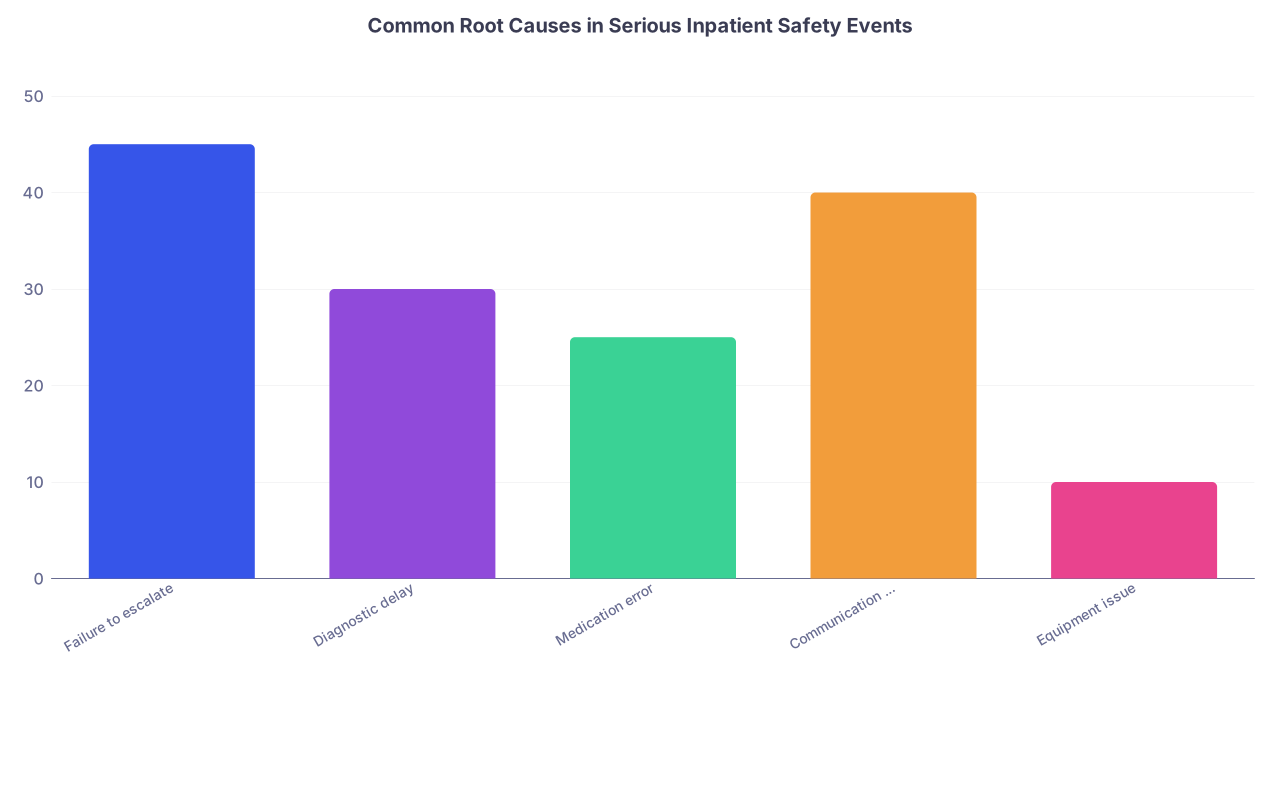
Look at root-cause analyses of serious safety events: failure to escalate, delay in notifying a senior or attending, and unclear responsibility appear repeatedly. The intern “waiting to see” overnight is a classic setup.Residents systematically overestimate their own competence early on.
There’s literature on Dunning–Kruger-like effects in medical training. Early on, people don’t know what they don’t know. That’s precisely when guardrails—i.e., calling the senior—matter most.Programs that intentionally improve escalation culture see fewer near-misses.
When hospitals implement “call early, call often” expectations, rapid response systems, and explicit escalation criteria, crash codes and ICU transfers from the floor typically drop or stabilize despite higher patient complexity.
Let me put that in one sentence: the safest systems are designed on the assumption that you will call, not that you will heroically manage alone.
| Category | Value |
|---|---|
| Failure to escalate | 45 |
| Diagnostic delay | 30 |
| Medication error | 25 |
| Communication breakdown | 40 |
| Equipment issue | 10 |
Studies of safety events often show “failure to escalate” and “communication breakdown” right at the top. That’s your “never call the senior” myth in real numbers.
The Psychology Behind Not Calling (And Why It’s Flawed)
No one sits there saying, “I want to put my patient at risk.” You don’t call for reasons that sound rational in your head at 3:00 a.m.:
- “I don’t want to look stupid.”
- “They’ll be mad I woke them up.”
- “Real interns handle this alone.”
- “I think I know what it is. Pretty sure. Mostly.”
Strip the emotion, and here’s what’s actually going on:
You’re confusing image management with competence.
You’re more afraid of how you look than of being wrong. That’s normal, human, but not defensible. You’re a doctor; patients trump pride.You’re selectively remembering stories.
You remember the one time a senior snapped: “You woke me for this?” but you conveniently ignore the dozens of times seniors said “Thanks for calling” or quietly fixed your management. That negativity bias pushes you toward silence.You overestimate the downside of calling and underestimate the downside of not calling.
Downside of calling: brief annoyance, maybe some eye-rolling, possible short-lived embarrassment.
Downside of not calling: patient harm, code, M&M spotlight, lawsuit, you replaying the night for years.
One of those risk profiles is obviously worse. Yet interns pick it daily because the cost is delayed and less visible.
The Real-World Consequences: What Happens When You Don’t Call
Let’s be concrete. Here are common “I didn’t want to call” scenarios I’ve seen turn ugly:
“Just” a blood pressure of 88/52 in a septic patient who “always runs low.”
Overnight intern increases fluids, ignores rising lactate, delays escalation. Patient codes at 6 a.m. when labs finally come back and the rapid response nurse walks by.New oxygen requirement chalked up to “atelectasis” in a postop patient.
No call, no imaging until next morning. Turns out to be a massive PE. Senior: “Why wasn’t I called when the sats dropped to 89%?”Confusion in an elderly patient labeled “sundowning” or “baseline dementia.”
No page to senior, no stat labs, no gas. Next morning: Na 120, ICU transfer.Rising creatinine and low urine overnight after contrast or ACEi.
Intern “watches it” instead of calling. By the time anyone acts, patient is in AKI needing dialysis.
All of those have one pattern: something changed, intern noticed, and no one else was involved.

Here’s the uncomfortable reality:
You will absolutely be in an M&M one day. The only question is whether you will be the person who can honestly say, “I called. I escalated. I asked for help,” or the one quietly wishing you had.
What Seniors Actually Think (Not the Stories You Hear)
There are toxic seniors. The ones who brag: “My interns know better than to wake me unless there’s a code.” But despite the mythology, that’s not the majority.
I’ve heard more seniors say this than anything else:
“I would much rather get 10 dumb pages than miss the one that matters.”
Because seniors know what happens when no one calls. They’ve seen it as PGY-2s. They’ve sat in those painful family meetings.
Let’s be clear about incentives:
- Seniors are responsible for your patients. Their name is on the list.
- Their evaluations, fellowship chances, and reputations are tied to service outcomes.
- They know attendings and program leadership will ask, “Were you aware?” if something goes sideways.
You think you are protecting them from being woken up.
What you are actually doing is exposing both of you to risk.
The more experienced the senior, the more they understand this. Often, the loudest “never call me” types are both:
- insecure about their own skills, and
- exhausted, burned out, and trying to protect their sleep by pushing risk onto you.
That’s not leadership. That’s self-preservation masquerading as toughness.
The Medicine Isn’t That Simple: You Don’t Know What You Don’t Know
Early intern year, your intuition about sick vs not sick is unreliable. You will misjudge:
- Which belly pain can go to CT in the morning vs needs a surgeon now
- Whether chest pain is reflux or missed STEMI
- How bad “mild” respiratory distress truly is at 2 a.m.
This is not a character flaw. It is developmental.
Think about how attendings work. A good attending constantly asks for help:
- Radiology: “Walk me through this scan.”
- ID: “Is this cefepime or meropenem territory?”
- Cards: “Would you cath this tonight or tomorrow?”
If people with 10–20+ years of experience routinely call for help, the idea that a first-month intern shouldn’t need to is laughable.
| Role | Typical Behavior With Uncertainty |
|---|---|
| Intern PGY-1 | Hesitates to call, fears judgment |
| Senior PGY-3 | Calls attending selectively |
| Fellow | Calls subspecialist frequently |
| Attending | Consults peers and services often |
Notice how the most experienced people normalize asking for input. The “never call” posture is actually a marker of inexperience, not strength.
How to Call in a Way That Shows You’re Competent (Not Clueless)
Here’s the part people rarely teach you: there is a big difference between “I page constantly” and “I escalate effectively.” The first is annoying. The second is essential.
If you want to both protect patients and earn respect, do this:
Do a focused assessment before you call.
Walk to the bedside. Look at the monitor, the MAR, the last few notes. Get vitals, a focused exam, and current meds.Use a tight structure (SBAR actually works if you don’t butcher it):
- Situation: “I’m the intern on 6E about Mr. Smith, 68, admitted for pneumonia. He’s now more hypotensive.”
- Background: “Came in yesterday, was stable on 2L NC, BP 120s. On ceftriaxone and azithromycin.”
- Assessment: “Now febrile to 39, BP 88/50, HR 120, lactate 3.2, requiring 4L NC, looks diaphoretic and confused.”
- Recommendation: “I’ve given 1L LR and drawn repeat labs. I’m worried about sepsis progressing and think he needs higher level of care. Can you come see him with me?”
That doesn’t sound weak. It sounds like a doctor who’s thinking.
Call early at the first sign of real concern, not after you’ve tried five things.
You are not required to run a mini-ICU before escalating. If your gut is screaming, involve someone sooner.Document the call.
Briefly note “Discussed with senior, plan is X.” This is good care and good medicolegal hygiene.

| Step | Description |
|---|---|
| Step 1 | Notice patient change |
| Step 2 | Go to bedside |
| Step 3 | Check vitals and monitor |
| Step 4 | Focused exam and chart review |
| Step 5 | Reassess plan later |
| Step 6 | Call senior with SBAR |
| Step 7 | Implement joint plan |
| Step 8 | Document discussion |
| Step 9 | Still concerned? |
Do that consistently and seniors quickly learn:
“When this intern calls, it’s for a reason. I’ll pick up.”
But What If My Senior Really Is Toxic?
Sometimes the problem isn’t culture in the abstract. It’s a specific human being.
You get:
- The senior who says “Don’t call me for X, Y, Z” on day one.
- The one who responds to your page with “And what exactly do you want me to do about it?”
- The passive-aggressive “SMH” or long silence after you present a concern.
Here’s the blunt advice:
Call anyway when patient safety is at stake.
Their bad mood doesn’t override your ethical duty. If they snap, they snap. You will sleep better knowing you put the patient first.Loop in attending/charge nurse/rapid response if needed.
Yes, you can go “around” a senior if you truly believe they’re blocking necessary escalation. You do this not as a power move but as a safety move. Charge nurses do this all the time; watch them.Document objective facts, not your feelings.
“Senior declined to evaluate at bedside after page, patient remained hypotensive.” Let the record speak.Quietly tell your program leadership about patterns, not single annoyances.
PDs and chiefs can’t fix what they never hear. When they see the same names attached to the same behavior over and over, they act.
There’s a difference between “my senior is tired and occasionally snappy” and “my senior actively discourages safe care.” Learn which is which. And do not let the second category train you into silence.

Practical Rules of Thumb: When You Should Absolutely Call
You want simple? Here’s a contrarian twist: your default should be to call, and you consciously opt out only when you’re clearly comfortable and it’s clearly minor.
Hard yes: you call the senior for any of these:
- New oxygen requirement or increased oxygen by more than 2L from baseline
- Systolic BP < 90 or MAP < 65 not clearly stable for that patient
- Sustained HR > 120 in someone who “was fine” before
- Acute change in mental status
- New chest pain, SOB, neuro deficits
- Rapid arrhythmia you’re not already explicitly managing with a plan
- Any lab that makes you say “uh oh” out loud (Na 120, K 6.5, lactate jump, troponin rise)
- Your gut says “this doesn’t feel right and I can’t shake the feeling”
Soft yes: probably call, especially early in intern year:
- You’re about to order something high-risk (pressors, big transfusion, heparin drip, thrombolytics)
- You’re considering delaying imaging or consults on someone borderline
- The nurse calls you the third time about the same concern
As you gain experience, you’ll handle some of these solo—with explicitly pre-discussed protocols from your team. Not with silent improvisation.
| Category | Value |
|---|---|
| Case 1 | 2,5 |
| Case 2 | 3,4 |
| Case 3 | 4,4 |
| Case 4 | 1,5 |
| Case 5 | 2,4 |
| Case 6 | 3,5 |
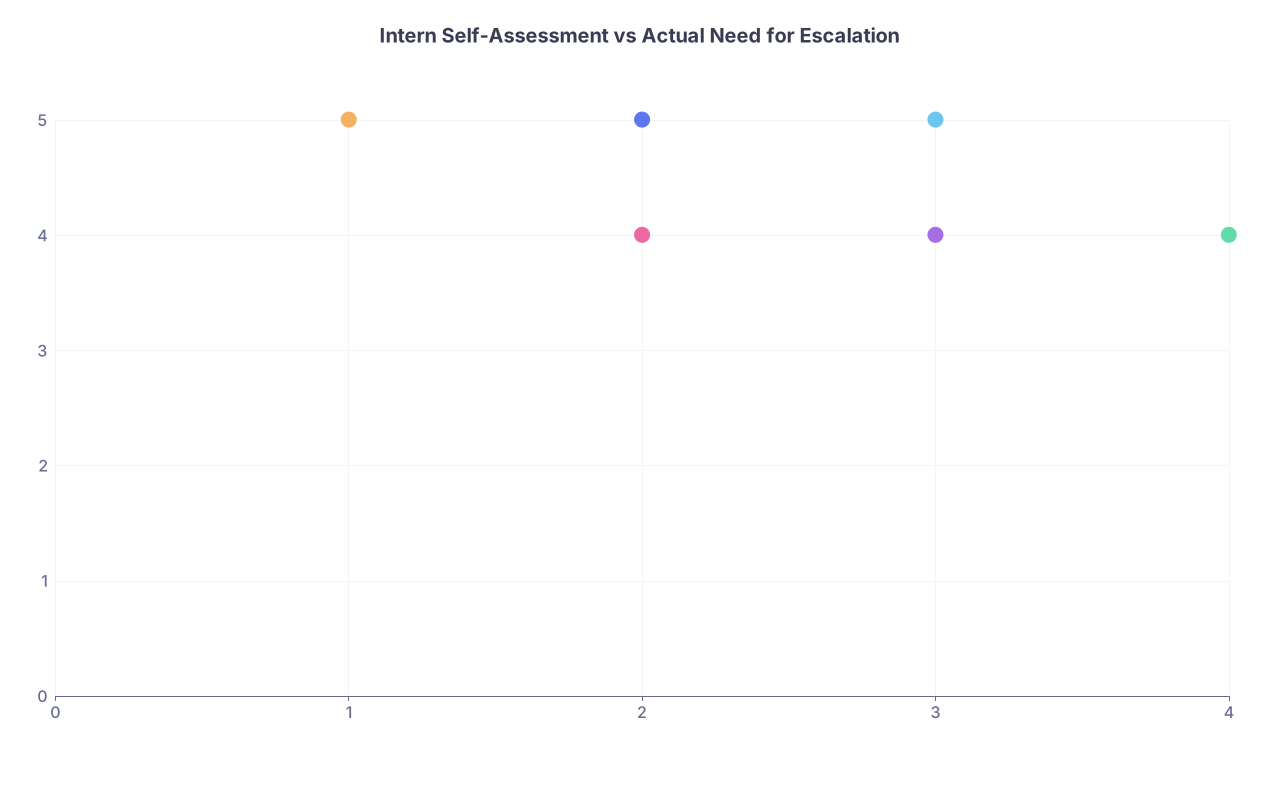
(In this stylized example, intern “worry level” often underestimates actual severity judged retrospectively. That gap early in training is why calling is safer than you think.)
Redefining What “Good” Looks Like as an Intern
Let me reframe the identity piece, because this is where the myth hooks people.
You’re told—implicitly or explicitly—that the best interns:
- Never wake the senior
- Handle everything quietly
- Don’t “bother” anyone
- Are “chill” on nights
That’s false.
The best interns I’ve worked with:
- Call early about real changes, with clear data and a proposed plan
- Are honest about what they don’t know
- Learn rapidly because they use seniors as educators, not gatekeepers
- Earn trust to practice more independently later in the year precisely because they were appropriately cautious early
You’re not proving your worth by managing silently. You’re gambling with someone else’s body to protect your ego.

Years from now, you’re not going to remember which senior rolled their eyes when you paged at 2:30 a.m. You will remember the cases where you listened to your concern, made the call, and changed the outcome.
Heroism in residency is not being the last person to ask for help.
It’s being the first person to speak up when something feels wrong—and refusing to let a rotten culture shame you into silence.