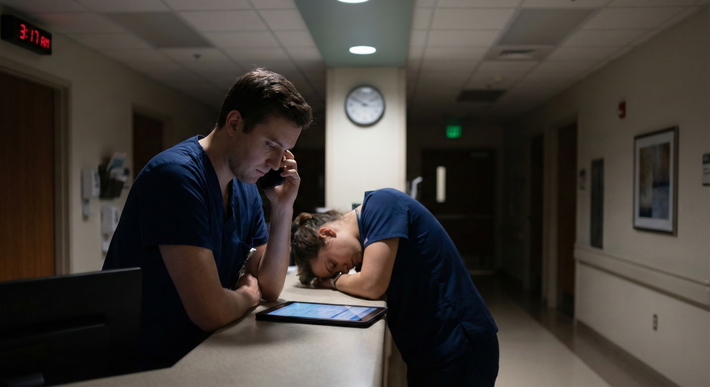
What exactly do you think your program director is more impressed by: you staying until 9:30 pm “to help out,” or you not making a dangerous insulin mistake at 4:45 am because you actually slept?
Let’s tear this apart, because the culture you’re about to enter (or just entered) runs on a myth: that the best interns are the ones who suffer the most visibly.
They’re not.
The “I’m so tired” Olympics is performative nonsense. And the data could not be clearer: chronic sleep deprivation makes you a worse doctor, a bigger liability, and frankly, a less reliable member of the team.
The Myth: Tired = Dedicated
I’ve watched this play out in multiple programs:
The intern who brags at sign-out, “I only slept two hours last night.”
The senior who laughs: “Welcome to residency.”
Someone mutters, “At least you’re putting in the work.”
This is how the myth survives: tiredness as a status symbol.
But here’s what nobody says out loud: the attendings and program directors who actually understand patient safety are not impressed by this. They’re worried.
There’s decades of data on sleep deprivation and performance. Not vibes. Not “back in my day” stories. Real numbers.
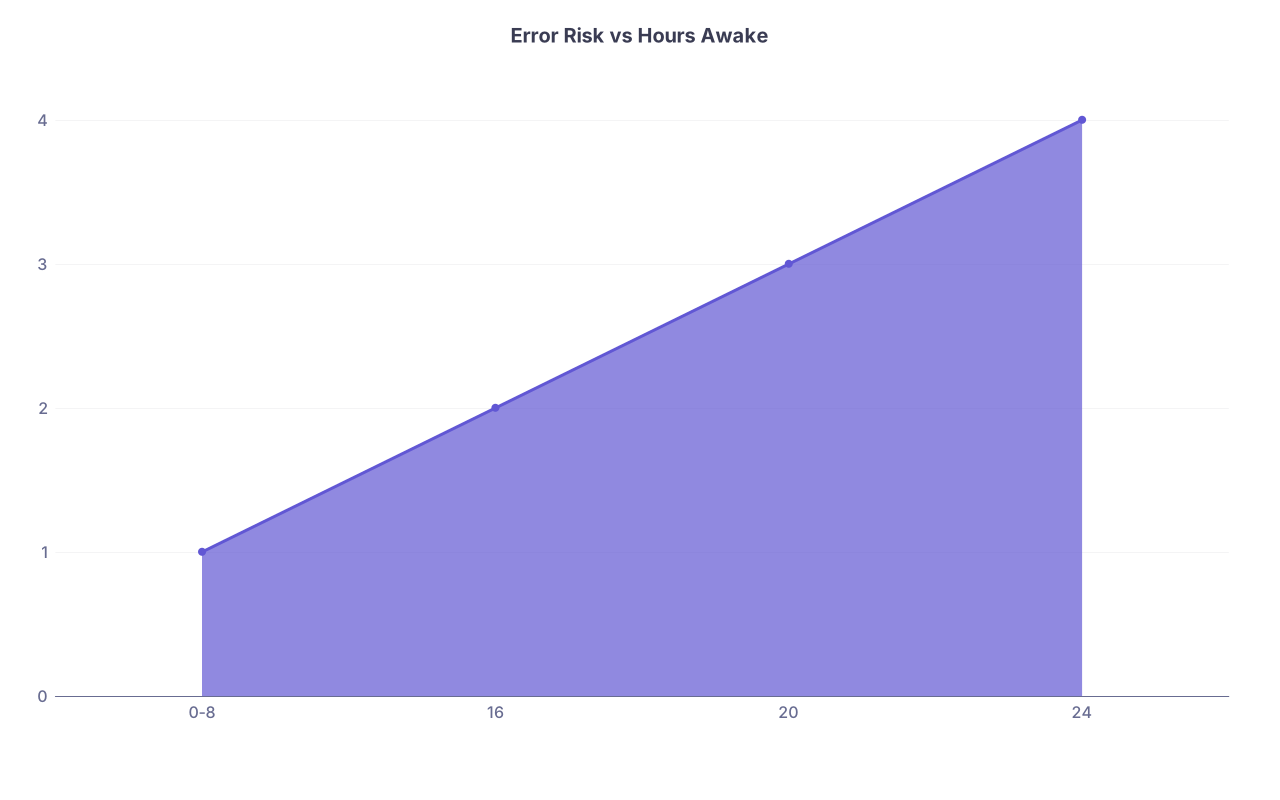
| Category | Value |
|---|---|
| 0-8 | 1 |
| 16 | 2 |
| 20 | 3 |
| 24 | 4 |
Multiple studies have shown:
- Being awake for 24 hours impairs performance as much as a blood alcohol level of about 0.10%—legally drunk in most states.
- Residents working traditional 24–30 hour shifts made significantly more serious medical errors than those on shorter shifts.
- Sleep-deprived doctors have more needle sticks, more car accidents after call, and worse diagnostic accuracy.
Yet somehow, interns still think the way to “show commitment” is to stay later, pick up extra calls, and answer every Epic message at 11:30 pm.
You’re not impressing your program director doing that. You’re broadcasting that you don’t understand your own limits—and that you’re more loyal to the myth than to patient safety.
What Program Directors Actually Notice (It’s Not Your Bedtime)
Let me translate what PDs and attendings actually care about, based on what they talk about when you’re not in the room.
They care about:
- Whether you call for help when you’re out of your depth
- Whether your notes are accurate and on time
- Whether your patients are safe, orders are correct, and follow-up happens
- Whether you’re reliable: show up, respond, don’t disappear
- Whether you’re coachable—not defensive when corrected
They do not sit around asking:
“Who stayed the latest last night?”
“Who charted from home until 1 am?”
What they do notice is:
- The intern who keeps making the same mistakes because they’re exhausted and scattered
- The one who becomes snappy with nurses after three bad call nights
- The one who clearly isn’t reading because they’re too wiped out to learn anything
Here’s the unpleasant truth: if your performance is slipping because you’re constantly sleep-deprived, nobody gives you extra “effort points” for trying hard while barely conscious. The work is still wrong. The note is still garbage. The patient is still harmed.
Your job as an intern is not to prove you can suffer. Your job is to be safe, learn fast, and be dependable. Sleep is mandatory for all three.
What the Evidence Actually Shows About Sleep and Residents
You’ve probably heard the line: “We trained on 36-hour calls and turned out fine.”
No, they didn’t. Many of them just didn’t see the errors they made. Or they blamed themselves instead of the system. Or they measured “fine” as “not fired” instead of “optimal care.”
Look at what the data actually shows.
| Outcome | Well Rested | Sleep Deprived |
|---|---|---|
| Serious medical errors | Baseline | 1.5–2x higher |
| Needle-stick injuries | Baseline | ~2x higher |
| Motor vehicle crashes | Baseline | 2–3x higher |
| Diagnostic accuracy | Higher | Lower |
These aren’t soft measures like “felt more tired.” These are injuries, crashes, and errors.
There was a landmark trial in internal medicine residents showing that extended-duration shifts led to substantially more serious medical errors and attentional failures. Another trial in surgical residents found more technical errors with sleep deprivation.
Translation: when you cut your sleep to “show dedication,” you’re not elevating your performance. You’re trading feeling heroic for quietly doing worse work.
And if you think you’re the exception—“I function fine on 4 hours”—that belief has also been studied. People are objectively bad at judging how impaired they are when sleep deprived. Your confidence climbs while your accuracy drops.
You’re not special. You’re just tired and unaware of how much you’re slipping.
Where the Pressure Really Comes From
Let’s be honest: most of this pressure doesn’t come directly from your program director. It comes from:
- Senior residents with a martyr complex
- Co-interns who brag about working more
- A hidden curriculum that worships “grind” and shames “boundaries”
You’ll hear things like:
“Yeah you can go home… but there’s still a lot to do.”
“I mean, it’s your day off, but can you just swing by to check on that patient?”
“If you really care, you don’t watch the clock.”
I’ve watched perfectly reasonable interns slowly absorb this and start doing dumb things:
- Staying 90 minutes after a 28-hour call “to help” with tasks that could easily be handled by day float or the day team
- Answering Epic messages from home at 11 pm because “it only takes a second”
- Coming in sick because they “don’t want to let the team down”
Here’s the thing: when something goes wrong because you were exhausted, nobody says, “Well, they were trying really hard.” They say, “Why was this person still working?” or “Why didn’t someone send them home?”
Your best defense—medically and professionally—is to respect your own limits and use the systems that exist: duty hours, jeopardy, sick call, sign-out.
How to Be Excellent Without Playing the Sleep Martyr
This is where most people get stuck. They think the only options are:
- Be “dedicated” and sleep-deprived
- Be “selfish” and well-rested
False dichotomy. You can be extremely committed and fiercely protective of your sleep. That’s not weakness; that’s professionalism.
Here’s how that looks in real life.
1. Work like hell while you’re there
If you want to impress people, this is where you do it.
When you’re on shift:
You move efficiently.
You anticipate.
You write the note now, not later.
You call the family now, not “after rounds.”
You don’t scroll your phone for 20 minutes then stay 20 minutes late whining about “how behind” you are. You don’t chat for half an hour at the nurses’ station then heroically stay until 7:30 pm “finishing work.”
You compress your work into your shift as much as humanly possible, so when it’s time to go, there’s very little spillover.
Producing high-quality work fast is a more impressive signal of competence than staying late.
2. Use duty hours as a safety guardrail, not a suggestion
Duty hours aren’t there to pamper you. They exist because people got hurt and died when residents were chronically overworked.
When you consistently violate duty hours voluntarily—“I just stayed to help finish some discharges”—you’re telling your program:
- “I don’t really believe in the safety data.”
- “I don’t manage my time well enough to finish in time.”
- “I need external boundaries because I won’t respect my own.”
None of that says “future chief material.”
If you occasionally go a bit over because of a crashing patient, fine. That’s what the system is built for: rare, justified exceptions. But habitually staying late to do work that could have been signed out or done more efficiently is not heroic. It’s poor systems thinking.
3. Protect post-call and golden hours ruthlessly
Your post-call day is not “bonus time to catch up on life.” It’s recovery time so that the next several shifts don’t degrade into dangerous fog.
And those hours between the end of your shift and your next one? That’s your sleep window. Guard it.
What this looks like in practice:
- You do not routinely schedule social events at midnight when you have to be in the hospital at 6.
- You say no to non-urgent charting, non-critical meetings, and elective tasks that invade that protected time.
- You learn your own minimum sleep threshold where you start to crumble—and you defend being above it like a medication you are required to take.
Is it always possible? Of course not. ICU weeks, nights, crazy admits will happen. But your default should be: sleep is non-negotiable, not “nice if it happens.”
How to Push Back on Toxic Sleep Culture Without Getting Labeled “Soft”
You’re probably thinking: “Sure, in theory. But I don’t want to be the only intern going home on time when everyone else stays.”
Real concern. But there are ways to do this that signal professionalism, not laziness.
When a senior says, “You can go, but we still have a lot left,” and it’s post-call and you’re barely functioning:
You say:
“I’ve signed out all active issues, notes are done, and orders are in. At this point I’m tired enough that I’m going to be less helpful than harmful. I’m going to head out so I’m safe for tomorrow.”
That is a patient safety argument, not a comfort argument.
When a co-intern brags about staying late and needles you for going home “early”:
You say:
“I’d rather work at full capacity for 12 hours than at 60% for 16. My patients don’t need the 16-hour version of me.”
When someone suggests doing work from home late at night:
You say:
“I’ve noticed my error rate goes way up when I’m tired. I try not to do clinical work from home unless it’s truly urgent. I’ll hit it hard when I’m back tomorrow.”
Most attendings will recognize that as maturity, not weakness. The ones who mock it are broadcasting that their practice is based on nostalgia and ego, not data.
No, You Won’t Be Punished for Sleeping
Let me be blunt: in every program I’ve seen, the residents who get into trouble are not the ones who sleep.
It’s the ones who:
- Consistently miss things
- Have multiple near-miss events
- Are chronically late finishing basic tasks
- Seem scattered, disorganized, and emotionally volatile
All of which correlate beautifully with chronic sleep deprivation.
I’ve never once heard a CCC discussion that sounded like:
“Her clinical reasoning is sharp, patients love her, she’s safe, she learns fast… but she leaves within 30 minutes of her shift ending. Red flag.”
I have heard:
“He’s always staying late but still misses key results. I wonder if he’s burning out or not managing his energy well.”
You’re not graded on how much you suffer. You’re evaluated on how well you function. Sleep supports that. Chronic deprivation destroys it.
The Bottom Line: What Actually Impresses Your Program Director
Strip the mythology away and you’re left with this:
Your program director is not secretly hoping you’ll prove how tough you are by wrecking your sleep. They’re hoping you’ll be the kind of intern who doesn’t harm patients, doesn’t implode halfway through the year, and actually grows into a competent independent physician.
You do not get there by treating sleep as optional.
You get there by:
- Working efficiently and intensely during your shift so you can actually leave
- Respecting duty hours and your own neurobiology instead of trying to out-macho physiology
- Choosing being accurate, calm, and teachable over being visibly exhausted and dramatic
If you remember nothing else, remember this:
- Chronic sleep loss makes you a worse, less safe doctor—no matter how “dedicated” you feel.
- Program directors care about performance, reliability, and safety, not your ability to brag about how little you slept.
- Protecting your sleep is not selfish; it’s part of being the kind of resident people trust with real responsibility.