“Just push through” is not tough. It is impaired.
In residency culture, especially your first intern year, chronic sleep deprivation is still worn like a badge. People brag about “32 hours, no nap” as if that proves dedication instead of dysfunction. You will hear some version of this from seniors, attendings, even program leadership: “Everyone’s tired. You get used to it.”
Here’s the problem: the data says that is flat-out wrong. You do not “get used to” chronic sleep deprivation. You just get worse at noticing how badly you’re performing.
The Myth of “You Adapt to No Sleep”
The most persistent lie in residency is that your body and brain will adapt to 4–5 hours of fragmented sleep. You’ll feel less miserable after a while, so surely that means you’ve adjusted. Right?
No. What’s actually happening has been documented over and over in sleep research: your subjective sense of how impaired you are plateaus, but your objective performance keeps declining.
One of the classic controlled lab studies out of Penn (Van Dongen, 2003) did something brutally simple: they restricted healthy adults to different doses of sleep for 14 days—4, 6, or 8 hours per night—and kept another group awake 3 days straight. Then they measured reaction times and cognitive performance repeatedly.
Here’s what the data showed:
- People on 6 hours a night for 2 weeks were as impaired on objective tests as people who had been awake for 24 hours straight.
- People on 4 hours a night for 2 weeks looked like they had been awake for 48–72 hours.
- Subjective sleepiness? It rose in the first few days, then flattened. Participants thought they’d “adjusted” while their performance just kept degrading.
Sound familiar? That’s PGY-1 in a nutshell.
You drag yourself through your first month on nights, feel like you’re dying, then by month three you say, “Honestly, it’s not that bad anymore.” But your cognitive function didn’t magically recover. You just lost insight into how bad it still is.
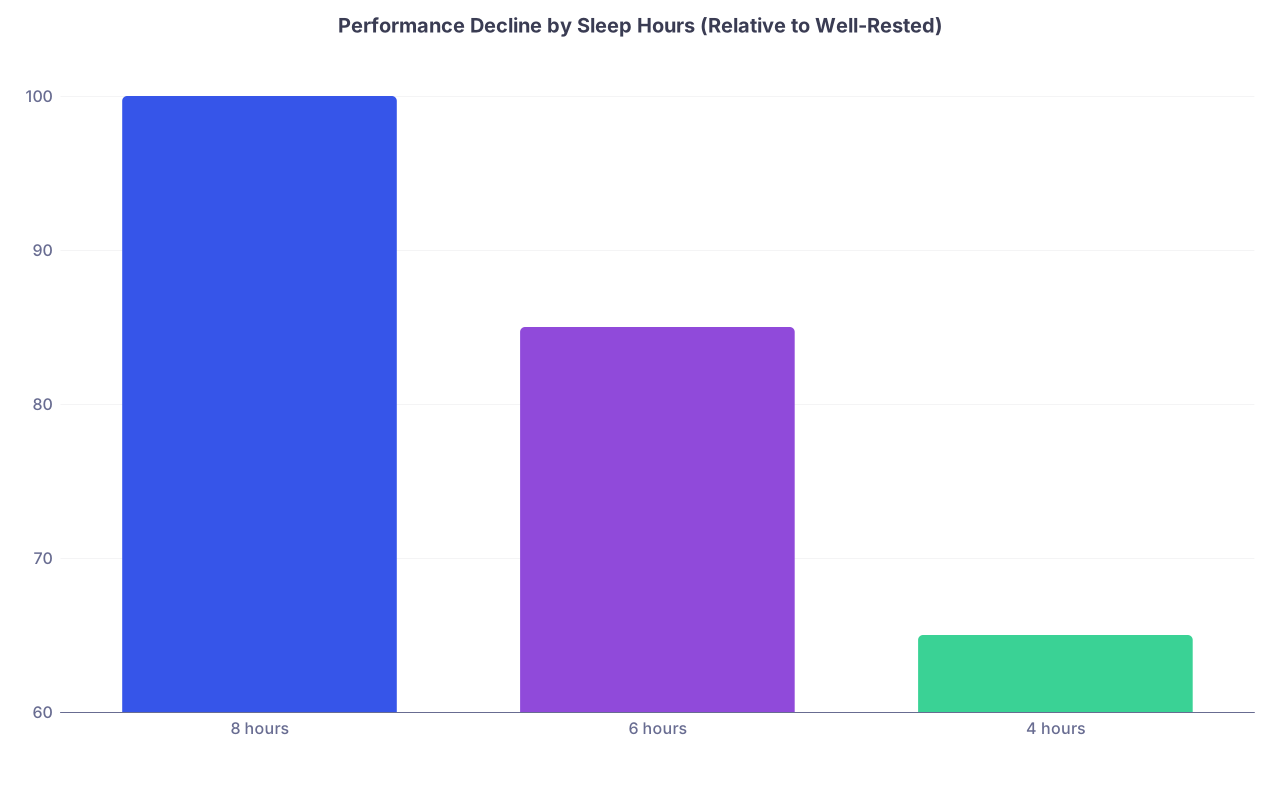
| Category | Value |
|---|---|
| 8 hours | 100 |
| 6 hours | 85 |
| 4 hours | 65 |
That “I’m fine, you’re just weak” attitude you’ll hear from some seniors? That’s not resilience. It’s anosognosia for fatigue.
What Chronic Sleep Loss Actually Does to You (Intern Edition)
Let’s drop the abstract physiology and talk about your actual call night.
You’re cross-covering 60 patients. It’s 4:10 a.m. A nurse calls: “Your patient in 7B is more short of breath, sats 88% on 2 liters.” You’ve been awake for 20+ hours, you slept 4–5 hours the night before, and this is your 4th night in a row.
If you’re routinely sleep-deprived, here’s what the evidence says is happening in your brain at that moment—whether you feel it or not.
1. Your working memory is shot
Working memory is the mental “RAM” that lets you hold a few data points in your head while you reason: vitals, exam, labs, trends, prior echo, home meds. Sleep restriction reliably degrades this.
So instead of thinking clearly, “She has CHF, mild AKI, recent fluids, new hypoxia, last CXR, last weight, what changed?” your brain jumps around:
- “Order a CXR.”
- Then you forget you never checked the last CXR.
- You can’t quite remember whether she was already on 2L or just went up.
- You mean to look at the I/O’s and forget halfway through clicking.
This isn’t a moral failing. It’s physiology. Imaging studies show prefrontal cortex—where this juggling act happens—basically goes on low power when you’re sleep-deprived. The slower, more effortful, and more error-prone thinking? That’s baked in.
2. Your risk assessment is skewed
Sleep loss doesn’t just slow you down; it warps your judgment.
Research on sleep-deprived subjects shows increased risk-taking, impulsivity, and poor evaluation of negative outcomes. In other words: you underestimate bad possibilities and overestimate your ability to handle them.
In clinical terms, that might look like:
- Not calling for help when something “feels off”
- Delaying an ICU transfer because you’re overly optimistic
- Writing “watch overnight” on a patient you should actually go re-evaluate
The truly dangerous part? You will feel more confident in your decisions than you should. There’s a well-described dissociation: confidence goes up or stays the same, performance goes down. That’s a great recipe for serious error.
3. Your attention has micro blackouts you don’t notice
Anyone who’s driven home after a 28-hour call and “lost” part of the drive has experienced this. Microsleeps—brief, seconds-long lapses in attention—are common under chronic sleep restriction.
You don’t need to faceplant on the keyboard for this to be a problem. On the floor at 3 a.m., a 2–3 second lapse during order entry can mean:
- Clicking the wrong medication
- Overwriting an order set
- Missing a key vital sign on the screen
I watched a co-intern almost discharge a patient on 100 units of Lantus twice daily because he scrolled, mis-clicked, and didn’t register the absurdity for a few seconds. This was a smart, meticulous person. His brain just wasn’t online.
4. Learning collapses—even if you’re “powering through”
You came to residency to learn. You want to remember that lecture on sepsis, the attending’s teaching during rounds, that ICU fellow’s explanation of ventilator settings.
Here’s the uncomfortable truth: without adequate sleep, you’re burning through experiences and retaining very little.
Sleep is when you consolidate short-term experiences into long-term memory. Studies on med students and residents show sleep-deprived learners remember less, integrate concepts more poorly, and perform worse on subsequent testing—even when they “paid attention” and “pushed through.”
So when someone tells you, “This is just residency, you’ll sleep when you’re an attending,” what they’re really saying is: “We’re fine wasting a big chunk of your peak learning window.”
It’s not heroic. It’s inefficient.
But Residents Have Always Done This—Isn’t That Proof It’s Fine?
No. “We didn’t die” is a staggeringly low bar.
The idea that “we all did 120-hour weeks and we’re fine” is comforting nostalgia, not evidence. Three problems with that argument.
Survivorship bias
You’re only hearing from the people who made it through and are still in the system. You are not hearing from the residents who:
- Left medicine entirely
- Switched specialties
- Developed major depression, anxiety, or substance issues
- Had serious health problems
They’re not at morning report telling you how that worked out.
System changes
The medicine you’re practicing now is more complex than what someone did in 1995. More meds. More guidelines. More EMR clicks. More documentation. More throughput pressure.
Layer that onto chronic sleep loss and the error margin shrinks. A sleepy 1990s resident wasn’t also managing 40 tabs in Epic, 6 quality metrics, and 20 cross-cover pages about order clarifications.
Outcome data actually exists—and it’s ugly
We’re not just guessing. There are multiple studies showing that:
- Residents working extended-duration shifts (24+ hours) had significantly more attentional failures and self-reported medical errors.
- Driving after a 24-hour call produced impairment comparable to or worse than moderate alcohol intoxication.
- Sleep-deprived clinicians have higher rates of needle sticks and occupational injuries.
In other words: the idea that this is “just part of training” is not backed by outcome data. It’s defended by tradition and ego.

“But Duty Hours Exist Now—Is This Still a Problem?”
Yes. Duty hours didn’t magically solve this.
The ACGME caps hours, but those caps still allow:
- 24+4 hour calls
- Consecutive long shifts with limited recovery sleep
- Chronic 6-hour nights when you factor in commute, sign-out, and basic human needs
What changed is not that residents suddenly get healthy sleep. What changed is that the abuse is slightly more regulated.
Look at it this way: the dose-response curve for impairment doesn’t care what the ACGME says. The Penn data didn’t show a big cliff at 80 hours a week. It showed gradual, cumulative damage from losing 2–3 hours a night, every night. Exactly what many residents are still doing.
| Schedule Type | On-Duty Hours/Week | Typical Sleep Window/Night | Risk for Chronic Deprivation |
|---|---|---|---|
| Home call + days | 70–80 | 5–6 hours | High |
| Night float (q4w) | 60–70 | 6–7 hours but misaligned | Moderate |
| Traditional 28-hr q4 | 75–80 | 4–6 hours on call nights | Very high |
| Shift-based ICU | 55–65 | 6–8 hours | Moderate to low |
Even in “good” programs, interns often live in the 5–6 hour range. The research is very clear: that is enough to keep you chronically impaired, no matter how normalized it feels.
The Hidden Costs You Won’t See On Your Eval
Program evaluations and milestone checklists won’t capture half of what chronic sleep deprivation is doing to you.
Cognitive scars
Long-term sleep loss is associated with slower processing speed and memory issues that do not always fully bounce back with one golden weekend. Ask any senior who suddenly starts needing three read-throughs to absorb a paper they’d have breezed through in M3.
No, residency doesn’t erase your brain. But if you live in a sleep debt hole for three years, don’t be surprised if your baseline sharpness is dulled.
Emotional fallout
Chronic sleep restriction cranks up irritability, blunts empathy, and worsens mood. Depression and burnout track frighteningly well with poor sleep among residents.
I’ve watched interns who were patient, kind, and thoughtful in July become snappy, numb, and disengaged by February. They didn’t “become jerks.” They became exhausted.
The stoic culture reframes this as “toughening up.” Translation: “You feel less because you’re too tired to feel fully.”
Health damage
You know this from lectures, but most residents behave like the rules don’t apply to them.
Chronic sleep deprivation is linked to:
- Higher blood pressure
- Weight gain and worse metabolic markers
- Immune dysfunction (hello, constant URIs)
- Increased risk of accidents—especially driving
I have personally seen more residents crash their cars driving home post-call than I’m comfortable with. This is not hypothetical.
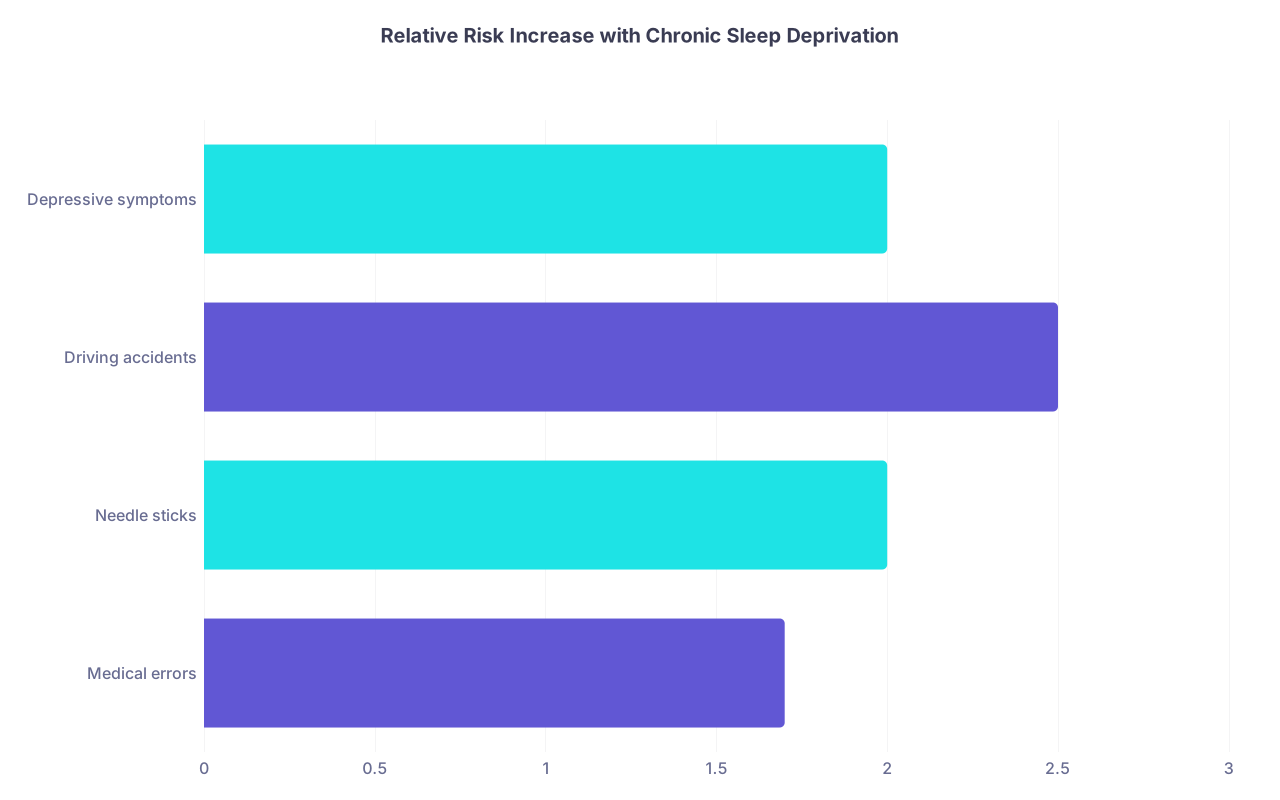
| Category | Value |
|---|---|
| Medical errors | 1.7 |
| Needle sticks | 2 |
| Driving accidents | 2.5 |
| Depressive symptoms | 2 |
So What Can You Actually Do As an Intern?
You can’t change the ACGME. You can’t single-handedly rewrite your schedule. But you are not helpless.
The goal is not “perfect sleep.” That’s fantasy. The goal is to avoid chronic, unnecessary deprivation and stop glorifying the rest of it.
1. Treat sleep like a critical order, not a luxury
You’d never hold a home beta-blocker “if convenient.” You shouldn’t treat your own sleep that way either.
On lighter rotations, you should be fighting to average 7–8 hours. On heavier ones, claw back as close to that as your schedule allows. That means:
- Stop doom-scrolling when you get home “just to decompress.”
- Choose between social plans and sleep when you have to. Not every invite deserves a yes.
- Use post-call time to actually sleep, not to “prove” you’re tough by staying up all day.
You can’t control census. You can control whether you waste the only hours your brain has to repair itself.
2. Protect your pre-call and post-call windows
The “just push through, I’ll catch up later” mindset is exactly what the data disproves. That’s not how recovery works. One long sleep does not erase 10 nights of deficit.
Instead:
- Pre-call: guard your sleep the night before like it’s an important exam.
- Post-call: sleep in a consolidated block as much as you realistically can, then go to bed early again. The point isn’t to feel perfect. It’s to reduce the multi-day hangover.
This isn’t softness. It’s minimizing the number of days you’re functioning like you’re legally drunk.

| Step | Description |
|---|---|
| Step 1 | Rotation Schedule |
| Step 2 | Protect pre-call sleep |
| Step 3 | Aim for 7 to 8 hours |
| Step 4 | Post-call long sleep |
| Step 5 | Early bedtime next night |
| Step 6 | Monitor mood and errors |
| Step 7 | Call or Nights? |
3. Stop cosigning the bravado
When someone says, “I was up for 30 hours, slept 4, now I’m back—no big deal,” you don’t have to applaud. You can say, “That’s not safe, and the data backs that up.”
You don’t have to start a war. But you can quietly refuse to mythologize self-harm as professionalism.
You can also normalize basic boundaries, like:
- “I’m too tired to be safe to drive; I’m going to nap in the call room first.”
- “I need a quick break; I’ve been awake 24 hours and I feel myself missing things.”
That’s not whining. That’s hazard mitigation.
4. Use your impairment as a signal, not a challenge
If you hit that point in the night where you can’t remember what you were just doing, or you’re staring at the screen like it’s in another language, that is not the time to grit your teeth and “prove” yourself.
That’s the time to:
- Double-check every order
- Ask another resident or nurse to co-sign critical decisions
- Call your senior sooner, not later
Interns sometimes think, “If I admit I’m tired, they’ll think I can’t handle it.” In reality, people trust the colleague who knows when they’re unsafe more than the one who pretends they’re a machine.
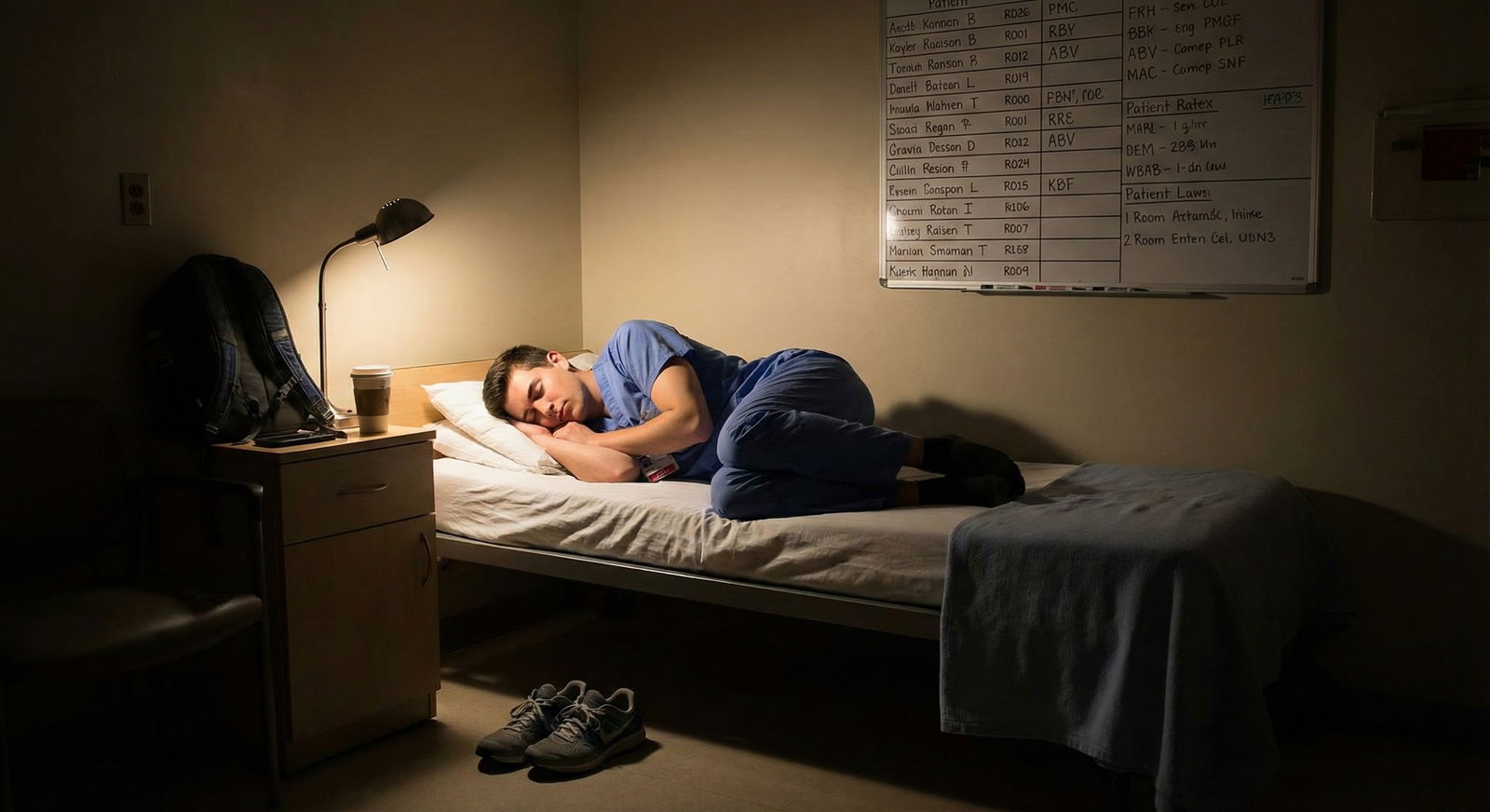
The Uncomfortable Truth
The culture that tells you to constantly “just push through” is not built on data. It’s built on nostalgia, ego, and a refusal to admit that the way many of us were trained was unsafe and inefficient.
The evidence on chronic sleep deprivation is brutally consistent:
- You do not adapt to sleeping 4–6 hours a night. Your performance degrades while your insight into that degradation fades.
- Sleep-deprived residents make more errors, take worse risks, learn less, and hurt more—emotionally and physically—even when they believe they’re “performing fine.”
- Treating sleep as optional is not a sign of commitment. It is a predictable way to become a worse doctor, a worse learner, and a less healthy human.
You can’t fix the entire system as an intern. But you can stop lying to yourself about what “pushing through” really costs. And you can quietly choose to be the resident who protects their brain instead of glorifying its slow, preventable breakdown.