
The “perfect intern” everyone talks about does not exist. And the interns who try hardest to look perfect are usually the ones who scare the attendings the most.
You are not trusted because you never make mistakes. You’re trusted because people can reliably see your limits before the mistake kills someone.
That’s the part nobody tells you on day one.
The Dangerous Myth of the “Perfect Intern”
Walk onto any July ward team and you’ll hear some version of the script:
“She’s amazing—never asks questions.”
“He’s sharp—already managing like a second-year.”
“They’re a rockstar—took cross-cover without calling once.”
This is sold to you as praise. It is not. It’s a red flag wrapped in a compliment.
Here’s what the data actually shows from patient safety and medical error research:
- Most serious errors in training environments are not because someone “didn’t know enough.”
- They’re because someone didn’t speak up soon enough, or at all.
- Overconfidence and poor help-seeking behavior are repeatedly identified as risk factors in adverse events and near misses.
Every major patient safety body—from the Agency for Healthcare Research and Quality (AHRQ) to the Joint Commission—has banged this drum for years: silence kills. Not ignorance. Silence.
Yet residencies still implicitly reward the exact opposite: the intern who never pages, never hesitates, never says “I don’t know.” You’re pressured to cosplay competence.
So you internalize the myth: “If I admit my limits, they’ll think I’m weak or incompetent.”
Reality: If you don’t admit your limits, the people who matter—your best seniors and attendings—will not fully trust you.
They might be polite about it. But they notice.
What Attendings Actually Trust (Versus What Interns Think They Trust)
Let me be blunt: most interns are miscalibrated about what impresses a good attending.
You think attendings trust:
- Flawless presentations
- Confident answers on the spot
- Saying “got it” to every task
- Handling cross-cover without calling
What attendings actually trust, if they’ve been around long enough to see bad outcomes:
- Interns who consistently surface uncertainty early
- Interns who change course when new data contradicts them
- Interns who escalate concerns without ego
- Interns who are predictable in how they handle being over their head
They’re not looking for theatrically confident.
They’re looking for predictably safe.
Ask any attending who has been through a real patient disaster with a trainee. The worst intern is not the “weakest.” It’s the one who quietly pushes through with partial understanding and a terrified need to look capable.
I’ve watched an attending tell the program director privately: “I’m fine with her not knowing a lot yet. I’m not fine with the fact that she keeps saying she understands when it’s obvious she doesn’t. I don’t know what she’ll hide next.”
That’s how trust erodes. Not from wrong answers. From hidden uncertainty.
The Psychology: Why You Hide Your Limits
You are not crazy for wanting to look like you know what you’re doing. The entire medical training pipeline taught you to fake certainty.
Premed: perform.
Step exams: binary right/wrong.
Clerkships: “confidence” = better evals.
Letters of rec: “sharp, independent, doesn’t need much hand-holding.”
So when you hit internship:
- You’re terrified of being labeled “needy” or “high maintenance”
- You’ve watched classmates brag about “never calling their senior”
- You’ve heard the horror stories of “that intern” who got a reputation early and never shook it
So you edit yourself. You turn “I’m not sure what to do” into “I’ll check on that.”
You turn “I need help” into “Just updating you.”
And the cognitive bias kicks in: the Dunning–Kruger effect. The least experienced are the most likely to overestimate their ability. You are literally in the peak danger zone for overconfidence and under-asking.
Now layer on hierarchy and stigma. Studies in resident communication show:
- Trainees routinely underreport uncertainty to supervisors
- Fear of judgment and evaluations is a major barrier to speaking up
- Residents often assume attendings expect independence earlier than they actually do
So yes, the deck is stacked against honest limit-setting.
But here’s the twist: the people whose opinions actually shape your long-term trajectory—the program director, the core faculty, the seniors everyone respects—tend to value the opposite of what you’re trying to project.
They know the literature. They’ve seen what happens when no one admits they’re lost.
Why Admitting Limits Builds More Trust, Not Less
Let’s be specific. “Admitting limits” isn’t some vague virtue. It’s a set of observable behaviors that signal to others: “When things get risky, you will not disappear into your own head.”
Supervisors learn to trust you when you:
- Say “I’m not sure” early, not after 12 hours of flailing
- Make your thinking transparent (“Here’s what I considered, here’s where I got stuck”)
- Connect your question to patient safety (“I’m worried about missing X if I choose Y”)
- Ask for the right kind of help (“Can you sanity-check this plan?” vs “What do I do?” every five minutes)
That doesn’t read as weak. It reads as metacognitive—aware of your own thinking. There’s education research showing that learners who recognize and communicate their knowledge gaps actually perform better long-term.
Here’s the core irony most interns miss:
Being explicit about what you don’t know makes people more comfortable letting you work independently.
Because now they have a mental model:
- “She’ll try on her own, but she’ll call when she hits a wall.”
- “He doesn’t overrepresent his competence; when he says he’s got it, he usually does.”
- “If something feels off, they’ll escalate—no ego.”
That’s the kind of intern a good senior will happily let manage three unstable patients at 2 a.m. They know you won’t quietly drown.
To make this concrete, let’s contrast two interns.
| Aspect | Intern A - Performative | Intern B - Transparent |
|---|---|---|
| Response to new task | "Yep, got it" | "I think I know the basics, but I haven’t done it solo yet" |
| When stuck | Keeps trying silently | Calls after attempting and defining the problem |
| Cross-cover night | Rarely pages, hides uncertainty | Pages with specific questions and clear reasoning |
| Senior’s trust | Smiles but double-checks everything | Actually delegates and sleeps |
Guess which one gets better evaluations after a few months. It’s not the one “who never needed help.”
What the Safety and Error Data Really Show
Let’s pull this out of opinion and into data.
Look at analyses of adverse events in teaching hospitals (there are plenty: AHRQ, major internal medicine and surgery journals). Patterns pop up over and over:
- Escalation failure: Resident recognized a problem but did not call or called too late
- Misplaced confidence: Trainee continued a plan despite new concerning findings
- Ambiguous supervision: Attending assumed the resident would call; resident assumed they were expected to “handle it”
Very rarely does the root-cause analysis read: “Intern admitted too many limits.”
In fact, the move to duty hour restrictions, checklists, and standardized escalation pathways over the last two decades is essentially the system forcing people to admit limits: limits of time, attention, human memory, cognitive bandwidth.
The profession—in policy—is saying: “We do not trust ‘I’ll just work harder and be more careful’ as a safety strategy.”
Yet culturally, on the ground, you’re still getting messages like, “We didn’t have duty hours and we turned out fine,” or “I never called my attending at night.” Translation: “I survived my training; therefore the system is fine.” Survivorship bias dressed up as toughness.
The data doesn’t support that nostalgia. High-reliability organizations (aviation, nuclear power) have known for decades that standardized communication of limits and uncertainty reduces catastrophic errors.
Healthcare is slowly catching up. Don’t be the one clinging to the older, more dangerous culture.
How to Admit Limits Without Looking Helpless
Now the practical part you actually care about: how to do this in real life without becoming “that intern who can’t do anything alone.”
The skill isn’t just admitting limits. It’s framing them.
Here’s a simple pattern that works:
- Show you’ve tried
- Name your limit clearly
- Anchor it to patient safety
- Ask for specific input
Example on cross-cover at 2 a.m.:
Wrong version:
“Hey, I have no idea what to do with this patient.”
Better version:
“I was paged about Mr. Lee with new shortness of breath. I went to see him, got vitals, listened to his lungs, and ordered a stat chest X-ray and labs. I’m not sure whether I should start diuresis before we have imaging, and I’m worried about missing a PE. Can I run the plan by you?”
Notice the difference:
- You are not throwing the problem in someone’s lap.
- You’re showing work.
- You’re precise about where your uncertainty lives.
- You explicitly tie the question to a safety concern.
That does not read as weak. It reads as appropriately cautious.
Another trick: pre-commit your escalation threshold with your senior or attending.
You can say on day one of a rotation:
“Just so you know how I think—I’m comfortable working through most things, but I’ll always call you for chest pain, breathing changes, new neuro deficits, or if I’m considering ICU-level care. If I’m unsure whether something crosses that bar, I’ll call to check. Does that match what you want?”
This does three things at once:
- Signals that you are not going to be a silent disaster
- Gives them a chance to calibrate your threshold (“Also call for XYZ”)
- Makes later calls feel expected, not like failures
You’ve turned “asking for help” from a personal weakness into a pre-agreed team protocol.
Here’s that escalation pattern as a simple visual:

| Step | Description |
|---|---|
| Step 1 | Identify patient issue |
| Step 2 | Gather key data |
| Step 3 | Form initial plan |
| Step 4 | Implement and monitor |
| Step 5 | Page senior with summary |
| Step 6 | Discuss options |
| Step 7 | Shared plan and follow up |
| Step 8 | Confident and low risk |
That’s what safe looks like. Not “never paging.”
When You Should Absolutely Admit Limits (No Debate)
There are non-negotiables where trying to look “perfect” is reckless. If you’re on the fence about whether to ask for help in these, the answer is yes:
- New chest pain or shortness of breath
- Any neuro change (even “subtle”)
- Hypotension or rapidly changing vitals
- Considering starting/stopping pressors, anticoagulation, or high-risk meds
- Unclear goals of care / family conflict about major decisions
- You feel a creeping sense of “I’m not seeing the whole picture”
That last one is not fluffy. There’s research on situational awareness and “gut feelings” in medicine—often it’s your pattern recognition noticing something off before you can verbalize it.
The mistake interns make is trying to “solve” that feeling alone to look competent. The better move is:
“I have a bad feeling about this patient and can’t fully articulate it. Can you lay eyes on them with me?”
I have never seen a good senior punish an intern for that sentence. I have seen lives saved by it.
How This Actually Builds Your Reputation Long-Term
Here’s the long game no one describes clearly.
In month 1–3, people are mostly asking:
- “Are you safe?”
- “Do you call when you should?”
- “Can I sleep when you’re on call?”
If the answer is yes, you start to earn a different kind of attention.
By month 6–12, attendings and seniors are watching:
- How your reasoning has evolved
- Whether you’ve internalized when to escalate and when to own a problem
- Whether you can now teach juniors the same habits
You do not get to that stage by being the quiet intern who never admitted limits. You get there by accurately representing your competence over time. As your skills expand, so does the zone where you genuinely “got it.”
That’s how trust compounds: people see that when you say “I’m comfortable managing this,” after months of honest limit-setting, they believe you.
And this is where your evaluations start to talk about you the way you wanted from day one:
- “Safe, reliable, and knows when to ask for help”
- “Rapid growth over the rotation; excellent judgment about limits”
- “I trusted them with complex patients because they’re honest about uncertainty”
Ironically, you end up looking like the “rockstar intern” everyone pretends to be on day one—except in your case, it’s actually true.
To make this progression clear:
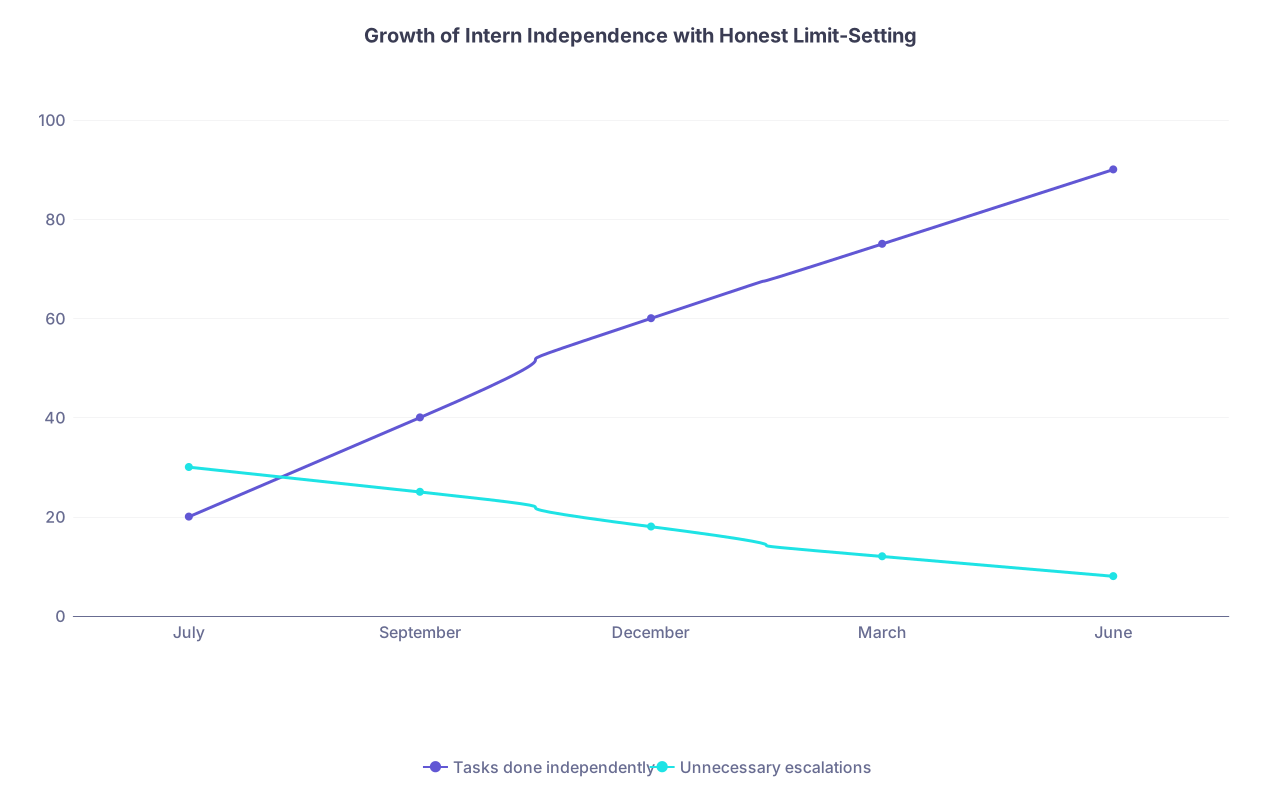
| Category | Tasks done independently | Unnecessary escalations |
|---|---|---|
| July | 20 | 30 |
| September | 40 | 25 |
| December | 60 | 18 |
| March | 75 | 12 |
| June | 90 | 8 |
The “perfect intern” myth tries to jump straight to 90% independence in July. That’s how you get into trouble. The safer—and ironically faster—path is incremental, honest expansion of your zone of comfort.
A Quick Word on Burnout and Mental Health
One more inconvenient truth: pretending you have no limits is not just bad for patients. It breaks you.
Residents who:
- Hide their struggles
- Avoid asking for help
- Feel they must maintain an image of perfection
…have higher levels of burnout, distress, and suicidality in multiple studies. The “strong, silent” intern isn’t strong. They’re isolated.
Admitting cognitive and emotional limits isn’t just a patient safety move; it’s a self-preservation strategy. Saying to your senior, “I’m at the edge of what I can safely handle right now,” is not weakness. It’s exactly the kind of boundary that keeps you functioning in a brutal job.
You’re not a safety valve for the hospital’s endless workload. You’re a human with a limited working memory buffer and a nervous system that eventually quits.

How to Start Practicing This Tomorrow
If you want to build trust fast in your first year, try this for one week:
- Once per day, explicitly say “I’m not sure” followed by what you’ve already tried.
- Before each shift, mentally define your hard escalation triggers (what you will always call for).
- After a complicated patient, debrief with your senior: “Was there any point where you wish I’d called earlier or could have handled more on my own?”
You’ll learn your program’s actual expectations far faster than if you just guess and hope.
And you’ll send a clear message, day after day:
“I know I’m not perfect. I know my limits. I will not hide when I hit them.”
That’s someone people can trust.
Key points:
- The “perfect intern” who never asks for help is a liability, not a role model. Real trust comes from predictable, honest escalation and visible self-awareness.
- Admitting limits—early, specifically, and tied to patient safety—signals reliability and accelerates your growth and independence, not the opposite.
- Long-term reputation is built on accurate self-assessment and transparent communication, not on performative confidence or silence.