
The belief that you must answer every page the second it beeps is wrong. And dangerous—for you and, ironically, for your patients.
You are not an emergency response robot. You are a physician in training. Those are not the same job.
Let’s dismantle this.
Where This Myth Comes From (And Why It Persists)
You know the script:
- “Always answer the page immediately.”
- “If the nurse has to page twice, you’ve failed.”
- “If something bad happens and you didn’t pick up, that’s on you.”
I have watched seniors say this on day one of orientation. I’ve heard program directors hint at it with, “Responsiveness is key,” and leave out the nuance. Nurses repeat it because they’ve been burned by truly unresponsive doctors. Interns repeat it because fear is contagious.
Here’s the reality: there is no evidence that “instant” response to every page improves outcomes across the board. What we do have data on is:
- Response time to true clinical deterioration matters.
- Interruptions and multitasking increase error rates.
- Physician burnout and sleep deprivation are strongly associated with mistakes, near misses, and worse patient care.
You’re being handed a cultural rule that clashes with human limits and cognitive science. And no one bothers to reconcile those.
So let’s reconcile them.
What Actually Needs an Immediate Response
First: not all pages are created equal. Your pager is a fire alarm, a calendar reminder, a spam folder, and a social network notification mashed into one primitive plastic brick.
Treating all pages as Code Blue alerts is how you fry your nervous system and start making sloppy errors on the stuff that actually matters.
Here’s the rough hierarchy of urgency that’s actually safe and defensible.
Truly time‑critical (drop what you’re doing)
These are “right now” or within a minute or two. These are the ones where, if you delay, you can genuinely hurt someone.
Common examples:
- Rapid Response or Code pages
- “STAT” page from bedside nurse about:
- New chest pain, acute shortness of breath
- Hypotension (especially MAP < 60, SBP < 90)
- New confusion, focal neuro deficit, seizure
- Sustained tachycardia with symptoms, arrhythmia concern
- Massive bleeding, hematemesis, melena with instability
- “Patient looks really bad / I’m very worried”
- Airway concerns of any kind
These you answer and prioritize even if you’re writing an order, halfway through another page, or documenting a note. Patient safety comes first. In these cases, the “answer immediately” instinct is correct.
Urgent but not emergent (within ~5–10 minutes)
These are things where a short delay is safe, but you shouldn’t ignore them for half an hour.
Examples:
- Lab calling critical values (K 2.8 / 6.2, Na 120, hemoglobin 6, lactate 5, etc.)
- New fever in neutropenic or post‑op patient
- Uncontrolled pain despite standing and PRN meds
- New onset oliguria, rising creatinine, possible urinary retention
- Blood cultures positive, radiology with concerning read that might change management now
Here, you can safely:
- Finish the order you’re entering.
- Wrap up a short key task.
- Then call back, quickly assess, and decide if you need to go see the patient now or in a bit.
Important but deferrable (within 30–60 minutes, sometimes longer)
These are the pages that residency culture still pressures you to treat like fires, even though they objectively are not.
Examples:
- “FYI: temperature 99.8, trending up from 98.9”
- “Patient wants to talk about their diet / discharge timeline / paperwork”
- Requests to “reorder” a med that’s about to expire but not needed this second
- Clarifying non‑urgent orders: “Can patient shower?” “Can we remove telemetry?”
- Chronic issue in stable patient: constipation for 2–3 days in someone otherwise ok
These you can—and should—batch. That means:
- Finish what you’re doing.
- Group similar pages.
- Call back when you can give real attention, not half‑listening while running between tasks.
No, you do not need to stop in the middle of admitting a crashing sepsis patient to immediately answer a page about whether Mr. Jones can have an extra snack at 2am.
Not your circus, not your monkey (misdirected pages)
You will get pages that:
- Are for a different service (e.g., you’re medicine, they want surgery)
- Are pharmacy/administrative issues not for you
- Refer to patients who are not yours
Early on, you’ll feel obligated to handle everything. Do not fall into this trap. You can safely:
- Reply: “That’s not my patient/service; please page X.”
- Or if you know the right contact, help once, then redirect: “This goes to ICU, not hospitalist night float.”
You’re allowed to have boundaries. In fact, you need them to stay competent for your actual patients.
The Data You’re Never Shown: Interruptions and Errors
Hospital culture worships fast responses. Patient safety literature is more nuanced.
There’s a body of work on interruptions, cognitive load, and error rates in clinical environments; the themes are consistent:
- Clinicians interrupted during prescribing or ordering are more likely to make medication errors.
- Frequent task‑switching increases time to completion and reduces accuracy.
- Fatigue and burnout correlate strongly with self‑reported errors and adverse events.
You know what causes nonstop interruptions at night? Exactly this myth: that every page is a grenade you must jump on instantly.
So you get:
- Intern writing orders for a sick admission.
- Pager goes off with three non‑urgent items.
- Intern stops mid‑thought, answers, half‑listens, enters half‑remembered orders, forgets to complete admission med rec.
Later, that oversight leads to a missed home beta‑blocker, uncontrolled blood pressure, maybe even a rapid response at 3am.
But hey, the pages were answered immediately. So we call that “responsible.”
This is backward.
Reasonable, prioritized responsiveness lowers error risk. Reflexive, panicked, answer‑everything‑now culture raises it.
What’s Actually Expected Legally and Professionally
Let’s talk liability and professionalism, because fear of “getting sued” or “getting written up” drives a lot of this anxiety.
There is no legal standard that says: “Interns must answer every page within 30 seconds.”
Standards of care focus on:
- Timely recognition and treatment of deterioration
- Reasonable availability and supervision
- Appropriate escalation and documentation
If a nurse has to page you 3 times over an hour for hypotension and you never respond? That’s a problem.
If you took 6 minutes to call back because you were in a patient room placing a central line, then responded appropriately, documented your assessment and plan, and escalated if needed? That’s defensible.
Professionalism, realistically, means:
- You respond consistently, within a reasonable timeframe relative to urgency.
- You triage—prioritize sick patients and high‑risk issues.
- You communicate if you’re truly tied up: “I’m at bedside with an unstable patient; please page senior or cross‑cover for anything urgent on others.”
No board, no court, no serious quality committee is going to crucify you because you called back about a constipation page 40 minutes later—if the patient was otherwise stable.
They might, however, be concerned if you miss hypoxia or hypotension because you were running down the hall sweating over a non‑urgent dietary question you felt compelled to handle “immediately.”
A Practical Triage System You Can Use Tonight
Here’s a sane, safe way to think about pages in real time.
| Category | Examples (Not Exhaustive) | Target Response Time |
|---|---|---|
| Emergent | Rapid, Code, airway, severe distress | 0–2 minutes |
| Urgent | Hypotension, chest pain, critical lab, neuro | 5–10 minutes |
| Semi-urgent | Poor pain control, new fever, urine issues | 15–30 minutes |
| Routine/Deferrable | Paperwork, FYIs, non-acute symptoms | 30–60+ minutes |
You will not hit these perfectly. No one does. But they’re a reasonable framework.
When the pager goes off:
- Look at caller ID or message text (if you have alphanumeric).
- Ask yourself: Which bucket is this?
- Decide: stop now, finish current task, or batch.
If you’re not sure, call back. A 30‑second phone call can reclassify a “not sure” page into “urgent” or “routine” quickly.
And sometimes you literally can’t pick up immediately—for instance, you’re:
- Doing a procedure where distraction is dangerous
- In a family meeting delivering bad news
- Running a rapid response
In those cases, you’re not being negligent not answering the pager. You’re being responsible by prioritizing the most critical active task. That’s what seniors and attendings do all the time. You’re allowed to operate with the same logic.
How to Communicate Boundaries Without Being “That Intern”
The fear under all this: “If I don’t jump on every page instantly, nurses and seniors will think I’m lazy or unsafe.”
You don’t fix that by sprinting around like a headless chicken. You fix it with clear communication and predictable patterns.
A few strategies that actually work:
1. Set expectations early
On day shifts, on a stable floor team, you can say to the charge or bedside nurses:
“If anything seems off or the patient looks bad, please page me as STAT and I’ll come right away. For pain meds, bowel regimens, or non‑urgent issues, pages are totally fine but I may batch them and call back within the hour so I can safely finish what I’m doing.”
You’ve just:
- Signaled you care about real emergencies.
- Normalized not instantly responding to routine stuff.
- Framed batching as safety‑oriented, not laziness.
2. Use the call‑back script
When you’re delayed:
“Sorry it took me a bit to get back—was in a room with a sick patient. Thanks for your patience. What’s going on with Mr. X?”
You don’t need to overshare or grovel. Short, clear, respectful.
3. Escalate when you’re genuinely overwhelmed
You’re cross‑covering 80 patients overnight, rapid response is active, two new admissions, pager is exploding. This is the moment to loop in your senior, not the moment to silently drown.
“Hey, I’ve got a rapid on 6E and two admits pending. I’m getting a bunch of pages I can’t safely keep up with. Can we split tasks or have someone help field non‑urgent issues for the next hour?”
That’s not weakness. That’s exactly what you’re supposed to do when your bandwidth is exceeded.
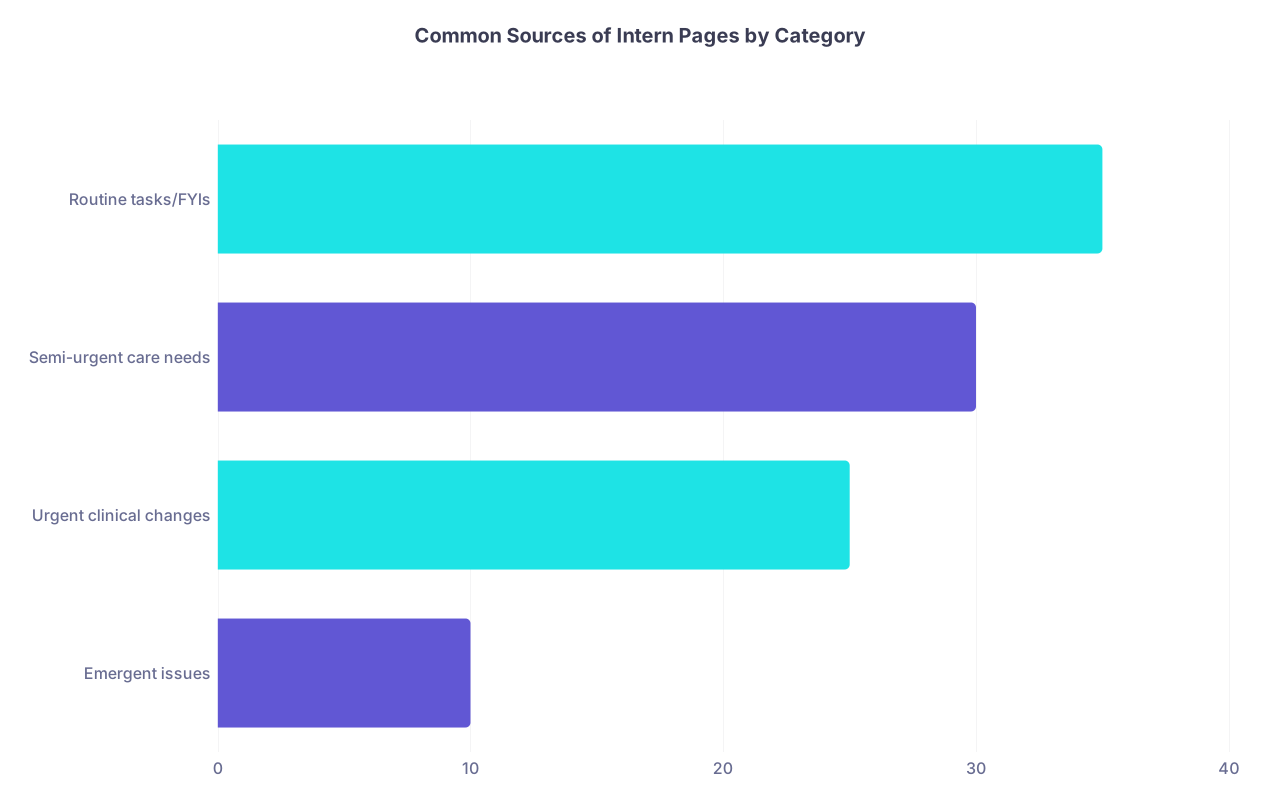
| Category | Value |
|---|---|
| Emergent issues | 10 |
| Urgent clinical changes | 25 |
| Semi-urgent care needs | 30 |
| Routine tasks/FYIs | 35 |
Notice that routine stuff is usually the majority. If you treat all of that as Code Blue, you will burn out.
Night Float Reality: You Can’t Do Everything Instantly
Night float exposes this myth faster than anything.
You might be covering:
- 40–100 patients across multiple floors
- Admits coming in non‑stop
- Cross‑cover pages for everything from chest pain to “patient wants a sandwich”
You cannot answer every page immediately and also:
- Do focused, safe assessments of sick patients
- Admit new patients properly
- Reconcile meds without major errors
So nights force a choice: either you embrace triage and batching, or you pretend you’re omnipotent, get pulled in twelve directions simultaneously, and start making mistakes.
I’ve seen the pattern:
- New intern tries to answer everything right away.
- Gets behind on admits.
- Misses subtle but real deterioration because they’re constantly reacting to noise.
- Leaves work late, exhausted, humiliated.
- Repeats until they either adapt or crash.
The senior who looks “laid‑back” but somehow always shows up fast when it matters? They’re not magical. They’re filtering. Aggressively.
They know which numbers coming from the pager are smoke, and which are fire.
You are allowed to learn that skill. In fact, you must.
When You Actually Should Answer Immediately
Let’s be very clear on the flip side, because some people will use “triage” as cover for neglect.
It is not safe to delay when:
- A nurse explicitly says “STAT,” “come now,” or “I’m very worried.”
- Vital signs show clear instability (hypotension, tachycardia with symptoms, hypoxia, new neuro changes).
- The rapid response team is calling you.
- There’s an airway, seizure, or severe bleeding issue.
- The same nurse has paged you multiple times about a clinical change and you haven’t physically seen the patient yet.
In those cases, you:
- Stop documentation.
- Pause the order you’re entering.
- Go.
If you’re legitimately tied up with another unstable patient, you escalate: call your senior or the covering physician and say, “I cannot leave this patient; someone else needs to see that one now.”
That’s adult medicine. Not heroics. Just prioritization and teamwork.

| Step | Description |
|---|---|
| Step 1 | Pager beeps |
| Step 2 | Read message or caller ID |
| Step 3 | Stop task and respond now |
| Step 4 | Finish current minute of work then call back |
| Step 5 | Batch and handle in 30-60 min |
| Step 6 | Clarify with quick call to re-triage |
| Step 7 | Emergent signs? |
| Step 8 | Urgent change? |
| Step 9 | Routine or FYI? |
Fixing the Story in Your Head
The story you probably absorbed is:
“If I’m a ‘good intern,’ I answer every page instantly or I’m unsafe and unprofessional.”
Replace that with something more accurate:
“A good intern responds quickly to real instability, consistently to urgent issues, and thoughtfully to everything else, while protecting enough attention and energy to think clearly.”
The dangerous behavior is not saying, “I’ll call about the bowel regimen after I finish dealing with this hypotension.” The dangerous behavior is letting fear of being perceived as “unresponsive” push you into a pattern of constant, unfiltered reaction.
Medicine is full of myths that confuse busyness with competence. This is one of the most persistent. You do not become a better doctor by jumping every time the pager squeaks. You become a better doctor by learning when to jump—and when to keep your hands steady.
Years from now, you won’t remember whether you called back in 4 minutes or 14 about a constipation page; you will remember the nights you learned to trust your judgment about what truly could not wait.