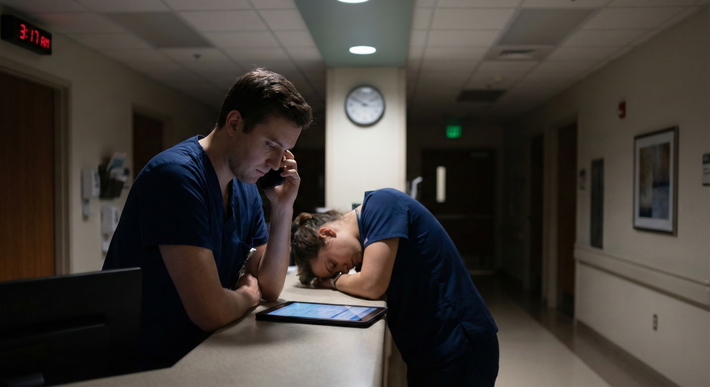
The belief that “more hours make you a better doctor” is mostly wrong—and in some ways, dangerously backwards.
If you’re a first-year intern, you’ve already heard the script: real commitment means staying late, picking up extra shifts, answering every page yourself, being the last one to sign out. The silent threat behind it: if you do not grind yourself down, you will be a worse physician.
Let me be blunt: beyond a certain point, extra hours do not improve your skills. They erode them. The data on this is not subtle.
What actually makes you better is deliberate exposure + rested brains + structured feedback. Not zombie-call weeks where you cannot remember the last patient’s sodium, let alone what you were supposed to learn.
Let’s separate mythology from evidence.
The Origin Story: Why People Still Worship Long Hours
The “more hours = better doctor” myth didn’t come from nowhere. It grew out of three half-true ideas that people stopped questioning.
Repetition builds expertise.
True: you do not become comfortable with chest pain or sepsis by seeing five cases. You need volume.Continuity matters.
Also true: knowing your patient over days instead of hours improves care and judgment.Older generations survived worse.
Your attendings trained under 120+ hour weeks, Q2 call, maybe sleeping on stretchers. Some of them came out excellent. Many also burned out, left clinical medicine early, or quietly carry trauma you never hear about.
Those grains of truth got twisted into a superstition: if we relax hours, residents will be soft, entitled, unprepared. That’s the lazy argument. Convenient for systems that depend on resident labor.
What the data actually shows is more nuanced—and it does not support the “just work more” model.
What We Know From Duty Hour Experiments
We’ve had a live-fire experiment going for 20+ years: duty hour limits.
In the U.S., big changes hit in:
- 2003: 80-hour workweek cap, 24+6 max shifts
- 2011: 16-hour cap for interns (later reversed for some programs)
People predicted disaster. Lower test scores. More errors. Worse doctors.
That never really materialized.
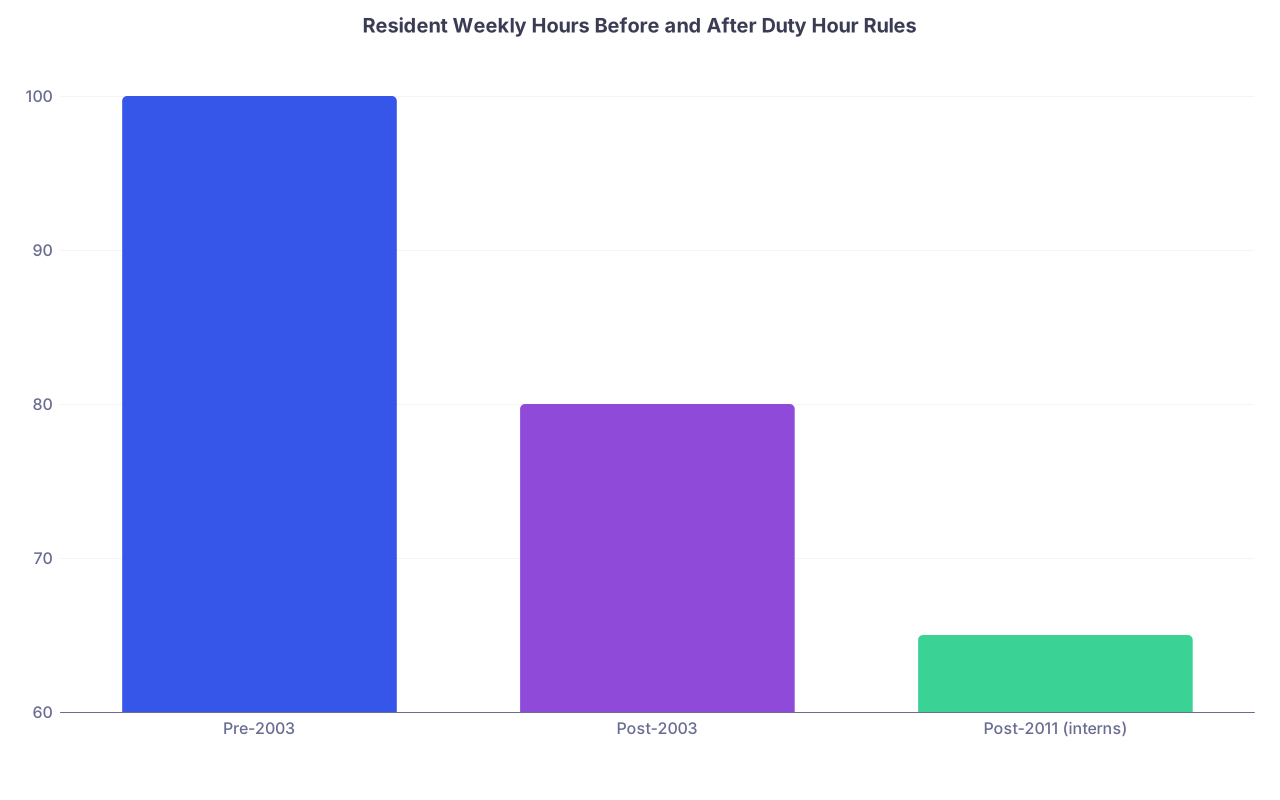
| Category | Value |
|---|---|
| Pre-2003 | 100 |
| Post-2003 | 80 |
| Post-2011 (interns) | 65 |
The real story from the major studies:
1. Patient outcomes did not collapse when hours dropped
Large observational studies looking at mortality before and after 2003 reforms—Medicare data, teaching vs non-teaching hospitals—basically show this:
- No clear worsening in inpatient mortality
- No consistent change in readmissions or major complications
- Some small, mixed benefits in specific conditions or specialties, but nothing like the catastrophe opponents predicted
Patients did not start dying because interns went from 100 hours to 80.
2. The big randomized trials didn’t rescue the “more hours = better” argument
Two key sets of trials are worth knowing:
- FIRST Trial (surgery) – compared standard ACGME rules to more flexible hours (longer shifts, fewer rules on time off)
- iCOMPARE (internal medicine) – similar idea with IM residents
The headline:
- No significant difference in 30-day patient mortality between standard and more flexible (aka longer) schedules.
- No big change in major complications.
But note what did not show up:
- There was no magical improvement in outcomes with more continuous coverage by the same trainee. The “if you just stay longer, your patients do better” claim didn’t pan out at scale.
So from a patient survival standpoint, more hours are not clearly better.
Cognitive Performance: Your Brain Has Hard Limits
Here’s where the “work more = better” idea really starts to crumble.
You can feel this on call: at 3 a.m., your diagnostic creativity is gone. You’re slower. You triple-check every dose because you don’t trust yourself. That’s not weakness. That’s biology.
Sleep science has beaten this to death for decades:
- Being awake for 24 hours puts your cognitive performance roughly on par with a blood alcohol of 0.10% in some tasks. That’s above the legal driving limit.
- Reaction time, working memory, and error detection all tank with sleep deprivation.
- Decision-making shifts toward riskier, more impulsive choices.
In residents, specific studies show:
- More fatigue → more self-reported errors and near-misses
- Extended-duration shifts (24+ hours) → higher risk of serious medical errors, needle sticks, and even car crashes post-call
Let me translate: the belief that your clinical judgment improves as you get more exhausted is nonsense. You might feel more “hardcore.” Objectively, you’re just more likely to screw up.
What About Learning and Competence?
Here’s where program directors get nervous: “But if you work fewer hours, you see fewer patients, so you learn less.”
Valid concern. Bad conclusion.
Exposure volume does matter. But more exposure under cognitive mush doesn’t translate into retained skill.
Think of studying for Step:
Reading 14 hours straight vs 8 good hours with sleep. You “put in more time” in the first scenario, but your recall and test performance are often worse.
Residency learning follows similar rules:
- Sleep-deprived brains consolidate memory poorly. You might see 30 admissions, but a week later you retain… what, exactly?
- Procedural learning (central lines, intubations, LPs) improves with repetition—but quality feedback and mental clarity beat sheer volume done in a fog.
Studies on resident duty hours and board performance:
- No consistent, large drop in board pass rates after duty hour limits
- Some specialties show essentially flat trends
- The “shorter hours are dumbing down training” story does not have strong data behind it
If pure hours were the magic ingredient, we’d expect obvious declines after each reform. That never happened.
Burnout, Depression, and the Cost of “Just Work More”
Here’s the ugly side people like to hand-wave away.
The more we pretend super-long hours create “better doctors,” the more we normalize:
- Depression and suicidality in residents
- Emotional blunting toward patients
- Substance misuse as a coping tool
- People leaving medicine entirely by mid-career
Burnout isn’t just “feeling tired.” It’s associated with:
- More self-reported errors
- Lower patient satisfaction
- Lower adherence to guidelines
- Worse teamwork and communication (which is where many errors actually occur)
If you care about being a better doctor in the long term, torching your mental health for a small, imaginary gain in short-term experience is a losing trade.
The Continuity Myth: “If I Stay, My Patient Is Safer”
There’s a more subtle myth hidden here:
“If I don’t sign out and just stay, my patient gets better care.”
Sometimes that’s true—for specific, high-acuity situations:
- You’ve been managing a crashing ICU patient all day
- You know every dose of pressor and every vent change
- The night covering team is stretched thin
Staying an extra hour to stabilize things? Reasonable.
Staying an extra 6–8 hours regularly because you feel morally obligated? That’s different.
Handoffs do introduce risk, but good systems mitigate that:
- Structured sign-out (I-PASS or similar)
- Clear contingency plans (“If BP drops below X, do Y before calling me”)
- Up-to-date notes and problem lists
The right takeaway from continuity concerns is not “never go home.” It’s “learn to sign out extremely well so patients stay safe when you’re not there.”
Because you will not always be there. Ever. Even as an attending.
Where More Hours Do Help (Within Limits)
Let’s not overcorrect. There are scenarios where extra hours and reps matter.
Early in intern year, being around more does accelerate your comfort with:
- Common cross-cover calls
- Running basic codes
- Interpreting bread-and-butter labs and imaging
Procedural specialties (surgery, IR, anesthesia):
- You really do need high case volumes
- You don’t learn to operate by reading; you learn by being at the table, repeatedly
But here’s the catch: the useful range is finite.
You get massive gains going from:
- 40 hours/week to 60
- 60 to ~70–80 early in training
Beyond that, the returns drop fast while cognitive and emotional costs spike.
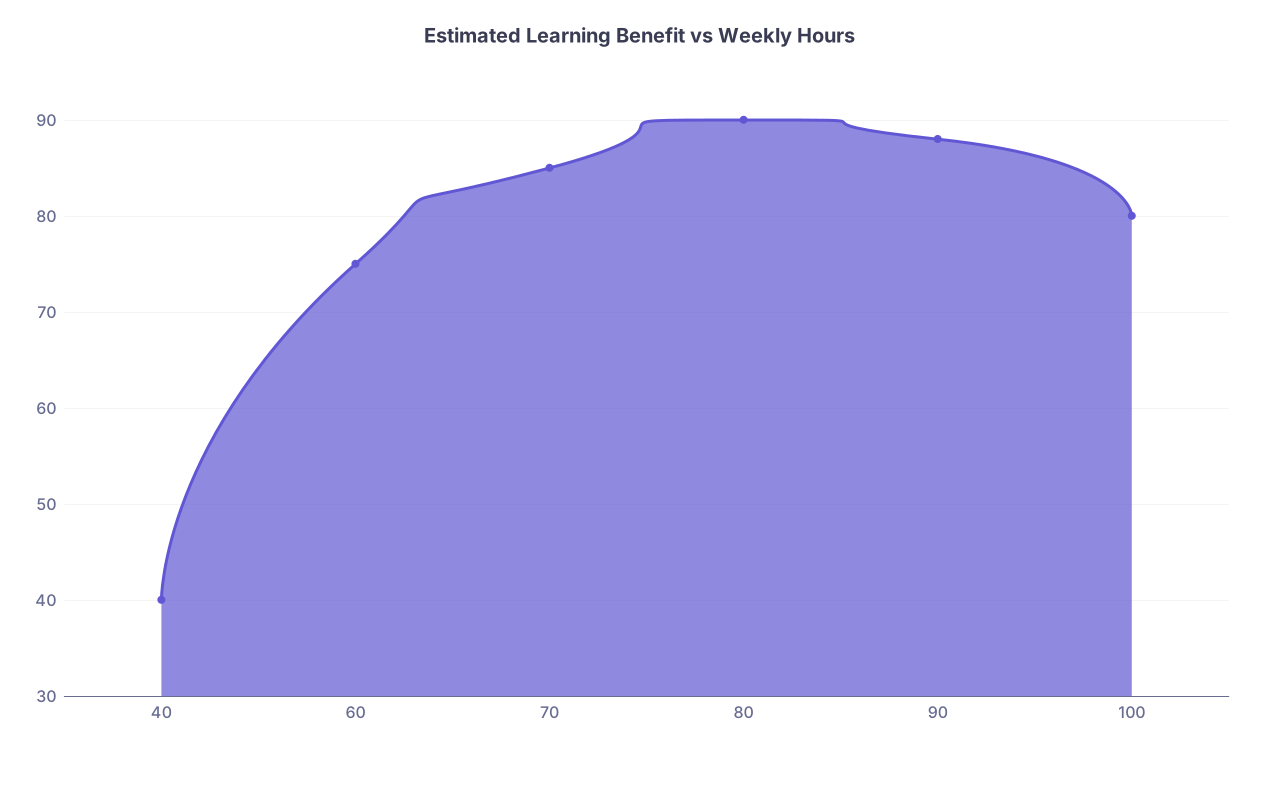
| Category | Value |
|---|---|
| 40 | 40 |
| 60 | 75 |
| 70 | 85 |
| 80 | 90 |
| 90 | 88 |
| 100 | 80 |
(Conceptual, but you get the idea: there’s a plateau and then a decline.)
Excessive hours don’t just fail to add benefit; past a certain point they actively subtract from learning and performance because you’re functioning impaired.
The Hidden Variable: What You Do With Those Hours
Here’s the part almost every “old school vs new school” argument skips: not all hours are equal.
Ask yourself: on a typical 12–16 hour day, how many hours are spent on actual physician learning?
Versus:
- Hunting for a working computer
- Fighting the EMR
- Calling transport
- Tracking down a missing med
- Doing duplicate documentation to satisfy billing
I’ve watched interns stay till 8 p.m. “to learn,” but all they really did was discharge summaries and med rec. Meanwhile, their brains were fried, and they retained nothing from the 3 p.m. teaching on hyponatremia.
You don’t become a better doctor by increasing the number of mindless hours you’re physically in the building.
You get better by maximizing:
- Focused time with patients
- Time watching and debriefing with good seniors/attendings
- Protected time to read about the cases you are actually caring for
- Sleep and recovery so your brain can encode any of that into long-term skill
If your program redesigned the same 70–80 hours to shift the ratio toward meaningful clinical work + teaching + less EMR junk, you’d become better faster without adding a single extra hour.
Practical Reality for Interns: What You Should Actually Do
You can’t unilaterally change ACGME rules. You can’t redesign your hospital’s workflow. But you can stop buying the lie that only martyrdom creates good doctors.
Here’s how to think about it in real life:
Respect the plateau.
Intern year will be heavy; 60–80 hour weeks happen. But once you’re hitting those ranges, obsessing about being there even more “or you’ll fall behind” is magical thinking. Use off time to sleep, recover, and study intentionally, not just exist in the hospital longer.Be ruthless about high-yield learning.
Stay late if:- There’s a unique procedure you may not see again soon
- A complex family meeting where you can learn communication skills
- A senior you actually learn from is doing bedside teaching
Do not stay late to “look dedicated” while you copy-paste problem lists.
Build handoff as a core skill, not a nuisance.
The system requires handoffs. Get very, very good at them. That improves patient safety more than you heroically staying another 4 hours once you’re already exhausted.Track your own performance honestly.
If you notice you’re missing details, forgetting to follow up on labs, or feeling mentally foggy, that’s a sign you’ve crossed from “working hard” into “functionally impaired.” Work with seniors to adjust what you’re holding, not just push through.Know that long-term competence needs longevity.
You’re not training to peak as a PGY3 and crash at 40. You’re building a 30–40 year career. Chronic overwork that destroys your health or makes you hate this job does not produce a “better doctor.” It produces an ex-doctor.
So, Does Working More Hours Make You a Better Doctor?
Short version: up to a point, yes. Beyond that point, no—and eventually the opposite.
The evidence-heavy answer:
- Reducing absurdly long hours did not tank patient outcomes or board scores.
- More hours on their own do not equal more learning—especially when those hours are sleep-deprived, administrative, and poorly structured.
- Fatigue reliably worsens cognitive performance and increases the risk of errors, burnout, and long-term career damage.
If you walk away with anything, let it be this:
- There is a real but limited benefit to high clinical exposure; past that, extra hours are mostly theater.
- Fatigue doesn’t build character; it degrades judgment. Stop glorifying it as a marker of competence.
- Being a better doctor is about how you use your hours—and whether your brain is functioning—not how many times you badge into the hospital in a week.