
The idea that “only weak interns ask for schedule or rotation changes” is not just wrong—it is backwards. In the current residency environment, the people who never question their schedule are often the ones making the worst decisions for themselves and for patient care.
Let’s tear this apart properly.
Where This Myth Comes From (And Why It’s Outdated)
You can basically trace this myth to three sources:
- Old-school “suck it up” culture
- Insecure seniors who equate suffering with strength
- Interns who brag about never asking for help because they think it makes them look hardcore
I have literally heard a chief say: “When I was an intern, I worked 100 hours a week and never switched a call.” That’s not a flex; that’s an OSHA case study.
Residency has changed. Duty hours exist for a reason. Multiple large studies have shown that:
- Fatigue impairs cognitive performance as much as being legally drunk
- Burnout correlates with medical errors, depression, and leaving medicine entirely
- Programs that respect scheduling flexibility have lower burnout and better morale without worse patient outcomes
But the culture lags behind the data. So the myth persists: if you ask for a schedule change, you’re “not committed,” “not resilient,” or “not a team player.”
Let’s look at what actually happens in real programs.
What The Data (And Real Programs) Actually Show
No, there isn’t a randomized controlled trial of “interns who request schedule changes” vs “interns who never do.” But we do have converging evidence from:
- Burnout literature
- Duty hour and fatigue data
- Resident wellness and retention studies
- Program director surveys about what they actually care about
And they all point in the same direction: rigid, fear-based scheduling culture is bad for everyone.
Take burnout and fatigue. Multiple studies (e.g., NEJM, JAMA) show that chronic fatigue and lack of schedule control are strong predictors of burnout scores. Burnout, in turn, correlates with:
- Increased self-reported medical errors
- Higher rates of depression and suicidal ideation among trainees
- More thoughts of leaving medicine or the specialty
So when an intern says, “I’m on q3 28-hour call, my grandmother is dying, and I haven’t had a real day off in three weeks—can we adjust this block?”—that’s not weakness. That’s a protective factor.
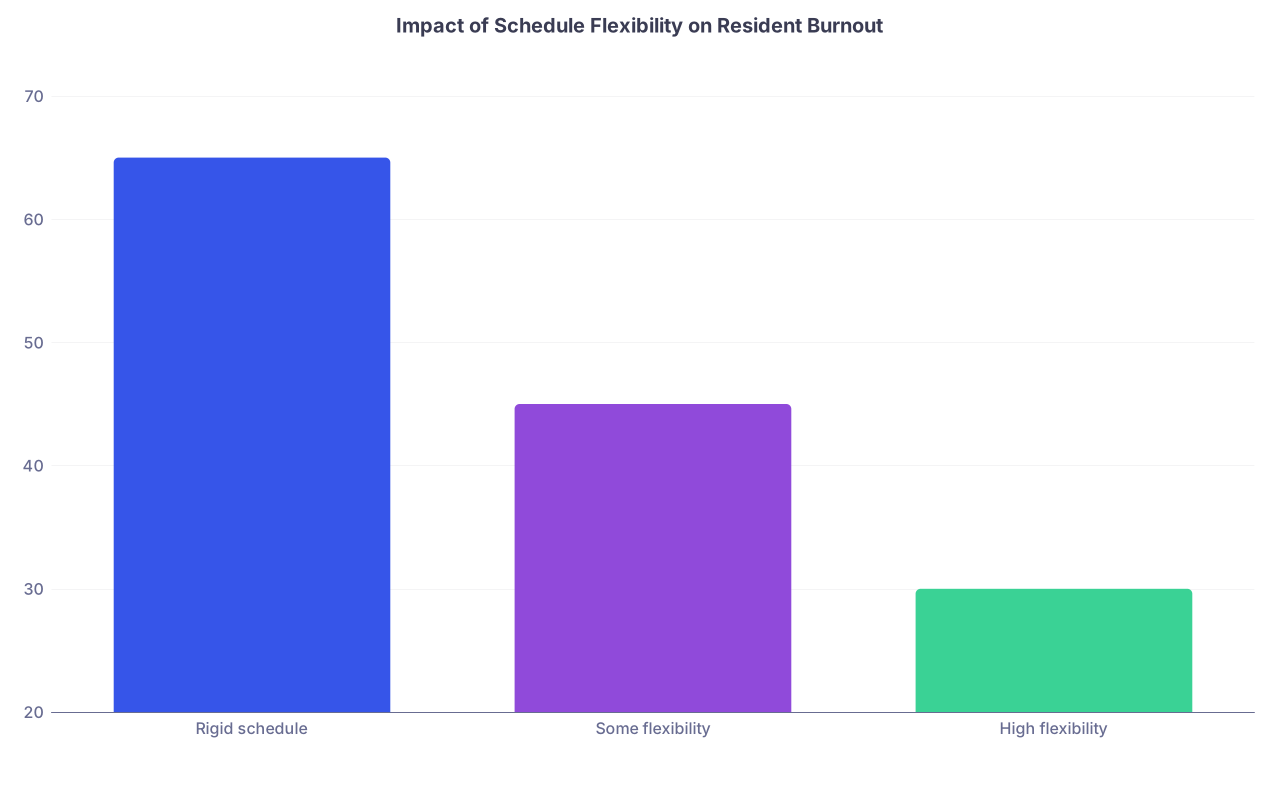
Programs that build in structured flexibility—back-up call pools, coverage systems, and simple processes to swap shifts—consistently report better resident satisfaction without any measurable drop in exam scores or perceived clinical competency.
| Category | Value |
|---|---|
| Rigid schedule | 65 |
| Some flexibility | 45 |
| High flexibility | 30 |
(Percent of residents with high burnout scores in several published studies and wellness surveys; the exact percentages differ, but the pattern is the same.)
The point: control over schedule—even partially—is protective. The “never ask for changes” mentality is not evidence-based. It’s nostalgia dressed up as toughness.
The Real Difference: Chaotic vs Strategic Requests
There is a pattern programs notice. But it’s not “interns who ask for changes are weak.”
It’s this:
- Interns who ask for disorganized, last-minute, poorly justified changes repeatedly cause chaos
- Interns who make targeted, early, well-communicated requests get labeled as mature and reliable
You know who gets in trouble? The person who:
- Tries to switch a call the night before
- Has “a personal thing” every other weekend
- Forgets to confirm coverage and then no one shows up
- Disappears, then emails: “Sorry, family emergency”
You know who quietly earns trust?
- The intern who, in May before starting, says: “I have a major surgery scheduled in October; can we avoid inpatient call that week?”
- The one who helps find their own coverage, confirms it in writing, and alerts the chief early
- The one who also says yes and picks up extra when they can
That’s not weakness. That’s what adult professionals do in every demanding field.
What Program Directors Actually Care About
The myth assumes PDs sit around thinking: “Wow, that intern asked to move a night shift. Weak.” That’s fantasy.
Here’s what most program directors actually track in their heads:
- Are you safe? (Fatigue, impairment, scary judgment calls)
- Do you show up when you’re scheduled—or find coverage if you can’t?
- Do you communicate early and clearly?
- Are you learning what you need for the boards and for independent practice?
- Are you cancerous to culture—or stabilizing?
If you’re the intern who:
- Speaks up when you’re dangerously fatigued
- Requests a change when you know a rotation will conflict with a major life obligation (wedding, serious illness, Step 3, etc.)
- Covers for others sometimes and doesn’t treat every ask like a personal attack
Most PDs will interpret you as: aware of limits, invested in safety, functioning adult.
Here’s the uncomfortable truth: The “I never ask for anything” intern is not inherently more valued. Sometimes they’re just invisible. Or suffering silently until they blow up, crash on a rotation, or quit.
| Intern Pattern | Typical PD Reaction |
|---|---|
| Never asks, always suffers | Neutral to mildly positive |
| Strategic, early, rare requests | Positive, seen as mature |
| Frequent, chaotic last-minute asks | Negative, seen as unreliable |
| Refuses to help others ever | Negative, seen as not a team player |
You want to be in that second row. Not the martyr. Not the chaos agent.
When Asking For Changes Is Actually The Strong Move
Let’s be specific. Here are scenarios where not asking for help or a change is the real liability.
1. You’re dangerously fatigued
Not “tired.” Everyone’s tired. I mean: you’re microsleeping at the computer, rereading orders three times and still not processing, fighting to keep your eyes open on rounds.
That’s when the risk of a real error spikes. The literature is clear: reaction time, working memory, and decision-making tank with sleep deprivation. Same domains you need to not mix up heparin doses or miss new chest pain.
If you’re on your fourth 28-hour call in 9 days and you’re not safe, forcing yourself through because “I don’t want to seem weak” is not noble. It’s negligent.
A strong intern says to the senior:
“I’m honestly at the point where I’m worried I’m going to miss something important. Is there any way we can redistribute some of this?”
That’s not whining. That’s risk management.
2. Major life events with real impact
Everyone has lives. Death in the family. Major surgery. Immigration hearings. Religious holidays that actually matter in your faith tradition. Not theoretical “self-care day” stuff—events that will wreck your focus or functioning if you try to push through.
A weak move: saying nothing, then mentally being somewhere else the entire ICU week, making mistakes, snapping at nurses, crying in the stairwell.
The strong move:
Emailing chief and PD early: “My father is in the ICU out of state and prognosis is poor. I may need time off for end-of-life decisions and the funeral. Can we discuss options that minimize service disruption but allow me to be present for this?”
That’s not entitlement. That’s what sustainable professionals do.
3. Educational gaps that your current sequence will worsen
You’re scheduled for two back-to-back outpatient months at the start of the year and your inpatients skills are trash. Or you’re an IMG with weaker U.S. system exposure, and you know you need inpatient early.
Or the big one: you’re planning to take Step 3 and your most reading-friendly month is currently scheduled after your exam date.
Silently accepting whatever the scheduler gave you “because I don’t want to be difficult” is not strong. It’s passive.
A one-time, well-argued email in June:
“I’m scheduled for back-to-back ambulatory in July/August. Given my background and board timing, would it be possible to swap one ambulatory with a later inpatient month or a lighter rotation before my Step 3 window?”
That’s the behavior of someone treating residency as training, not punishment.
4. Clear, ongoing mismatch with your health/limitations
Chronic illness. Pregnancy with complications. Prior major depression. None of these disappear “because you’re an intern now.”
Working 7 nights in a row with hyperemesis gravidarum is not resilience. It’s cruelty—often self-inflicted because you were afraid to ask for a change.
There’s plenty of published data linking untreated depression and anxiety with higher rates of medical error and leaving training. Programs want you to tell them before you become another statistic.
Again: strength = naming the problem early, working with the system to adjust and still do your job.
How To Ask For Changes Without Getting Labeled A Problem
Here’s the part people actually need: the mechanics. How do you ask without being That Intern?
Rule 1: Early > Perfect
The earlier you bring it up, the more likely you’ll get a yes.
Bad: “Hey chief, I just noticed I’m on nights starting tomorrow and I have my green card interview… can we switch?”
Better: “I just got the date for my immigration appointment—it’s in three months but falls on a call day. Can we look at options now before the schedule locks?”
Rule 2: Be concrete and honest
Vague “I have something personal” every few weeks? People stop trusting you.
Clear and proportionate works better:
- “I’m in therapy for major depression and my psychiatrist strongly advised against back-to-back night float months. Can we spread them out?”
- “My wife is due the first week of October; is there a way to avoid nights that exact week?”
You do not owe every detail, but if it’s a serious ask, give enough context that a normal human would say “Yeah, that’s legitimate.”
Rule 3: Bring solutions, not just problems
“Can you fix this?” creates work for chiefs. “Here’s a proposal that keeps coverage intact” makes you an ally.
A strong message looks like:
I’m on night float the week of my Step 3 date. I spoke with Alex on X team, and he’s preliminarily open to swapping his NF week in November for my week in September if that works for the program. If this is acceptable, I’ll confirm and send an updated schedule.
Now you’re not the needy intern. You’re the one solving for both needs.
Rule 4: Have a give-and-take track record
If you say yes sometimes—picking up a shift, staying late to help a co-intern, swapping to make someone’s wedding—you buy a lot of goodwill.
Interns who only ask and never give? They’re the ones seniors roll their eyes about.
Rule 5: Reserve the “hard asks” for real issues
If you’re trying to flip every other weekend to line up with your partner’s days off, people stop listening quickly.
Use the big guns for:
- Safety
- Serious personal or family events
- Health
- Education/boards
Pick your battles. That’s strategy, not submission.

| Step | Description |
|---|---|
| Step 1 | Need schedule change |
| Step 2 | Consider accepting or casual swap |
| Step 3 | Plan early request |
| Step 4 | Draft clear reason and dates |
| Step 5 | Propose coverage or swap |
| Step 6 | Email chief or scheduler |
| Step 7 | Confirm in writing |
| Step 8 | Clarify constraints and adjust plan |
| Step 9 | Serious impact on safety, health, or key life event |
| Step 10 | Approved? |
When The Culture Really Is Toxic
Let’s be honest: some programs weaponize this myth. They shame any request. They tell residents, “You’re lucky to be here; your life can wait.” They call people “soft” behind closed doors.
That’s not strength culture. That’s dysfunction.
If you’re in a place where:
- Reasonable, rare requests get punished
- Residents are afraid to say they’re unsafe
- People hide pregnancies, illnesses, or deaths in the family because of fear
You’re not dealing with a “tough, elite” program. You’re dealing with a liability factory.
In that situation, you document. You use GME. You loop in mentors outside your direct chain of command. And you plan your exit strategy—fellowship elsewhere, transfer if it’s bad enough.
But do not swallow the line that you are weak for wanting a survivable, sustainable training experience.
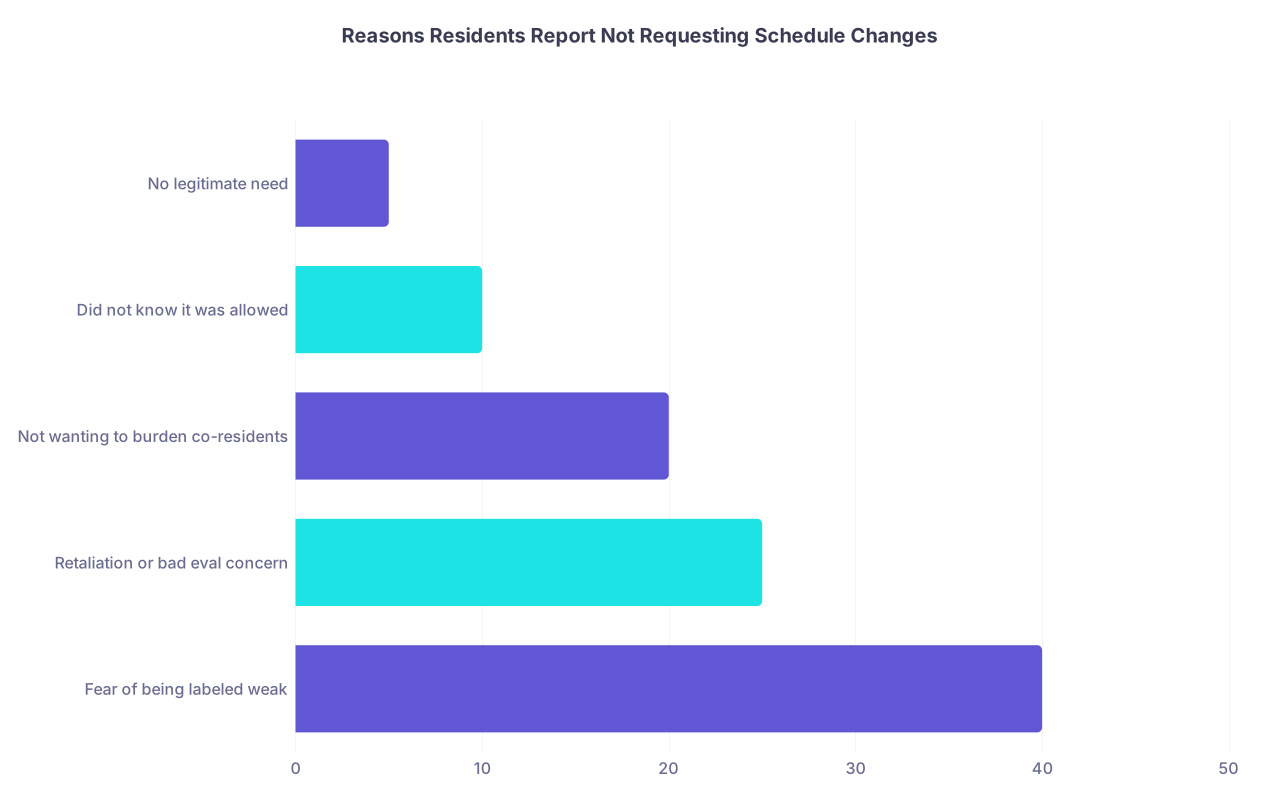
| Category | Value |
|---|---|
| Fear of being labeled weak | 40 |
| Retaliation or bad eval concern | 25 |
| Not wanting to burden co-residents | 20 |
| Did not know it was allowed | 10 |
| No legitimate need | 5 |
Those top three are culture problems, not resident flaws.
Final Reality Check
So let’s kill the myth cleanly.
- Asking for schedule or rotation changes—strategically, rarely, and early—is a sign of judgment, not weakness.
- The interns who reflexively “suck it up” through unsafe fatigue, major crises, and avoidable educational problems are not more committed. They’re just quieter about the damage.
- The real red flag is not that you ask, but how you do it: chaotic, chronic, last-minute demands mark you as unreliable; thoughtful, solution-oriented requests mark you as a professional.
You’re not in boot camp. You’re in training for a career you’re supposed to survive. Treat your schedule like part of that training—not a punishment you passively endure.