
The Real Reason You Keep Getting the Worst Intern Call Schedule
It’s 10:47 p.m. in the call room. You’re post-call tired but too wired to sleep, scrolling through next month’s schedule on Amion or QGenda. Your name is sitting on every other weekend. Nights. Random split days off. While your co-intern somehow has four golden weekends and a cushy holiday off.
You zoom in. Check again. There it is. You’re on Christmas. And New Year’s. And the Sunday before your best friend’s wedding.
And the same thought hits you that hits every intern at some point:
“Why do I always get the worst call schedule? Is this rigged? Do they hate me?”
Let me tell you what actually happens behind the curtain.
I’ve sat in on these scheduling meetings. I’ve listened to chiefs argue over who gets what. I’ve watched attendings glance at a name and say, “They’ll be fine. Put them there.” It’s not random. It’s also not a grand conspiracy.
But there are reasons you keep drawing the short straw. And most interns have no idea what those reasons are.
Let’s walk through them.
How Call Schedules Actually Get Made (Not the Official Story)
On paper, your program might tell you: “We use an automated system to ensure fairness and equal distribution of nights, weekends, and holidays.”
That’s half-true at best.
Here’s the real structure at most programs:
- The skeleton of the schedule is built by a chief resident or scheduling chief.
- They use an online tool (Amion, QGenda, some homegrown Excel monster) to assign required coverage.
- The system can balance total nights, total weekends, and holidays… if someone actually sets the rules and cares enough to enforce them.
- Then the human factor kicks in. That’s where things tilt.
There are a few types of power in these rooms:
- The formal power: chiefs, attendings, program coordinators.
- The subtle power: loud residents, squeaky wheels, “favorites,” and the people everyone is trying not to piss off.
As an intern, you’re usually neither. You have the least leverage and the least visibility. Which is why, unless you’re careful, the schedule tends to tilt onto you, not in your favor.
Let’s break down the unspoken rules that shape where your name ends up.

The Quiet Mistakes That Get You Buried in Calls
Nine times out of ten, the intern with the consistently awful call schedule isn’t cursed. They’re doing a series of small, invisible things that make them very easy to load up.
1. You never submitted your preferences clearly or on time
I’ve watched this scene more times than I can count:
Chief opens the “holiday preference” or “schedule request” spreadsheet.
Half the residents filled it out: details, explanations, ranked preferences.
Then there’s a blank row or a single line like: “No big preferences. Anything is fine.”
Guess whose name absorbs the leftover garbage?
Yours.
Chefs don’t have time to chase down your preferences. If your name is a blank, you get whatever doesn’t fit anyone else.
Here’s how this actually plays when chiefs are tired and on a deadline:
“Okay, we still need someone to cover Thanksgiving and the Sunday after. Who doesn’t have a hard request in? …Alright, them. Drop them there.”
Is that fair? Maybe not. But it is real.
If you didn’t:
- Fill out the request when they asked
- Use clear, assertive language
- Rank your holidays or weekends in a usable way
You signaled, “I’m low-priority. Use me as filler.”
They believe you.
2. You’re “too nice” in all the wrong ways
You know the intern who says this kind of thing on day one:
“Oh, I don’t really care about weekends off. I’m just here to work and learn.”
or
“I’m flexible, I can do whatever, honestly.”
That sentence gets remembered.
Six weeks later, the chiefs are stuck trying to solve a puzzle:
“We’ve got to protect X’s wedding, Y’s childcare, Z’s religious holiday… and we still need someone for these brutal night blocks.”
Someone will say:
“What about [Your Name]? They’re pretty chill about schedule stuff.”
And just like that, your casual “I’m flexible” comment turns into a permanent identity: the intern who doesn’t mind taking the hit.
Being helpful is good. Being a scheduling doormat is not.
3. You didn’t realize who actually controls your fate
Most interns think the program director is controlling their schedule. In reality, your day-to-day fate is in the hands of:
- The chief residents
- The scheduling chief (if separate)
- Occasionally the program coordinator inputting data
Here’s the uncomfortable truth: If you’re invisible to them, you don’t get protected. You get allocated.
I’ve watched chiefs spend an hour trying to protect the holiday of a resident they liked and respected, while casually dropping another intern onto a terrible stretch because “they haven’t said anything, they’ll deal.”
If they:
- Don’t know you
- Only know you as “the quiet one”
- Only see your name when someone complains about your notes or signout
You are not getting schedule favors. You’re getting schedule math.
The residents who get their schedule nudged in their favor aren’t always the smartest or hardest workers. They’re the ones who:
- Made a human connection with the chiefs
- Were clear about what they needed
- Didn’t make the chiefs’ lives harder
You can be outstanding clinically and still get destroyed on the schedule if you never show up on the chiefs’ radar as a real human with real constraints.
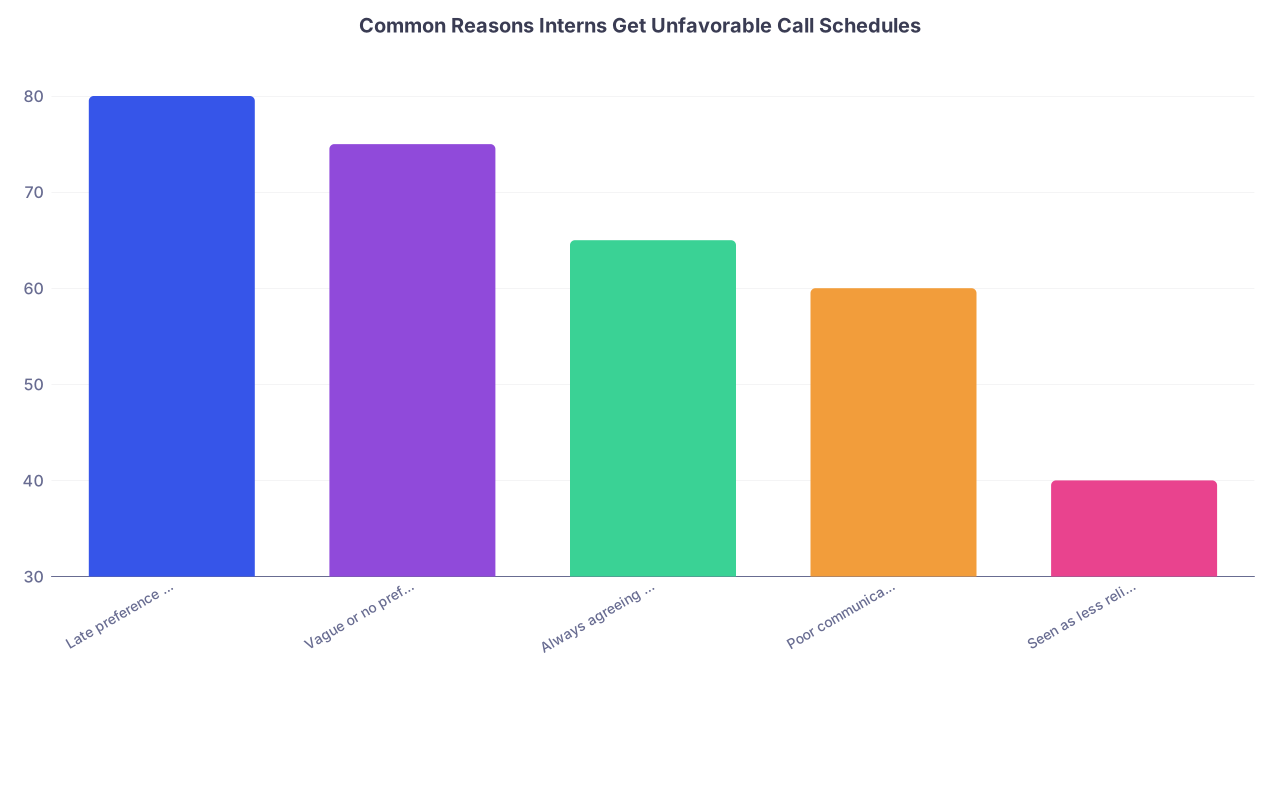
| Category | Value |
|---|---|
| Late preference requests | 80 |
| Vague or no preferences | 75 |
| Always agreeing to switch | 65 |
| Poor communication with chiefs | 60 |
| Seen as less reliable | 40 |
The Reputation Problem You Didn’t Know You Had
Now for the part no one tells you explicitly: your reputation affects your call schedule.
Not the official PGY evaluation. The unofficial hallway reputation that gets tossed around when someone pulls up your name in the scheduling software.
I’ve heard exact phrases like this in scheduling meetings:
“Honestly, they can handle a rough stretch. They’re solid.”
vs.
“I’m not putting them on a heavy weekend. Last time they were on nights, it was a mess.”
vs.
“They never say anything when we move their calls. Use them to plug the gaps.”
Those three sentences create three very different schedules.
4. You’re easy to load because you never push back
If every time someone emails:
“Can anyone switch into this night block? I got stuck with a conflict.”
You’re the first to reply:
“I can take it if needed.”
Or if chiefs say:
“Hey, we had to move you to another call because of X, hope that’s okay.”
And you always reply:
“Totally fine, no worries!”
You’re broadcasting one message: “I’m expandable. I’ll absorb hits.”
I watched one intern do this all year. Went from having a relatively fair starting schedule to being on every random extra night, every weird Sunday, because everyone subconsciously saw them as “the helper.”
By March they were burnt out and resentful. But by then, the pattern was baked in.
5. Someone on leadership quietly doubts your reliability
On the flip side, there’s a darker reason you might be getting the ugliest call stretches: people don’t trust you to handle more nuanced or lighter assignments.
If a chief or attending has clocked you as:
- Frequently late
- Sloppy with notes
- Hard to reach overnight
- Slow to respond to pages
- Unreliable with signout
They sometimes do the opposite of what you’d expect. They stick you into more brute-force shifts (heavy but straightforward coverage) and avoid giving you positions that require autonomy or finesse.
You might not be in the room when these conversations happen, but I’ve heard:
“I don’t want them as the only senior overnight with an unstable census.”
or
“I’d rather pair them with strong co-interns on busy weekends so there’s redundancy.”
Translation: You get stuck on the ugly shifts because people want backup around you, or they don’t want you alone in high-stakes, politically sensitive situations.
The solution for that isn’t a scheduling trick. It’s fixing the underlying performance and communication problems.
| Intern Type | What Chiefs Say | Schedule Impact |
|---|---|---|
| The Rock | "They can handle anything" | More balanced but still heavy; trusted on tough nights |
| The Ghost | "Who is that again?" | Used as filler for leftover nights/weekends |
| The Doormat | "They never complain" | Absorbs random gaps, unfair stretches |
| The Problem | "Last time was rough" | Stuck where damage control is easier |
| The Squeaky Wheel | "They always email about schedule" | Sometimes protected, sometimes avoided for prime slots |
The “Fairness” Myth vs What Actually Feels Fair
Programs love to say, “Everyone has the same number of calls” as if that’s the end of the story.
You already know that’s nonsense.
Five calls on:
- A calm ward month with good seniors
is not the same as five calls on:
- A malignant ICU with an attending who rounds for 6 hours, plus holiday coverage.
Here’s what’s actually being balanced behind the scenes:
- Required coverage slots (nights, weekends, holidays)
- Who must be there (seniors, specific specialties)
- Known hard requests (weddings, pregnancies, visas, major religious holidays)
- Personality and politics
You, as an intern, usually only see the final product. You don’t see that some people:
- Emailed early with clear, non-negotiable events
- Reached out privately to chiefs with context
- Traded strategically instead of reactively
If all you do is look at your schedule the day it drops, get mad, then fire off a vague, emotional email… you’re always going to be behind.
Let me tell you how the people with decent schedules actually play this.

| Step | Description |
|---|---|
| Step 1 | Schedule Draft Created |
| Step 2 | Chiefs consider constraints |
| Step 3 | Used to fill gaps |
| Step 4 | More likely to get protected days |
| Step 5 | Neutral scheduling |
| Step 6 | More nights and bad weekends |
| Step 7 | Small adjustments made |
| Step 8 | Did you submit clear preferences on time |
| Step 9 | Do chiefs know you personally |
| Step 10 | Do you push back professionally |
How to Stop Being the Dumping Ground (Without Being “That Person”)
Here’s what the smart interns do differently. Not the loudest. The smart ones.
6. They treat schedule requests like a professional negotiation, not a wish list
When the chiefs ask for preferences, they don’t write essays. They write useful constraints.
Bad:
“Would really like to have some weekends off in August if possible because I’ve had a hard year and my partner lives far away.”
Better:
“I have a non-movable family event on August 12 and 13. I’m happy to work other weekends in August if needed, but I can’t work those dates.”
Bad:
“I don’t really care which holiday I get off, whatever is fine.”
Better:
“Holiday priorities: 1) Off on Dec 24–25 if possible; 2) If I work Christmas, I’m fine working New Year’s as well; 3) Totally flexible on Thanksgiving.”
You’re signaling you understand their constraints and you’re collaborating, not begging.
Chiefs remember the people who make their job easier, not harder. Those are the names they subconsciously try to avoid screwing over.
7. They follow the “one big ask” rule
You cannot protect every holiday, every weekend, and every random day. If you try to, chiefs tune you out.
The residents who get the most accommodation almost always follow an internal rule:
“I’m going to really push for one big thing and be flexible on the rest.”
Examples:
- Your sibling’s wedding
- USMLE Step 3 date you already paid for
- A major religious holiday that actually matters to you
- A visa/immigration appointment
If every schedule cycle you come with “just one more thing,” you will get quietly deprioritized.
Pick your battle early. Communicate it clearly. Then be seen as easy to work with on everything else.
8. They don’t just complain; they offer swaps that solve problems
Chiefs hate vague complaints like:
“My schedule is horrible. This isn’t fair.”
They love emails like:
“I noticed I’m on three consecutive weekends in August. Would it be possible to swap my August 20–21 weekend with [Co-intern Name]’s August 6–7 weekend? I already spoke to them and they’re okay with it if it works for the service.”
You did three things there:
- You identified a specific problem
- You brought a proposed solution
- You got buy-in from the other person first
That’s how you get changes. Not by arguing about “fairness” in the abstract.

The Traps That Keep You Stuck in Bad Schedules
Some patterns I see interns fall into year after year.
9. You react emotionally instead of strategically
You see the schedule, feel punched in the gut, and your first move is to:
- Vent in the group chat
- Complain to co-residents
- Fire off a long, heated email
Everything you say after that is discounted because you sound like every other overwhelmed intern.
The residents chiefs actually listen to do something different:
- They wait 12–24 hours.
- They write down specifically what’s bad (e.g., “three straight weekends,” “no golden weekend all month,” “holiday plus consecutive nights”).
- They draft a concise email focusing on 1–2 concrete fixes, not everything that sucks.
You can be upset. You just cannot lead with upset if you want anything changed.
10. You always say yes in public and regret it in private
Someone posts in the group chat: “Can anyone switch into my night float? I have this thing that came up.”
Silence. Then you chip in: “If no one else can, I can probably do it.”
Now you’re locked. Backing out looks flaky.
The people who avoid this trap have a simple rule: never commit in the group chat.
Better response:
“Text me directly, I may be able to help depending on dates.”
Then you can:
- Actually look at your full schedule
- Ask what they’re offering in return
- Decide if this is worth it
If you keep rescuing people publicly, you’ll keep getting used. Not maliciously. Just predictably.
11. You’ve already trained everyone to see you as the one who “can handle it”
If you’re competent, fast, and not loud… people will lean on you more. This is the curse of being actually good at your job early.
I’ve seen it with strong interns on ICU and nights. They always get placed on heavy coverage because:
“They won’t drown. And if we put them on a lighter service, someone else will suffer.”
The only way to blunt this is to be deliberate:
- Communicate your limits before you’re broken.
- When asked to take on yet another rough stretch, it’s okay to say, “I can do this one, but I’ll really need a lighter month after — I’m already coming off two heavy rotations.”
That sentence lodges in chiefs’ minds. They may not fix it immediately, but it shapes future decisions.
What to Do Tomorrow Morning
You’re not going to flip your schedule overnight. But you can start shifting how your name gets treated every time someone opens the call matrix.
Tomorrow, do three things:
- Look at the next 3–4 months and identify one or two truly non-negotiable days you need protected. Document them clearly.
- Draft a short, respectful email to the chiefs with specific dates and a collaborative tone, not a vague “my schedule is bad.”
- Decide right now: you’re going to stop being the first person to say yes to every terrible switch. You’ll still help—just strategically, not reflexively.
And over the next few weeks, make sure at least one chief actually knows who you are as a person, not just a name on Amion. That alone changes things more than you’d think.
Because behind the official talk about “equity” and “balanced distribution,” schedules are built by tired humans under pressure, making tradeoffs. If you don’t speak up, plan ahead, and manage your reputation, those tradeoffs will keep landing on you.
You are not cursed. You’re just playing this game with half the rulebook.
Start using the other half.
Key points to remember:
- Chiefs use your behavior and communication as a guide when dumping or protecting bad calls; silence and “I’m flexible” paint you as filler.
- Clear, early, specific requests and proposed solutions get far more traction than emotional complaints about fairness.
- Your informal reputation with leadership quietly shapes your schedule; fix performance gaps, build human connections, and stop automatically taking every bad swap.