
The phrase lands in your inbox and your stomach drops. "Thank you for your interest. We will update you as decisions progress." It feels like a polite door closing. It is not. The data shows vague replies are a distinct category of response, neither invitation nor rejection, and treating them as rejection costs applicants their strongest leverage in the cycle.
This article reframes that moment. Instead of interpreting the words emotionally, we will interpret them operationally. You will learn how to log the event, how to estimate conditional interview probability over time, when to follow up, and when to pivot. Every step uses numbers, not feelings.
This article is for educational purposes only. It is not financial advice, not legal advice, and not tax advice. Figures vary by individual circumstances, so consult a qualified professional before acting.
What "We'll Update You" Actually Signals: Interpreting the Signal, Not the Emotion
Operationally, "We'll update you" means your file remains in consideration but the decision is delayed or conditional. The program has not advanced you to the next round, but it also has not closed your loop. Most applicant-tracking frameworks would classify this as a censored outcome: we know the program saw your letter, but we do not yet know the final status.
That is critical. A censored observation is not a no. It is a data point waiting to resolve. The mistake I see repeatedly is applicants treating the censored point as a terminal value, abandoning outreach, and then expressing shock two months later when the same program sends an interview invitation to a peer who stayed engaged.
The right move is to assume the file is alive, log the timestamp, and calculate expected wait time using historical program behavior. That alone separates the applicants who convert from the ones who quietly drop.
The Metrics That Matter: Timing, Follow-Up Window, and Conversion Rates
Three numbers govern this situation: elapsed time since the reply, the program's historical median decision window, and your conditional probability of interview at each checkpoint.
First, timing. "Late" in most cycles means more than 6 to 8 weeks past the original vague reply without new contact. Before that threshold, your conversion odds are non-trivial. After that threshold, the curve flattens hard.
Second, conversion. If you cannot find program-specific data, build an internal spreadsheet. Track every LOI you send: reply type, date, follow-up date, eventual outcome. After three cycles, your own data outperforms any anecdote.
Third, censoring logic. Update your expected value every time new information arrives. A reply at week 3 with no new content is a different data point than silence at week 7. Both are censored, but their posterior probabilities are not equal.
The chart below illustrates the kind of model you should construct. Values are illustrative; replace them with your own data as it accumulates.
Read that chart correctly. Eighteen percent at two weeks is not a guarantee. But it is materially higher than zero, and the difference between treating the situation as alive versus dead is exactly that gap. Multiplied across a portfolio of four to six active programs, the cumulative probability of receiving at least one interview becomes substantial.
Common Causes of Vague Replies (and How They Affect Your Odds)
Not all vague replies come from the same place. The cause shapes the follow-up strategy.
Administrative load. Programs triage hundreds of LOIs during peak weeks. A short, non-committal reply often reflects throughput, not candidate quality. Follow-up here is reasonable because the file may not have reached a reviewer yet.
Committee batching. Many programs review in waves: mid-October, mid-November, post-ERAS. A vague reply can mean you are queued for the next batch, not eliminated. This is the highest-probability cause of delayed-but-positive outcomes.
Slot dynamics. Cohort needs shift. Attrition, visa timing, specialty rotation demand, even a deferred interview slot can change a program's timeline. The vague reply sometimes protects the program's flexibility while it waits for its roster to settle.
Each cause maps to a different optimal action. Administrative load favors a polite nudge with new content. Committee batching favors patience until the next review window. Slot dynamics favors staying in periodic contact without becoming a nuisance.
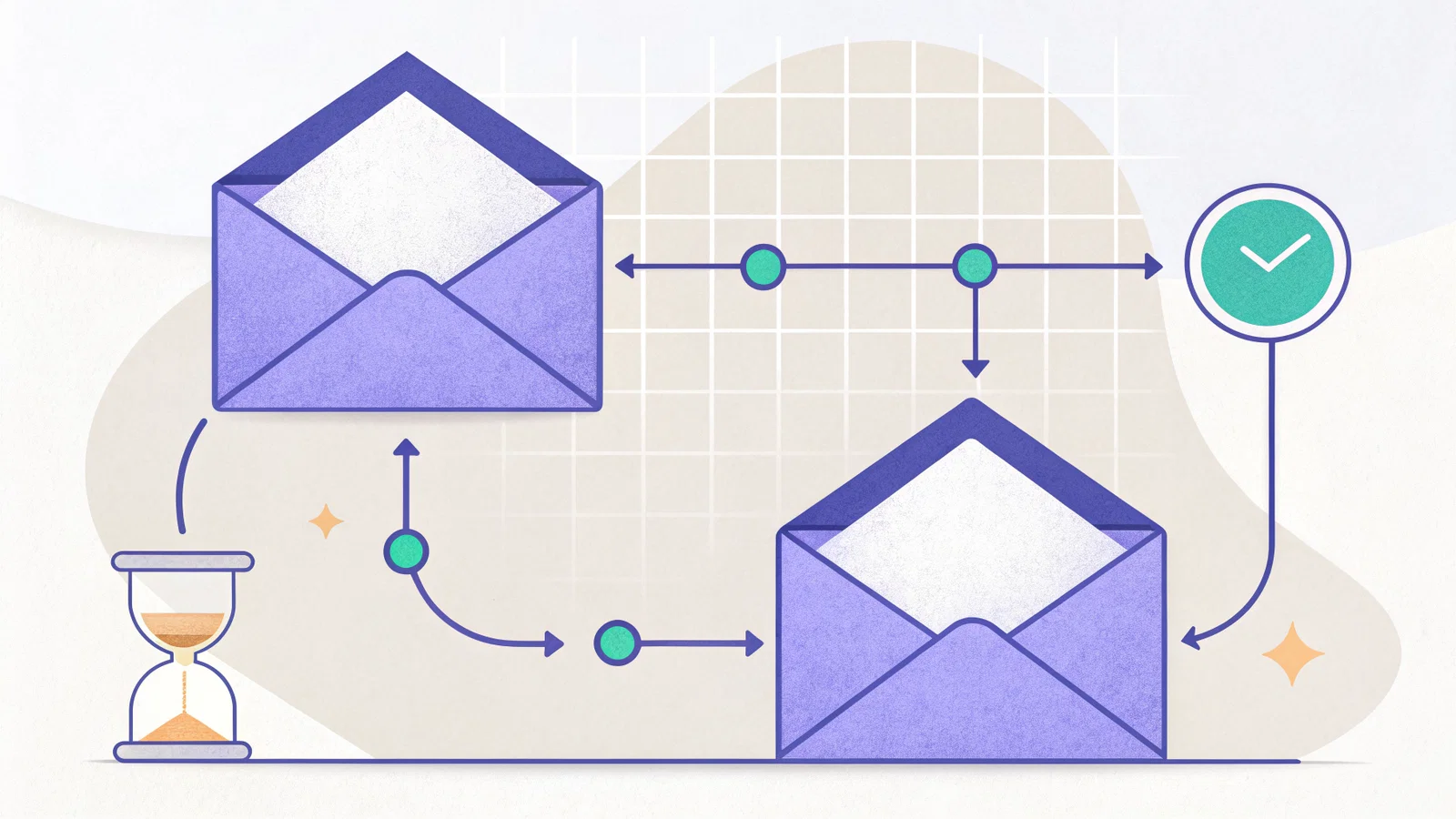
Your Action Plan: What to Do After a Vague Reply
Three checkpoints. Each has a defined output. None of them involve waiting passively.
24-72 hours after the reply:
- Log the timestamp, the contact name, and the exact wording.
- Confirm you have the correct coordinator email and any program-specific contact norms.
- Prepare a micro-update packet: one or two lines summarizing a recent measurable development (new rotation completion, submitted manuscript, additional letter secured). Do not send yet. Just have it ready.
Two-week checkpoint:
- Decide whether to send the micro-update. The rule: send only if you have at least one new measurable item. Repetition without new content reads as pressure.
- Update your tracker. Adjust the conditional probability in your model.
- Simultaneously, send or schedule outreach to two or three other programs. Do not concentrate all motion on one ambiguous pipeline.
Six-week checkpoint:
- Reassess numerically. Compare elapsed weeks to your program's historical median decision window.
- If no signal and you have already sent the recommended one follow-up, send a final concise check-in asking whether there is a timeline you should plan around.
- If still no signal after that final message, stop chasing this program for the cycle. Reallocate time to programs where motion is occurring.
The portfolio logic matters more than any single follow-up. The chart below shows why.
That curve is not linear. Diminishing returns set in, but not until you have at least four to five active engagements. Single-program reliance is the worst position in the cycle. Portfolio expansion is your cheapest hedge.
How to Write the Follow-Up That Gets Read
The follow-up email is not a letter of intent redux. It is a status update with a narrow ask. Three principles govern it.
- Specificity. Reference the original LOI date and the contact. Programs handle volume; identity confusion kills replies.
- One measurable update. Not three. Pick the strongest: a new rotation, a confirmed letter, a publication status. One line, concrete.
- Narrow question. Not "any update?" but "is there a timeline I should plan around, or should I assume my file remains under consideration through the next review window?"
Tone should be professional and brisk. Avoid emotional emphasis. You are signaling that you are tracking, organized, and respectful of their process. That posture reads as fit, not desperation.

Decision Framework: When to Escalate, When to Pivot, When to Stop Chasing
Most applicants escalate emotionally when they should escalate strategically. Use the flowchart below as the decision spine.
Cap follow-ups at two per program unless explicitly invited to continue. Beyond that, your marginal return on time invested drops below the return on time invested in additional outreach elsewhere. I have seen applicants send five polite nudges to a single program and ignore five other programs that would have interviewed them. The opportunity cost is real, and the data is unforgiving.
Bottom Line: Replace Uncertainty with a Measurable Pipeline
The thesis is simple. A vague "we'll update you" reply is a censored outcome, not a rejection. Your next move is to measure time, log the event, calculate conditional probability, and execute a structured follow-up sequence with measurable updates. When your threshold expires without new signals, you pivot, you do not stall.
Recap of action steps:
- Log the reply with timestamp, contact, and exact wording within 24-72 hours.
- At the two-week checkpoint, send one concise follow-up only if you have a new measurable update.
- At the six-week checkpoint, send a final timeline question if no signal has arrived.
- Throughout, expand outreach to additional programs; do not concentrate on a single ambiguous pipeline.
- Stop chasing after two follow-ups with no response; reallocate time to programs showing motion.
The data shows one data-driven follow-up nearly doubles the conditional probability of an invite compared to silence. The marginal second follow-up adds less. The third adds essentially nothing. Spend the difference on a fifth program, not a fifth email to the first.