
What actually happens if you tell a program, “I want to be in your city because my partner already has a job there”? Does that help you… or does it sound clingy and weird?
Let me answer the core question first, then we’ll get into nuance:
You should be specific enough about location that they clearly understand you have a real, grounded reason to stay there, but not so detailed or personal that it feels like oversharing, emotional leverage, or irrelevant to your training.
That’s the balance. Now let’s break down how to actually do that.
1. What Programs Really Want To Know About Your Location Reasons
Programs don’t care that you “like four seasons” or “love the outdoors.” They’ve read that line 400 times this season already.
They care about two things:
- Are you actually likely to come here if we rank you?
- Are you likely to be happy enough here not to flame out, transfer, or be miserable for three years?
Location reasons are just a proxy for commitment and fit. That’s it.
So when you’re writing a letter of intent (LOI) and wondering how specific to be, you’re really answering:
- How convincingly can I signal, “If you rank me, I will come”?
- How reasonably can I show, “I understand what life here is like, and I’m okay with it (or excited about it)”?
Overly vague = they don’t buy it.
Overly personal/intense = they’re a little uncomfortable.
Specific but grounded = ideal.
2. Good vs Bad Specificity: Concrete Examples
Let’s get very practical. Here’s how this plays out in real LOI language.
Weak, generic location reasons (too vague)
- “I love the city and the culture.”
- “I’m drawn to your location because of its diversity and vibrant atmosphere.”
- “I’ve always wanted to live in [big, popular city].”
Programs see that and think: “Cool, you and 10,000 other people.”
That doesn’t differentiate you. It doesn’t scream, “This person is more likely to come here than anywhere else.”
Overly personal or awkward (too much)
- “My partner and I are struggling with long distance and this program would save our relationship.”
- “I have significant family trauma and really need to be close to my parents to cope.”
- “My entire emotional support system is here and I don’t think I could handle being anywhere else.”
Do you feel those are real? Yes.
Should you write them in this form? No.
They make the program feel like they’re responsible for your emotional stability. Programs want residents with support systems, not residents dependent on the program as their only support system.
Strong, appropriately specific reasons (the sweet spot)
- “My partner has a long-term position in [City], and we plan to stay in this area well beyond residency.”
- “My parents live 30 minutes from [Hospital], and I’m looking forward to being able to support them as they age while building my career here.”
- “I attended undergrad in [Region] and have close friends and mentors here. It’s a community I already feel at home in, and I’d be excited to return long-term.”
- “I intend to practice in [Region] after residency, particularly in [urban/rural/suburban] settings similar to your catchment area.”
These do three things well:
- They’re specific (partner job, nearby parents, previous time in region).
- They’re long-term oriented (staying beyond residency, future practice).
- They’re professional (not emotional manipulation or dramatic).
That’s exactly the level of specificity you should aim for.
3. What Types of Location Reasons Are Strongest?
Here’s how programs unconsciously “rank” types of location reasons in terms of credibility and helpfulness.
| Location Reason Type | How Programs Usually See It |
|---|---|
| Spouse/partner has stable job there | Very strong, credible |
| Close family lives nearby | Strong, especially if long-term |
| You trained or studied in that area | Strong, shows familiarity |
| You want to practice in that region | Strong if connected to specifics |
| You like general lifestyle (outdoors, city life) | Mild, easy to ignore |
| Vague “good vibe” / “love the culture” | Weak, boilerplate |
Notice the pattern: anything that suggests long-term, anchored reasons for being in that region is strong. Anything that could apply to 50 cities? Weak.
If you can connect at least one anchored reason (partner job, family, previous life there, or realistic plan to practice there) plus one lifestyle or professional reason (fit with patient population, type of community, etc.), that’s ideal.
4. How Specific Is Too Specific?
Here’s where people screw it up: they think “more detail = more convincing.” Not always.
Use this filter:
Ask: Does this detail help them understand my stability and fit, or just expose unnecessary personal information?
Things that are usually fine to specify:
- “My spouse works as an engineer at [Big Company] in [City].”
- “My parents are in [Suburb Name], about 20 minutes from the hospital.”
- “I went to undergrad at [University] and still have a strong community here.”
Things that are usually too much:
- “My spouse is stuck in a toxic work environment and we need to be here to pay off our debt.”
- “My dad is very ill with [specific diagnosis] and I’m worried about him.”
- “My partner and I are trying to save our relationship and being in the same city is crucial.”
Programs don’t want your entire family medical history, emotional situation, or financial narrative. They’re not your therapist.
General rule: name the relationship + the anchor, not the drama.
So:
- “I have aging parents in [City] I’d like to be close to” → good.
- “My dad’s dementia is progressing and I’m the only child who can help” → too much detail for an LOI.
Keep the fact, skip the backstory.
5. What If I Don’t Have a “Big” Location Reason?
You’re not doomed if you don’t have a spouse, kids, or parents in the area. You just have to be more thoughtful.
You still have three angles that are completely fair game:
Professional alignment with the region
- “I’m interested in working with [immigrant, rural, underserved, inner-city] populations, and your program’s patient population and community partners align very closely with how I see my future practice.”
- “I’m especially drawn to [Midwest/New England/West Coast] because I see myself working in a [urban/rural] setting with similar patient needs.”
Prior ties, even if indirect
- “I spent a summer in [City] doing research at [Institution], and got a sense of both the hospital culture and city life; I’d be excited to return.”
- “I have several close friends from medical school who’ve made [Region] home, and through them I’ve gotten a realistic picture of life here.”
Clear, believable interest in building a life there
- “I’m at a point in my life where I’m ready to put down roots, and I see [Region] as a place where I could build a long-term clinical and academic career.”
Don’t fake massive ties you don’t have. Programs can smell it. But you can still be clear: “I want to build my life here” is a legitimate reason, as long as you sound grounded, not dreamy.
6. How Much of the LOI Should Be About Location?
This is another place people overdo it. The LOI is not a love letter to the city.
Rough proportion that works well:
- Location-specific reasons: ~20–30% of the letter
- Program-specific reasons (training, curriculum, people): ~50–60%
- You-specific reasons (fit, goals, what you bring): ~20–30%
If your entire LOI is basically, “I want to be in [City] so badly,” you sound like you’re applying to the zip code, not the program.
The program needs to believe you’re choosing them, not just their weather, sports team, or airport.
7. Concrete Templates: What to Actually Write
Here’s the kind of specificity that works.
Example 1: Strong family/partner tie
“I’m particularly interested in training in [City] because my partner has a long-term position here, and we’ve built our life in this area. We plan to stay in [Region] after residency, and the opportunity to train at [Program Name] would allow me to grow professionally while remaining rooted in the community we’ve started together.”
Specific, anchored, not melodramatic.
Example 2: Family plus long-term practice goals
“My parents live about 30 minutes from [Hospital], and I’m looking forward to being more present for them as they age. At the same time, I’d like to build my career in [Region], ideally continuing to work with the same [urban/rural/underserved] population that your residents serve. Training at [Program Name] would allow me to do both: stay close to family and develop as a physician in the community where I hope to practice long term.”
Again: stable, practical, believable.
Example 3: No big personal tie, but strong regional interest
“While I don’t have family in [City], I’m intentionally looking to build my career in [Region]. I’m drawn to the mix of [urban academic medicine / community-based care / rural outreach] and the patient population your program serves, which aligns with my long-term goal of working with [specific population]. I can see myself establishing both my professional and personal life here.”
This is honest but still gives them what they want: a sense you’re likely to stay and be happy.
8. Timing and Use: Where Do Location Reasons Go?
Location reasons usually live in one main paragraph of your LOI, not sprinkled all over.
A simple structure that works:
- Open with clear intent: “I’m writing to let you know that [Program] is my top choice and I would be thrilled to train with you.”
- Talk about program fit: curriculum, teaching style, subspecialty exposure, resident culture.
- Then: one focused paragraph on location.
- Close with what you’ll bring and a brief reaffirmation of your interest.
Don’t make the entire letter a geographic argument. That looks shallow.
9. Quick “Specificity” Checklist Before You Send
Ask yourself these questions about your LOI location paragraph:
- Does it reference at least one concrete anchor (family, partner, prior time in region, or future practice there)?
- Does it avoid oversharing details that belong in therapy, not in an LOI?
- Does it clearly connect your desire to be there with stability and long-term presence?
- Does it sound like you’re choosing this program in this place, not just this place?
- Could your paragraph be copy-pasted to five other cities with only names swapped? If yes, it’s too generic.
If you can answer “yes” to the first four and “no” to that last one, you’re probably at the right level of specificity.
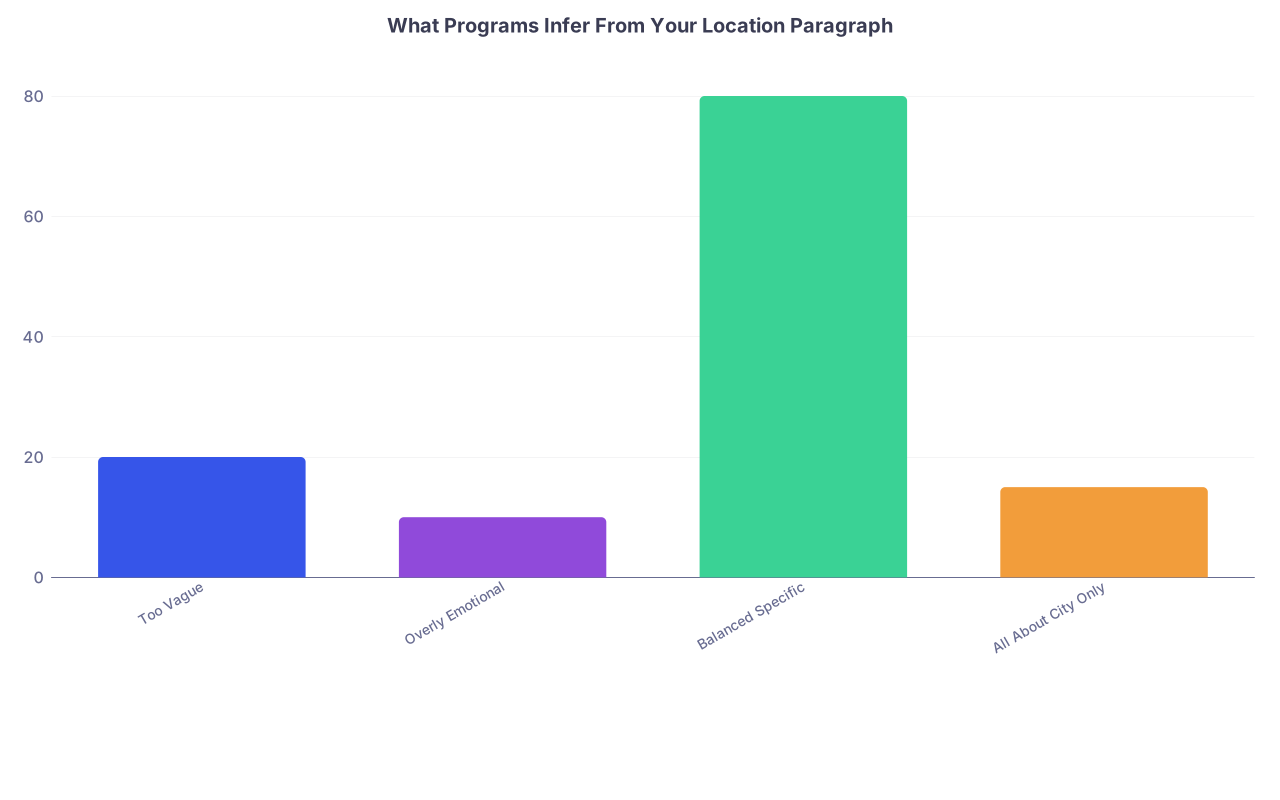
| Category | Value |
|---|---|
| Too Vague | 20 |
| Overly Emotional | 10 |
| Balanced Specific | 80 |
| All About City Only | 15 |

| Step | Description |
|---|---|
| Step 1 | List all your location reasons |
| Step 2 | Consider including |
| Step 3 | Probably omit |
| Step 4 | Refine into 2 3 sentences |
| Step 5 | Add to one location paragraph in LOI |
| Step 6 | Does it show stability or long term tie |
| Step 7 | Is it oversharing or dramatic |

10. The Future Angle: Why Location Will Matter Even More
Since your category is “future of medicine,” let’s be blunt: location-related commitment is only getting more important.
Programs are sick of:
- Residents transferring after PGY1 because they “realized they don’t like the city.”
- Applicants mass-applying nationwide then barely ranking half the places they interview.
- People saying “top choice” to multiple programs with zero real tie.
As virtual interviewing persists and geographic barriers shrink, programs will lean harder on believable signals of commitment. That includes:
- Realistic family/partner anchors
- Clear long-term regional practice goals
- Prior meaningful time in the region
In other words, getting this location paragraph right isn’t fluff. It’s part of how you compete in a world where everyone can technically “apply anywhere.”

FAQ: Location Specificity in LOIs
1. Should I ever name my partner’s employer or just say they work in the city?
You can safely name large, generic employers (“My spouse works at [Tech Company] in [City]”) if you want, but you don’t have to. The key is clarity that they’re anchored there long-term. “My partner has a long-term position in [City] and we plan to stay in the region” is usually enough.
2. Is it okay to say “You are my top choice” partly because of location, not just program features?
Yes. That’s real life. Just don’t make it only about location. Pair it with specific program-based reasons—curriculum, resident culture, subspecialty exposure, mentorship, etc.—so it doesn’t sound like you’d choose any program in that zip code.
3. How do I handle it if I have equally strong location reasons for two different regions?
Pick one program to tell “top choice” in a formal LOI. Everyone else gets “very highly ranked” or similar language. Your location reasons can still be honest in both letters, but that explicit “if offered a position here, I will rank you first” language should go to exactly one program.
4. Should I mention a sick family member as a reason to be near home?
You can reference family needs in broad terms (“I’d like to be close to my aging parents in [City]”), but I wouldn’t go deep into diagnoses or crisis details. You’re aiming to show stability and grounded priorities, not ask for pity or trigger concern about your ability to function.
5. What if my only location reason is ‘I like this city and could see myself living here’?
Then that’s what you say—but you strengthen it by tying it to your professional goals and lifestyle in a realistic way. Talk about the patient population, type of community, and how the region fits the kind of physician you want to be, not just that you like restaurants and parks.
6. Can I reuse the same location paragraph for multiple programs in the same city?
You can reuse the core reasoning (partner job, family, long-term regional plans), but tweak a line or two so the paragraph doesn’t feel copy-pasted. At minimum, make sure program names, hospital references, and any city specifics are accurate and not clearly generic.
7. How long should my location section be in the LOI?
Usually 3–6 sentences. One tight paragraph. Long enough to clearly explain your anchor and long-term interest, short enough that the letter still feels focused on training and fit rather than geography.
Key takeaways:
- Be specific enough about location to show real anchors and long-term commitment, but don’t overshare personal drama.
- Make location one clear, grounded paragraph—anchored in family/partner, prior regional ties, or realistic future practice plans—inside a letter that still mainly focuses on program fit and what you bring.