
The myth that “programs don’t really care if you send multiple letters of intent” is dead wrong. They care. They track. And yes—people get quietly blacklisted over it.
Let me walk you through what actually happens behind the scenes when you try to game the letter of intent game and get caught.
How Programs Really See Letters of Intent
By January, every program director is exhausted. They’ve seen hundreds of personal statements, sat through endless interviews, and listened to the same “I would be honored to train here” line in slightly different fonts.
Then the flood of “letters of intent” and “you’re my number one” emails starts.
Here’s the part most applicants never fully understand: programs treat a genuine, well-timed, exclusive letter of intent as a currency of trust. Not because NRMP enforces it. Because in a crowded field of basically qualified humans, trust matters. A lot.
But here’s the second part: they also treat dishonesty as a quiet disqualifier. Not in an official, documented, “we reported you to NRMP” way. In a simple, off-the-record, “we’re not ranking this person where they think they’re going” way.
The “We Save These” Folder
Most programs have some version of this:
- A shared Outlook folder or Gmail label where all “you are my #1” or “I will rank you to match” emails go.
- A shared spreadsheet or note in their internal ranking database with fields like: “LOI received?” “Said we are #1?” “Strong interest note?”
Pathology, IM, EM, anesthesia, surgery—it doesn’t matter. Someone on the team is tracking these messages. Sometimes it’s the coordinator. Sometimes a chief. Sometimes the PD themselves.
And no, they aren’t dumb. They know most applicants are sending “strong interest” letters to multiple places. That’s not what gets you in trouble.
What gets you quietly burned is sending multiple explicit “I will rank you #1 / you are my top choice / if you rank me, I will match here” letters to different programs—and having them find out.
How Multiple Letters of Intent Actually Get Discovered
You think programs don’t talk. They do. Not every day, not about every applicant. But when your name comes up in the right (wrong) context, it spreads fast.
Here’s how you get exposed.
1. PDs Compare Notes More Than You Think
I’ve watched this happen in real time on PD listservs and at national meetings.
Imagine this scenario:
Program A PD (mid-tier IM) at a regional conference:
“Anyone looking at [Your Name] from [Your Med School]? Strong interview for us. Sent us a letter saying we’re their number one.”
Program B PD (same region, same specialty):
“Wait, they told us the same thing. Literally said ‘you are my number one choice.’”
Program C PD (across the table):
“Hold on. They wrote that to us too. That’s… interesting.”
That’s it. You’re done in that circle.
No drama. No email to you. Just a shared understanding: this person either lies easily or is naïve enough to play games with people who all know each other.
You’ll never hear about this conversation. You’ll just slide on their rank lists.
2. The Coordinator / Chief Resident Network
You’re picturing PDs making all the calls. That’s not how it works.
A lot of the quiet checking happens at the coordinator and chief level:
- Coordinators in the same region talk. Constantly. About no-shows, problem applicants, strange emails.
- Chiefs share screenshots of bizarre or aggressive LOIs in group chats.
- Alumni from your school who are now residents at different programs compare “my school classmates” stories.
If your letter of intent is copy-pasted to five programs, one of them is going to forward it to someone they know. Once two identical letters show up in two inboxes, the trust is gone.
3. The “Matched Elsewhere After Swearing They’d Come Here” Memory
Program directors have a longer memory than you think. They remember the people who said: “If you rank me, I will match here,” and then matched somewhere else obvious.
What do they do? They start checking:
- “Wait, did this person also tell [Other Program] they were #1?”
- “Did their advisor mention they were trying for [Big Name Program] at the same time?”
And the answer is often yes. And those stories get told next cycle: “Last year we had someone from [School] lie to multiple programs. Watch out for that.”
This is how an entire class or school quietly gets a reputation.
What “Blacklisted Quietly” Really Looks Like
Let’s get clear about what I mean by “blacklisted,” because there’s a lot of drama and not a lot of precision in how applicants talk about this.
Programs are not building some formal shared blacklist document where your photo has a red X across it.
Here’s what actually happens.
1. You Lose the Tie-Breakers
In the final ranking meetings, there are dozens of “either/or” situations.
Two similar applicants:
- Same STEP scores.
- Similar grades.
- Both interviewed well.
- Both would be fine residents.
One of them sent a thoughtful, consistent letter of intent that made sense with their application and their geography.
The other is the one they now know sent multiple “you are my number one” messages around, or clearly played both sides.
Who do you think loses every time?
They don’t need to move you from #20 to “Do Not Rank.” They just need to slide you from #20 to #45. In some specialties, that’s the difference between matching and scrambling into a prelim year.
2. You Trigger the Quiet “Do Not Trust” Flag
I’ve literally sat in ranking meetings where someone said, “I don’t trust this one,” and the room just… nodded. No further debate.
Once someone says:
- “They told us we were their top choice, but they were also clearly shopping elsewhere.”
- “This is the third person from [School] in two years who’s played that game.”
You’re done. Nobody wastes energy defending a maybe-resident with a trust issue when there are plenty of decent alternatives.
3. You Become a Story for Future Years
Residency leadership turns your decision into institutional memory.
Future script, two years later:
“We had an applicant a couple cycles back who promised us we were their #1 and then played the same card at multiple places. We still matched fine, but I do not take LOIs at face value from that school anymore.”
Now it’s not just you. It’s the student two classes below you who never even met you, who now starts at a small disadvantage they’ll never know about.
The Dirty Secret: Programs Game Letters Too
Let’s be honest. Programs play games with this stuff as well.
You aren’t the only one stretching the truth. I know PDs who do all of the following:
- Send “very strong interest” language to multiple applicants they have no intention of ranking near the top.
- Say “we will rank you highly” while knowing full well that “highly” means “somewhere in the middle where we’ll never actually get to you.”
- Use vague but flattering language in replies just to keep you emotionally attached to their program.
So yes, there’s hypocrisy here. But here’s the catch: they hold the power.
They’re not the ones who get burned for the dishonesty. You are.
This is why your strategy has to be smarter and cleaner than theirs. Not more manipulative.
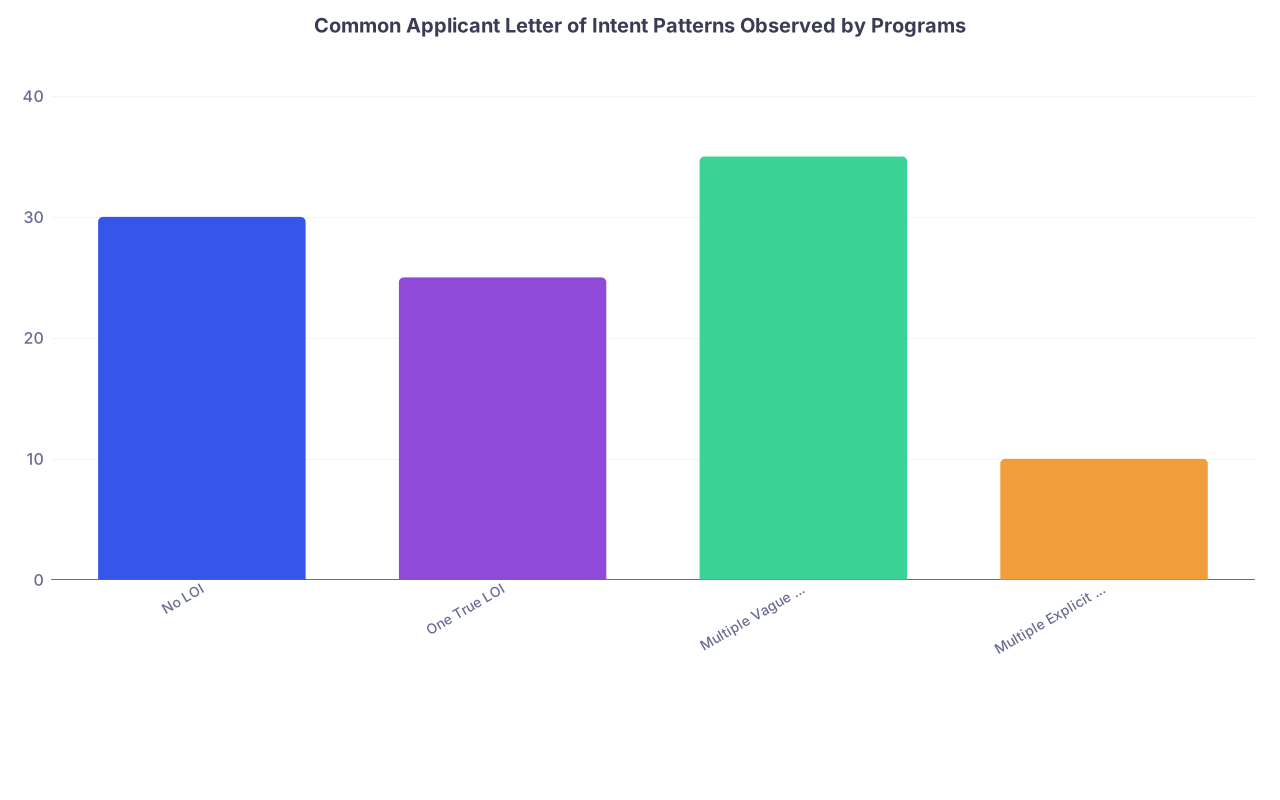
| Category | Value |
|---|---|
| No LOI | 30 |
| One True LOI | 25 |
| Multiple Vague LOIs | 35 |
| Multiple Explicit #1 LOIs | 10 |
The group that quietly suffers the most? That last 10%. The ones who swear exclusivity in too many directions.
What a “Safe” Letter of Intent Actually Looks Like
You want the insider template? Fine. Here’s the truth: the key is to be specific, enthusiastic, and honest—without making commitments you’re not ready to keep.
The Safe But Strong Structure
A strong, non-self-destructive LOI usually has:
A clear statement of genuine interest.
“After the interview day and further reflection, I can confidently say your program is one of my top choices.”Specific program-based reasons.
Concrete. Real. Not just “great teaching and collegial environment.”A realistic, honest line about your rank list.
“I plan to rank your program very highly.”
That’s it. That language is powerful, and you can send that to multiple programs without burning yourself.
What crosses the line?
- “You are my number one choice.” (If that isn’t literally true and exclusive.)
- “If you rank me, I will match here.” (You have no control over that.)
- “I will be coming to your program next year.” (Unless you’ve already matched SOAP prelim and this is a PGY2 letter, no.)
When It’s Appropriate to Say “You Are My #1”
You should only say “you are my number one choice” to exactly one program, after you’ve built your rank list and are ready to die on that hill.
Meaning:
- You’ve looked at your list.
- You’ve accepted that if your #1 actually ranks you low, you might slide to #2 or #3.
- You are still okay committing emotionally and ethically to that #1.
And then yes—send one, and only one, explicit “you’re my top choice” letter.
If you’re not ready to do that, don’t play with that language at all. Use “rank you highly” or “one of my top choices” and sleep better at night.
How Timing Changes the Impact of Your LOI
Letters sent too early or too late do different kinds of damage.
Too Early: Before They’ve Even Finalized Their Impressions
If you fire off a “you’re my #1” email the day after the interview in November, you look impulsive. A little desperate. And the PD knows one of two things will happen:
- You’ll send five more of these to other programs once your anxiety kicks in.
- You’ll change your mind but never retract it.
They don’t take those early November “I will rank you #1” messages seriously. Usually they just file them away for later amusement.
The Sweet Spot
Most PDs start building serious rank lists in late January to mid-February.
That’s the window where:
- Your letter might actually get read thoughtfully.
- It might bump you a few spots higher in the “which of these similar applicants do we favor?” tier.
- They still remember you from the interview.
A well-timed, truthful, specific note here can help. It won’t take you from “we hated them” to “we must get them.” But it can definitely move you from mid-pack to safely match territory.
Too Late
That email sent 3 days before rank list certification?
They see it. Many don’t bother replying. Some forward it to chiefs with “lol too late.”
They’re simply not going to re-open the entire rank meeting and renegotiate your position for a last-minute emotional email. That’s fantasy stuff applicants tell themselves at 1 AM.

| Step | Description |
|---|---|
| Step 1 | Interview Completed |
| Step 2 | November LOI |
| Step 3 | January LOI |
| Step 4 | Late February LOI |
| Step 5 | Seen as anxious or premature |
| Step 6 | Max realistic impact |
| Step 7 | Minimal to no impact |
How This Plays Out in Real Life: A Few Composite Stories
These are composites—based on patterns I’ve watched across years, not one isolated drama.
Case 1: The Overconfident Applicant
- Mid-tier US MD, Step scores solid, strong research.
- Applies to a very competitive specialty.
- Sends “You are my #1” letters to three programs in the same geographic region, all of which talk regularly.
Result:
- One PD forwards the email saying, “We got this, thought you should know.”
- The others confirm: same exact line, same timestamp range, same student.
- All three programs keep the applicant on the list—but drop him just enough that he falls out of realistic match range at each.
He matches, but lower than he expected, and is confused. On paper, he “should have” matched higher.
He never finds out those three PDs quietly took a step back.
Case 2: The Naïve Dual-Interest Applicant
- Applicant is torn between two specialties: IM and Neurology.
- Sends “You are my top choice and I can see myself building my entire career here” to an IM program.
- Sends essentially the same emotional narrative to a Neuro program in the same hospital system.
Result:
- Department chairs talk.
“He told us neuro is his life.”
“Funny, he said IM was his dream calling.” - Neither program wants to be the backup choice in a high-maintenance story.
- Both rank the applicant, but not favorably.
They match somewhere else in a different city, still wondering why neither of those “dream” programs came through.
Case 3: The Copy-Paste Disaster
- Applicant creates a strong letter for Program X.
- Copy-pastes it and just changes the program name for Program Y.
- Forgets to change one small detail: a faculty name, a track name, or a phrase like “since I have family in [City X]” when Program Y is in a different state.
Program Y coordinator sees it and sends it straight to the PD: “Look at this.”
Now you’re not just dishonest. You’re careless. That’s almost worse. Because residency is mostly about reliability.
You’re not getting a benefit of the doubt after that.
The Future: Programs Are Getting More Sophisticated About This
The game is shifting, slowly.
More programs are:
- Building structured ways to log LOIs (fields in Thalamus, ERAS notes, internal sheets).
- Paying attention to patterns by school or advisor.
- Getting more cynical about explicit “you are my #1” language.
And with email search, Slack, Teams, and institutional memory, your words are far more durable than you think. The days of “I’ll just tell everyone what they want to hear and nobody will cross-check me” are over.
What still works—and will keep working—is consistency.
Your application narrative.
Your interview story.
Your LOI language.
All pointing in the same direction, even if you’re still anxious and unsure inside.
That consistency is how you stay off the quiet blacklist.
| Phrasing Type | Risk Level | Can Send to Multiple Programs? |
|---|---|---|
| No LOI | Low | N/A |
| "Very strong interest" | Low | Yes |
| "One of my top choices" | Moderate | Yes, if honest |
| "I will rank you very highly" | Moderate | Yes, but limit it |
| "You are my number one choice" | High | No – only one program |
How To Use LOIs Without Screwing Yourself
If you want a clean, insider-approved framework, use this:
- Decide if you have a true #1. If yes, send one explicit LOI to that program only, with “you are my top choice” language. Be prepared to stand by it.
- For your realistic top 3–6, send sincere, specific “rank you highly / one of my top choices” letters if you genuinely mean it.
- For everywhere else, if you send anything, keep it simple: a short thank you, one or two specifics, no rank language.
- Never copy-paste full letters without editing for specific details. The minute two programs see the same paragraph, you’re marked.
And then—you stop. You don’t chase every doubt with another email.
There is a point where another LOI doesn’t help you. It just increases your risk of saying something you cannot back up.
Years from now, you won’t remember the exact words you put into some letter of intent. You will remember whether you handled this process with a spine—clear, consistent, and honest in a system that quietly punishes people who try to out-manipulate it.
Use LOIs as a scalpel, not a shotgun. Programs are watching more closely than you think.