
If You Had a Poor Interview Day: Framing It in a Thoughtful LOI
Did you walk out of what should have been a dream interview day thinking, “I just tanked my shot at this program—now what?”
You are not the first person to feel sick in the parking lot after an interview. I’ve seen people do great all season and then absolutely fumble one key day: awkward Zoom lag, a bad answer about red flags, tears when something personal came up, or just flat affect because they were on post-call. Then two weeks later they’re asking:
“Can I fix this with a letter of intent?”
Short answer: maybe not fix, but you can absolutely re-frame. And if you are going to send a LOI after a poor interview day, you cannot send some generic “Thank you for the opportunity, you’re my top choice” fluff. That will not help you. It might even hurt.
Let’s build what you actually need: a targeted, honest, strategically framed letter that acknowledges what needs acknowledging, highlights what they didn’t see, and leaves them thinking, “That interview might not have been their best, but this applicant is the real deal.”
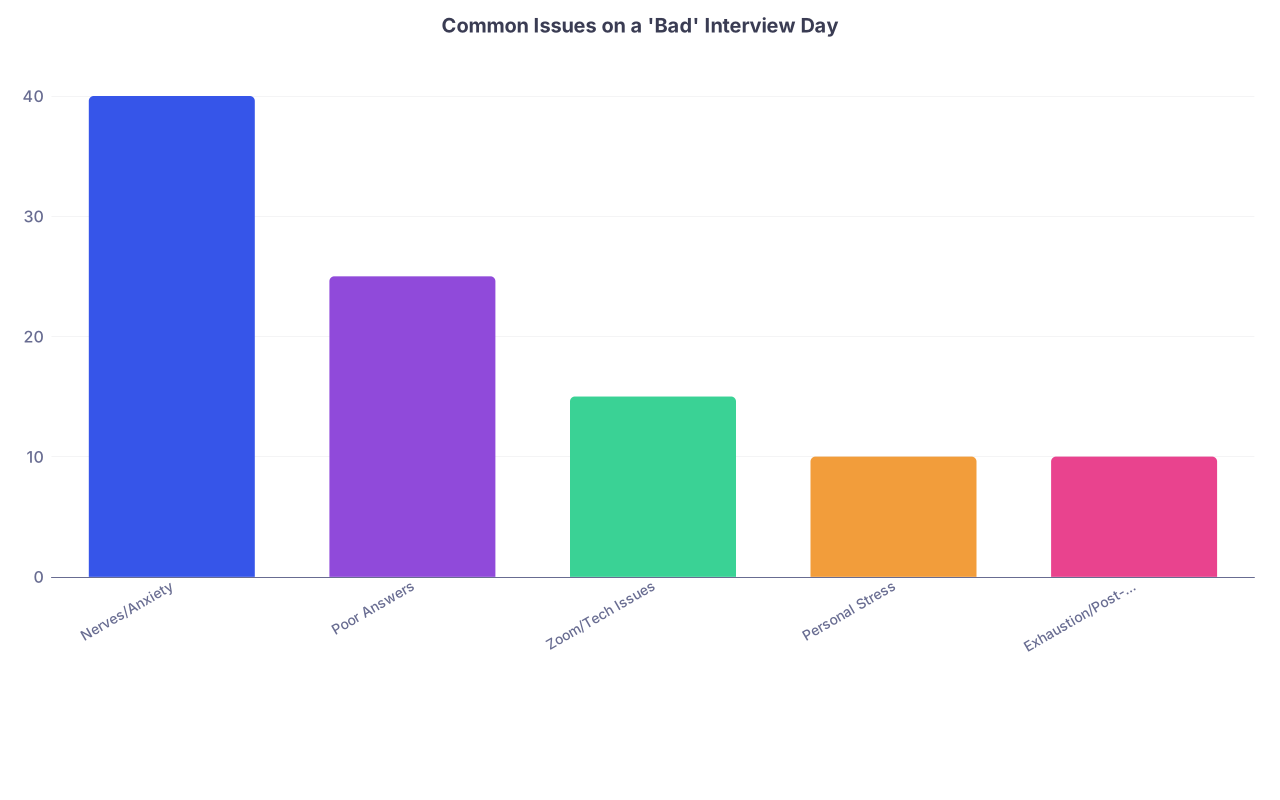
| Category | Value |
|---|---|
| Nerves/Anxiety | 40 |
| Poor Answers | 25 |
| Zoom/Tech Issues | 15 |
| Personal Stress | 10 |
| Exhaustion/Post-call | 10 |
Step 1: Be brutally honest about what went wrong
Before you write anything, you need to name exactly what sucked about that day. Vague guilt doesn’t help.
Common patterns I’ve seen:
- You froze on a core question: “Why this program?” “Tell me about a time you failed.” “Why this specialty?”
- You came across low-energy, distracted, or disinterested (often because you were sick, post-call, or coming off a personal crisis).
- You got defensive about your red flags (failed exam, leave of absence, poor eval).
- You rambled, went off on tangents, or never gave a concrete story.
- You had visible tech issues on Zoom—frozen video, bad audio, dropped connection—and the whole thing just felt disjointed.
You cannot fix all of that with a letter. But you can decide which part is worth addressing, and which part you should leave alone.
As a rule:
- If it was visible and clearly affected the conversation (you cried, your Wi-Fi died, you mentioned a big life event), you can gently contextualize it.
- If it was content-based (you gave a weak answer, forgot to mention a key experience, or didn’t explain a red flag well), you can clarify, but you have to be concise and non-defensive.
- If it was just nerves but not overtly disruptive, don’t write a whole confession about anxiety. They interview nervous people all day. That’s not unique.
Write down, for yourself, in one or two sentences:
“What I think they walked away thinking about me that isn’t the full truth.”
Example:
- “They probably think I’m not that interested because my answers about their program were generic.”
- “They probably think I’m emotionally fragile because I got teary when discussing my family illness.”
- “They might think I’m not great at communication because my answers were disorganized and my Zoom audio cut in and out.”
That sentence is the core of what your LOI needs to quietly counter.
Step 2: Decide if a LOI is actually the right move
Not every bad interview deserves a letter of intent. Sometimes you had a rough but average day. That’s not what we’re talking about.
A LOI makes sense if:
- This program is truly top-3, preferably top-1, for you.
- You could realistically see yourself there and thrive.
- You had at least some positive interactions (with residents, PD, chair, coordinator) that you can reference specifically.
- You didn’t behave in a way that crossed a professional line (inappropriate comments, lateness without apology, clear disrespect). A LOI doesn’t erase serious professionalism issues; that’s a different problem.
Do not send a LOI to:
- Every place where you feel you underperformed. That looks desperate and insincere.
- A program you would not actually rank highly just to “save face.”
- A place where your main issue was fundamental mismatch (“I actually don’t like your patient population or call schedule”). A LOI can’t fix misalignment.
If this is a program you’d honestly rank in your top couple spots and you feel your interview didn’t reflect your true fit—then yes, a thoughtfully constructed LOI can be useful.

| Step | Description |
|---|---|
| Step 1 | Bad Interview Day |
| Step 2 | Do Not Send LOI |
| Step 3 | Consider Direct Apology Email Instead |
| Step 4 | Standard Thank You Only |
| Step 5 | Send Targeted LOI |
| Step 6 | Program is Top Choice? |
| Step 7 | Any Professionalism Breach? |
| Step 8 | Specific Things To Clarify or Highlight? |
Step 3: Core principles for framing a “bad-interview” LOI
You are trying to do three things:
- Reaffirm genuine interest in the program.
- Quietly repair or contextualize what went wrong.
- Showcase strengths and fit that did not fully come across that day.
You are not writing:
- A therapy letter about how anxious you were.
- A scripted apology for every awkward answer.
- A multi-page personal statement 2.0.
Think of it as: “If I had 5 calm, collected minutes with the PD after the season, what would I say?”
A good LOI after a poor interview day has this vibe:
- Grounded, not dramatic.
- Specific, not generic.
- Forward-looking, not stuck replaying the disaster.
Step 4: Structure of a thoughtful LOI after a poor day
Use this as a skeleton. Then we’ll walk through versions depending on your situation.
1. Header and basics
Standard formal letter. No need to be cute.
- Date
- Program Director name and title
- Program name and institution
- “Dear Dr. ___ and the [Specialty] Residency Selection Committee,”
Keep it simple and professional.
2. Opening: Clear loyalty statement + brief gratitude
You do not need three paragraphs of flattery. But you do need to be unambiguous.
Examples:
- “I am writing to express my strong interest in the [X] Residency Program at [Institution] and to state clearly that your program is my top choice for residency training.”
Or, if you aren’t ready to go “top choice” but it’s truly near the top:
- “I am writing to express my strong interest in the [X] Residency Program at [Institution]. After reflecting on my interview day and learning more about your program, I anticipate ranking [Institution] among my very top choices.”
Then one line of genuine gratitude:
- “Thank you again for the opportunity to interview and to speak with Dr. [Name] and the residents about the program.”
Stop there. Don’t describe the weather. Don’t recap the itinerary.

3. Addressing the “off” interview day (only if truly needed)
This is the landmine section. Overdo it and you look unstable. Ignore it when it was clearly an issue and you look oblivious.
Here’s how to do it well:
Keep it to 2–4 sentences. No oversharing. No excuses. Context + reassurance.
Example: emotional / distracted
“On a personal note, I left interview day feeling that I had not fully represented myself. A recent family health issue was weighing heavily on me that week, and I recognize that I came across more reserved and less focused than is typical for me clinically and academically. My current supervisors at [Hospital] would describe me as reliable, steady under pressure, and strongly team-oriented, and I hope my application materials and letters reflect that more accurately than my demeanor did that day.”
Example: tech issues / disjointed Zoom
“I am also aware that the technical issues during our virtual interview limited how smoothly I was able to communicate. I appreciate your patience with the audio and connection problems, and I regret that this may have made my responses seem less organized than they are in my day-to-day work with patients and teams.”
Example: weak red-flag explanation
“After reflecting on our conversation, I am concerned that I did not clearly explain the context around my leave of absence. I took that time to address a health issue that is now fully resolved, and I have since completed my clinical rotations without interruption, with strong evaluations. I am confident I can sustain the rigor of your residency schedule.”
You are doing three things there:
- Acknowledging reality without dramatizing it.
- Providing just enough context.
- Explicitly contrasting how you appeared that day with how you function in real life.
Do not:
- List every mistake (“I know I rambled on the X question and forgot to mention Y and probably sounded dismissive about Z…”).
- Over-apologize (“I am deeply sorry, I was devastated, I could not sleep…”).
- Turn it into a medical note about your mental health.
You’re not trying to win pity. You’re trying to restore an accurate picture.
Step 5: Re-build your case: fit, specifics, and value
Once you’ve addressed the elephant (if needed), you pivot hard to: Why you belong there and what they get if they rank you.
Concrete, program-specific. No generic stuff like “strong clinical training” and “diverse patient population” unless you tie it to you.
Structure this part with:
- One paragraph: Why this program – specific elements that matter to you.
- One paragraph: What you bring – strengths that didn’t fully come through that day.
- Optional short paragraph: Any updates since the interview.
“Why this program” – real details
Bad:
“I was impressed by your diverse patient population and supportive learning environment.”
Better:
“I remain especially drawn to [Institution] because of the combination of high-acuity training at [Hospital Name] and the strong outpatient experience at [Clinic Name]. Speaking with Dr. [Faculty] about your X curriculum and with the residents about the night float system confirmed that this is the type of rigorous but supportive environment in which I thrive. The program’s emphasis on [specific track – global health, QI, med-ed, etc.] aligns directly with my long-term goal of [concrete plan].”
The test: Could you drop this paragraph into another program’s LOI unchanged? If yes, it’s too generic.
“What I bring” – correct the impression
This is where you quietly contradict whatever “off” impression you think they got.
If you seemed flat/withdrawn:
“I realize our brief conversation may not have fully conveyed my energy and commitment on the wards. My current residents and attendings often comment on my reliability, follow-through, and calmness on busy call nights. At [Current Hospital], I have consistently taken on extra responsibility for coordinating care for complex patients, and I enjoy being the person my team can rely on when things get hectic.”
If you were disorganized / rambly:
“Since starting my sub-internship at [Site], I’ve made a point to structure sign-outs and presentations clearly and concisely, and I have received positive feedback on my ability to prioritize key issues. I bring that same focus to QI work, where I helped streamline [specific project] to improve [concrete outcome].”
If you fumbled the “Why this specialty?” question:
“Although I did not articulate it as well as I would have liked on interview day, my commitment to [specialty] has been shaped by [1–2 concise experiences]. Working with [patient population] during my rotations showed me that I am most fulfilled when I am [specific type of work: continuity, procedures, acute care, etc.], and I am eager to build a career in that space.”
You’re not rewriting history. You’re completing the picture.
Optional: Updates
If you have real updates, include them briefly near the end:
- New publication accepted / major abstract.
- New leadership role.
- Strong sub-I / rotation completed since interview.
Example:
“Since we met, I have completed my sub-internship at [Hospital], where I received strong evaluations for my ownership of patient care and teamwork. I also learned that our manuscript on [topic] was accepted for publication in [journal], and I look forward to continuing similar work during residency.”
If you have no real updates, skip this. Do not invent fluff.
| Interview Issue | Address in LOI? | How to Handle |
|---|---|---|
| Visible distress/tears | Yes | Brief context + reassurance |
| Zoom/tech problems | Yes | Acknowledge + emphasize usual clarity |
| Poor red-flag explanation | Yes | Concise clarification + stability now |
| Mild nerves/awkwardness | Usually no | Let it go |
| One mediocre answer | No | Over-fixing looks insecure |
| True professionalism breach | Maybe, carefully | Often better as direct apology email |
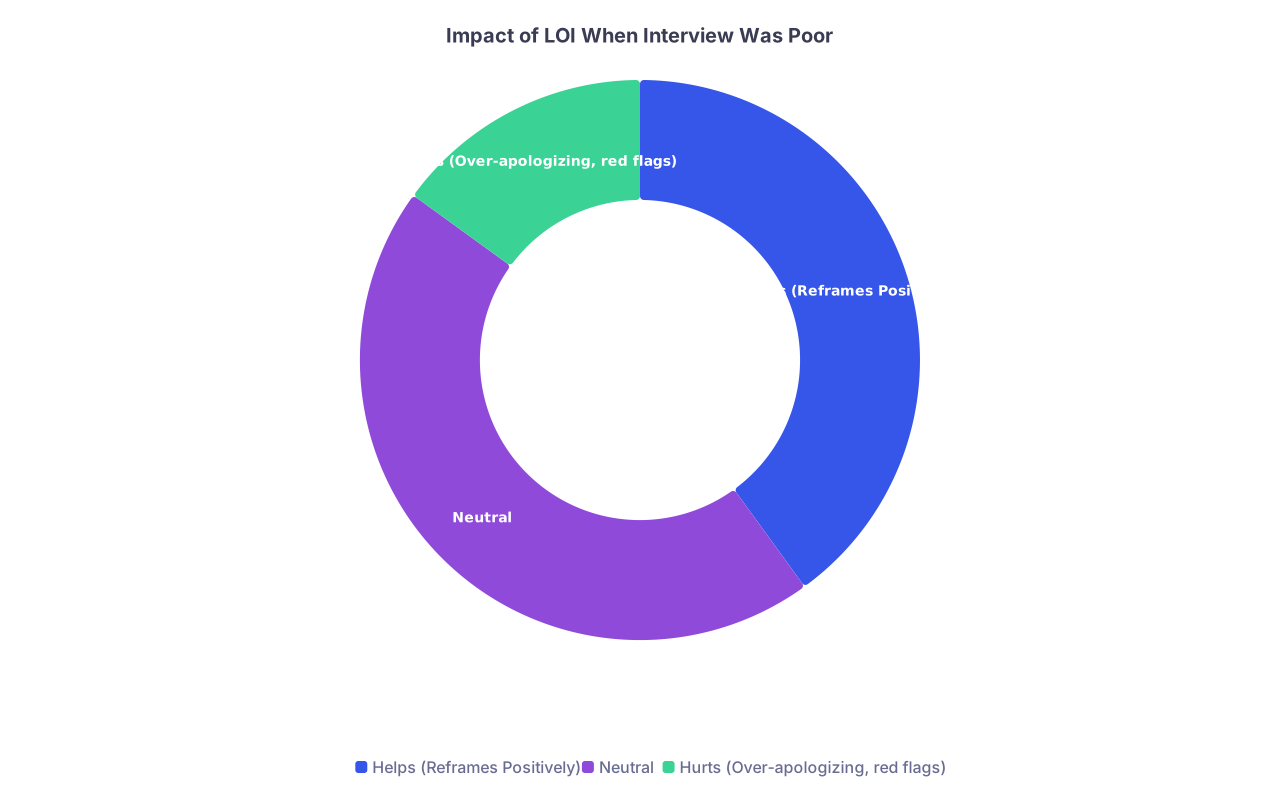
| Category | Value |
|---|---|
| Helps (Reframes Positively) | 40 |
| Neutral | 45 |
| Hurts (Over-apologizing, red flags) | 15 |
Step 6: How direct should you be about ranking?
If you genuinely know this is your #1 program: say it. Cleanly.
- “Your program is my unequivocal top choice, and if given the opportunity, I would be honored to train as a resident at [Institution].”
Skip the fake humility like “I would be grateful just to be considered.” They already know that; you applied.
If it’s near the top but you’re not ready to commit to #1, do not lie and call it #1. But also don’t be vague.
- “I anticipate ranking [Institution] among my very top choices and would be thrilled to train with your team.”
Programs can tell when they’re getting a copy-pasted LOI sent to 10 other places. Being honest but strong actually reads better than fake exclusivity.
Step 7: Putting it together – Sample framework
Here’s a composite version you can adapt. Do not copy it verbatim; programs read hundreds of these.
Paragraph 1: Clear interest + gratitude
Paragraph 2: Brief acknowledgment of poor/atypical performance (if needed)
Paragraph 3: Why this program – specific details
Paragraph 4: What you bring – correcting the impression, highlighting strengths
Paragraph 5: Updates (optional) + ranking statement + closing

Example skeleton (shortened):
Dear Dr. [PD] and the [Specialty] Residency Selection Committee,
I am writing to express my strong interest in the [Specialty] Residency Program at [Institution] and to state clearly that your program is my top choice for residency training. Thank you again for the opportunity to interview and to speak with your faculty and residents.
I left interview day feeling that I had not fully represented myself. A recent family health issue was weighing on me that week, and I recognize that I appeared more reserved and less focused than is typical for me clinically. My attendings at [Current Hospital] know me as a calm, reliable team member who remains steady under pressure, and I hope my evaluations and letters convey that more accurately than my demeanor did that day.
Despite my less-than-ideal performance, my interest in [Institution] has only grown. I was particularly drawn to the combination of high-acuity training at [Hospital] and the longitudinal clinic experience at [Clinic]. Hearing Dr. [Faculty] describe your [track, curriculum, or initiative] aligned directly with my goal of developing expertise in [interest], and the residents’ descriptions of your culture—supportive, hardworking, and unpretentious—matched the environment in which I know I thrive.
I also want to reiterate what I would hope to bring to your program. On my sub-internships, I have consistently taken ownership of complex patients, communicated clearly with nursing and consultants, and stayed late to ensure that tasks are completed. I enjoy being the person my team can rely on when the list gets heavy, and I look forward to contributing that same reliability, work ethic, and collegiality as a resident at [Institution].
Since we met, I have completed my sub-internship at [Site], where my evaluations highlighted my initiative and team-based approach to patient care. Your program remains my unequivocal top choice, and I would be honored to train at [Institution] if given the opportunity.
Sincerely,
[Your Name], [Med School]
Adjust to your reality. Cut what does not fit you.
Step 8: Timing and logistics
You are not sending this the next morning in a panic.
General timing rule:
- 1–3 weeks after your interview, or
- Around when you expect programs are starting to build their rank lists.
Too early, and you write while still emotionally flooded. Too late, and their list may already be basically set.
Other logistics:
- Email is fine. PDF attachment or email body; I lean toward email body for ease of reading.
- Subject line: “Letter of Intent – [Your Name], [Specialty] Residency Applicant”
- Send to: PD and/or program’s central email, cc coordinator. Don’t spam every faculty you met.
Do not follow up repeatedly after sending. One LOI. One thank-you (if not already sent). Then stop.
Step 9: Mental reset: LOI as closure, not a magic spell
You might send the perfect LOI and still not match there. That’s the truth.
Here’s what the letter can realistically do:
- Rescue a borderline impression when your application is otherwise solid.
- Tip the scale when you’re clustered with similar candidates.
- Counteract a specific misimpression from a rough moment.
Here’s what it cannot do:
- Override major deficits in your application.
- Turn a truly toxic interview dynamic into a “misunderstanding.”
- Guarantee anything.
But there’s another purpose: it lets you close the loop. You know you gave them the clearest, calmest version of who you are and why you belong there, not just the version who stumbled through a bad morning on Zoom.
Write it. Send it. Then go back to your life.
Key takeaways
- A LOI after a poor interview day should be short, specific, and steady: brief context, strong fit, clear ranking.
- Acknowledge the off day only if it was obvious and relevant—never turn the letter into a confession or a plea.
- Use the LOI to correct the impression: highlight how you usually function on teams, why this program’s specifics fit you, and what value you’ll actually bring. Then send it once and move on.