
It’s mid-January. You’ve just finished a virtual interview day that actually felt…good. You clicked with the residents, the PD seemed engaged, and as the session wrapped up the PD said something like:
“We really appreciate follow‑up communication. If you’re particularly interested in our program, feel free to send us a letter of intent or interest.”
Now you’re sitting at your desk with 6 other programs you like, a half‑drafted “you’re my top choice” email in a Word doc, and a knot in your stomach. Is this a test? Do they really want LOIs? If you send one, what exactly should you say? And if multiple PDs say this, who gets the “I’ll rank you #1” line?
Here’s how to handle that exact situation, step by step, without lying, over‑promising, or shooting yourself in the foot.
1. First: Decode What “We Encourage LOIs” Actually Means
Programs do not all mean the same thing when they invite LOIs. You need to translate the subtext.
Common PD phrases and what they usually signal:
| PD Phrase | Rough Translation |
|---|---|
| "We welcome LOIs/letters of interest." | You can email us; we might skim it. |
| "If we are your top choice, we encourage you to let us know." | We want to know if we’re your #1. |
| "Communication will not affect your rank, but we appreciate it." | Official line: no impact. Reality: may color our impression. |
| "We consider post-interview communication in our process." | LOIs can nudge you a bit, especially at tie-break level. |
| "We cannot respond to preference signaling emails." | Don’t expect individualized replies; still read them. |
The reality I’ve seen over and over:
Strong, honest LOIs matter most when:
- You’re in the “tie-breaker” group.
- You’re a solid but not slam-dunk applicant.
- The program is mid-tier or regional and actually competes for applicants.
LOIs matter less when:
- You’re either clearly at the top or clearly at the bottom of their list.
- It’s an ultra‑competitive program with 1,000+ apps and a chaotic rank meeting.
But if a PD explicitly says they welcome or encourage LOIs, that’s your permission slip. Not a guarantee of anything—but you should assume they will at least register your interest.
So your job is not to obsess about the micro‑effect on your rank. Your job is to:
- Not lie.
- Not spam.
- Use the opening strategically and surgically.
2. Decide: Are You Sending a “You’re My #1” LOI or a “Strong Interest” Letter?
Before you type a single word, you need a policy. Otherwise you’ll start making emotional decisions at 1 a.m. after a shift.
You have two main categories of letters:
True Letter of Intent (LOI)
Content: “I will rank you #1.”
This is a commitment, not a vibe.Letter of Strong Interest (LSI)
Content: “I’m very interested; you’re one of my top choices / highly ranked on my list.”
Strong, but not a promise.
Here’s the ethical and strategic bottom line:
- You should send only one true LOI that explicitly says:
- “I will be ranking your program first on my list.”
- You can send multiple “strong interest” letters that say:
- “I will be ranking your program highly.”
- “You are one of my top choices.”
- “I strongly hope to match at your program.”
If a PD says “we encourage LOIs,” they may be mixing these ideas. You don’t have to follow their language exactly. You have to follow what you can honestly say.
How to decide who gets the true LOI
If you’re not sure who’s #1, you’re not ready to send a true LOI. Do this:
Sit down and rank your programs today as if ROLs closed tonight.
Ask:
- Where do I see myself happiest on an average Tuesday?
- Where would I feel truly disappointed not to match?
- Who felt like my people, not just “good training”?
If there is a clear #1, that’s the only program that should ever see:
“I will rank you first.”
If you genuinely have a tie for #1, you’re not ready to send a true LOI. Send only “strong interest” to both until the tie breaks.
3. Match the Program’s Ask to the Right Type of Letter
Let’s take some concrete scenarios you might run into and translate them into action.
Scenario A: PD explicitly says “If we’re your top choice, tell us”
Example from closing remarks:
“If after your interviews you decide we’re your top choice, we would appreciate hearing that.”
Strategic response:
- If they are your clear #1 → send a true LOI once you’re sure.
- If they’re top 3 but not #1 → send a strong interest letter, do not claim #1.
Scenario B: PD says “We welcome LOIs/letters of interest”
Example:
“We welcome letters of interest if you feel particularly drawn to our program.”
Strategic response:
- They’re implicitly including both #1 and “very interested” applicants.
- If they’re #1 → send a true LOI.
- If they’re in your top 5 and you’d be genuinely happy there → send a strong interest letter.
Scenario C: Email after interview encouraging LOIs
You get a message from the coordinator:
“Dr. X encourages candidates to send a letter of intent or interest if you remain highly interested in our program.”
This is usually a canned template to get some signal from applicants.
Strategic response:
- Treat it like Scenario B.
- Don’t panic if you can’t reply immediately. Better a thoughtful letter in a week than a sloppy one tomorrow.
4. Timing: When to Send (and When Not To)
Timing actually matters more than people think.
Here’s the rough shape of most programs’ rank timeline (varies by specialty and year, but the pattern is consistent):
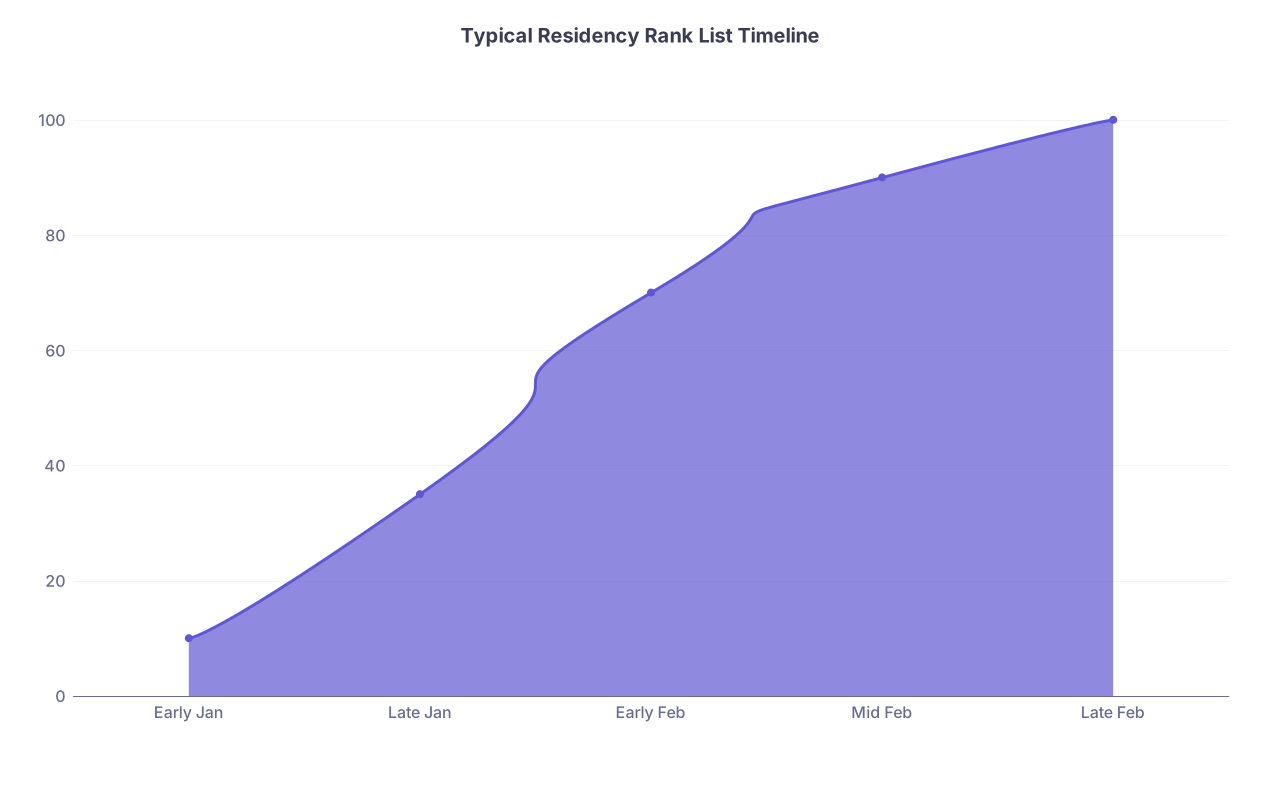
| Category | Value |
|---|---|
| Early Jan | 10 |
| Late Jan | 35 |
| Early Feb | 70 |
| Mid Feb | 90 |
| Late Feb | 100 |
That “values” line is roughly “percent of rank list thinking done.” The closer you get to rank meeting, the harder it is to move the needle.
Best window:
- About 1–3 weeks after your interview
- And before typical rank meetings (often early-to-mid February for many specialties, but verify by asking residents casually “When do you guys do rank meetings?”)
Reasonable rules:
- Do not send a true LOI within 24 hours of your interview. Your brain is still in “post-interview high” mode.
- Aim to send your big LOI once you’ve:
- Completed most of your interviews.
- Drafted a provisional rank list.
- Had at least a few nights of sleep not immediately after that interview.
If you’re late in the season and worried it’s “too late,” send it anyway if you can still be honest. Worst case, they ignore it. Best case, it bumps you up a tie-break.
5. How to Write a Strategic LOI (With Real Phrasing)
Let’s talk content. You don’t need poetry. You need clarity, honesty, and specifics.
Structure for a True Letter of Intent
Use email. Subject line simple.
Subject:
“Letter of Intent – [Your Name], [Specialty] Applicant”
Basic skeleton:
- Short greeting and thanks
- Clear statement of your intent (the actual commitment)
- 2–3 specific, program‑unique reasons
- Quick reminder of your fit/strengths
- Gracious closing, no demands
Example (tight and effective):
Dear Dr. Smith,
Thank you again for the opportunity to interview at [Program Name] on January 8. I truly enjoyed meeting you and your residents.
After completing my interviews, I have decided that [Program Name] is my top choice, and I will be ranking your program first on my rank list.
This decision is based on several specific aspects of your program that stood out to me: – The structured mentorship model you described, where each intern is paired with both a senior resident and faculty advisor, aligns with the type of guided training I know I learn best from.
– The strong exposure to [specific clinic/service] and the opportunity to work with [named faculty or track] match my goal of pursuing a career in [field/subspecialty].
– The culture your residents described—particularly the emphasis on supporting each other on difficult rotations—felt like a community I’d be proud to join.I believe my background in [briefly mention key strengths—research focus, leadership, teaching, prior career] would allow me to contribute meaningfully to your program.
Thank you again for your time and for considering my application. I would be honored to train at [Program Name].
Sincerely,
[Full Name], [AAMC ID or ERAS ID if you want to be extra clear]
Key details you shouldn’t skip:
- One clear, unambiguous sentence that they are your #1.
- Three concrete reasons that could not apply equally to 20 other programs.
- One sentence connecting you to them (fit).
Structure for a Strong Interest Letter
Same bones. Just no #1 promise.
Subject:
“Letter of Interest – [Your Name], [Specialty] Applicant”
Core section tweak:
After completing many of my interviews, I remain very interested in [Program Name] and anticipate ranking your program highly on my list.
or
[Program Name] is one of my top choices, and I would be very excited to match there.
Use the same “3 specific reasons” formula and a brief fit paragraph. Do not accidentally imply #1 status with vague language like “my top choiceS” and then follow it with something that reads like a promise.
6. If Multiple PDs Encourage LOIs: Managing the Chaos
This is where people screw up. They hear similar language from many PDs and suddenly everybody’s getting a “you’re my favorite” email.
Don’t do that. Program leadership talks. Faculty move around. Coordinators compare notes at conferences. You’re not as anonymous as you think.
If you’re in this situation:
- 4–6 programs explicitly said “We welcome LOIs.”
- You like all of them.
- You’re tempted to maximize your odds by sending 6 near‑identical “you’re very high / maybe #1” emails.
Here’s your strategy:
One true LOI with “I will rank you first.”
Sent to your actual #1.2–5 strong interest letters
To programs in your top cluster that:- You’d be genuinely happy to match at.
- You think are in a score/competitiveness range where a small nudge might matter.
Silence is acceptable for:
- Places that are backup‑backups.
- Programs where you honestly did not mesh but might still rank them low.
If you’re tempted to bend the truth “just a little” in all 6 letters—stop. You do not need to play that game to match. And if you get caught, you look unprofessional.
7. How Aggressive Should You Be? Matching Tone to Reality
Different specialties and program tiers treat LOIs differently. Broad strokes (not universal, but I’ve seen this pattern repeatedly):
| Program Type | LOI Impact | Comments |
|---|---|---|
| Community / smaller | Moderate | PD often reads every email |
| Mid-tier academic | Low–Moderate | Helps on the margins |
| Top-tier academic | Low | Often overwhelmed, many LOIs |
| Very competitive specialty | Low | Everyone sends them |
If your PD explicitly encouraged LOIs, you can assume their program is at least moderately receptive. But your tone still needs to be sane.
- Don’t sound desperate: no “I will be devastated if I don’t match here.”
- Don’t overshare: this is not a personal statement 2.0.
- Don’t send multiple follow‑ups asking “Did you see my letter?”
One clean, well‑targeted email is enough. They either use that info or they don’t.
8. Red Lines: What Not to Do Under Any Circumstance
Let me just be blunt about the landmines:
Do not lie about your #1.
Even if everyone on Reddit says “everyone lies.”
You have no idea who’s comparing notes behind the scenes.Do not send copy‑paste letters that forget to change program names.
This happens every year. It’s a near‑instant red flag.Do not negotiate.
No “If you rank me highly, I’ll rank you #1.” That’s illegal and unprofessional.Do not send a LOI every week.
One LOI. Maybe a brief thank‑you if something major happens (new publication, significant award) and is truly relevant.Do not send a LOI if you honestly wouldn’t be happy there.
It’s not just about matching. It’s about not dreading your life for 3–7 years.
9. Special Cases: Odd Situations and How to Respond
A few weird but common situations you might actually be in:
Case 1: You Sent a Strong Interest Letter, Then They Become Your #1
You wrote to Program A: “You’re one of my top choices.” A week later, after more interviews, you realize they’re actually your clear #1.
Yes, you can send a follow‑up.
Short and direct:
Dear Dr. Smith,
I wanted to briefly follow up on my prior email. Since then, I have completed my remaining interviews and finalized my rank list. After considering all of my options, I have decided that [Program Name] is my top choice, and I will be ranking your program first.
Thank you again for your consideration.
Sincerely,
[Name]
Programs understand that preferences evolve as you finish interviews. Just don’t flip‑flop every three days.
Case 2: Two PDs Explicitly Say “If We’re Your #1, Tell Us,” and They’re Almost Tied
You’re stuck between two programs you love. Both PDs invited LOIs. You don’t know who’s #1.
Do not send a #1 LOI until you know. Until then:
- Draft strong interest letters to both.
- Keep them honest: “one of my top choices,” “will be ranked highly.”
- Give yourself a deadline (e.g., 1 week before ROL lock) to decide on the true #1 and send that final, clear LOI.
If you never become sure, then you never send a true LOI. That’s okay.
Case 3: You’re Below Their Usual Stats and Hope the LOI “Fixes” It
You interviewed at a dreamy program where your scores are clearly below their typical average. PD encouraged LOIs and you’re hoping yours will magically erase the gap.
Reality: it probably won’t. But it can still help a bit—especially if your lower metrics were already discussed and context was clear.
In this scenario:
- Still send a letter if they’re in your top few.
- Make your case on fit and value, not apologizing endlessly for scores.
- One solid, professional letter beats none. But don’t expect miracles.
10. One More Layer of Strategy: Your Own Sanity
LOIs are a tiny part of the match algorithm circus. They get far more emotional energy than they deserve.
Here’s how to keep yourself from spiraling:

| Step | Description |
|---|---|
| Step 1 | Finish Interview |
| Step 2 | Preliminary Rank List |
| Step 3 | No LOI |
| Step 4 | Send True LOI to That One |
| Step 5 | Send Strong Interest Letters |
| Step 6 | Update ROL Later if Needed |
| Step 7 | Program in Top 5? |
| Step 8 | Clear #1? |
Notice what’s not in that diagram: 27 drafts, constant second‑guessing, or tracking other people’s LOIs.
You do a structured reflection, decide where programs stand for you, send communications that match that reality, and move on.
11. Example Language Bank (So You’re Not Staring at a Blank Screen)
Use this like a phrase menu, not a script.
Openers:
- “Thank you again for the opportunity to interview at [Program Name] on [date].”
- “I appreciated the chance to learn more about your program and to meet your residents and faculty.”
Clear #1 line (pick one):
- “I have decided that [Program Name] is my top choice, and I will be ranking your program first on my rank list.”
- “[Program Name] is my first choice, and I will be ranking your program #1.”
Strong interest lines:
- “I remain very interested in [Program Name] and anticipate ranking your program highly.”
- “[Program Name] is one of my top choices, and I would be excited to match there.”
- “I plan to rank [Program Name] near the top of my list.”
Specific reason frames:
- “I was particularly drawn to…”
- “I was impressed by…”
- “Your emphasis on [X] aligns with my goals in [Y].”
Fit lines:
- “I believe my experience in [A/B/C] would allow me to contribute meaningfully to [Program Name].”
- “Given my interest in [subspecialty/track] and my background in [research/leadership/teaching], I see an excellent fit with your program.”
Closings:
- “Thank you again for your time and for considering my application.”
- “I would be honored to train at [Program Name].”
- “Thank you for your consideration.”
12. Quick Reality Check: What LOIs Actually Change
Let me set expectations bluntly.
Most of the rank list is driven by:
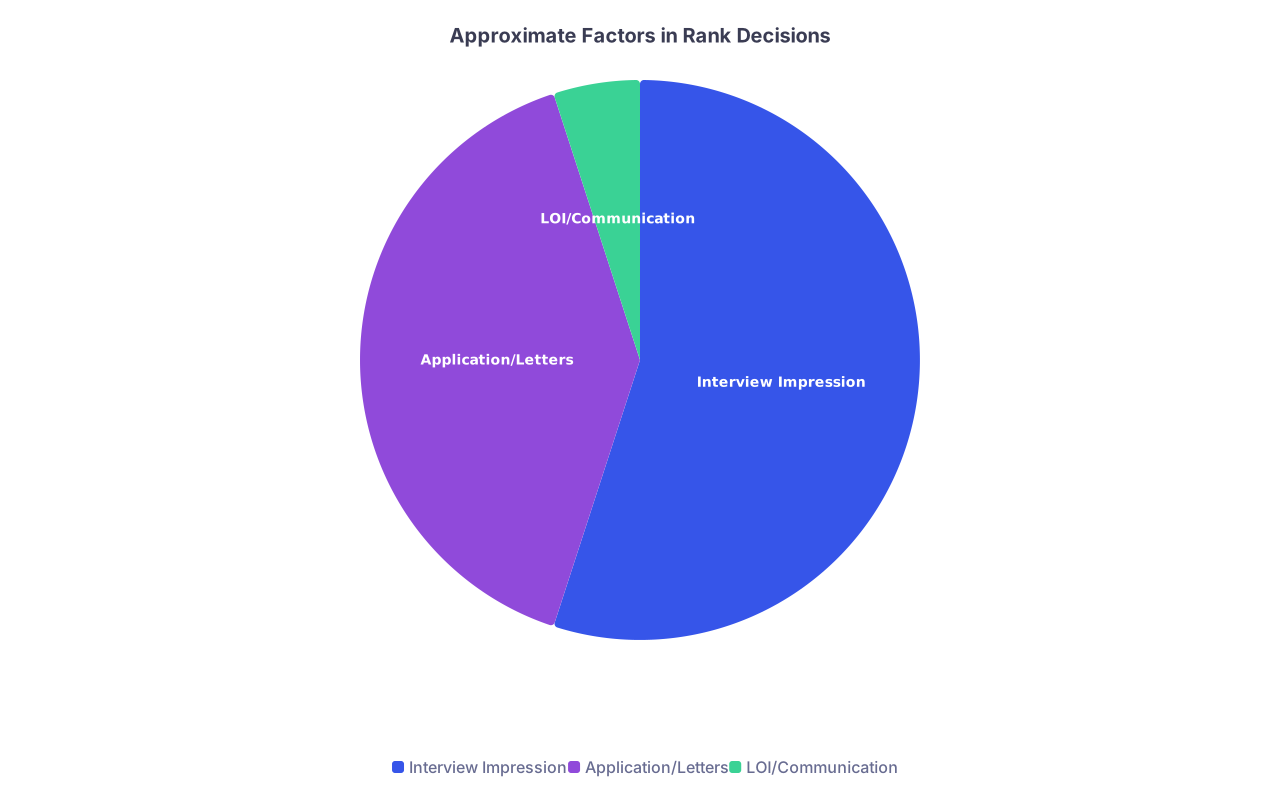
| Category | Value |
|---|---|
| Interview Impression | 55 |
| Application/Letters | 40 |
| LOI/Communication | 5 |
Is that precise? No. But it’s directionally correct. Your interview day and your application did almost all the work already.
A good LOI:
- Can bump you up in tie situations.
- Can reassure a program that you’d actually come if they rank you high.
- Can give a small edge over an equally strong applicant who stayed silent.
A LOI will not:
- Turn a disastrous interview into a save.
- Override severe concerns about professionalism or fit.
- Guarantee anything, even if you’re a superstar.
So use LOIs like seasoning. A little, applied at the right time, can help. A lot, thrown around chaotically, just makes a mess.
Final Takeaways
- Treat a PD’s encouragement of LOIs as permission, not an obligation, and match your response to reality: one true #1 LOI at most, several honest “strong interest” letters if they’re actually top choices.
- Be crystal clear and truthful about your level of interest; never promise “I’ll rank you first” unless that’s actually your plan when you certify your list.
- Focus on specific, program‑unique reasons and fit, send one well‑timed, professional email per program, and then stop tinkering—your interview and application are still carrying almost all of the weight.