
Most letters of intent fail in the last 10 minutes before sending—because people do not have a ruthless final checklist.
You do now.
This is the rapid, no-excuses system you run every single time before you send a letter of intent (LOI) to any program. Med school, residency, fellowship, job in academic medicine. Same principles, slightly different details.
You are not polishing prose for fun; you are preventing three things:
- Red flags
- Missed strategic opportunities
- Basic, embarrassing errors that quietly kill credibility
Let me walk you through a hard-edged, practical checklist that takes 15–20 minutes and dramatically raises the floor on your letter.
1. Sanity Check: Should You Even Send This LOI?
First fix: do not send a letter of intent when a letter of interest, update letter, or silence would have been smarter.
Run this 60-second triage before editing a single word.

| Step | Description |
|---|---|
| Step 1 | Considering LOI |
| Step 2 | Send interest or update letter |
| Step 3 | Skip LOI or send neutral thank you |
| Step 4 | Write and send LOI |
| Step 5 | Is this your true top choice? |
| Step 6 | Are you willing to commit to rank 1? |
| Step 7 | Program accepts LOIs? |
Use this filter:
Is this truly your #1 program?
If you are not prepared to rank them first, you have no business using the phrase “letter of intent.”
Use “letter of strong interest” or “update letter” instead.Have you already sent a “you are my #1” LOI somewhere else?
If yes, stop. Sending multiple “you are my top choice” LOIs is unethical and risky. Program directors talk.Does the program/state/body prohibit or discourage letters of intent?
Some programs (and some specialties) explicitly say they will not consider post-interview communication.
In that case:- Thank-you note = fine
- Update letter that is informational = usually fine
- Explicit “I will rank you #1” LOI = often pointless and sometimes frowned upon
If the LOI is appropriate for this program, move on. If not, retitle and reframe it as an update or interest letter before you waste more time.
2. Structural Pass (2–3 Minutes): Does This Read Like a Letter of Intent?
You can fix content later. First make sure the bones are correct.
Open your letter and verify these elements:
Correct header and greeting
- Date
- Program name written exactly as they use it
- Full official title:
- “Internal Medicine Residency Program, XYZ Hospital”
- Correct recipient:
- Program Director (PD) or designated contact
- Greeting:
- “Dear Dr. [Last Name],” or
“Dear Dr. [Last Name] and Residency Selection Committee,”
- “Dear Dr. [Last Name],” or
Four clear sections
- Opening: direct statement of intent
- Middle 1: why this program specifically
- Middle 2: what you bring / fit
- Closing: restate intent + appreciation + brief signoff
If your letter is meandering, story-heavy, or looks like a personal statement 2.0, that is a problem. LOIs are short, blunt tools, not essays.
Target length: 300–500 words. Longer than that and most faculty will skim—or skip.
3. Intent Clarity Pass (3–5 Minutes): Is Your Commitment Unambiguous?
This is where many people fail. Vague commitment language sounds safe but accomplishes nothing.
Scan your opening and closing paragraphs and ask:
- Do I clearly state:
- That this is a letter of intent
- That I will rank this program #1 (for match settings) or consider it my top choice
You want language that is:
- Direct
- Specific
- Legally and ethically honest
Strong examples for residency/fellowship:
- “I am writing to express my clear intent to rank the [Program Name] Internal Medicine Residency Program as my first choice.”
- “I will be ranking [Program Name] as my number one program on my rank list.”
Weak, useless phrases to delete:
- “You are among my top choices.”
- “I am very interested in your program.”
- “I would be honored to train at your institution.” (Fine as fluff, not sufficient as intent.)
If you cannot put that direct sentence in because you are not fully committed, then it is not a letter of intent. Rename it: “Update Letter” or “Letter of Strong Interest” and remove any implication of ranking.
4. Program-Specific Content Pass (5–7 Minutes): Strip Out the Generic Fluff
If a generic applicant could send your same letter to 10 programs just by swapping names, it is bad.
You want to quickly test how program-specific your content really is.
Use this method:
Highlight all program-specific references in one color:
- Names of rotations, tracks, pathways
- Specific faculty
- Unique curriculum features
- Location-linked reasons that actually matter (family, spouse job, long-term plans)
Highlight generic statements in another color:
- “Your strong clinical training and research opportunities…”
- “Your diverse patient population…”
- “Your commitment to teaching and mentorship…”
If more than half your letter is generic, you need to sharpen it.
Aim for at least 3–5 specific, non-obvious details that prove you know the program beyond the brochure.
| Type | Weak Version | Strong Version |
|---|---|---|
| Curriculum | Strong clinical training | X+Y schedule with +2 ambulatory weeks for continuity clinic |
| Faculty | Great mentorship | Dr. Patel's global oncology work and weekly fellows' conference |
| Track/Pathway | Research opportunities | Dedicated Clinician Educator track with protected teaching time |
| Location | Love the city | Partner's job at [Hospital], long-term plan to stay in region |
Fix checklist here:
- Replace vague compliments with concrete features:
- “Strong research” → “Funded QI curriculum with protected project time PGY-2 year”
- Name people sparingly but accurately:
- If you mention a faculty member, spell their name correctly and only if you had a real interaction or read their work
- Avoid obvious brochure lines:
- “Level 1 trauma center”
- “Diverse patient population”
- “Cutting-edge research”
You can reference those, but tie them to you:
- “As someone who has worked primarily in community settings, I am particularly drawn to the level 1 trauma exposure at [Program] because…”
5. Alignment and Value Pass (5–7 Minutes): Do You Actually Sell Yourself?
Too many LOIs are all “you, you, you” about the program. They forget to answer: “Why should we want you?”
You need a tight alignment section:
- 2–3 short paragraphs or a compact block that:
- Connects your experiences → their strengths
- Shows what you will contribute, not just consume
Run through these questions fast:
Have you clearly stated what you bring?
- Teaching experience
- Research or QI strengths
- Leadership roles
- Language skills
- Ties to the community/region
- Subspecialty interest that fits their strengths
Are your examples specific and recent?
- “During my sub-internship at [Hospital], I…”
- “As chief of our student-run free clinic, I…”
Is there at least one concrete future-oriented statement?
- “At [Program], I hope to expand on my work in [X] by joining [Y] project/team.”
If your value section is all adjectives (“hard-working, team player, passionate”), that is fluff. Swap adjectives for evidence and actions.
Better pattern:
- Weak: “I am a strong team player and dedicated to patient care.”
- Strong: “On my sub-internship in cardiology, I volunteered to coordinate handoffs for a complex heart failure patient panel, which reduced sign-out issues and was recognized by the senior resident.”
6. Ethics and Match Rules Pass (3–4 Minutes): Are You Accidentally Lying or Violating Norms?
This is the unsexy but critical part. The final review must include an ethics check.
Confirm:
You are not promising what you cannot deliver.
- If you write:
- “I will rank [Program] number one.”
- Then you must actually do that. No exceptions.
- If you write:
You are not pressuring or fishing for commitment from them.
- Avoid:
- “Please let me know how likely I am to match at your program.”
- “I hope to hear that I am ranked highly on your list.”
- These sound needy and unprofessional.
- Avoid:
You are not referencing conversations you should not.
- Do not write:
- “During my interview, when Dr. X said I would be ranked to match…”
- That drags them into potential NRMP issues and makes you look naïve.
- Do not write:
Keep your LOI clean:
- Express commitment and enthusiasm
- Provide relevant updates and alignment
- Do not discuss rank list details on their side
7. Language, Tone, and Length Pass (5–7 Minutes): Cut the Fat, Fix the Tone
Now you refine. But efficiently.
A. One-pass trimming method
Read the letter once out loud. Every time you trip or feel bored, flag that sentence. Then:
Remove:
- Long autobiographical tangents
- Repeated points already covered in your application
- Unnecessary adverbs (“very,” “extremely,” “truly”)
Shorten:
- Multi-clause sentences into 1–2 clear ideas
- Formal fluff:
- “I am writing to you today to say that…” → “I am writing to state that…”
Goal: 300–500 words. Shorter is usually better if it is clear and specific.
B. Tone calibration
You want: confident, appreciative, professional. Not: desperate, arrogant, or robotic.
Check for:
- Over-apologizing:
- “I know I am not the strongest applicant…” → cut
- Over-selling:
- “I am uniquely qualified…” (You are not. Use evidence instead.)
- Excessive flattery:
- “Your program is unparalleled and the best in the country…”
- Faculty roll their eyes at this.
Good closing tone examples:
- “Thank you again for the opportunity to interview and for your time in reviewing my application and this letter. I would be thrilled to train at [Program Name] and to contribute to your community.”
- “I appreciate your consideration and remain genuinely excited about the possibility of joining [Program Name].”
8. Error and Identity Pass (5–10 Minutes): Prevent the Stupid Mistakes
This is where otherwise strong applicants sink themselves. Misspelling the PD’s name. Referencing the wrong program. Leaving in another institution’s name from a prior letter.
Run a hard, mechanical check:
A. Names, titles, and programs
Search manually for:
- Program name
- Institution name
- City
- Program Director name
- Any faculty you mention
Confirm:
- Spelling is 100% correct
- Capitalization matches their usage
- You did not mix up two different institutions with similar names
Basic structure checklist:
- Date is correct
- “Letter of intent” or equivalent phrase appears early
- Program name correct in all locations
- PD name and title accurate
- Your name and AAMC ID (for residency) appear in signature block
B. Typos and grammar
You are not writing a novel. But an error-riddled LOI is a quiet demerit.
Do this fast:
- Run spellcheck (Word, Google Docs, whatever).
- Read it out loud once, slowly.
- Use a text-to-speech tool if you are prone to missing your own errors.
Target: zero spelling errors, zero obvious grammar issues, no weird formatting.
C. Contact information and identifiers
Your signature block should include:
- Full name
- Degree(s) (e.g., “John Doe, MS4” or “Jane Smith, MD”)
- Medical school or current institution
- AAMC ID or ERAS ID (for residency/fellowship)
- Email and perhaps phone number
9. Timing and Logistics Pass (3–5 Minutes): Are You Sending At the Right Time, in the Right Way?
People obsess over wording and then mess up timing.
A simple planning view:
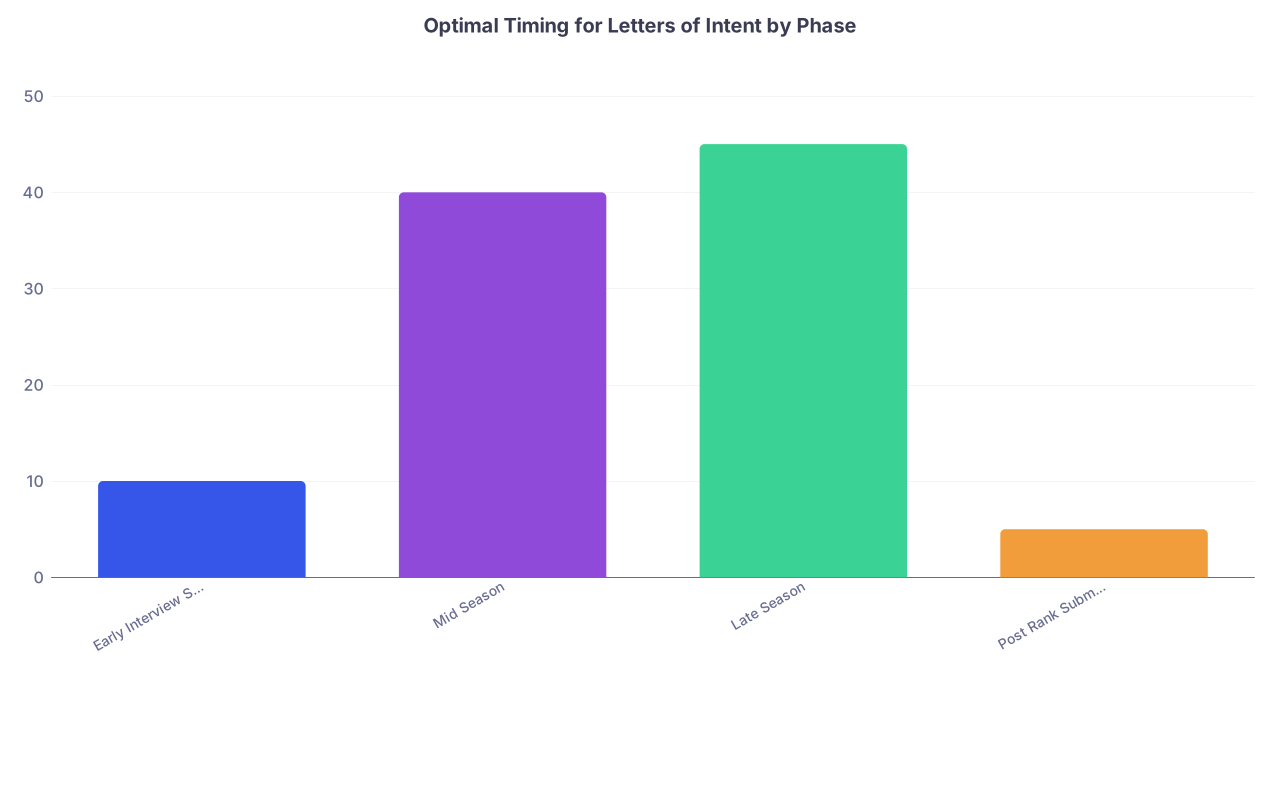
| Category | Value |
|---|---|
| Early Interview Season | 10 |
| Mid Season | 40 |
| Late Season | 45 |
| Post Rank Submission | 5 |
Interpretation: Most effective LOIs cluster in mid-to-late season, before rank lists are due.
Quick checks:
Is it too early?
- Do not send a letter of intent after your first interview of the season when you have no comparison.
- Programs may not believe you—and you may regret it.
Is it too late?
- For residency:
- Aim for 2–3 weeks before rank list certification.
- Earlier is fine, but after programs lock their lists, your LOI likely has zero impact.
- For residency:
Is the channel correct?
- Follow program instructions if they state:
- Upload through portal
- Send to coordinator, not PD
- If unclear:
- Email to PD + cc program coordinator is standard
- Subject line template:
- “Letter of Intent – [Your Name], [Specialty] Applicant”
- Follow program instructions if they state:
One letter per program, max.
- Do not send repeated “just checking in” LOIs. You can send:
- Thank-you note post-interview
- One LOI when you are sure they are #1
- Optional brief update if you have a truly major achievement later (grant, major publication, significant award)
- Do not send repeated “just checking in” LOIs. You can send:
10. Final 2-Minute Checklist: The Rapid Run-Through
You are about to hit send. Run this final short checklist mentally or on paper:
Content and ethics
- This is truly my #1 program (for a true LOI)
- I clearly state I will rank them first (or equivalent for non-match settings)
- I am not making any false or exaggerated claims
- I am not hinting or fishing for where I am on their list
Program specificity
- At least 3 clear, specific reasons tied to their program
- At least 1–2 concrete things I will contribute or build there
Mechanics
- Program name and PD name are correct everywhere
- No leftover text from another program’s letter
- No obvious typos or grammar errors
- My name, school, and AAMC/ERAS ID are in the signature block
Strategy
- I have not sent a competing “you are my #1” LOI to any other program
- Timing makes sense relative to rank list deadlines
- Method of sending follows program norms or instructions
If any box is “no” or “I’m not sure,” fix that first. Then send.
11. Future-Proofing: Build a Reusable LOI Framework
You do not want to reinvent the wheel every time you need a high-stakes letter. You want a modular template.
Here is a basic structure you can adapt quickly:
Opening (2–3 sentences)
- Identify yourself
- State purpose (letter of intent vs. interest vs. update)
- Make your ranking/priority statement (if LOI)
Program fit (1 short paragraph)
- 2–3 specific program features
- Tie each to your goals or values
Your value (1 short paragraph)
- 2–3 concise bullets or sentences: experiences, skills, or traits supported by brief evidence
- At least one future-oriented sentence: what you will do there
Updates (optional paragraph)
- Only include genuinely meaningful updates since your application or interview
- Keep it tight: 2–3 sentences max
Closing (2–3 sentences)
- Restate intent (for LOI)
- Express appreciation
- Professional signoff
You can reuse ~40–50% of this structure for multiple programs, swapping out:
- Program-specific details
- How your background aligns with their particular strengths
- Any updates that are especially relevant to that site
Just do not reuse phrases that sound template-like. Faculty see hundreds of these. They can spot the “copy-paste with find–replace” letters instantly.
12. How This Fits the Bigger Picture: Letters in the Future of Medicine
One last point. As applications bloat and everyone sends more emails, the marginal value of a mediocre letter of intent is approaching zero.
But a sharp, honest, specific LOI still cuts through the noise.
In an environment where:
- AI tools generate generic letters
- Applicants apply to 60+ programs
- Faculty are overwhelmed and cynical about post-interview communication
The only letters that still matter:
- Are selective (you send very few)
- Are specific (you prove you understand the program)
- Are ethical (you say what you mean and follow through)
Think of your LOI as a professional contract with yourself: “This is where I want to be, and this is what I will bring if you take a chance on me.”
Write it that way. Review it ruthlessly. Then send it once.


| Step | Description |
|---|---|
| Step 1 | Draft LOI |
| Step 2 | Confirm true top choice |
| Step 3 | Fix structure and intent |
| Step 4 | Add program specific content |
| Step 5 | Highlight your value |
| Step 6 | Ethics and error check |
| Step 7 | Timing and send |

Key Takeaways
- A real letter of intent is for one true top choice only, with a clear and honest ranking commitment.
- Specificity and alignment win: name concrete program features and show exactly how you fit and what you will contribute.
- A 15–20 minute final checklist—structure, intent clarity, program specificity, your value, ethics, and error-proofing—turns an average LOI into a professional, credible signal that programs actually respect.