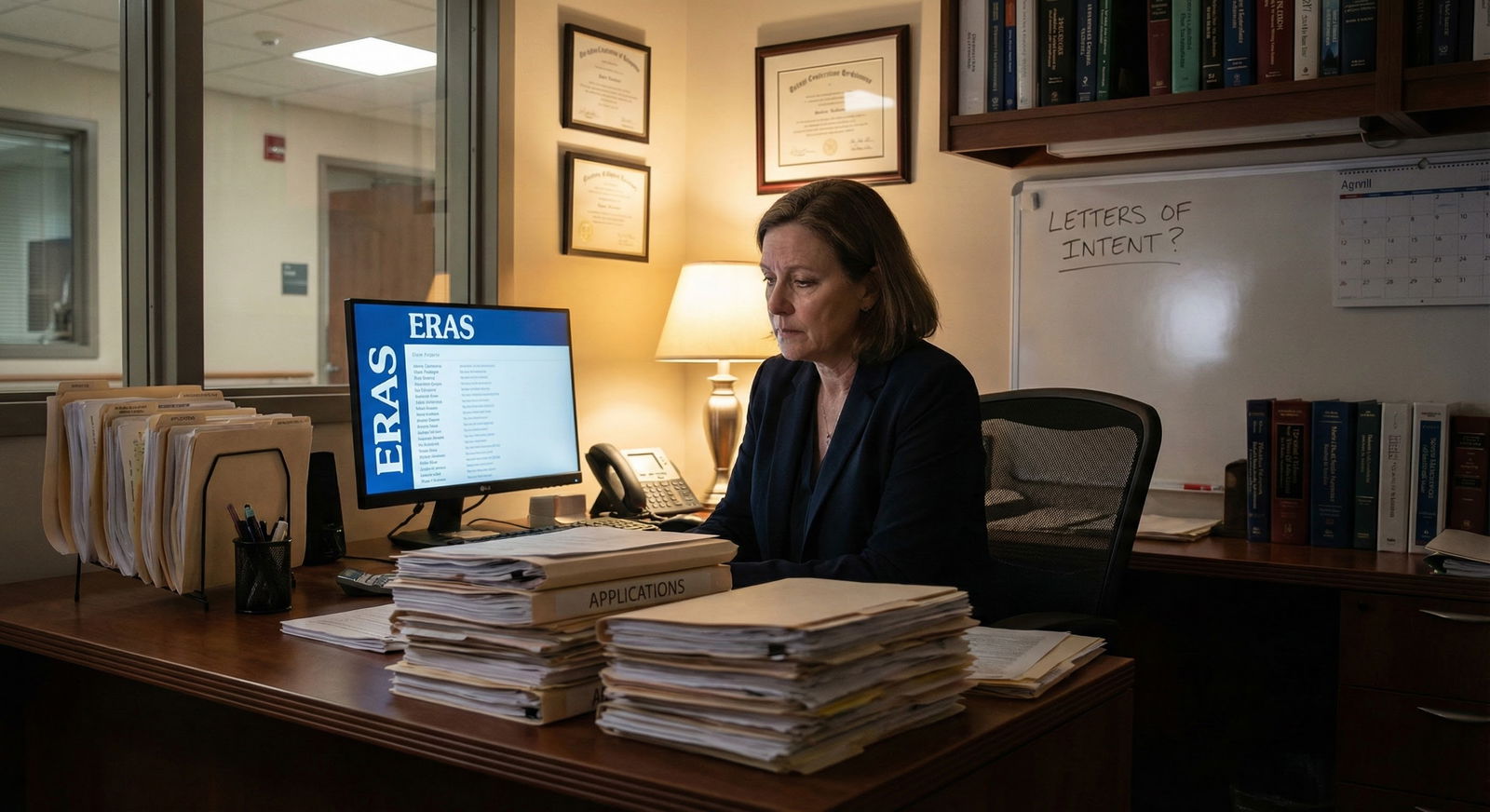
The biggest mistake applicants make with letters of intent is believing we read them in isolation. We don’t. We read them against your interview behavior like a cross-exam.
Let me tell you what really happens behind closed doors when PDs, APDs, and faculty compare “I will absolutely come here if ranked” with how you actually acted on interview day.
The letter of intent is not about flattery. It’s about internal consistency.
Most guides talk about content: show interest, mention mentors, explain “fit.” That’s amateur hour. At almost every mid- to high-tier program I’ve sat in on, the real use of the letter of intent isn’t to be persuaded. It’s to check if you were telling the truth on interview day.
That’s the part no one tells you.
We already formed our primary impression of you during:
- Morning introduction and Q&A
- Individual and panel interviews
- Resident lunch / socials
- How you interacted with staff and coordinators
- Your thank-you emails (or lack of them)
By the time your letter of intent shows up—usually December to early February—we already have a working rank structure in our heads. Your letter is not arriving into a vacuum. It’s landing on top of a mental file labeled:
“Enthusiastic, clearly loves us, borderline too intense but solid team player”
“Quiet, strong on paper, seemed disinterested in residents”
“Said we were top choice, but body language screamed ‘backup’”
When your letter hits the PD’s inbox, they will unconsciously (or very consciously) check it against those tags. I’ve watched it happen in real time.
I’ve sat in an office where the PD opened a letter of intent, scanned it, and said:
“Huh. That’s not how she acted on interview day.”
Rank position didn’t go up after that. It went down.
This is the part you need to understand: letters of intent are validators or red flags. Rarely neutral.
How PDs actually remember you from interview day
You think we remember your CV details. We don’t. We remember patterns and moments.
What sticks:
- The person who asked residents, “So where else did you all interview?” three different ways.
- The applicant who kept glancing at their phone between sessions.
- The one who smiled at everyone—from the coordinator to the janitor—and seemed genuinely curious.
- The candidate who told three different faculty some version of “This is my top program” then sent the same line to three other institutions.
Faculty don’t sit down with a spreadsheet of your entire application when they read your letter of intent. They rely on their gut memory and whatever they wrote down that day.
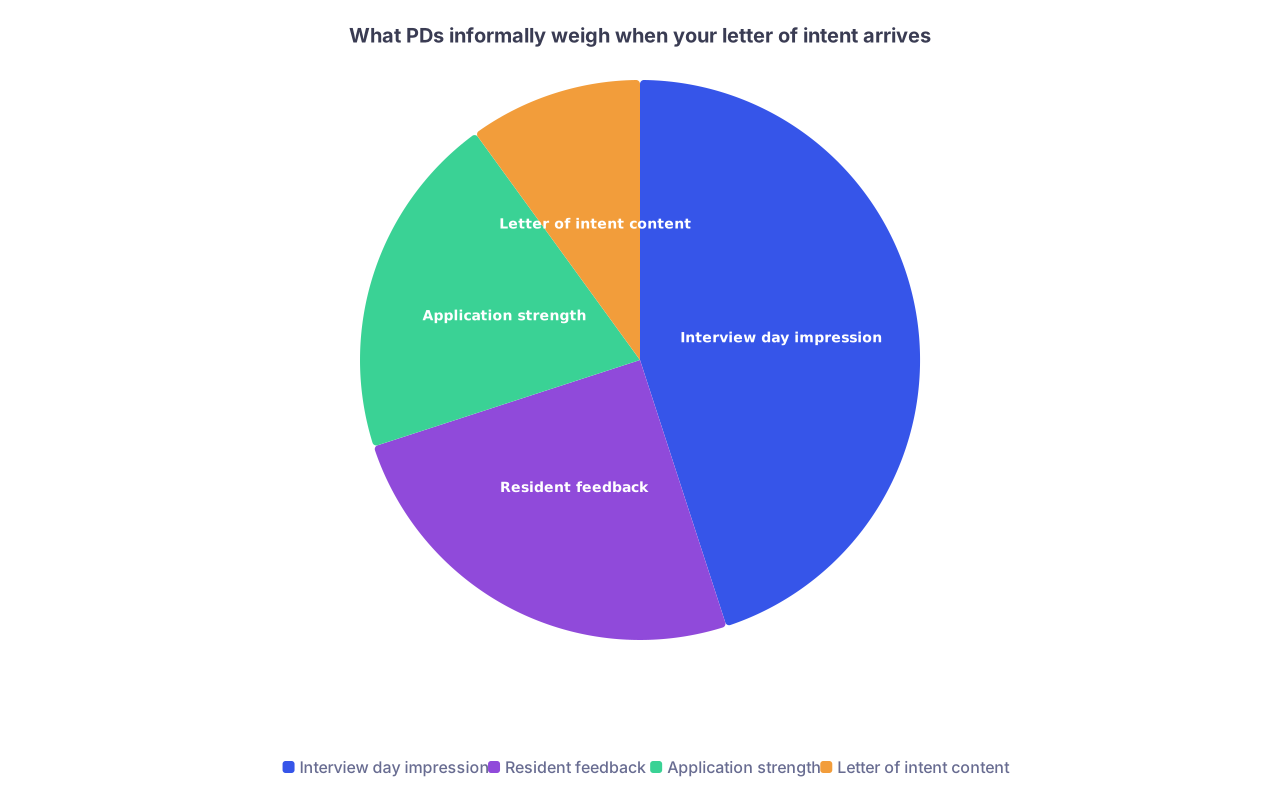
| Category | Value |
|---|---|
| Interview day impression | 45 |
| Resident feedback | 25 |
| Application strength | 20 |
| Letter of intent content | 10 |
No one admits that out loud, but in every closed-door ranking meeting I’ve seen, this is basically the breakdown.
When your letter of intent arrives, PDs are thinking:
- “Was this the guy who told everyone he wanted to be in Chicago, but we’re in Kansas City?”
- “Is this the woman residents loved because she stayed late in the social?”
- “Is this the one who called us ‘top choice’ three times during the interview?”
So when you write: “You are my clear #1 choice,” we instinctively do a mental replay of your behavior:
- Did you seem fully present, or were you half out the door?
- Were your questions and comments consistent with someone who has actually researched us?
- Did you show genuine interest in our specific program, or could your comments have been copy-pasted to any mid-sized academic center?
If there’s a mismatch, we don’t say “Nice letter.” We say “They’re gaming the system.”
And that costs you.
The three big consistency checks PDs run subconsciously
1. Stated preference vs. geographic behavior
Programs are hyper-sensitive to geography. They’ve all been burned by “We love this city” applicants who bolted the second a coastal program called.
So PDs look for coherence between:
- What you said on interview day about geography
- Your ERAS personal statement/geographic preferences
- Your interview behavior
- Your letter of intent
Here’s what that looks like behind the scenes.
I watched this at a midwest IM program I consulted with:
- On interview day, the applicant kept asking:
“How hard is it to get to the airport?”
“Do residents usually stay here after residency or move back to the coasts?”
“Is it common to match to California from here?”
Residents walked away saying, “He’s fine, but clearly wants West Coast.”
Two months later, letter of intent comes in:
“Your program is my clear #1. I am very committed to training in the Midwest long-term…”
The PD literally pulled up his notes from the resident feedback channel, saw the “wants West Coast” comment, and said:
“Nope. He’s playing everyone. Push him down a tier.”
He didn’t fall off the list completely—he was still good—but he dropped below several candidates with slightly weaker boards but more believable commitment.
Programs know applicants may prefer somewhere else. That’s not the issue. The problem is when your letter of intent tries to rewrite how you obviously felt on interview day.
2. Academic story vs. “passion” claims
You tell us a lot with what you’ve done the last 3–5 years. PDs are not stupid. If your CV screams, “I am on a mission to be a tertiary-care academic subspecialist,” and then your letter of intent to a community program says:
“I have always been drawn to community-based medicine and long-term patient relationships…”
We notice.
Same the other way. If you’re applying to a research-heavy program and your entire application shows zero sustained research interest, and you suddenly write:
“Your NIH-funded environment is exactly where I see myself…”
We go back to the interview in our heads and ask:
- Did they talk about research coherently?
- Did they know our core labs or faculty names?
- Did they seem even vaguely excited when research came up?
If no, your letter of intent becomes evidence against you, not for you.
3. Interpersonal vibe vs. “culture fit” language
Every letter of intent has some version of: “I felt like I fit so well with your residents and faculty.”
We don’t take that at face value. We check it against what we observed and what residents reported:
- Did you actually talk to residents, or did you hide in a breakout room corner?
- At dinner/social, did you ask them real questions or only talk about yourself, your Step scores, your couples match partner?
- Did you respect staff? How you treated the coordinator matters more than you think.
At one large university program, the resident chief told the PD after a social:
“She’s good on paper but low-key condescending. Everyone picked up on it.”
Two weeks later, that same candidate sends a glowing letter of intent describing:
“I felt an immediate, authentic connection with your residents. I could easily see myself laughing with them at sign-out and supporting each other on tough days…”
The PD forwarded it to the chief with one line: “This match your experience?” Chief replied: “Not at all.”
She dropped ~10 spots on the rank list. Not because of the letter itself, but because it exposed the disconnect more starkly.
How letters of intent move you up, not just avoid hurting you
Let me be clear: a smart, honest, well-timed letter of intent can move you.
Not from middle to #1 if you were never in the running. But from #12 to #6? From “probably out of reach” to “we should make room if we can”? Yes.
The bump happens when your letter of intent:
- Reinforces the exact impression we already had of you, and
- Adds one or two crisp, concrete reasons that deepen that impression
The “yes, that tracks” reaction is what you’re going for.
Imagine the PD’s inner voice saying:
“Yeah, this sounds exactly like the person we interviewed.”
That’s the gold standard.
Here’s a real example from a strong but not superstar applicant at a solid academic program:
Interview day impression notes:
“Calm, thoughtful, seemed genuinely interested in our underserved rotations. Residents liked him. Wants to be a hospitalist. Midwest roots.”
His letter of intent hit in late January. It said, in tight, plain language:
- He was ranking them #1.
- He appreciated specific aspects of their curriculum (named two rotations and a faculty member he’d met).
- He mentioned his family already living an hour away and wanting to stay in the region.
- He echoed his interview-day goal: community-focused hospitalist with teaching responsibilities.
The PD skimmed it, nodded, and said:
“That’s exactly who he was when he came. Bump him up a few spots—he’s likely to stick and be a solid citizen.”
And they did.
The letter didn’t introduce a new persona. It confirmed and strengthened the existing one.
How PDs catch you playing both sides
Here’s another behind-the-scenes truth: PDs talk. Not constantly, and not about every applicant. But they talk enough.
Especially in small specialties, same city programs, or when you mess up badly.
Common ways you get exposed:
- You tell two programs in the same city they’re each your “clear #1,” and residents from those programs are friends. Screenshots get shared.
- An APD who trained with another faculty member forwards your letter “because it was interesting” and they compare wording.
- You tell one program you’re committed to a very specific niche (say, academic transplant hepatology), and your letter to another program emphasizes a diametrically opposite identity (rural primary care) with equal “lifelong passion.”
Not every case gets caught. But enough do that PDs have become skeptical.
I once watched a PD read a glowing letter of intent, then say:
“This is exactly the same phrasing he used on interview day—‘hands down my top choice.’ Want to bet he’s using that line everywhere?”
Applicant still matched well—just not there. They ranked him, but lower than his “stats position” because they disliked the performance.
The lesson isn’t “never tell a program they’re #1.” It’s:
- Only say it if it’s true.
- Say it once, clearly, without melodrama.
- Make the rest of the letter so specific that they believe it.
What PDs really look for in the content of your letter
Forget flowery language. PDs scan quickly and react to a few core things:
Clarity of intent. Do you clearly state where you’re ranking them? “I will rank your program first” or “I will be ranking your program very highly” (if you’re not committing). No vague nonsense like “top tier on my list” that signals hedge.
Program-specific detail that matches your interview. Mention what you actually talked about and showed interest in. If you spent the entire interview talking about global health, and your letter only praises their ICU research, we side-eye that.
Plausible life story. Your geography, family, long-term goals—all should make it reasonable that you’d be happy there for 3–7 years. Doesn’t have to be perfect. Just believable.
Tone alignment. If you were quiet and reflective on interview day but your letter reads like a LinkedIn influencer wrote it, that feels off. Write in your own voice, not ChatGPT’s sterile corporate script or some over-coached consultant template.
| Area | Aligned Example | Misaligned Example |
|---|---|---|
| Geography | Midwestern applicant, family nearby, says wants to stay in region | East/West coast history, says “lifelong dream” to be in small Midwest town |
| Career goals | Talked about hospitalist track; letter reiterates that | CV full of PhD-level research, letter suddenly claims passion for community-only practice |
| Culture fit | Residents loved applicant; letter mentions specific names and interactions | Residents flagged arrogance; letter claims “instant connection” and “shared humility” |
When all of those line up with what we remember from your interview, your letter of intent quietly helps you. When they clash, your letter becomes evidence that you’re acting, not choosing.
Timing: when your letter helps vs. when it’s white noise
Most programs have an internal timeline that looks roughly like this:
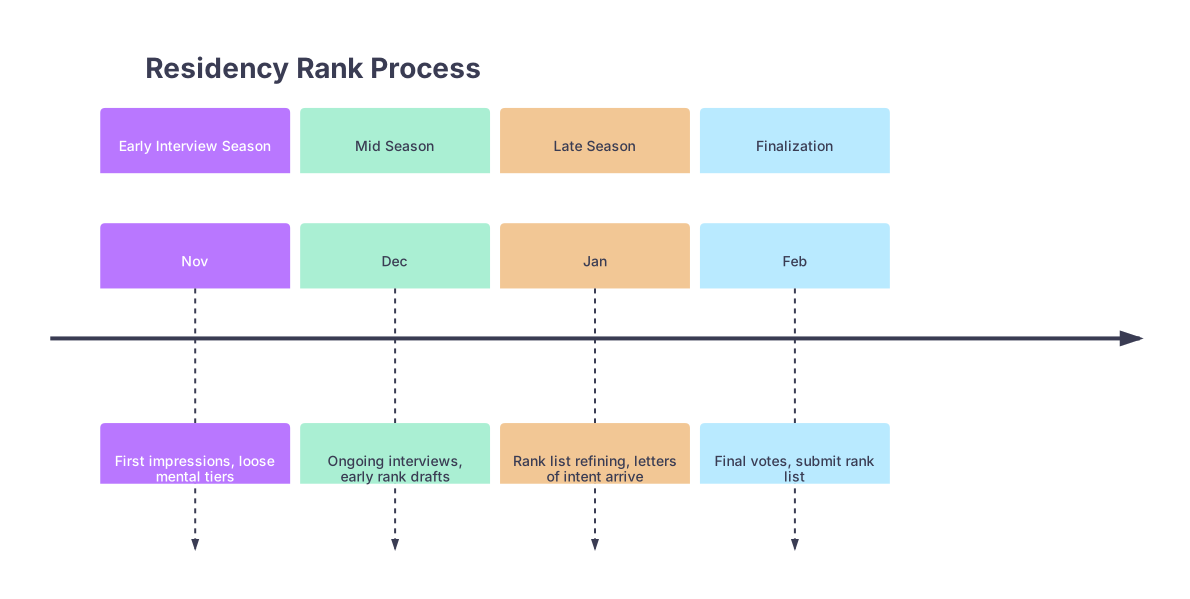
| Period | Event |
|---|---|
| Early Interview Season - Nov | First impressions, loose mental tiers |
| Mid Season - Dec | Ongoing interviews, early rank drafts |
| Late Season - Jan | Rank list refining, letters of intent arrive |
| Finalization - Feb | Final votes, submit rank list |
If your letter of intent arrives:
- Before they’ve created any preliminary rank list: it’s premature, often ignored until later.
- Right as they’re refining tiers (late Dec to mid Jan): that’s when it can actually move your position.
- After they’ve already had the final rank meeting: it does almost nothing. At some places, no one even opens it.
So yes, timing matters. But only if your letter is consistent with your interview persona. A perfectly timed, poorly aligned letter will hurt you more than a late but authentic one.
How to avoid the trap: build your letter from your interview, not around it
The applicants who do this right treat the interview as the “source of truth” and the letter of intent as a reflection of that day, not a rewrite.
Practical way to do that:
Right after your interview (that same day), jot down:
- What you actually said about geography, family, and long-term plans
- The faculty and residents you genuinely connected with
- Specific elements of curriculum, patient population, or culture that genuinely excited you
- Any phrases you used repeatedly (e.g., “I’m really drawn to X,” “This lines up with my interest in Y”)
When it’s time to write your letter of intent, you don’t invent a new story. You simply formalize what you already showed them in person.
If, on interview day, you clearly seemed like:
- Someone motivated by academic advancement and complex cases
- Or someone driven by community engagement and relationships
- Or someone trying to be in a specific city for family reasons
Lean into that. Don’t try to backfill a new identity to match what you think they want.
Because here’s the real secret: PDs don’t want whatever generic aspirational persona you’re constructing. They want residents whose words, actions, and documented history point in the same direction.
That’s where trust comes from. And trust matters in ranking decisions more than you think.
The bottom line: what actually sticks in PDs’ minds
By early February, in a typical academic program, this is what the PD really knows and believes about you:
- A rough sense of your clinical and academic strength from the application.
- A crystallized, gut-level impression from interview day.
- Informal resident feedback—basically, “We’d love to work with them” vs “Please no.”
- Whatever your letter of intent either confirms or calls into question.
You’re not fighting for a fresh slate with your letter. You’re either:
- Reinforcing a positive image → small but real upward shift in rank, or solidifying your spot.
- Fixing a neutral/uncertain image → occasionally possible if the letter is laser-specific and aligned.
- Contradicting their memory of you → mild to serious downward shift.
So if you’re smart, you’ll stop asking, “What magic sentence should I put in this letter?” and start asking:
“Does this letter sound like the same person they met on interview day?”
If the answer is yes, you’re using the letter of intent the way PDs actually use it: as a consistency check, a trust builder, and a quiet tie-breaker.
If the answer is no, you’re just giving them a reason to doubt you.
Key points to remember:
- PDs don’t read your letter of intent in isolation; they compare it directly to your interview behavior and prior impressions.
- Consistency across geography, career goals, and culture fit matters more than poetic language or flattery.
- A good letter of intent doesn’t reinvent you—it echoes who you already were on interview day, in clearer, more committed terms.