
It’s late. You’ve already cranked out one heartfelt letter of intent, and now you’re staring at a blank screen for program number two. You’re exhausted, the match deadline is creeping closer, and the little voice in your head is asking: “Can I just copy chunks of that first LOI and reuse them? Is that… safe?”
Here’s the answer: yes, you can reuse parts of one LOI for another program — but only if you do it intelligently. Sloppy reuse can absolutely hurt you. Smart reuse won’t.
Let me walk you through exactly how to do this without shooting yourself in the foot.
The Core Principle: Reuse Your Story, Not Their Story
You have two types of content in your letter of intent (LOI):
- Stuff that’s fundamentally about you
- Stuff that’s fundamentally about them (the program)
You can safely reuse the first. You must heavily customize the second.
Good reuse:
- Your reasons for going into a specialty
- Your long-term career goals
- A consistent narrative of what you value in training
- A couple of key experiences that shaped your priorities
Bad reuse:
- Generic “I really admire your program’s commitment to excellence” nonsense
- Vagaries that could apply to literally any mid-sized academic IM program
- Copy-pasted paragraphs with the wrong program name, city, or faculty (yes, I’ve seen “I’m excited by your Chicago location” sent to a program in Texas)
If you remember nothing else: your personal story can be reused; your program-specific pitch must be tailored.
What You Can Safely Reuse (And How)
You don’t need to reinvent yourself for each LOI. That’s not the point. A strong LOI set has a stable core and a customized shell.
Here’s what you can absolutely reuse with minimal tweaks:
1. Your “Why This Specialty” Paragraph
If you have a clear, tight explanation of why you chose IM, EM, Ortho, whatever — keep it. Reuse it.
Just make sure:
- It’s not clearly tied to a program-specific experience (e.g., “During my sub-I at this program…”)
- It doesn’t reference specific patient populations that don’t exist at the other program
Example of safe, reusable content:
My decision to pursue internal medicine stems from a consistent pattern throughout my training: I’m drawn to complex, multi-problem patients where success depends as much on longitudinal relationships and systems thinking as on acute decision-making.
That works anywhere.
2. Your Long-Term Career Goals
Your general direction doesn’t change from program to program. If it does, that’s a problem.
Career goals that are usually safely reusable:
- “I plan to pursue a fellowship in cardiology with an interest in academic medicine.”
- “My long-term goal is to work in a community emergency department with a strong focus on QI and operations.”
- “I hope to combine clinical practice with medical education and curriculum development.”
Just don’t say you “definitely want a career in academic cardiology” to a tiny community program that doesn’t send people to fellowship often — without explaining why their environment still makes sense for you.
3. 1–2 Key Anecdotes
If you’ve got a personal story that explains your values — a continuity clinic patient, an inspiring attending, a turning point in third year — you can reuse that. Programs aren’t comparing notes on your internal narrative.
What you should tweak:
- The lesson you highlight from the story
- How that lesson connects to this program’s environment
Same story, slightly different emphasis.
What You Cannot Safely Copy-Paste
Here’s where people get burned: they try to reuse the parts that should be the most customized.
1. Your “Why This Program” Section
This is the most dangerous thing to reuse. It’s also the part programs care about most in an LOI.
Two hard rules:
- You should not have a single “why this program” paragraph that you just swap names in
- If a generic paragraph could apply to 50+ programs, it’s weak and not helping you
Weak, over-reused content:
I am drawn to your strong clinical training, diverse patient population, and supportive learning environment.
That means nothing. Every program markets itself as all three.
Strong, custom content:
During my interview day, what stood out most was the way residents described the autonomy they have in the MICU while still feeling closely supported by faculty. I’m specifically looking for a program where I can manage complex patients early, but with enough backup to grow safely. Your night float structure and the chance to lead family meetings as a PGY-2 align very closely with the training environment I’m seeking.
You can’t copy-paste that. And that’s the point.
2. Mentions of Faculty, Hospitals, Rotations
This is where people expose themselves:
- Copying a paragraph about how excited they are to work with Dr. X — who doesn’t work at the second program
- Complimenting the “county hospital experience” to a program that doesn’t have a county hospital
- Talking about “your new IM track” when that’s only true for the last place
Programs do notice this, and yes, it makes you look careless and less committed.
3. Ranking/Intent Language
This matters. A lot.
If you’re sending a true “letter of intent” (the “you are my #1” variety), that line cannot be reused. Ever. At all.
You cannot safely:
- Tell more than one program “you are my top choice and I will rank you first”
- Send the same “I intend to train at your program” wording to multiple places if it clearly implies #1 intent
You can have tiers of language, but they must be precise and honest:
- True LOI: “I will be ranking your program first on my list.”
- Strong interest: “Your program is among my top choices, and I would be thrilled to train there.”
- Interest without rank language: “I remain very interested in your program and believe it would be an excellent fit.”
If you’re reusing that last line, fine. But don’t send multiple “I will rank you first” copies. That’s lying, and it occasionally backfires.
A Safe System for Reusing LOI Content
Here’s the clean, low-risk way to reuse parts of one LOI for another without creating a mess.
Step 1: Build a Master LOI Template
Create a “master” letter with four clear chunks:
- Opening + your current status
- Your story: why this specialty, who you are, what you value
- Program-specific section
- Closing + your level of interest / rank intent (if applicable)
Example skeleton:
- Paragraph 1: “I’m a fourth-year at X, interviewed at your program on Y, still very interested…”
- Paragraph 2–3: Reusable personal narrative
- Paragraph 4–5: Deeply customized “why your program”
- Paragraph 6: Honest interest/rank language + thank you
Paragraphs 2–3 and part of 6 are usually reusable. 1, 4, and most of 5 need customization every time.
Step 2: Create a Reusable “Personal Core”
Take the parts you’ll reuse and store them separately:
- Your 1–2 best paragraphs explaining your story and goals
- Your favorite short anecdote
- A couple of closing lines that feel like you
This is your “personal core” text bank. Every LOI pulls from here.
Step 3: For Each Program, Write a Fresh Program-Specific Middle
Now for each program:
- Reuse your core
- Completely re-write the program-specific middle
Use actual details:
- Specific rotations (e.g., county ICU, VA continuity clinic)
- Something residents said that stuck with you
- The style of teaching (bedside rounds vs didactics)
- The program’s outcomes (fellowship match, community jobs, leadership roles)
If you can’t find at least 2–3 real details that make sense to mention, you probably shouldn’t be sending that program a “letter of intent” anyway. Maybe just an update email.
Step 4: Run a “Name & Detail” Error Check Every Time
Before sending, do a focused, ruthless check:
Search for:
- Other program names
- Other cities
- Hospital names
- Faculty names
- Track names (research track, primary care track, etc.)
If you’ve reused a chunk from another LOI, you are absolutely at risk for stray names. Ctrl+F (or Cmd+F) is your friend.
How Much Similarity Is “Too Much”?
Programs are not running letters of intent through plagiarism checkers. You’re not going to get “caught” for having the same career goals paragraph in three letters.
The real issue isn’t them noticing reuse. It’s them noticing laziness.
Red flags:
- Entire letter feels like it could go to any program
- You say nothing unique about their institution
- Language is so generic that it reads like an AI-generated brochure
Safe zone:
- 30–60% of your text is stable “you” content
- 40–70% is clearly tailored to them
If you catch yourself thinking, “Eh, this is fine for anywhere,” that’s your cue to rewrite that section.
A Quick Comparison: Smart vs. Dumb Reuse
| Area of Letter | Safe to Reuse? | Risk Level | Notes |
|---|---|---|---|
| Why this specialty | Yes | Low | Keep it stable, minor tweaks |
| Career goals | Yes | Low | Same goals across all programs |
| Personal anecdotes | Usually | Low | Adjust the lesson/connection |
| Program description | No | High | Rewrite for each program |
| Faculty/hospital | No | High | Must be program-accurate |
| Rank #1 language | No | Very High | Only one true LOI per applicant |
Does Reusing LOI Content Even Matter for Match Outcomes?
Short version: your LOI is a small lever. Don’t pretend it’s a crane.
Most of the match is decided by:
- Interviews
- Rank list construction based on those impressions
- Your overall application quality
LOIs can:
- Nudge you up if they already liked you
- Reassure a program you’ll actually come if ranked
- Occasionally break a tie between similar candidates
LOIs generally do not:
- Save you from a bad interview
- Turn a weak candidate into a top-tier one
- Overcome major red flags
So yes, you should write them well and avoid stupid mistakes. But you don’t need to reinvent brand-new prose for 8 different letters to “win” the match. That’s not how this game is scored.
Future-Proofing: LOIs in a More Transparent Match World
There’s a slow but steady trend toward more transparency in the match process and more skepticism about love letters and “gamesmanship.” NRMP already frowns on misleading communication.
What that means for you:
- Don’t lie about rank order
- Don’t promise #1 to multiple programs
- Don’t use manipulative language
- Do keep your LOIs consistent with what you actually value
If programs move further toward structured signaling (tokens, preference signals, etc.), generic LOIs will matter even less. Clear, honest, specific communication will still matter.
So reuse your authentic story as much as you want. Just make sure each program hears how their environment fits that story.

Practical Template You Can Adapt
Here’s a rough structure you can reuse safely, with clear “reuse” vs “custom” zones:
Opening (custom)
- Who you are, when you interviewed, why you’re writing now
Personal core (reusable)
- Why this specialty
- What kind of physician you’re trying to become
- 1 short anecdote that shaped that vision
Why this program (custom)
- 2–4 specific details from interview day, website, or conversations
- How those details map onto your training needs and goals
Interest/rank language (partially reusable)
- Tiered phrase that’s honest (true #1 vs “among my top choices” vs “strongly interested”)
- Thank you and brief closing line you like
Save sections 2 and part of 4 as your personal core. Rewrite 1 and 3 from scratch for every program.
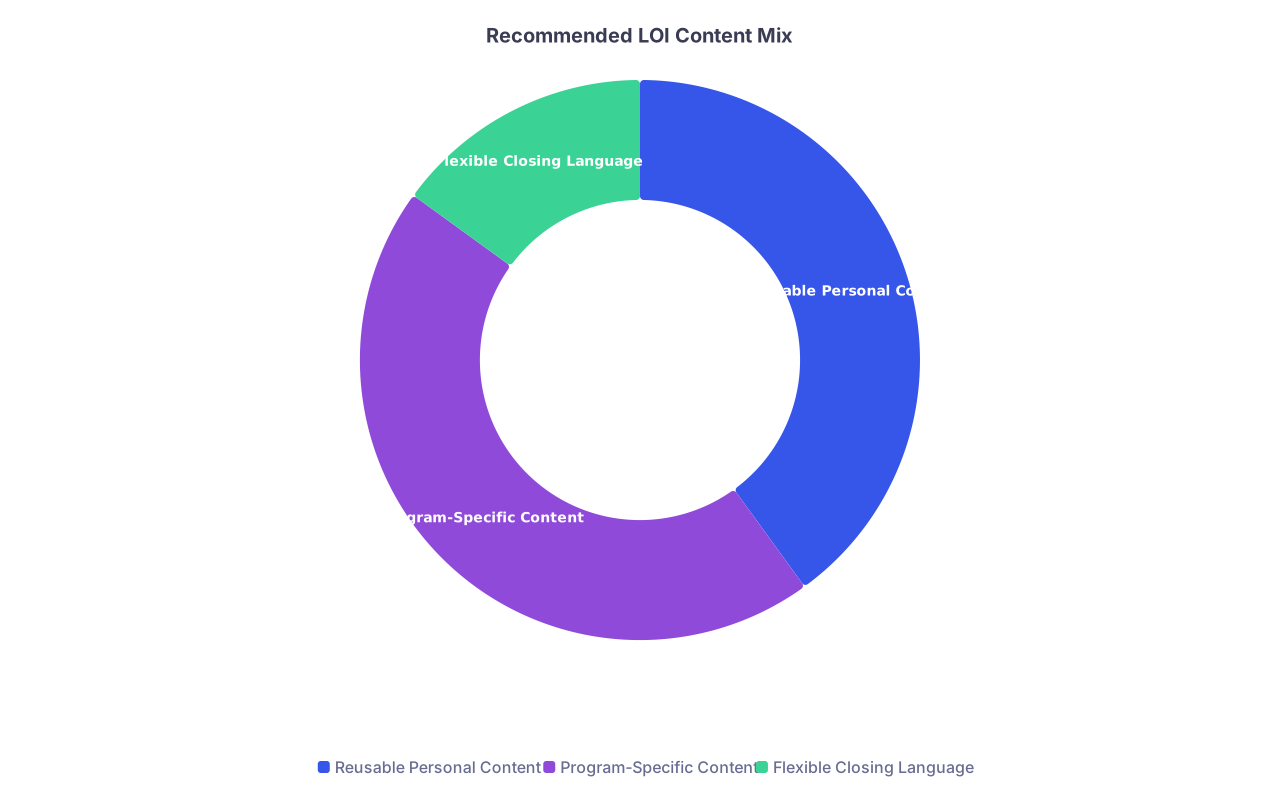
| Category | Value |
|---|---|
| Reusable Personal Content | 40 |
| Program-Specific Content | 45 |
| Flexible Closing Language | 15 |
FAQ (Exactly 5 Questions)
1. Can I send the exact same LOI to multiple programs if I just change the name?
You can. You shouldn’t. That kind of generic letter rarely helps you and makes you look uninterested if they notice the boilerplate. Reuse your personal story, but write a fresh, specific “why your program” section for each place that actually matters to you.
2. Will programs actually notice if I reuse content from another LOI?
They won’t notice reused personal content. They will notice if you leave in the wrong hospital name, city, faculty member, or track. That’s where people get caught. They don’t care if your “why IM” paragraph is the same across letters; they care if your “why your program” paragraph feels lazy or incorrect.
3. Is it unethical to reuse most of my LOI and just tweak a few lines?
No. It’s fine to reuse your own writing about your own story. The ethical line is about honesty, not reuse. Don’t lie about rank order. Don’t pretend unique loyalty to multiple programs. But reusing your specialty motivation and career goals is both normal and sensible.
4. How many programs should I send LOIs to, realistically?
For true “you are my #1” LOIs: one. That’s the whole point. For “I am very interested” letters or updates: usually a small subset where you had good interviews and could realistically match. Sending 20+ “you’re one of my top choices” emails just dilutes the signal and wastes your time.
5. What if I genuinely don’t have many program-specific details to mention?
Then it’s probably not a program that deserves a full-blown LOI from you. You can still send a brief, honest update email (“I remain interested, here are new updates”), but a true letter of intent should only go to places you know well enough to say something real about. If you can’t find 2–3 specific reasons they fit you, that’s your answer.
Bottom line:
Reuse your personal story aggressively, your closing language selectively, and your program-specific content not at all.
Be honest about rank, specific about fit, and disciplined about error-checking names and details.