
The myth about letters of intent is simple: you think they decide your fate; most programs barely know what to do with them.
Let me tell you what actually happens to that carefully worded “You are my top choice” email once it lands in a PD’s inbox—and how some programs do weaponize them behind closed doors in rank meetings.
This is the stuff nobody says on podcasts and certainly not on program websites.
What really happens when you send a letter of intent
First, strip away the romanticism. Residency programs are not sitting around waiting for love letters like a college admissions office from a movie. They’re drowning in emails, half-finished notes, and endless institutional nonsense.
Here's the typical sequence when your letter of intent shows up:
- The program director sees the subject line: “Letter of Intent – Thank you for the interview”
- They skim it. Sometimes on their phone between cases.
- One of four things happens:
- They mentally nod: “Okay, this person is serious about us.”
- They forward it to the coordinator: “Add to file.”
- They ignore it entirely.
- They get mildly annoyed because they’ve already had three LOIs from people who are obviously also emailing other programs the same thing.
And then comes the important part: how, if at all, that letter shows up in the rank meeting.
Some programs never mention it again. Others use it as a quiet tiebreaker. A few—very few—track it systematically.
To understand what your letter is actually doing, you need to understand how rank meetings really work.
Inside the rank meeting: where decisions are really made
Rank meetings are messy. They’re a mix of data, memory, politics, and fatigue.
You’ve probably imagined some super precise algorithmic exercise with detailed scoring rubrics. The reality: 30–70 applicants they actually remember and argue about, then a long tail they barely discuss.
Here’s the structure at most academic programs I’ve seen:
- They start with a preliminary list created from interview scores, file review scores, maybe a few flags (research, diversity, dual-physician couples).
- They go through the list from top to bottom or in “tiers.”
- People jump in: “I really liked her,” “I had concerns about his professionalism,” “This one is a big research asset,” “This guy wants to stay here for life.”
- Notes from interview day get pulled up. Sometimes your ERAS file is opened again, sometimes not.
- And yes—occasionally—someone says: “By the way, this is the one who emailed saying we’re their number one.”
That line—“This is the one who said we’re their number one”—is the entire effective footprint of your letter of intent at many programs.
It’s not the main driver. But it absolutely can move you a few spots up or down when people are fighting over positions in the top 5–15 on the list.
Now, there are patterns to how different kinds of programs handle this.
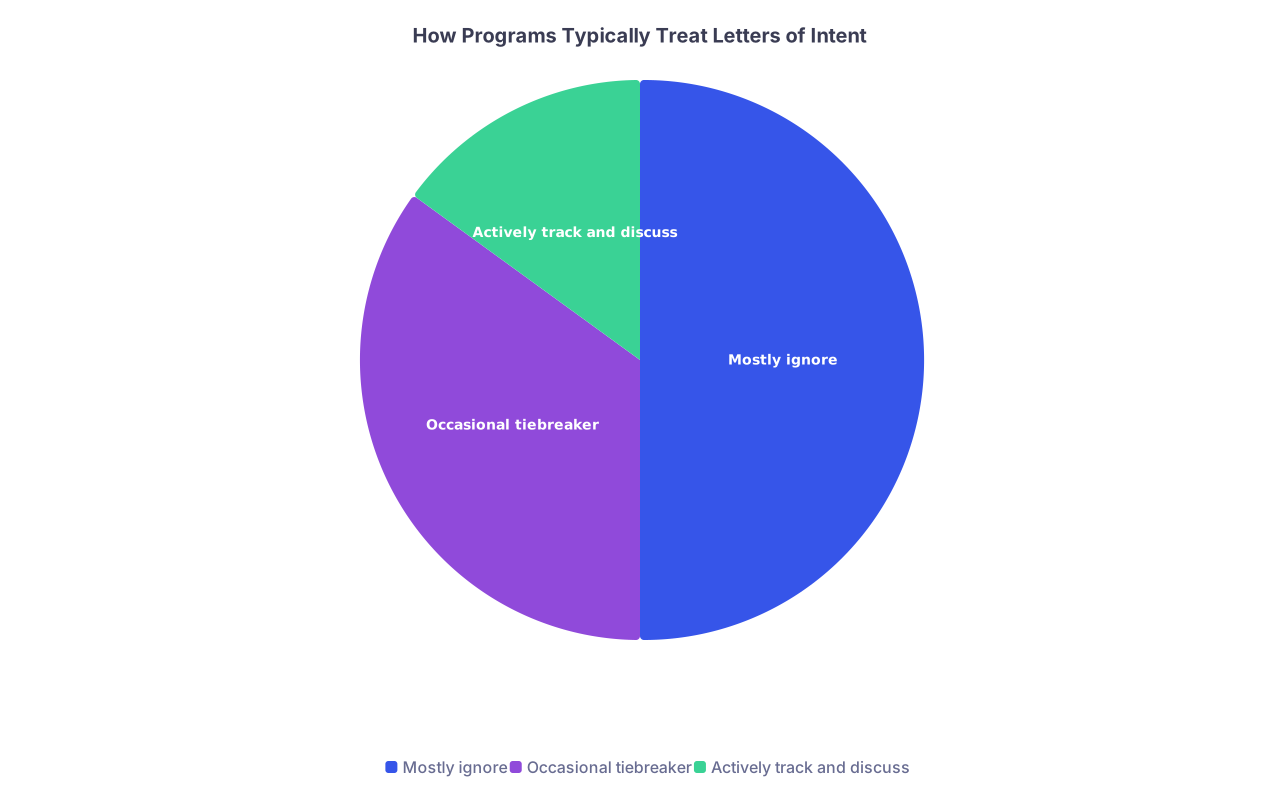
| Category | Value |
|---|---|
| Mostly ignore | 50 |
| Occasional tiebreaker | 35 |
| Actively track and discuss | 15 |
Half basically ignore LOIs. Around a third use them in the gray zones. A minority track them carefully.
The three program archetypes: which one you’re dealing with
I’ll break this down because your strategy should change depending on which type of program you’re emailing.
1. The “we don’t care” programs
Plenty of big-name academic programs fall in this category. Think large, brand-name IM or general surgery places with 2500+ applications a year and a deeply entrenched process. Internally, you’ll hear comments like:
- “Everyone says we’re their number one.”
- “We don’t move our list based on letters. That’s a slippery slope.”
- “If we start responding to these, we’ll drown.”
At these places, what happens to your LOI?
- Coordinator files it in your ERAS “additional documents” or a notes field.
- PD skims it once, if at all.
- It doesn’t come up explicitly in the rank meeting.
However—and this is the nuance—the letter still contributes to a vague gestalt: “This person seems really interested in us.” That might already be in the PD’s mind from your interview day. The letter just reinforces it.
But they will never admit, even internally, that your LOI changed your rank number from 18 to 12. They pride themselves on being “data-driven.”
2. The “tiebreaker” programs
This is a very common pattern in mid-sized academic and strong community programs.
What they actually say in the room sounds like this:
- “We’ve got too many good ones in this tier. Who is actually likely to come here?”
- “This guy wrote that we’re his top choice.”
- “If she really wants us, we should bump her above the ones who are clearly aiming for MGH/Brigham.”
At these programs, your letter of intent becomes currency only in the top 10–20 slots. Below that, it still matters, but only in the sense of “If we end up with them, we’ll be happy—they like us.”
What I’ve seen more than once: two applicants with very similar interview impressions and files. One sent a specific, credible LOI. One did not. The LOI person gets nudged 3–10 ranks higher. That can easily be the difference between matching and not, depending on the program’s popularity that year.
3. The “we track this” programs
These are fewer, but they exist. Often in smaller or newer programs, or in locations that are fighting perception issues (geography, reputation, lifestyle).
They have some version of a list or flag:
- Spreadsheet column: “Expressed strong interest / LOI”
- Bookmark in ERAS with a note: “Says we are #1”
- Email folder: “LOIs – review before rank”
They won’t say this publicly because NRMP rules are clear: programs are not supposed to solicit or rely on explicit ranking commitments. But internally, they justify it as: “We are trying to gauge the likelihood of a match. That’s strategic, not coercive.”
In rank meetings here, I’ve heard:
- “We only have 8 categorical spots. We can’t waste top-10 ranks on people who will never come.”
- “He told us flat out we’re his top choice. That matters.”
- “She said we’re one of her top three and we believe her. Still worth ranking highly.”
These programs actually do use letters of intent as part of their rank-order logic, especially for top spots and near the “we’d be thrilled if they came” tier.
This is where your letter of intent can have real leverage.
How letters of intent get referenced in the room
Let’s go even more granular. Here’s what it looks and sounds like when your LOI surfaces in a rank meeting.
The list is on a screen. Maybe it’s in REDCap, maybe in some custom Excel-like thing that IT whipped up ten years ago. Applicants in rows. Columns for interview score, faculty comments, board/pass, “red flags,” and maybe a generic “interest” score.
You’re Applicant 23 on the draft list.
The PD scrolls.
“Next one. Patel.”
Chief: “Great interview. Strong letters. Wants cardiology. From the region.”
Faculty 1: “Yeah, I liked him. Mature. Already did a year of research.”
Faculty 2: “He sent that email saying we’re his number one, right?”
Coordinator: “Yes, I think so. I added a note.”
PD: “Okay. Any concerns? No? Where do we want him? Above or below Nguyen?”
Now—this is it. That’s the whole impact. The LOI gives them a reason to say, “Let’s put him above.”
Another version, more cynical:
“Smith. High Step 2. Strong app. But honestly, I got the sense he’s only here as a backup.”
Chief: “Yeah, he was very ‘I’m applying widely, we’ll see.’ No follow-up.”
Faculty 1: “Did he ever send anything after the interview?”
Coordinator: “No, not that I saw.”
PD: “Then leave him where he is. We’ve got enough people who actually want to be here.”
The LOI—or lack of it—doesn’t magically rescue a weak interview. But it pushes on the margins.

| Step | Description |
|---|---|
| Step 1 | Applicant Interviewed |
| Step 2 | Draft Rank List Created |
| Step 3 | Minimal impact of LOI |
| Step 4 | Faculty discuss candidate |
| Step 5 | Potential small rank boost |
| Step 6 | Rank based on file and fit only |
| Step 7 | In top discussion tier? |
| Step 8 | LOI on file? |
When letters of intent don’t matter at all
There are several situations where your LOI is basically theater.
You’re already in their “must get” tier
If you’re one of the 3–5 applicants everyone raved about, they’re ranking you at or near the top no matter what you send. At that level, they assume you’ll be heavily recruited and they just hope you match. Your email becomes a nice ego stroke, not a factor.You tanked the interview
Residents flagged you as arrogant. An attending wrote “serious professionalism concerns” or “seemed uninterested in patient care.” Your seventeen-paragraph LOI will not fix that. Nobody is going to say, “He creeped out the residents but he wrote a very committed email, so let’s bring him up.”You’re buried in the lower half of their list
If you’re at rank 60 on a program that typically fills by rank 30–35, your LOI is more fantasy than strategy. They’re ranking you as “fine if we get that far.” Your letter might move you from 60 to 50. You’re still not touching their match range.They’re philosophically opposed to using them
Some PDs are almost militant about this. They see LOIs as ethically muddy and bias-inducing. A few even instruct faculty: “Do not bring up letters like that in the meeting. We’re not basing this on gamesmanship.”
At those programs, your time is better spent improving your Step 2 CK, doing a strong Sub-I, or sending a concise, thoughtful “thank you and here’s why I fit” note rather than explicit ranking promises.
Where letters of intent do move the needle
Now the part you care about: where does this actually change outcomes?
The “swing tier”
Think of a typical strong IM or EM program. They might have:
- 5–10 “absolute top” candidates
- 15–30 “strong, very acceptable” candidates
- 30–60 “we’d be happy with them” candidates
The LOI matters most in that middle bucket. Too strong to be ignored. Not so strong they’re obviously going to match at UCSF or Duke unless they fall down the stairs.
In that middle zone, PDs ask two practical questions:
- “Will they actually come here?”
- “Do they see themselves as a fit with us, or are we just an insurance policy?”
A believable LOI answers both in your favor.
Regional and lifestyle programs
Community programs in desirable cities (San Diego, Denver, Austin) or places with strong lifestyle appeal pay attention to “likely to stay” signals. They’ve been burned before: high-performing applicants matching, then leaving after PGY-1 for “better name” places.
I’ve seen this exact argument:
- “We’ve got three people in this range. Two are clearly aiming for bigger names. One wrote that she wants to be here long-term, family nearby, this is her top choice.”
- “Put her above the other two. We need people who will commit.”
Again—your LOI isn’t saving a bad candidate. It’s tipping the scales among roughly equivalent ones.
Programs under recruitment pressure
Newer programs. Places in less popular cities. Programs that just graduated from probation. They’re anxious about filling. For them, every hint of interest matters.
Here, a strong, specific LOI can push you into the aggressively discussed top tier, not just higher within it. They want people who are excited to be there, not people regretting “having to settle.”

How programs sniff out fake or recycled letters
Program directors aren’t naive. They’ve been reading these for a decade or more. They recognize patterns. The generic LOI format—“After careful consideration, I have decided to rank your program #1 because of your strong clinical training, supportive residents, and excellent fellowship match”—is a punchline, not a persuasion tool.
Here’s what raises eyebrows in the room:
- Vague language: “Very high on my list,” “one of my top choices” when they specifically know that applicant also told three other places “you’re my top choice.”
- Obvious copy-paste structure that matches what faculty at other programs say they are getting from the same applicant.
- Overly dramatic tone that does not match your actual behavior on interview day (“From the moment I stepped onto your campus, I knew this was home” when you seemed bored on Zoom and asked zero questions).
Some PDs quietly compare notes at national meetings. Yes, they talk.
I’ve personally heard:
“Did you all get that LOI from [Applicant Name]? Because he told us we’re his number one, but I’d bet money he’s doing that with multiple places.”
You’re playing a small world game. Don’t forget that.
How often do PDs actually believe LOIs?
Less than you think.
Most PDs treat LOIs as probabilistic, not binding. They assume:
- A small number of applicants are honest and strategic: one real LOI to one program.
- A moderate number send “soft” interest letters to multiple programs: “you’re very high on my list.”
- A nontrivial minority either lie or play semantic games.
So they don’t trust the words. They look for coherence:
- Did you show interest on interview day?
- Do you have a regional or personal tie that backs up “I want to be here”?
- Are you applying mostly to a certain tier/geographic band that makes your claim plausible?
If those line up, your LOI is believed enough to matter. If they don’t, it becomes background noise.
The ethics nobody wants to say out loud
Let’s address the uncomfortable part: yes, NRMP rules technically frown on directly soliciting or using explicit commitment language. And yes, plenty of programs quietly use it anyway.
Do programs “punish” applicants they suspect of lying? Not explicitly. But if they feel you’re playing games—telling three places they’re your #1—that does color their perception of your professionalism and integrity. It may not drop you 20 spots, but I’ve seen it tip someone from “off the charts” to “good but not special” in the room.
Programs also worry about optics. They do not want emails or screenshots circulating that suggest they are pressuring or bargaining. That’s why almost all official communications toe the NRMP line: “We will rank you highly” or “We enjoyed meeting you” but nothing about your exact list.
Behind the scenes, though, LOIs clearly enter the calculus. Not as documented criteria. But as part of the “how likely are we to match this person?” discussion.
| Signal Type | How PDs Usually Read It |
|---|---|
| Explicit #1 LOI + local ties | High likelihood of matching |
| Explicit #1 LOI, no ties | Some skepticism, still a plus |
| Vague interest email | Mild positive, low impact |
| No post-interview contact | Neutral to slight negative |
| Multiple LOIs discovered | Questionable integrity, small hit |
The quiet role of coordinators and chiefs
One last insider detail everyone overlooks: your LOI isn’t always managed by the PD. It’s often the coordinator or chief resident who remembers you “wrote that strong interest email.”
I’ve seen chiefs say in the room:
- “This is the student who wrote that really thoughtful email about wanting to work with our underserved population.”
- “He followed up after the interview and asked smart questions about our ICU experience; seems genuinely invested.”
Those comments aren’t about the existence of the letter but the content. A bland template LOI doesn’t give anyone ammunition to advocate for you. A targeted, specific note does.
That’s the subtle power of doing this well. Not magic. Just leverage.

So what should you actually do?
You wanted insider truth on how LOIs are used in rank meetings. Here it is, stripped of the mythology:
- They almost never rescue a weak candidate.
- They sometimes matter a lot in the “strong but not elite” tier.
- They matter more at programs that feel vulnerable—newer, less famous, or geographically challenged.
- They’re filtered through human skepticism. PDs believe patterns, not poetry.
The smart play?
Write one true letter of intent to the place you’re actually willing to put at #1. Make it specific enough that it could not have been sent to anyone else. Use it to give rational people in a conference room a reason to say, “Let’s put this one a bit higher; they want to be here.”
For every other program, if you want to reach out, keep it honest: strong interest, clear reasons for fit, no ranking language you do not mean.
The rank meeting is not a courtroom where your LOI is entered into evidence and weighed with formal rules. It’s more like a messy jury room where half-remembered impressions, gut feelings, and short comments shape your final position on a long list.
Now you know how your words show up in that room.
With that picture in your head, you’re ready to think carefully about when to send a letter, what to say, and who deserves to hear “you’re my number one.” The next step is crafting that letter so it sounds like a real person making a real choice—not just another applicant parroting templates. But that’s a conversation for another night.