
The belief that a letter of intent has to be long to show you’re serious is backwards. The longer most LOIs get, the less sincere and less effective they become.
The Length Obsession Is a Distraction
Let me be blunt: nobody on a residency or fellowship selection committee is sitting there thinking, “Wow, this LOI is 1,200 words, they must really want us.”
What they’re usually thinking is closer to:
- “Why is this person repeating their personal statement?”
- “Does this say anything that changes how I rank them?”
- “Do they understand what a letter of intent is actually for?”
A letter of intent is not a second personal statement. It’s not a dissertation on your life story. It is a short, targeted signal sent at the exact point when programs are asking one crucial question:
“If I rank this applicant highly, how likely are they to actually come here?”
That’s it. That’s the hidden game. Programs are trying to reduce uncertainty and protect their rank lists. Your LOI is a probability nudge, not a writing competition.
And guess what? Probability nudges don’t require word count. They require clarity and credibility.
| Category | Value |
|---|---|
| Quick Scan | 80 |
| Close Read | 20 |
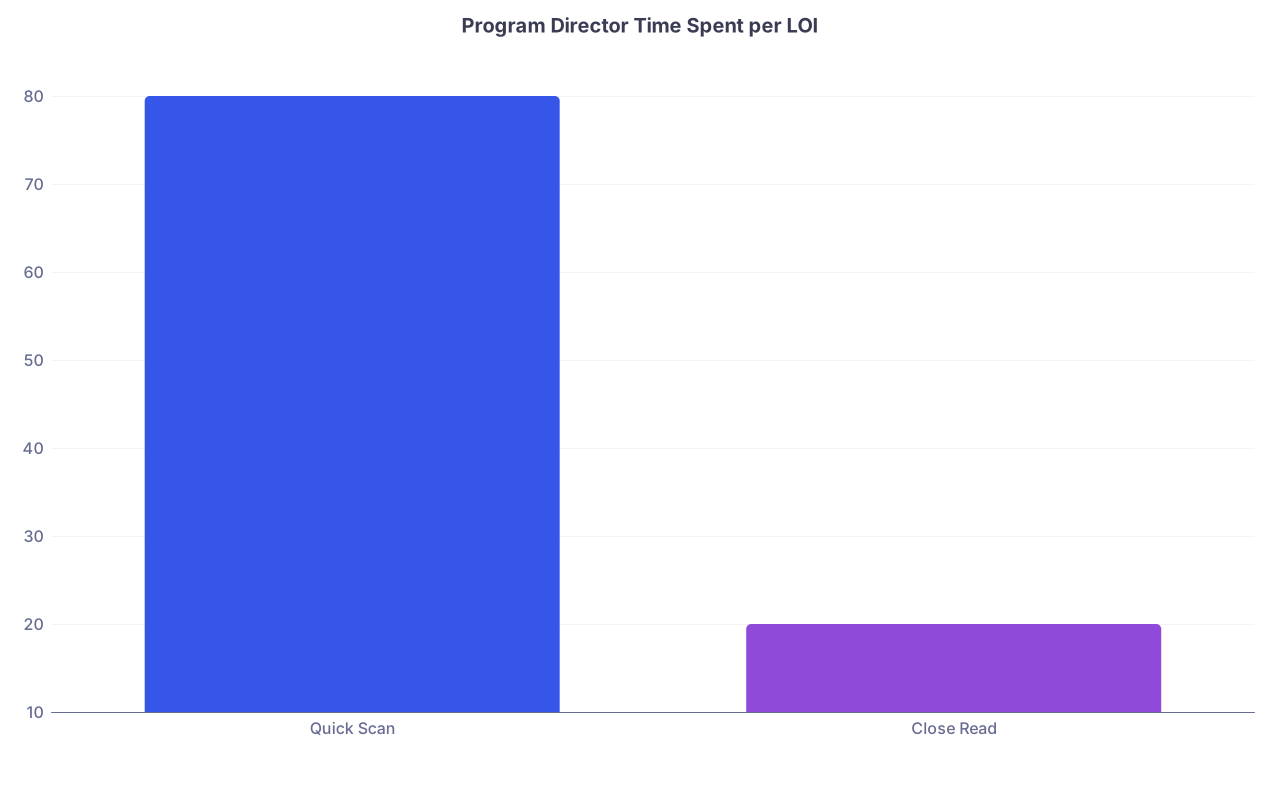
Most PDs and APDs I’ve talked to will admit: 80%+ of LOIs get a quick scan — 30–60 seconds, tops. Only a minority earn a careful read, usually because:
- The applicant is already on their radar, and
- The letter is tight, clear, and obviously relevant
Long-winded, generic letters don’t help you get into that minority. They bury the few important things you should be saying under paragraphs of fluff.
What LOIs Actually Do (And Don’t Do)
If you want to write an effective LOI, you need to stop guessing and start aligning with how programs actually use them.
What LOIs do:
Clarify your intent in the rank process
- “If offered a position, I will rank [Program] #1.”
- Or, more honestly: “I intend to rank [Program] very highly.”
- This matters because programs hate “wasting” top rank spots on people who won’t come.
Provide specific, decision-relevant information they don’t already have
Examples I’ve seen actually influence discussions:
- A spouse or partner is locked into work / training in that city.
- You speak the predominant language of the patient population and have prior experience with that community.
- A clear and specific career path that aligns tightly with the program’s strengths (e.g., you want academic cardiology and they have a strong research track).
Reassure them you understand who they are
Not “I love your strong clinical and research training.” Everyone says that. And it’s useless.
Instead: “I’m particularly drawn to your four+one ambulatory structure and the protected QI time in the PGY-2 year, because I want to build a career in population health.”
That’s the job description of an LOI. Notice what’s missing:
- No requirement to be emotionally dramatic.
- No requirement to retell your entire journey to medicine.
- No requirement to hit some mystical word count to prove you “care enough.”
What LOIs don’t do, no matter how long they are:
They don’t rescue a weak application
If your scores, clinical performance, and letters are significantly below a program’s usual range, no amount of passionate prose is going to vault you into their top tier. A long LOI here just makes it painfully obvious you don’t understand the power dynamics.
They don’t erase red flags
Failed Step, professionalism issues, terrible interview? A letter might contextualize some of this, but that belongs in your application or in the interview conversation, not buried in a rambling “intent” essay.
They don’t magically create “fit”
You can’t manufacture genuine alignment with a program by listing every feature from their website. Fit is demonstrated by very specific overlaps between your actual experiences/trajectory and their actual structure and priorities. That takes precision, not length.
They don’t impress with vocabulary or storytelling
PDs are not literature reviewers. They’re trying to staff a functional, safe, reliable residency. Flowery language and emotional monologues don’t score you points. They often trigger an eye roll.
So when you stretch a LOI to a page and a half because you’re scared it’ll seem “too short,” you’re usually just diluting the only things that might matter.
The Sweet Spot: Short, Specific, Verifiable
Let me give you a rough calibration, since people love numbers.
For most residency and fellowship LOIs, the effective length range is:
One well-structured email
~250–400 wordsOr a short, clean letter
~300–500 words, if you’re attaching a PDF
Not 900. Not 1,500. Once you push past ~600 words, the additional content is almost always repetition, generic flattery, or your personal statement in disguise.
The better question is not “How long?” but “Can a tired PD skim this in 45 seconds and walk away knowing three things with zero ambiguity?”
Those three things:
- How you will rank them (within ethical limits and honesty).
- Why they are specifically high on your list (with concrete, program-specific reasons).
- Any critical contextual info that makes you especially likely to come and thrive there.
Everything else is optional.
| LOI Type | Typical Length | PD Reaction Pattern |
|---|---|---|
| Bloated pseudo–personal statement | 800–1500 | Skim, sigh, ignore |
| Standard generic LOI | 500–700 | Scan, maybe one phrase noted |
| Focused, specific, credible LOI | 250–450 | Actually discussed in meeting |
Notice: the “high value” range is not the longest. It’s the most efficient.
Why Long LOIs Backfire Psychologically
There’s also a cognitive problem with overlong letters. Long LOIs create three unconscious reactions in the reader, none of which you want.
1. “This feels desperate.”
If you are declaring them your #1, fine. Say that. Say why. Close the letter.
When you pad that basic message with three extra paragraphs of emotional over-sharing and vague superlatives, the subtext becomes:
“Please pick me, I’m begging you, look at how much effort I put into this letter.”
Neediness is not attractive in dating or in match lists.
2. “This applicant doesn’t respect my time.”
PDs get dozens of these. Some get hundreds.
I’ve literally watched an APD scroll through a 1,200-word LOI on her phone, mutter “You’ve got to be kidding me,” and then just search the email for the word “rank” to see if it said #1 anywhere. That’s what a long letter actually buys you: someone doing a Ctrl+F while annoyed.
A concise letter that gets to the point signals you understand the realities on their end. And yes, that matters — they’re deciding if you’ll be pleasant and efficient to work with for three or more years.
3. “I can’t tell what’s real anymore.”
When applicants throw 10 reasons into a letter, half of them generic, the credibility of all of them tanks.
- “Your research opportunities”
- “Your strong clinical training”
- “Your diverse patient population”
- “Your supportive culture”
- “Your impressive board pass rate”
- “Your commitment to innovation”…
The reader mentally translates this to: “I copy-pasted your website and changed the program name.”
Two or three sharp, verifiable, clearly linked-to-your-history reasons are much more believable than ten vague ones. Specificity creates credibility. Length dilutes it.
What Actually Moves the Needle in a LOI
Let me pull this out of theory and into reality. Here’s what I’ve repeatedly seen actually influence post-interview discussion, rank conversations, or at least get a PD to lean forward instead of glazing over.
1. A clear, honest statement of rank intention
Yes, programs know the NRMP “rules.” Yes, they also know everyone lies. But LOIs still matter because many applicants are careless or non-committal.
Examples that work:
- “I want to be clear that if I match at [Program], it would be my top choice and I intend to rank [Program] #1.”
- “I expect to rank [Program] within my top three, and realistically as my top choice if my partner’s job search in [City] proceeds as planned.”
They know life is messy. They’re looking for directional honesty, not contractual guarantees.
What doesn’t work: three paragraphs of glowing language with no concrete statement about where they stand on your list. That just tells them you aren’t willing to be transparent.
2. One or two program features that only make sense for this program
You need details that would sound weird applied to someone else.
Bad:
“I’m drawn to your strong clinical training and dedicated faculty.”
That could be written to any program without a single edit. Translation: you didn’t bother to look beyond the top half of their website.
Better:
“I’ve been looking for a program with a four+one structure and a dedicated community clinic track like your [Name] clinic. My experience at [Free Clinic] solidified that I want continuity with underserved populations, and your program is one of the few where that’s structurally built in.”
“Your PGY-3 global health elective in [Partner Country] aligns perfectly with my prior work in [Country] and my plan to keep working in East African health systems.”
The program should be able to say, “Yep, that is us. And that does fit this person’s history.”
3. Context that increases your likelihood of coming
Programs don’t just want people who “like” them. They want people who are likely to come if ranked highly. That means:
- Family or partner geographically tied to the area.
- Prior life in that city/region and strong desire to return.
- Visa constraints that make their sponsorship type uniquely appealing.
- Career interests that are unusually well-served by that program (for real, not fantasy).
You don’t need an essay to say this. You need 2–4 sentences that connect the dots.
I’ve watched committee conversations that went like this:
“We liked Applicant A and B about the same. A wrote and said spouse is starting law school here in August and they’re ranking us #1. B sent nothing. I’d bump A up a spot.”
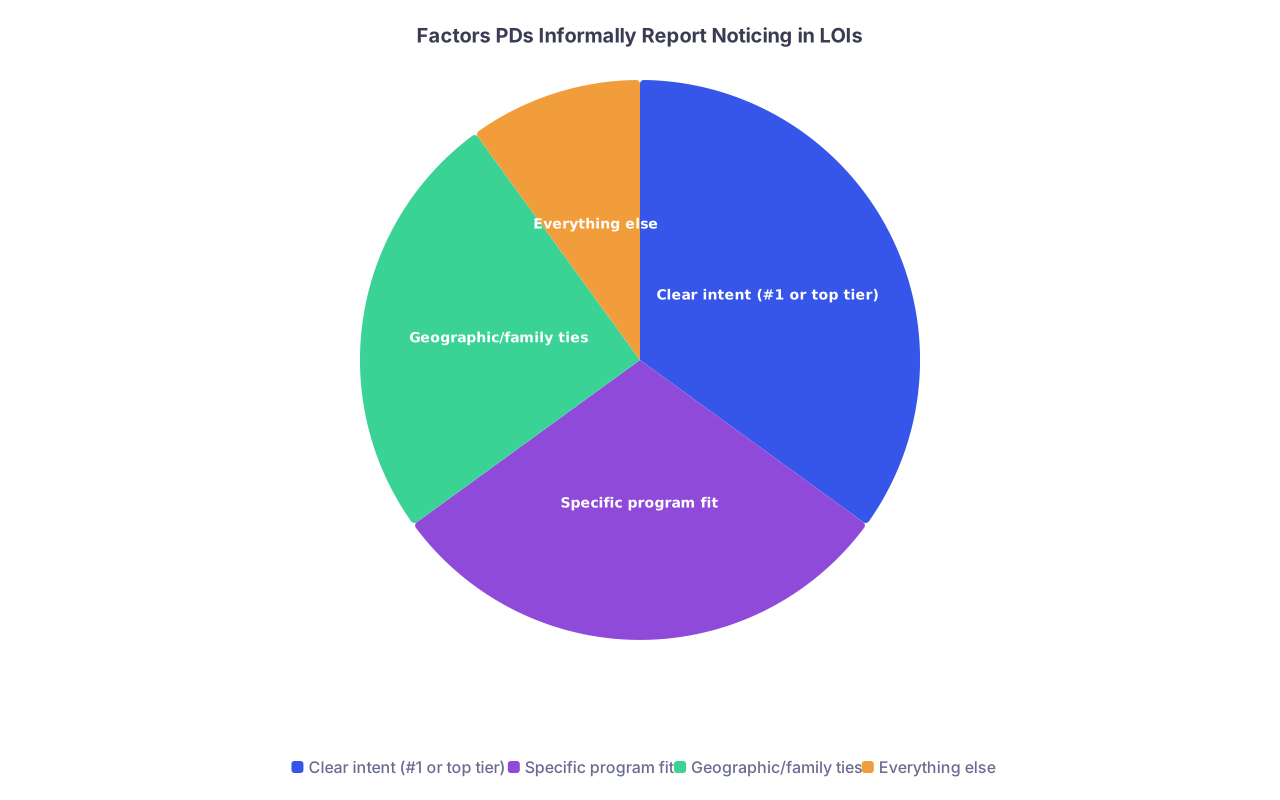
That’s the real impact. Not dramatic. But in a tightly packed rank list, those small nudges matter — and they come from content, not length.
| Category | Value |
|---|---|
| Clear intent (#1 or top tier) | 35 |
| Specific program fit | 30 |
| Geographic/family ties | 25 |
| Everything else | 10 |
How Short LOIs Fit Into the Bigger Future
There’s another angle no one talks about: the trajectory of graduate medical education is moving away from long-form narrative as the primary signal.
You’re already seeing it:
- More structured evaluations and competency-based milestones.
- Pass/fail Step 1 shifting attention to other quantifiable or semi-structured data.
- Programs adopting standardized supplemental applications and signaling systems.
In that ecosystem, a 1,200-word “love letter” to a program looks increasingly archaic. It’s misaligned with where the field is going: toward structured, high-signal, low-noise communication.
I’d bet on a few future trends:
- Programs formally limiting or even discouraging LOIs.
- Centralized signaling systems (like preference signaling on ERAS) gaining more weight than any individual letter.
- PDs increasingly relying on brief, structured communications over sprawling narratives.
So training yourself to write short, high-yield LOIs isn’t just about gaming this cycle. It’s about matching where medicine as a system is already headed — valuing efficiency, clarity, and signal density over word count.

| Step | Description |
|---|---|
| Step 1 | Now |
| Step 2 | Many long LOIs |
| Step 3 | PD fatigue |
| Step 4 | Preference signals & structure |
| Step 5 | Fewer, shorter, targeted LOIs |
A Simple Template That Stays Short (And Works)
If you’re still anxious and want something concrete, here’s a structure that keeps most people in that 300–450 word sweet spot without sounding robotic.
Paragraph 1 – Direct and short:
Who you are + thank you + explicit intent.
Paragraph 2 – 1–2 specific, credible program fits that clearly link to your history or goals.
Paragraph 3 – Any key contextual factors that increase your likelihood to attend and a closing sentence reaffirming intent.
That’s it.
If you “need” five paragraphs, you’re probably trying to make the LOI do a job it wasn’t designed for.

The Myth, Broken Down
Let me bring this home.
- Long LOIs are not a sign of commitment. They’re usually a sign of anxiety and misunderstanding of how programs think.
- Short, specific, and credible LOIs are far more likely to be read, remembered, and actually influence a rank decision.
- The direction of the field — more structure, more emphasis on clear signals, less tolerance for noise — favors applicants who can say something meaningful in a few tight paragraphs.
If you remember nothing else:
- Your LOI is a signal, not a story.
- Commitment is shown by clarity and specificity, not by word count.
- If a PD can’t grasp your key message in under a minute, the letter is too long — and probably less effective.