
The standard advice about letters of intent is a mess. Half superstition, half hearsay repeated by people who have never actually sat on a rank committee.
Let’s pull it apart.
You’re told: “Everyone sends LOIs,” “You have to send a love letter to your top program,” “More emails = higher match chance,” “Programs don’t care what you send,” and its opposite, “Programs rank you down if you contact them.”
Most of that is wrong. Or at least badly oversimplified.
This isn’t magic. It’s incentive structures, limited human attention, and a rank algorithm that does not care about your feelings.
Myth #1: “Everyone sends LOIs, so you have to or you’re at a disadvantage”
No, everyone does not. At least not in any meaningful, program-changing way.
Here’s what actually happens at many mid-to-large programs:
- 5–15% of interviewed applicants send something that looks like a formal “Letter of Intent” (LOI: “You are my #1 and I will rank you first”).
- A bigger chunk, maybe 30–60%, send at least one “thank you / update / interest” email.
- A small subset sends 3–10+ emails to multiple people at the program.
So when the chiefs or APD say “everyone sends LOIs,” what they often mean is “we get a ton of emails and they blur together.”
Programs are not tallying, “Did this applicant send a classic, capital-L Letter of Intent PDF vs a polite interest email?” They’re asking simpler questions:
- Do we believe this person would actually come here if we rank them high?
- Did they show any engagement, or are they clearly just shotgun-applying?
- Are they professional in how they communicate?
That first question matters more for small and mid-size programs, rural or less “name-brand” places, and newer programs, because filling their class is non-trivial. For ultra-name-brand places, your “intent” matters less; they already know plenty of people would come if offered.
An LOI is a signal, not a requirement. Not sending one doesn’t automatically hurt you. Sending a sloppy one can.
The “disadvantage” isn’t about failing to send a letter. It’s about failing to demonstrate any specific interest in a program that’s taking a risk ranking you aggressively.
If you had a great interview day, wrote a thoughtful thank-you, maybe sent one meaningful update, and then went quiet? You’re not at some catastrophic disadvantage just because you didn’t title something “Letter of Intent” in bold at the top.
Myth #2: “Letters of intent dramatically move you up the rank list”
This is the myth that drives the mania.
I’ve watched rank meetings where faculty say out loud: “Oh, he sent us a letter saying we’re his #1.” Once in a while, that bumps someone a bit if they were already in the conversation. More often, it gets a shrug and a “good to know” comment—and then the committee keeps ranking based on how they actually evaluated you.
Here’s the unsexy truth:
- If you’re already in the borderline/upper-middle cluster, clear demonstrated interest might nudge you a few spots when people are deciding who to fight for in the top half of the list.
- If you were mediocre on interview day, your LOI doesn’t magically override “we had concerns about their communication” or “they didn’t answer any questions directly.”
- If you impressed everyone and you’re sitting near the top, your LOI is nice, but not the reason you’re there.
Programs vary. Some community-heavy fields (FM, IM, psych, peds at certain sites) may care more about “would they really come if we rank them high?” while hyper-competitive surgical subspecialties mostly care about letters, research, and “do we want to work with this person at 2 a.m. in the OR.”
But across specialties, what actually moves you up is:
- How you performed on interview day (and yes, that includes being normal to coordinators and residents).
- Strength of your application: letters, scores, research, clinical track record.
- Whether someone on the committee is willing to advocate for you.
An LOI is, at best, ammo for a champion who already likes you: “They told us we’re their first choice, we could probably safely rank them high and they’d come.” It is not a magic spell that converts a lukewarm eval into a top-10 rank.
So no, LOIs do not “dramatically” move you. They conditionally, occasionally, nudge the edge cases.
Myth #3: “Programs don’t care about etiquette; it’s all about numbers”
People love to cope with this one. “They only care about Step and publications. Nothing else matters.”
Also wrong.
Programs start caring with screens and metrics. They finish caring with human behavior.
You know what gets remembered in rank meetings far more often than your Step score? Stories.
- “This was the one who wrote the really thoughtful thank-you about our addiction clinic—remember?”
- “She was the only applicant who asked about our QI project and then followed up with a paper she’d done on similar work.”
- Or on the flip side: “This is the guy who emailed me 5 times over two weeks asking for updates and saying we were his ‘dream place’ for three different programs.”
Etiquette is not about being fake-polite. It’s about signaling professionalism, judgment, and whether people want to work with you for the next 3–7 years.
Where etiquette does matter:
- Timely, concise thank-you notes: Not required, but they keep you anchored as “engaged and professional.” They’re especially helpful when the interview was late in the season and memories are fuzzier.
- Targeted updates: One or two relevant, program-specific updates (“I matched into AOA,” “Our paper on sepsis QI—similar to your unit’s work—just got accepted”) can actually differentiate you.
- Respecting boundaries: If a program says “No post-interview communication will be considered,” and you barrage them anyway, that signals that you either can’t read or don’t care. Neither screams “reliable resident.”
Where etiquette does not matter as much as people think:
- Perfect letter formatting, dramatic subject lines, or quoting NRMP policy at them.
- Flowery language about “lifelong dream since childhood to serve this community” that obviously just got copy-pasted.
The data we have—NRMP Program Director Surveys across years—show consistent themes: interview performance, LORs, and perceived “fit” (yes, that squishy word) rank high. Post-interview contact is somewhere down the list, not irrelevant but not top-tier. That’s your hint.
Etiquette is a tie-breaker and a risk-signal. Use it that way.
Myth #4: “You should tell multiple programs they’re your #1”
This is the sleazy one.
Applicants convince themselves: “Everyone lies to multiple places; I have to play the game.” They send three different “You are my absolute first choice and I will rank you #1” emails. Usually forgetting faculty actually talk to each other across programs and institutions.
Reality check:
- Some programs absolutely know when people are double-dipping. Faculty swap stories. PDs text each other. A famous applicant name doing research at one big institution will get noticed if they “promise” two competing programs.
- Getting caught doesn’t mean you get blacklisted by a national cabal, but it does brand you as unreliable in the only arena that currently matters to your future: professionalism.
Do programs expect some game-playing? Yes. They know some applicants send overly committal “strong interest” messages to many programs. But there’s a difference between:
“I’m extremely interested in your program and will rank you very highly,”
versus
“You are my number 1 and I will rank you first.”
One is strategic but honest (you might rank them #2 and that’s still “very high”). The other is a specific claim. If you make that promise to multiple programs, you’re the one lying. Not them.
If you want a simple rule you can actually live with:
- Use “you are my top choice / I will rank you first” for exactly one program, if you choose to at all.
- For other programs you genuinely like, say “I will rank your program very highly” or “you’re among my top choices.” Which can be true, even if you’re #3.
I’ve seen applicants try to be clever: they send “#1 in X region” to three different cities, or “my top choice for training in the Midwest” to two states. Faculty are not that stupid. Programs have maps.
You do not need to burn your integrity to match. You need to be strategically honest, not creatively dishonest.
Myth #5: “If you don’t send anything after interviews, programs assume you’re not interested”
Another exaggerated fear.
Does silence sometimes get interpreted as “maybe they’re not that into us”? Yes, especially in smaller or less famous programs that are actively trying to avoid going unmatched.
But ranking committees are not children reading into every texting delay. They know:
- Some med schools and advisors tell applicants not to send anything.
- Some specialties emphasize “no post-interview communication” (often honored in the breach).
- Some people are just cautious and don’t want to say anything that feels like a promise.
What silence does is remove you from the “clearly interested” bucket. It doesn’t automatically downgrade you into “do not rank.”
Here’s how it usually plays out in a rank meeting:
- If you’re excellent and everyone liked you, you’ll still be high whether you emailed or not.
- If you’re borderline and they’re deciding between you and a similar applicant who did reach out thoughtfully, that person might get the edge.
- If a PD is paranoid about going unfilled, they might slide people who demonstrated strong interest a bit higher in the mid-ranks, because they’re more likely to actually show up.
If you don’t want to send LOIs, fine. At least send short, specific thank-yous to places you’d actually be happy to train. It’s a 5-minute time investment that keeps you from being entirely forgettable.
Myth #6: “More contact = more interest = better ranking”
This one causes the worst applicant behavior.
No, blasting programs monthly does not raise your stock. It raises your creep factor.
The reality inside a busy program:
- The coordinator is drowning in email—interview logistics, faculty schedules, onboarding paperwork, GME bureaucracy.
- Residents and faculty are juggling full patient loads, notes, call schedules, and their own families.
- When they open email from applicants, they’re subconsciously sorting: normal, enthusiastic, or needy.
One well-timed, concise LOI or strong-interest message? Normal. Shows awareness but not drama.
Weekly “just checking in,” “any updates on the rank list,” “I wanted to reiterate that you are my top choice”—that’s needy. And it will get mentioned: “This applicant has been a bit intense with the emails.”
Programs are not measuring the derivative of your enthusiasm over time. They don’t need five data points to believe you’re serious.
A functional strategy looks like this, for programs you actually care about:
- Post-interview: brief, specific thank-you email, ideally within a week.
- Later in the season: if there’s a meaningful update or you’ve decided they’re truly your top (or top few) choices, one additional email that either:
- Shares a real update, or
- States your genuine level of interest clearly.
And then stop.
If they don’t respond, it does not mean they hate you. Many programs have explicit policies about not expressing interest level back to applicants. They’re not allowed to say, “We’re ranking you high.” So they say nothing.
Silence from them doesn’t mean your email hurt you. It means they’re obeying policy, or they’re busy, or they just don’t see replying as necessary.
Myth #7: “LOIs don’t matter at all because the Match algorithm protects you”
This is the intellectually lazy, pseudo-sophisticated take.
Yes, the NRMP algorithm is applicant-proposing and benefits you ranking programs in your true preference order. No, that doesn’t mean your communications can’t affect where a program ranks you.
Two separate things:
The algorithm:
It will match you to the most preferred program on your rank list that also ranks you high enough on theirs to intersect. This part doesn’t care about your emails. It cares about rank lists.How rank lists get made:
That’s where human behavior, risk tolerance, and perception of your interest come in.
Programs don’t want to go unfilled. Community and smaller programs especially hate scrambling. So they may:
- Push up people they think are more likely to actually come if ranked highly.
- Tread more cautiously with “superstars” who seem to be reaching for only big-name places.
Your LOI and general behavior live in that second layer. They indirectly affect your match probability by altering your spot on their list.
But the algorithm still wants you to be honest on your side. Let me be clear:
Lying on LOIs so you can feel safer gaming the system doesn’t suddenly hack the algorithm in your favor. It just inflates noise in the system and occasionally blows back on your reputation.
If you want to respect both the math and your sanity:
- Rank programs in your true order of preference. That part is non-negotiable if you care about outcome quality, not just any match.
- Use LOIs and interest notes to reduce program uncertainty at the places you most want to train. Not to pretend you love places you’d actually hate, just to “have a safer match.”
The algorithm protects you from being “penalized” for ranking “reach” programs first. It doesn’t protect you from the consequences of being obviously disingenuous.
So what actually makes sense to do?
Let’s translate the debunking into a rational approach.
First, one clear table for how contact is usually perceived:
| Action | Typical Program Perception |
|---|---|
| No post-interview contact | Neutral to mildly negative if borderline |
| One thank-you email | Mildly positive, professional |
| One thoughtful update/LOI to true #1 | Positive, can help at margins |
| Multiple generic LOIs to many programs | Neutral at best, sometimes eye-roll |
| Frequent repetitive emails (3+) | Negative, seen as needy or lacking judgment |
Then, some simple rules you can follow without losing your mind:
- Do not confuse volume with value. One or two smart, honest contacts beat ten frantic ones.
- Do not tell multiple programs they’re your unequivocal #1. If you wouldn’t say it face-to-face to both PDs in the same room, don’t email it.
- Do not assume LOIs are magical. They’re tiebreakers and reassurance, not rescue missions.
- Do not play “too cool to care.” Silence makes it harder for risk-averse programs to bet on you.
And yes, you can match at fantastic programs having never used the phrase “Letter of Intent” a single time.
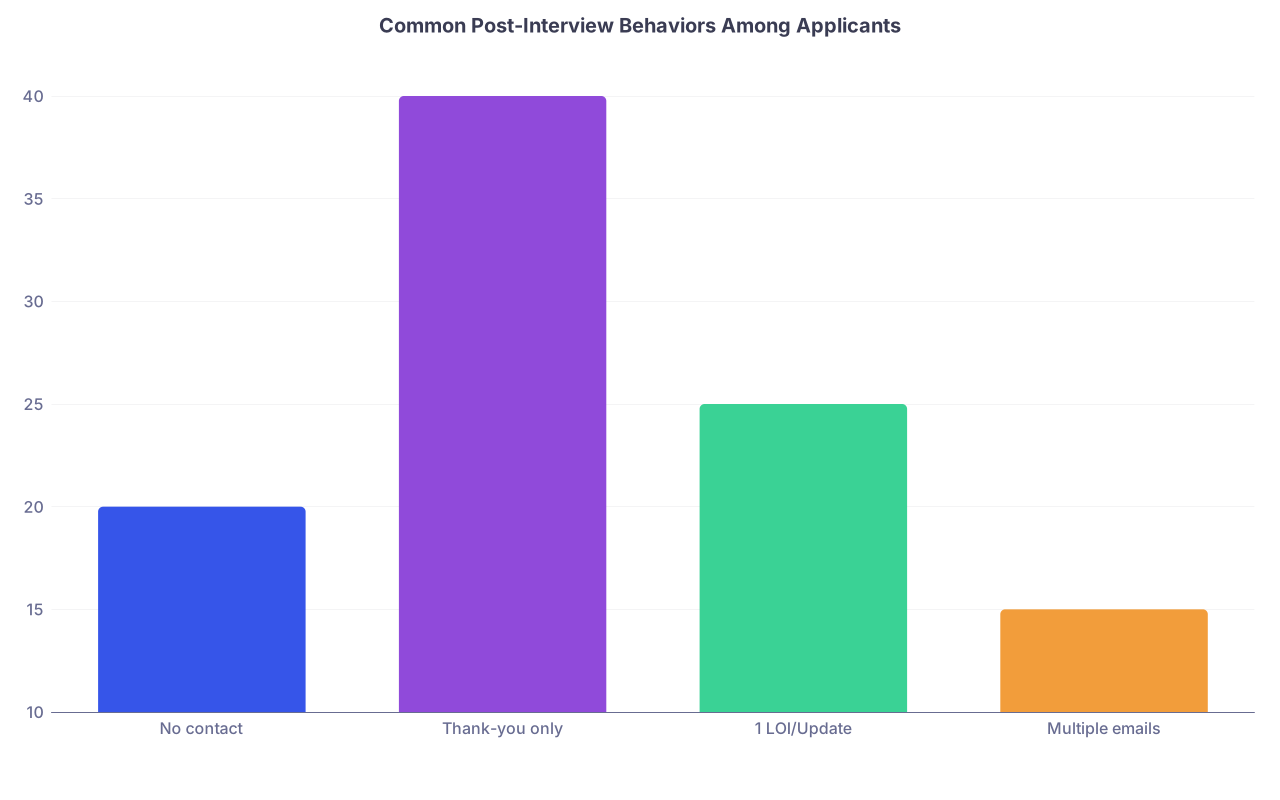
| Category | Value |
|---|---|
| No contact | 20 |
| Thank-you only | 40 |
| 1 LOI/Update | 25 |
| Multiple emails | 15 |


| Step | Description |
|---|---|
| Step 1 | Applicant Interview |
| Step 2 | Upper Rank Cluster |
| Step 3 | Lower Rank Cluster |
| Step 4 | Small Upward Nudge Possible |
| Step 5 | Remain in Strong Group |
| Step 6 | May Avoid Drop |
| Step 7 | Low Priority |
| Step 8 | Evaluation Strong? |
| Step 9 | Clear Interest Shown? |
| Step 10 | Clear Interest Shown? |

The short version
Three things to walk away with:
- LOIs are weak levers, not main engines. They can help at the margins when you’re already competitive, but they don’t transform a bad or forgettable interview into a top rank.
- Honesty and restraint beat volume and theatrics. One true “you are my #1” (if you choose to send it), plus a few smart, specific contacts, is as much as any sane program expects.
- Etiquette is a proxy for professionalism. Programs don’t obsess about your email style, but they absolutely notice if you’re thoughtful, sane, and not a chaos generator before they sign up to work with you for years.