
The panic around NRMP rules and “commitment letters” is wildly overblown—and often flat‑out wrong.
You’re being fed myths by co-residents, Reddit threads, and occasionally by programs that should know better. Let’s walk through what the rules actually say, what programs can and cannot do, and how you should handle letters of intent without lying to yourself or anyone else.
What NRMP Really Cares About (And What It Doesn’t)
The National Resident Matching Program (NRMP) is not in the business of policing your emails for “I really love your program” language. It exists to protect the integrity of the Match algorithm and to prevent coercion and fraud.
Strip away the legalese, and the NRMP cares about a few core things:
- You submit an honest rank list based on your true preferences.
- Programs do the same.
- Nobody pressures the other party to commit or reveal rank order.
- Nobody backs out of a match once it’s finalized, except under formal waiver.
Everything else—“love letters,” thank you notes, “we will rank you highly”—lives in a gray social zone, not a legal one. Commonly treated as sacred. Mostly toothless.
Here’s the part most people miss: the NRMP has already published a clear policy on communication. They’re not vague about it.
- Programs may tell you they’re interested.
- You may tell programs you are interested.
- Neither side may require or demand any statement about rank intentions.
- Neither side may commit as a condition of ranking.
This is from their own Match Participation Agreement and Code of Conduct, not internet lore.
The Big Myth: “Commitment Letters Are Illegal”
No, they are not.
Programs sending you an email that says, “We intend to rank you highly” or “You’re one of our top choices” is not illegal. You telling a program, “You are my #1 choice” is also not against NRMP rules.
The problem is not legality. The problem is honesty and coercion.
The actual NRMP violations around this stuff are about:
- Asking you to reveal your rank list (“Will you rank us first?”)
- Pressuring you to commit as a condition to rank you (“We will only rank you if you promise to rank us first and say so in writing”)
- Threatening or punishing based on what you say (“If you don’t commit, we’ll assume you’re not interested and rank you low”)
A “commitment letter” itself—a letter of intent, a “you are my top choice” email—is not forbidden. Misusing it is.
So when someone says, “You can’t send a letter of intent, it’s against NRMP rules,” they’re wrong. Completely.
What is true: the NRMP explicitly says all these communications are non-binding. The algorithm ignores them. You can tell three programs “you’re my top choice” and the algorithm will not care. (The programs might, but the NRMP won’t.)
What the Data and Enforcement History Actually Show
The NRMP does a periodic Program Director Survey and Applicant Survey. Over and over, you see the same pattern: everyone thinks post‑interview communication and signals are hugely important, but the hard decisions are driven by:
- Interview performance
- Letters of recommendation
- Board scores (where relevant)
- Clerkship grades
- Perceived “fit”
Love letters sit way down the list. “Post-interview contact” usually ranks as moderately important at best.
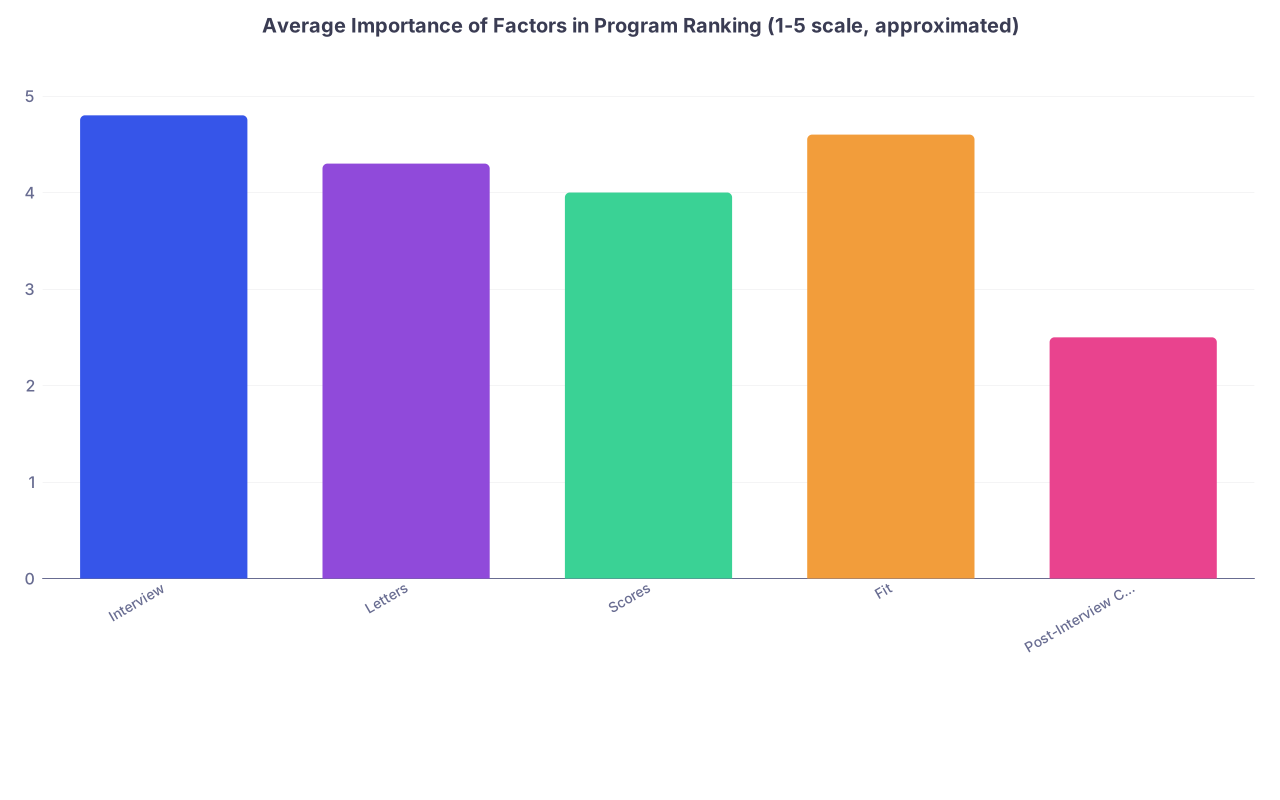
| Category | Value |
|---|---|
| Interview | 4.8 |
| Letters | 4.3 |
| Scores | 4 |
| Fit | 4.6 |
| Post-Interview Contact | 2.5 |
Now, enforcement.
Every year, a small handful of programs and applicants are investigated or sanctioned for NRMP violations. Most of those cases involve:
- Premature contract offers (outside the Match)
- Withdrawing from a match without a waiver
- Program-side coercion or misrepresentation
You know what you don’t see? People getting nuked for sending a sincere “you’re my top choice” email. Or for not sending one. The NRMP doesn’t have the time or desire to read your love notes.
The NRMP will act if:
- A program makes ranking contingent on a written promise.
- A program threatens to rank you lower if you won’t reveal your rank intentions.
- There’s documented coercion.
They are not ranking your etiquette. They are protecting the structure of the market.
Letters of Intent: What They Are and What They’re Not
Let’s clean this up.
A letter of intent is simply:
“Based on what I know now, you are my first choice, and if I match there, I’ll be thrilled.”
That’s it. Not:
“I legally swear I will rank you #1 and never change my mind under penalty of career death.”
Key reality: NRMP rules already assume your final rank list is your actual intent. The piece of paper that matters is the list you submit in the R3 system, not the email you send the PD.
So should you send a letter of intent? Here’s the honest breakdown.
When a Letter of Intent Makes Sense
It’s useful when:
- You truly have a clear #1.
- The program is realistically within your range.
- You want to differentiate yourself from a large middle pack.
- The program leadership seems to care about applicant interest (many community programs, some mid‑tier academics).
In that context, one carefully written, honest letter can help slightly at the margins. Not transform your odds from 10% to 90%. But nudge.
When It’s Useless or Counterproductive
I’ve watched people churn out five “You are my #1” letters in one weekend. That’s not strategy. That’s panic.
You should either:
- Have one true letter of intent (one program gets the “#1” language), or
- Send only “strong interest” / “rank-to-match range” style messages without #1 claims.
Once you start playing word games—“you’re my top choice on the East Coast,” “you’re my first choice among programs with an attached VA”—you’re signaling exactly what you think you’re avoiding: that you’re hedging.
Program directors can smell this. They’ve read thousands.
What Programs Are Allowed To Say vs. What They Actually Say
There’s an ugly gap between NRMP rules and on-the-ground behavior.
NRMP says programs may not:
- Ask you to disclose your rank list.
- Ask you to commit to rank them first.
- Offer or imply a guarantee of matching.
But here’s what you’ll actually hear:
- “If you rank us highly, we’ll rank you highly.”
- “We’d love to have you—if you’re willing to commit.”
- “We have a policy of only ranking applicants who show strong commitment to our city/program.”
I’ve seen programs straight up write: “We need to know if you will rank us first so we can decide how to place you on our list.” That’s a violation, period.
Will the NRMP swoop in instantly and punish them? Probably not, unless someone reports it with documentation. But you don’t have to play along. And you definitely shouldn’t feel obligated to lie.
Here’s the part people underestimate: programs send feel‑good emails all the time that mean almost nothing.
“Ranked to match.”
“Very competitive on our list.”
“Near the top of our list.”
I’ve seen applicants with those emails end up unmatched at that same program. The emails weren’t legally binding. They weren’t practically binding either.
So treat all post‑interview program messages as marketing. Some honest, some aspirational, very few truly actionable.
How to Write an Ethical, Effective “Commitment” Letter
If you’re going to play this game, at least play it clean.
You want three things at once:
- Stay within NRMP rules.
- Don’t lie.
- Still communicate clearly.
Here’s a template skeleton that hits those:
- Open with a simple, specific statement of gratitude and context.
- One sentence that honestly describes your interest level.
- 2–3 concrete reasons that are actually about them, not generic boilerplate.
- A closing line reaffirming interest, without making impossible promises.
For a true #1 letter, that one key sentence might be:
“After completing all of my interviews, your program is my first choice, and I plan to rank you #1 on my list.”
That is allowed. Why? Because the NRMP only forbids making you sign some external pledge as a condition. They do not forbid you from voluntarily telling the truth about your plans.
For strong-interest letters to others, you drop the #1 language:
“You are one of the programs I’m most excited about, and I will rank you very highly.”
That’s honest, accurate, and within the spirit and letter of the rules.
What you do not do:
- Promise the same #1 status to multiple programs.
- Overstate your certainty if you’re still undecided.
- Send panicked “actually you’re my #1 now” messages three days before rank list locks because you heard a rumor.
NRMP Rules vs. Match Strategy: What Actually Moves the Needle
This is where most of the mythology about “commitment letters” collapses.
The Match algorithm is applicant‑proposing. Translation: you should rank programs in your true preference order. That maximizes your chances of getting the best possible outcome for you.
Rank based on:
- Where you’d genuinely want to train.
- Where you realistically think you can match, based on your overall profile.
- Geographic/personal priorities that matter to your life.
Do not rank based on:
- Who sent the nicest email after interview day.
- Who implied you were “ranked to match.”
- Where your friend says they think you’re safer.
A program’s “strong interest” does not override the math of the algorithm. If you’d rather be at Program B than Program A, you rank B higher—even if A wrote you a gushy love note and B stayed silent.
The horror stories of people “getting burned” by ranking their true #1? Almost always distorted retellings. The real pattern is: they had a reach #1, weak middle, and didn’t build a realistic rank list. The algorithm did exactly what it was supposed to do.
NRMP rules are on your side here. The entire point is to let you rank honestly without being punished for not playing commitment games.
Red Flags and When to Walk Away
There are a few program behaviors that should make you question how they operate, regardless of whether you report them.
Watch for:
- Explicit demands: “We will only rank applicants who commit to us as their first choice in writing.”
- Pressure via timeline: “If we don’t receive your commitment by X date, we will assume lack of interest and move on.”
- Conditional threats: “Ranking us lower may negatively impact your chances of being ranked at all.”
These aren’t just NRMP red flags. They’re cultural red flags. If a program is manipulative before you even sign on, imagine what they’ll be like when they own your schedule.
You’re allowed to respond with something like:
“Per NRMP guidelines, I’ll be submitting my rank list based on my true preferences after completing all interviews. I’m very interested in your program and appreciate the opportunity to have interviewed.”
Polite. Clear. Non-compliant with coercion.
And if that costs you a spot on their list? You dodged a bullet.
Quick Comparison: Reality vs. Myth
| Topic | Reality | Myth |
|---|---|---|
| Are letters of intent allowed? | Yes, voluntary communication of interest is allowed. | “Letters of intent are illegal under NRMP rules.” |
| Are they binding? | No. Only the rank list is binding. | “If you send a commitment letter, you’re locked in legally.” |
| Can programs ask your rank order? | No, that’s a violation. | “Programs can ask and you should answer honestly or you’ll be blacklisted.” |
| Should you rank based on interest emails? | No, rank by true preference. | “Always rank the program that tells you you’re ranked to match.” |
| Do letters drastically change outcomes? | Usually minor impact at best. | “A strong letter can rescue a mediocre interview.” |
Simple Flow: How to Handle Post-Interview Communication

| Step | Description |
|---|---|
| Step 1 | Finished Interviews |
| Step 2 | Send honest #1 letter |
| Step 3 | Wait until you decide |
| Step 4 | Optionally send strong interest notes to a few others |
| Step 5 | Send only strong interest emails |
| Step 6 | Submit rank list by true preference |
| Step 7 | Have clear #1? |
| Step 8 | Still undecided near rank deadline? |