
What subject line is sitting on some PD’s screen right now making them less likely to open your letter of intent—maybe even screenshotting it to laugh about with the APD?
If you think, “It’s just the subject line, the content is what matters,” you’re already walking into the trap.
Your letter of intent is one email in an inbox that sees hundreds of “Dear Program Director” messages every cycle. The subject line is your only shot to avoid being:
- Ignored
- Misfiled
- Or quietly judged before they read a single word
Let me walk you through the biggest subject line mistakes I keep seeing from students and residents — and how to not be that email.
1. The “Trying Too Hard” Subject Line
You know these when you see them:
- “My Absolute Top Choice – Please Read!”
- “Committed To Your Program Above All Others”
- “Passionate About Joining Your Incredible Team”
They scream desperation. And worse, they sound like spam.
Program directors don’t want theatrics in the subject line. They want clarity and professionalism. When you load the subject line with emotion, it raises flags:
- Are you sending the same dramatic subject to five other programs?
- Are you going to be this over-the-top and high-maintenance as a resident?
- Is there any substance behind this or just flattery?
The mistake: using the subject line to “sell” instead of to label.
A letter of intent is a formal communication, not a clickbait email. You’re not trying to “hook” a newsletter subscriber. You’re documenting a commitment.
A safe, strong pattern looks more like:
- “Letter of Intent – [Your Full Name]”
- “Letter of Intent – [Your Name], [AAMC ID]”
- “Letter of Intent – [Your Name], [Specialty] Applicant”
Is it boring? Yes. That’s the point. You want zero cringe and zero ambiguity.
Don’t try to be creative here. Creativity is where people embarrass themselves.
2. The “Vague and Useless” Subject Line
On the opposite end of the spectrum: the subject line that says nothing.
Common offenders:
- “Question”
- “Follow-up”
- “Thank you again”
- “Update”
- “Quick note”
Here’s the problem. PDs and coordinators quickly triage email. A vague subject line forces them to open it just to figure out what category it belongs in.
That’s not good. That’s annoying.
I’ve seen coordinators scroll down an inbox and selectively open only what looks obviously relevant:
- “Interview Cancellation”
- “ERAS Application Update”
- “USMLE Step Score Update”
- “Letter of Intent – [Name]”
“Quick question” from an unknown name? Often gets left for later. Later may never come.
If your subject line doesn’t answer “What is this?” at a glance, you’re making them work. Never make a busy PD or coordinator work more than necessary.
Use functional, descriptive language. At minimum, include:
- That it’s a letter of intent
- Your name
- Optional but helpful: AAMC ID or specialty
Don’t bury the purpose. Put “Letter of Intent” as the first phrase. Not the last.
3. The Dishonest or Misleading Subject Line
This one can quietly wreck you.
Examples I’ve seen:
- “Updated Step Scores – [Name]” when the actual body is 90% “you’re my #1” and there’s one sentence of “no new scores yet.”
- “Time-Sensitive Application Question” when it’s just a LOI and nothing is time-sensitive about it.
- “Ranking Decision Information” when you’re not actually sending anything new, just begging to be ranked higher.
The temptation is obvious: you want them to open it. So you dress it up as something “urgent” or “official.”
Do not do this.
Program directors are used to being manipulated by subject lines. They’re not stupid. They will catch the mismatch between subject and content. And once they feel tricked, you’ve just told them something about your integrity.
If it’s a letter of intent, call it what it is:
- “Letter of Intent – [Your Name]”
- “Letter of Intent and Brief Update – [Your Name]”
If there truly is a time-sensitive piece (e.g., you matched elsewhere in a scramble scenario, or you’re updating an acceptance/withdrawal), then specify clearly:
- “Status Update – [Your Name] – Withdrawing from Consideration”
- “Status Update – [Your Name] – Ranking and Availability”
But if it’s not urgent or time-sensitive, don’t pretend it is. That’s how you look like spam.
4. The “Program Name Disaster” Subject Line
If there’s one way to get your email read and then dismissed in under 10 seconds, it’s this:
Get the program name wrong. Or include the wrong city. Or, and I’ve seen this, the wrong specialty.
Things I’ve watched PDs and coordinators show each other on their screens:
- “Letter of Intent – [Applicant Name] – University of Pittsburgh”
…sent to a program in Philadelphia. - “Letter of Intent – [Applicant Name] – Internal Medicine”
…sent to a Family Medicine program. - “Letter of Intent – [Applicant Name] – [Other Institution Name]”
Copy-paste fail. Easy to spot. Hard to forgive.
You might think, “But it’s just the subject line; the body will clarify.” They don’t care. They see the error and assume:
- You mass-sent letters to multiple programs
- You don’t have attention to detail
- Your “you’re my #1” claim is probably a lie
If you’re going to include the program name, it must be airtight. If there is any risk you’ll screw it up, leave it out of the subject line and keep it in the body only.
Risk calculus:
- High attention to detail + single letter of intent = include program name if you want
- Rushing, sleep-deprived, applying in a competitive specialty, juggling 5 versions of a LOI = don’t put the program name in the subject line at all
Instead of:
- “Letter of Intent – [Your Name] – University of Chicago IM Program”
Use:
- “Letter of Intent – [Your Name] – Internal Medicine Applicant”
Then inside the email:
“I am writing to state that your Internal Medicine Residency at the University of Chicago is my clear first choice…”
Lower risk. Same clarity.
5. The “ALL CAPS / Punctuation Explosion” Subject Line
Normalize something in your brain: PDs and coordinators have seen every flavor of unhinged email.
When your subject line looks like this:
- “URGENT: LETTER OF INTENT!!!”
- “PLEASE READ – My #1 Choice!!!”
- “VERY IMPORTANT LETTER OF INTENT”
You think you’re emphasizing importance. What they see is stress, immaturity, and a whiff of instability.
Common red flags:
- All caps words (“URGENT”, “IMPORTANT”)
- Multiple exclamation points
- Excessive punctuation (“??”, “!!”, “?!?!”)
- Emojis (yes, someone actually did “🙏” in a subject line)
You’re not emailing your friend. You’re communicating with people who decide your professional future and who are hypersensitive to professionalism.
Use normal capitalization and zero drama. No exclamation points. No emojis. No artificial urgency.
A subject line that blends in is safer than one that stands out for the wrong reason.
6. The Overloaded, Paragraph-Long Subject Line
Some applicants overcorrect and try to shove their entire pitch into the subject line.
Examples that actually happen:
- “Letter of Intent – [Name], US MD, 250 Step 2, Strong Fit for Academic IM and Particularly Interested in Your Clinical Research and Community Outreach”
- “My Commitment to Ranking Your Program First on My NRMP List and Reasons Why I Believe I Would Thrive in Your Environment”
This is exhausting to read. On mobile, it truncates. On desktop, it wraps messily. On the PD’s brain, it registers as “too much.”
Subject line = label. That’s it. Not a mini-personal statement.
You don’t need:
- Scores
- Class rank
- Research topics
- Flattery
- Justifications
All of that belongs in the email body. The subject just needs to tell them:
- What the email is
- Who it’s from
That’s it. Anything more is trying too hard and usually backfires.
Keep it under 80 characters whenever possible. Cleaner, easier to scan.
7. The Confusing “Chain Reply” Subject Line
Another sneaky mistake: replying to an old email chain with an unrelated subject.
For example:
You received an interview day logistics email titled:
“Interview Information – [Program Name] [Date]”
You then hit reply and send your letter of intent on that same thread.
Now your LOI is buried under a subject line that looks like logistic noise. And possibly under a long chain that the coordinator has already archived.
Why this is a problem:
- They may not realize it’s a fresh, important message
- It doesn’t stand out amid other admin emails
- It looks lazy, like you just grabbed the easiest way to email rather than write a proper, standalone professional communication
For a true letter of intent, start a new email with a clean, accurate subject line:
- Do not recycle interview reminder subjects.
- Do not bury intent in a “Re: Interview Day Parking Info” thread.
If you must reply in an old chain (some systems make this easier), at minimum change the subject line to reflect the true purpose. But the cleaner approach: fresh message, clear subject.
8. The Anonymously-Worded Subject Line
Here’s another one people underestimate.
If your subject line is just:
- “Letter of Intent”
You’re making the recipient click into the email just to figure out whose it is. Multiply that by dozens of similar messages, and it becomes friction.
They often print or forward these emails to the ranking committee. “Whose LOI is this?” shouldn’t be the first question they have to answer.
Include your name. Every time.
Better:
- “Letter of Intent – [First Last]”
- “Letter of Intent – [First Last], AAMC [Number]”
Putting your name up front:
- Helps programs quickly cross-reference with their list
- Looks organized and adult
- Reduces their mental load (which they appreciate more than you think)
If you’re worried about length, cut the fluff, not your name.
9. The Wrong Timing Wrapped in the Wrong Subject
Timing and subject line interact more than people realize.
Two risky combinations:
Late-cycle Hail Mary + Dramatic Subject
- Subject: “URGENT LETTER OF INTENT – PLEASE READ TODAY”
- Sent 48 hours before rank list is due
This looks like panic. PDs know when the deadline is. Shouting “urgent” doesn’t help; it just broadcasts that you’ve waited too long.
Early, Premature LOI + Overconfident Subject
- Subject: “Formal Letter of Intent – Ranking Your Program #1”
- Sent before you’ve completed all interviews or before you even receive one from them
Some programs find this presumptuous, especially if they haven’t offered you an interview yet.
Your subject line shouldn’t fight your timing. It should match reality.
If you’re sending it near the end of the season, keep it calm and straightforward:
- “Letter of Intent – [Name]”
If you’re updating past communication or clarifying something, say so:
- “Letter of Intent Clarification – [Name]”
- “Final Letter of Intent – [Name]”
What you don’t want is to look frantic or manipulative. The subject line is the first place that leaks.
10. The Unprofessional Address/Display Name Combo
Not exactly the subject line, but it shows up in the same row in their inbox and can poison the first impression.
Some of you are sending:
- From: “Doc2Be💉”
- From: “FutureSurgeon1995”
- Or from ancient college emails like “partyanimal24@…”
Then the subject line, even if perfect, is sitting next to that disaster.
Here’s the effect: cognitive dissonance. You’re claiming to be ready to function as a physician while emailing from something that looks like a teenager’s TikTok handle.
Fix before you send:
- Use a clean email address: some version of firstname.lastname@provider
- Set your display name to exactly how you want it to appear professionally:
- “First Last, MS4” is fine
- Or simply “First Last”
Then, with a solid subject like:
- “Letter of Intent – First Last”
Your entire inbox row says: adult, professional, competent.
11. The Multi-Program, Copy-Paste Subject Line Trap
One of the fastest ways to accidentally expose that you’ve sent letters of intent to multiple programs is through sloppy copy-paste across subject lines.
Scenario I’ve seen:
- Program A receives: “Letter of Intent – [Name] – Your Program is My #1 Choice”
- Program B gets the same, except you tweak the middle of the body and forget the subject references them generically
- Two faculty in different institutions know each other. Someone forwards your email as a “look at this applicant’s LOI.” They realize you used the same subject and nearly identical phrasing.
Now you’ve got a reputation issue.
The safest strategy:
Only send one true letter of intent (the “you’re my #1” type). If you’re sending multiple “interest” emails, don’t label them all “Letter of Intent.”
Use more honest, less binding subject lines for the others:
- “Expression of Strong Interest – [Name]”
- “Program Interest Update – [Name]”
And never:
- “Letter of Intent – [Name] – Ranking You #1” to more than one place.
That’s not just a subject line mistake. That’s a character mistake.
If you do send more than one intent-style message (against common advice), at least don’t broadcast it through templated subjects that will out you.
12. Safe Subject Line Templates (And How People Still Ruin Them)
Let’s simplify. You don’t need to invent anything cute.
Here are plain templates that work:
- “Letter of Intent – [First Last]”
- “Letter of Intent – [First Last], AAMC [########]”
- “Letter of Intent – [First Last] – [Specialty] Applicant”
If including program name (only if you’re meticulous):
- “Letter of Intent – [First Last] – [Program Name] [Specialty]”
Here’s how people wreck even safe templates:
- Typos in “intent” (“Letter of Intenet”, “Letter of Intrest”)
- Using nicknames instead of full name (“Letter of Intent – Mikey”)
- Unnecessary adjectives (“Formal and Sincere Letter of Intent – [Name]”)
- Stacking prefixes: “Re: Fwd: Re: Letter of Intent – [Name]”
Slow down. Type it once. Then literally read it out loud:
“Letter of Intent dash First Last.”
If you stumble, it’s probably too long or too messy.
Quick Comparison: Strong vs Weak Subject Lines
| Type | Subject Line Example |
|---|---|
| Strong | Letter of Intent – Jordan Smith |
| Strong | Letter of Intent – Jordan Smith, AAMC 12345678 |
| Acceptable | Letter of Intent – Jordan Smith – Internal Medicine |
| Weak/Red Flag | URGENT!!! My #1 Choice – Please Read |
| Weak/Red Flag | Quick Question |
| Weak/Red Flag | Letter of Intent – Jordan Smith – University of X (wrong program) |
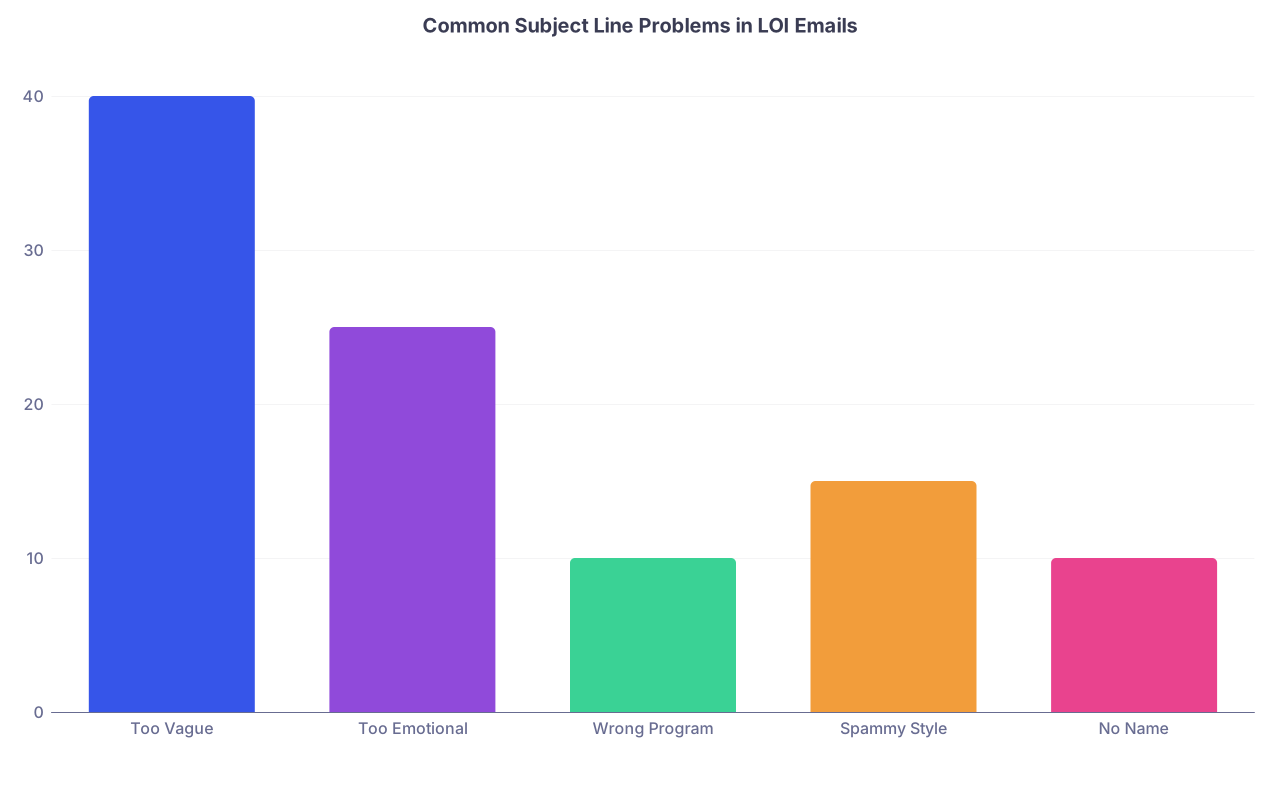
| Category | Value |
|---|---|
| Too Vague | 40 |
| Too Emotional | 25 |
| Wrong Program | 10 |
| Spammy Style | 15 |
| No Name | 10 |

| Step | Description |
|---|---|
| Step 1 | Writing LOI Email |
| Step 2 | Use phrase Letter of Intent in subject |
| Step 3 | Use Interest or Update instead |
| Step 4 | Add Full Name |
| Step 5 | Optionally add Program Name or Specialty |
| Step 6 | Skip Program Name in subject |
| Step 7 | Label clearly - Interest or Update |
| Step 8 | Final subject - clear and professional |
| Step 9 | Is this a true letter of intent? |
| Step 10 | Confident in program name accuracy? |
Final Takeaways
Keep this simple and you’ll avoid 90% of the disasters:
- Subject line = label, not sales pitch. Use clear, boring phrases like “Letter of Intent – [Your Name].”
- Don’t lie or overdramatize. No “URGENT!!!”, no fake urgency, no spammy tricks.
- If you include program name or specialty, triple-check it—or leave it out to avoid a fatal copy-paste mistake.
Your subject line shouldn’t impress anyone. It should quietly pass the “no red flags” test and let the content of your letter do the actual work.