
The fastest way to quietly kill your chances with a program director is to recycle a letter of intent template and miss the clues you forgot to delete.
Not ghosting them. Not a mediocre away rotation. A lazy, sloppily recycled LOI that exposes you as generic, inattentive, and—worst of all—not actually committed.
I have read these. Faculty on admissions committees trade screenshots of them. Residents laugh about them in the workroom. PDs remember names. You do not want to be that story.
Let’s walk through the non‑obvious ways people sabotage themselves with recycled LOI templates—and how to stop yourself before you hit send.
The Core Problem: Your Template Is Louder Than Your “Sincere Interest”
People think the risk of reusing a letter of intent (LOI) is just a wrong program name here or there.
That is not the main problem.
The real danger is that your template voice—vague, interchangeable, plastic—drowns out anything specific you claim about “fit” or “top choice.” Programs know what a template sounds like. Most of them could recite it by heart:
“I am writing to express my sincere interest in your esteemed program. After interviewing at numerous excellent programs, I am confident that [PROGRAM] offers the ideal environment for me to grow…”
You could drop that paragraph into any program in the country and it would still “work.” That is exactly why it fails.
If 90% of your LOI is template and 10% is genuinely tailored, you are signaling three things:
- You are not actually obsessed with their program.
- You rely on generic language instead of real thought.
- You missed details. And they know you probably missed other details too.
That is what a PD reads between the lines.
The Most Common “Leftover Clues” That Expose Your LOI Template
Let’s start with the visible landmines—the things PDs, APDs, and chiefs actually quote back in committee because they are so painfully obvious.
, Mixed Institution Details, Outdated Info](https://cdn.residencyadvisor.com/images/articles_svg/chart-common-loi-template-mistakes-3716.svg "Common LOI Template Mistakes")
| Category | Value |
|---|---|
| Wrong Name/Title | 65 |
| Wrong Program Details | 55 |
| [Copy-Paste Formatting](https://residencyadvisor.com/resources/letter-of-intent-strategy/copy-paste-letter-of-intent-red-flags-programs-spot-instantly) | 40 |
| Mixed Institution Details | 35 |
| Outdated Info | 30 |
1. Wrong program name or institution
Yes, people still do this. Every year.
You write to “Massachusetts General Hospital Internal Medicine Residency Program” and two lines later you say you would be “honored to train at Brigham and Women’s.”
Or you email the PD at “University of Colorado” and your subject line says “Letter of Intent – University of Utah.”
Programs do not assume “honest typo.” They assume:
- You mass‑emailed multiple places.
- You are sending the same “top choice” letter to several programs.
- You do not pay attention to details.
And if you are sloppy in a short, critical document you had days to polish, what are you going to be like with chemo orders and insulin drips at 2 a.m.?
2. Wrong specialty / track / city references
I have seen:
- “I am excited about your strong exposure to pediatric patients” in an adult neurology LOI.
- “I am particularly interested in your rural track” sent to a program that has only urban sites.
- “Your program’s emphasis on community‑based training in Houston” sent to a program… not in Houston.
These tell the reader one thing: you are splicing chunks of text from multiple letters and not reading the final version like a human.
3. Named faculty and features that are not theirs
This one is more subtle and more dangerous.
You write:
“I was impressed by the longitudinal clinic in East Baltimore and your robust global health track.”
Except this is not Hopkins. It is a completely different program that does not have:
- Longitudinal clinic at that site
- That specific global health structure
- Any connection to East Baltimore
You obviously mined another program’s website or notes and forgot to strip the detail out when you recycled your LOI. That screams “control‑F edit” instead of real engagement.
4. Skeleton language that never got filled in
Watch for phrases like:
- “Your focus on [resident well‑being / diversity / research] really resonates with me.”
- “The opportunity to work with faculty such as Dr. [X] would be invaluable.”
- “Your program’s unique [insert feature] stands out among others.”
People literally leave the bracket placeholders or forget to replace them with anything concrete. Or they replace one but not the other.
You would be surprised how many PDs can quote an applicant’s “[insert program strength here]” line.
5. Mixed program facts from two different places
This happens when you over‑recycle.
You interviewed at:
- Program A: strong VA experience, no county hospital.
- Program B: huge county experience, minimal VA.
Your LOI mash‑up says:
“I am excited by your VA and county experience, and your 6+2 clinic structure.”
They have one of those things. Maybe two. But not all three. They can tell you slapped a “best of everything” paragraph together from multiple letters.

The Hidden Metadata Traps You Forgot Even Exist
The worst mistakes are the ones you cannot see at first glance. Programs can.
1. Document properties that reveal another program’s name
If you attach a PDF or Word document, there are invisible fingerprints:
- Title
- Author
- Last saved by
- Comments
- Sometimes even an initial file name embedded in metadata
I have opened LOIs where the file name on upload was “MGH_final_LOI_for_upload” and the student was writing—allegedly—a “top choice” letter to a completely different program.
Here is what usually gives it away:
- Word “Title” field: “Letter of Intent – Mayo”
- Adobe PDF “Subject”: “Brigham LOI v3”
- Track changes comments saved in the file from faculty with program names in them
Most PDs are not hunting for this, but some IT systems show these things automatically. Do not assume no one will see.
2. Version control giveaways in file names
You think you are being careful by naming your file:
- “LOI_final_EDITED”
- “LOI_top_choice_v7_revised”
- “LOI_UCLA_USE_THIS_ONE”
They see desperation. Or worse, they see evidence you sent variants of “top choice LOI” to multiple places.
If your ERAS or email attachment shows clearly that this is v7 and you made multiple “top choice” versions, the credibility of your “I will rank you #1” line plummets.
3. Inconsistent fonts, spacing, and copy-paste scars
Nothing screams “stitched together from other letters” like:
- Half of one paragraph in Times New Roman, rest in Calibri.
- Random double spaces between sentences in just one section.
- A single line in a slightly different font size.
- Quotation marks or apostrophes that look different (straight vs curly) because they came from another document.
People on selection committees may not consciously name this as a template. But they feel it. It reads disjointed. Artificial. Careless.
4. Time‑stamp contradictions
There are schools and programs that track:
- When the file was created
- When it was last modified
- When it was uploaded
If your email claims “I have reflected at length since my interview on November 18,” and the file was created on November 16 and never touched again, that mismatch is obvious.
Again—no one is running forensic-level investigations. But when something feels off, these are the things that confirm their suspicion.
The Ethical Minefield: Template LOIs and Dishonesty
Let me be blunt. The biggest mistake with LOI templates is not technical.
It is ethical.
Many students recycle a “you are my top choice” letter to two, three, five programs. Same skeleton. Slight variations. That is not just “strategy.” It is lying.
| LOI Behavior | Risk to Credibility | Comment |
|---|---|---|
| No LOI sent | Low | Neutral, not fatal |
| Specific, honest LOI to one program | Low | Can help at the margins |
| Generic template LOI to many | Moderate | Wasted effort, looks plastic |
| Recycled “top choice” LOI to many | High | Ethically and strategically bad |
Here is how this backfires:
- Programs talk. Not in some conspiracy-theory way, in a “we share applicants, we share impressions” way.
- Residents cross‑compare stories. “Wait, he told us we were his absolute #1 too…”
- Faculty have friends at other institutions. Texts happen.
If two PDs both have “you are my clear #1” letters from you and happen to chat, whose credibility evaporates? Yours.
You are allowed to be uncertain. You are allowed to not send a top-choice LOI at all. You are not allowed to tell three different programs that you will rank them all #1. That is how you damage trust and your reputation.
How To Reuse Structure Without Leaving Clues
You do not need to reinvent the wheel every time you write a letter. You do need to stop being lazy about the parts that actually matter.
Here is the safe compromise: reuse structure, not substance.
Step 1: Build a clean, generic skeleton
Your template should only contain:
- A basic greeting and format
- A standard closing
- A small, generic “who I am” paragraph that is factual, not flattering
Everything program‑specific gets stripped out. No names. No cities. No program features. No “top choice” language.
Step 2: Create a structured “program‑specific” section
Reserve the middle paragraph(s) for content that is fully rewritten for each program:
- Exactly why this program stands out for you
- Specific residents or faculty you met and what they said
- Features that only this program has (or does better than others)
- How your background connects to those specific features
If that middle section could be copy‑pasted into another LOI with minimal edits, you did not go far enough.
Step 3: Add a red‑flag pass before you hit send
Do not trust your eyes alone. Run a deliberate, almost mechanical check:
- Search for every prior program name you have used in any draft this season.
- Search for every city and state you have written.
- Search for key features that belong to other programs (“VA,” “county,” “global health,” “3+1,” etc.) and confirm they actually apply.
- Look at the letter with the mindset: “Could this be addressed to three other programs and still make sense?” If yes, rewrite.
It takes 5–10 minutes. That 10 minutes beats months of regret.
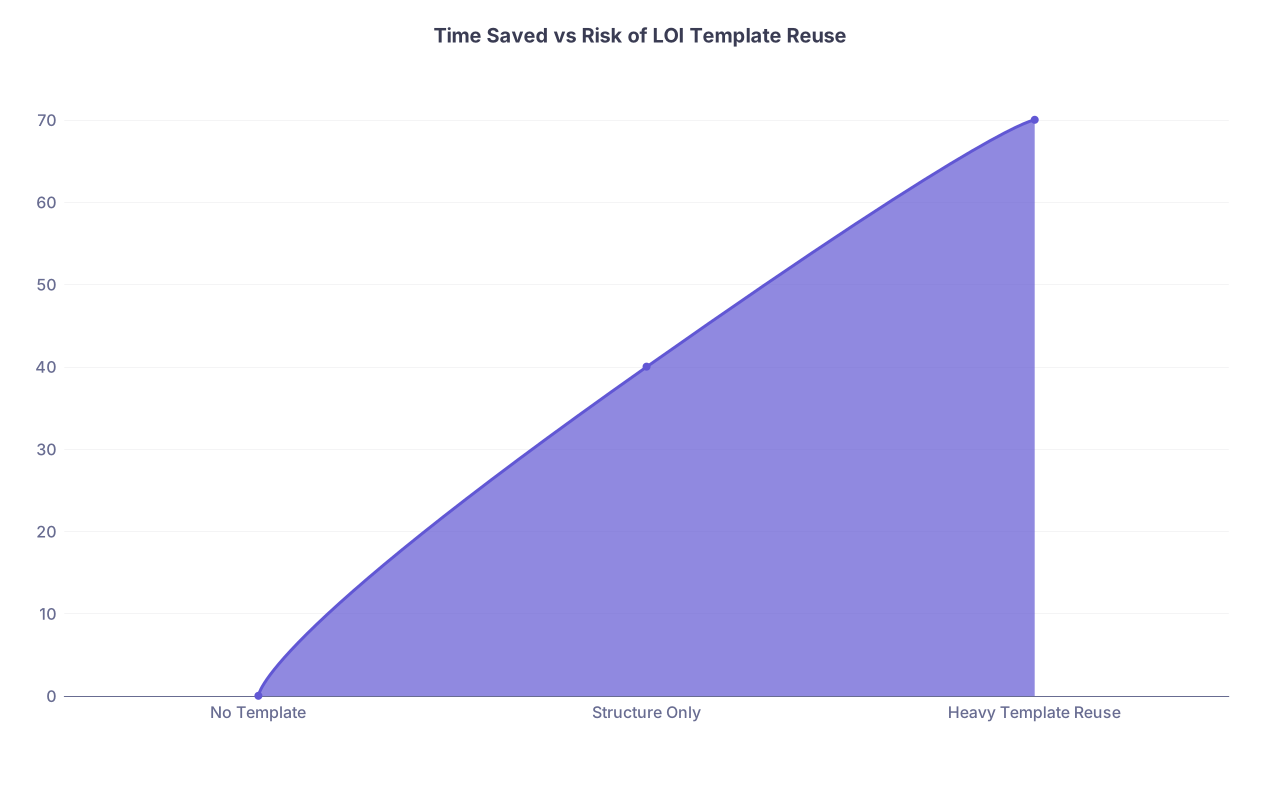
| Category | Value |
|---|---|
| No Template | 0 |
| Structure Only | 40 |
| Heavy Template Reuse | 70 |
(That chart is the reality: yes, heavy template reuse saves time. It also cranks the risk way up.)
Step 4: Lock the file cleanly
Before attaching or uploading:
- Save as a new PDF with a neutral name:
Lastname_Firstname_LOI_ProgramName.pdf - Clear document properties if you used Word or similar (File → Info → Inspect Document).
- Open the PDF and scan for weird fonts, spacing, or formatting glitches.
That extra step is how you avoid having “MGH_v5_LOI” burned into your application at a completely different institution.
The Future Problem: AI‑Generated Templates Making You Blend In
We need to talk about the new twist: AI‑generated LOIs.
They sound polished. They use all the right buzzwords. They are also starting to sound the same. Programs are already noticing.
Here is the trap:
- You feed ChatGPT or some other tool a description of your favorite program.
- It spits out a glowing, coherent LOI.
- You tweak a line, paste your name, hit send… and then reuse that pattern 8 more times.
What you do not see: the exact same tone, paragraph flow, and “I am confident your program will provide the ideal training environment to become a well‑rounded, compassionate physician” line appearing across dozens of applicants.
The mistake is not using AI as a tool. The mistake is relying on the AI draft as your template without brutal personalization.
If your LOI reads like a brochure and has zero rough edges—no specific patient stories, no real conversations described, no slightly quirky detail you noticed on interview day—it looks manufactured. Interchangeable. Low‑effort.
Use AI, but:
- Generate only structure and then heavily rewrite in your own voice.
- Inject detail that an AI would not know: names, exact anecdotes, phrases faculty actually used.
- Strip the generic “I am confident” boilerplate and replace it with real observations.
If your letter sounds like corporate marketing copy, assume the PD has already read five near‑identical versions that week.
Quick Self‑Audit: Does Your LOI Actually Sound Like You?
One more subtle but important point. Templates—human or AI—flatten your voice. That is another clue you forgot to delete.
Ask yourself:
- Do I use phrases in this letter that I never say out loud? “Esteemed institution,” “robust clinical training,” “unique blend,” “my passion for…”
- Does this read like every “sample letter of intent” on Google?
- Could a friend recognize this as mine without my name on it?
If the answer to those is “no, yes, no,” you are hiding behind a template.
You do not need to write poetry. You do need to sound like an actual person who knows this actual program.
A PD will forgive a slightly clunky sentence if it contains something undeniably real:
“When Dr. Patel walked us through how he handled the patient with DKA in the ED, I could see how seriously your team takes resident teaching, even when the department is drowning.”
That is specific. You were there. You saw that. You did not copy‑paste that from another LOI, and they know it.

When In Doubt: Less LOI, More Integrity
Here is the uncomfortable truth: a perfect LOI does not rescue a weak application. But a sloppy, dishonest, or obviously templated LOI can absolutely hurt a solid one.
If you are torn between:
- Sending a generic, lightly edited “you are my top choice” template to 5 programs, or
- Sending 1–2 honest, carefully written, fully specific letters and skipping the rest,
Choose the second. Every time.
Programs care far more about:
- Board scores
- Clerkship performance
- Letters of recommendation
- Interview impressions
Your LOI is seasoning, not the main dish. But spoiled seasoning can ruin the plate.
Three Things To Remember Before You Hit Send
- A recycled LOI template is not just lazy; it is diagnostic. PDs read it as a proxy for your attention to detail, honesty, and actual interest.
- The “clues you forgot to delete” are not just wrong names. They are mismatched details, metadata, formatting scars, and generic AI voice that betray mass production.
- If you cannot write a truly specific, honest letter to a program, do not fake it. A smaller number of authentic LOIs beats a dozen cloned “top choice” letters every single day.