
The fastest way to get your letter of intent ignored is to sound like you think the program director works for you.
Letters of intent are not the place for swagger. Program directors (PDs) are allergic to entitlement, grandiosity, and anything that smells like you think you are doing them a favor by matching there. I have watched PDs literally roll their eyes, read one sentence out loud to the committee, and say, “Hard pass.”
This is preventable. But only if you stop copying the exact phrases that keep showing up in rejected applicants’ emails and letters.
How PDs Actually Read Your Letter of Intent
Before we get into specific phrases that turn PDs off, you need to understand the context.
Most PDs read your letter of intent:
- Tired
- Late in the season
- After seeing the 50th variation of “I am confident I will be an excellent resident in your program”
They are not hunting for reasons to love you. At this stage, they are scanning for:
- Red flags
- Dishonesty or gamesmanship
- Evidence you do not understand the power dynamic
- Proof you will be high‑maintenance or difficult to supervise
Your letter of intent is not:
- A negotiation tool
- A place to demonstrate dominance, leverage, or “alpha energy”
- An essay where you prove your genius
It is a brief, respectful signal of sincere interest and professionalism. Anything that deviates from that lane risks irritating the person who controls your rank position.
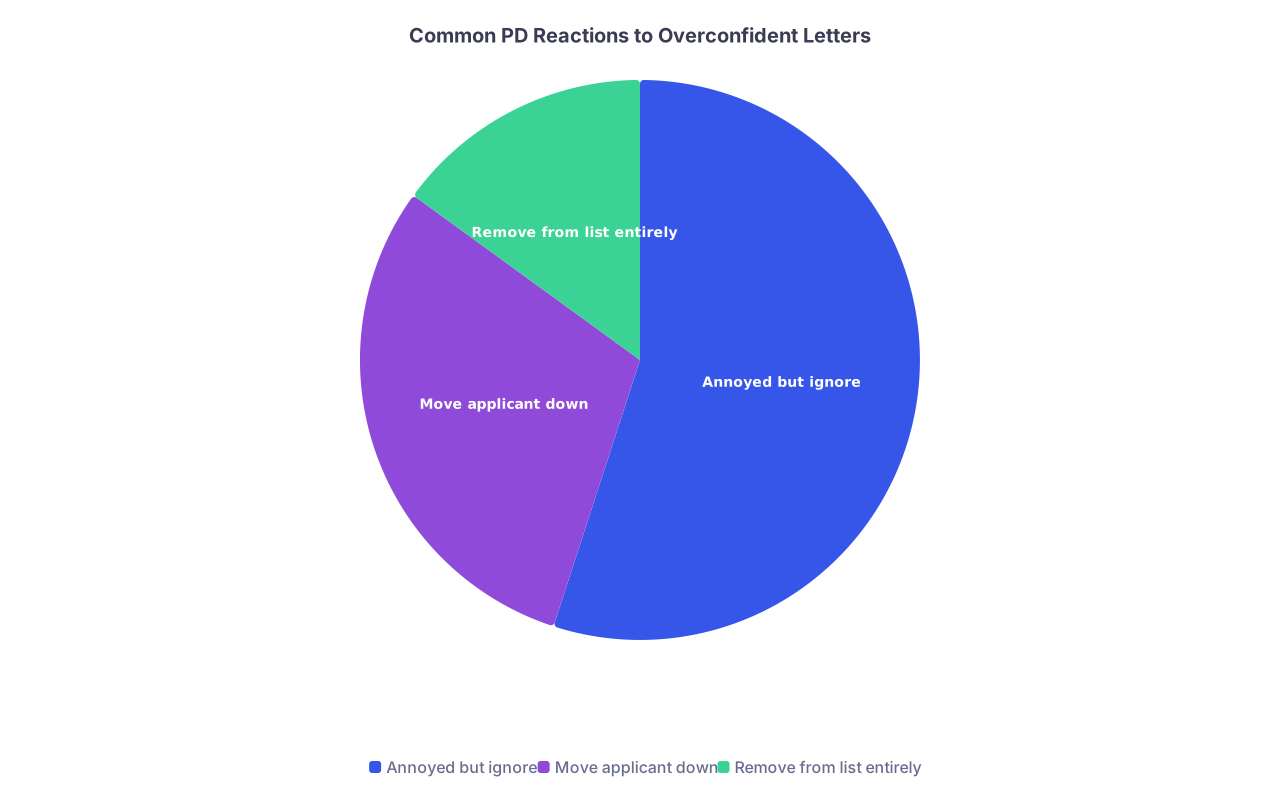
| Category | Value |
|---|---|
| Annoyed but ignore | 55 |
| Move applicant down | 30 |
| Remove from list entirely | 15 |
Category 1: “You Owe Me” Phrases
These are the phrases that suggest the program is somehow obligated to rank you favorably. They are more common than you think. And they are poison.
1. “I look forward to training at your program.”
On the surface, harmless. But read how PDs hear it:
- You are speaking as if the outcome is decided.
- You are subtly presuming an offer.
- You are flipping the power dynamic.
Better version: “I would be genuinely excited for the opportunity to train at your program.”
The difference is humility. One acknowledges uncertainty and respect. The other sounds like you are confirming a hotel reservation.
2. “I am confident I will be an asset to your program.”
I have seen this line or some variant at least a hundred times. The problem:
- You do not get to decide you are an “asset.” They do.
- It reads as self‑promotion instead of evidence‑based confidence.
- PDs are wary of residents who overestimate their own value on day one.
What to do instead: Show, do not declare.
Wrong:
- “I am confident I will be an asset.”
Better:
- “My experiences in [X] and [Y] have prepared me to contribute meaningfully in areas such as [specific clinic, QI work, teaching medical students].”
Specific contribution > generic “asset” boasting.
3. “I know I will be a top resident in your program.”
This is not confidence. It is delusion. How would you know that? You have never been an intern.
PDs read this as:
- You lack insight about how hard residency is.
- You are likely to struggle with feedback or correction.
- You are comparing yourself to residents you have not even met.
You can express commitment without ranking yourself against imaginary co‑residents:
- “I am committed to working hard, being coachable, and growing into a strong resident in your program.”
Category 2: Manipulative “Leverage” Language
You are not in a business negotiation. You are applying to a training program with strict rules, institutional politics, and NRMP guidelines.
When you try to sound like you have leverage, it backfires. Quickly.
4. “You are my top choice unless…”
Examples I have actually seen:
- “You are my top choice unless I receive an offer from X program.”
- “I plan to rank you highly, depending on upcoming offers.”
- “You are among my top programs, subject to other interviews and opportunities.”
You think this sounds honest and strategic. PDs hear:
- You are hedging.
- You will say the same thing to six other programs.
- You do not understand how the Match works.
If you are not ready to commit as “number one,” then do not use letter‑of‑intent language. Send a “continued interest” note instead:
- “Your program remains one of my top choices, and I would be very happy to train there.”
Do not dangle conditions. You are not negotiating call schedules.
5. “If you rank me highly, I will rank you highly.”
Blunt: this is gross. Also unnecessary. The Match algorithm is designed so you should always rank your true preferences first, regardless of what the program does.
Why PDs hate this:
- It is a veiled quid‑pro‑quo statement.
- It edges toward NRMP code‑of‑conduct violations.
- It reveals that you do not understand — or do not respect — the rules.
A PD I know forwarded an email with exactly this language to their GME office with the subject line: “This is why we stop reading these.”
You want to sound mature and ethical, not transactional.
Category 3: Fake Certainty and Shaky Promises
Overstating your position is one of the biggest letter of intent mistakes. You think you are signaling strong interest; PDs see dishonesty or naivety.

6. “I will be ranking you #1, no matter what.”
If that is true, and you truly mean it, you can say it. Once. To one program. The danger is when:
- You send that exact sentence to more than one program.
- You say it in December, then change your mind in February.
- You phrase it in a way that seems performative, not genuine.
PDs are not stupid. They have seen applicants claim “#1” to them and multiple peer programs. They talk.
If you do send a true “you are my #1” letter:
- Do it late enough in the season that you are confident.
- Be specific about why.
- Keep the tone humble and appreciative, not triumphant.
Wrong:
- “I will be ranking you #1, and I look forward to joining your program.”
Better:
- “After completing my interviews, your program is my clear first choice, and I will be ranking you #1. I would be grateful for the opportunity to train with your team if I am fortunate enough to match there.”
Notice the “if I am fortunate enough to match there.” That humility matters.
7. “I guarantee I will match at your program.”
I have seen applicants say versions of this to “signal” confidence. PD response?
- “If you think you can ‘guarantee’ the Match, you do not understand the system.”
- “You are overestimating your control over a complex process.”
You cannot guarantee anything about Match outcomes. Pretending you can makes you look immature.
State your enthusiasm and hope. Do not make promises you have zero power to keep.
Category 4: Arrogant Self‑Branding
There is a huge difference between confidence grounded in evidence and self‑branding jargon that sounds like a LinkedIn influencer.
| Bad Phrase | Better Alternative |
|---|---|
| "I am a top-tier candidate." | "My strengths include X and Y, as reflected in Z." |
| "I will be a star resident." | "I aim to grow into a strong, dependable resident." |
| "I stand out above other applicants." | "My background in A and B may offer a unique perspective to your team." |
PDs have a strong radar for insecure overcompensation. The more you proclaim your greatness, the more they assume you are overcorrecting for something.
8. “I am a top-tier candidate who will elevate your program.”
Three problems:
- You are rating yourself.
- You are implying the program needs to be “elevated.”
- You sound like a marketing brochure.
I once watched a PD underline “elevate your program” and say, “We have board pass rates over 99%. Elevate us how, exactly?”
If you genuinely bring something special, name it concretely:
- “My prior work developing a QI curriculum at [institution] has prepared me to contribute to your ongoing resident education initiatives.”
Specific, factual, and not condescending.
9. “I will be a star resident.”
You do not know that. No one knows that. And frankly, PDs are not shopping for “stars.” They are shopping for:
- Reliable team members
- People who show up on time
- Residents who will not melt down at 3 a.m. on night float
“Star” energy reads as:
- Potential diva behavior
- Drama with feedback or evaluations
- Risk of conflict with peers
Aim for solid, teachable, and dependable. If you become a star later, it will speak for itself.
Category 5: Tone‑Deaf Flexing
One underrated mistake: flexing your stats or offers as if PDs will be impressed. They will not. They already know your scores. And they are not competing in some fantasy league draft.
10. “Given my Step scores and research output, I know I can match at any program I want.”
Yes, people write things like this. Usually as a preamble to “but I choose you.” PD interpretation:
- “If anything goes wrong, this is the resident who will threaten to transfer.”
- “This person’s identity is too tied to their metrics.”
- “They are already overestimating their control. Residency will humble them, and it may not be pretty.”
If you want to reference your achievements, do it in service of fit, not dominance:
- “My background in research aligns with your program’s emphasis on resident scholarship, and I would be excited to contribute to ongoing projects.”
No chest‑thumping required.
11. “I have been invited to many top programs, but yours stands out.”
This is like telling someone on a date: “Many people want me, but I am choosing to be here.” This is not the flex you think it is.
PDs know they run a competitive program. They do not need you to validate them. They need to know you understand what they offer and that you would not be miserable there.
Drop the flex. Keep the specific reasons:
- “Your strong [X fellowship] placement and the culture I saw on interview day make your program stand out to me.”
Category 6: Overstepping Professional Boundaries
Some applicants use letter of intent language to try to steer, pressure, or “check in” on rank decisions. That crosses lines quickly.

| Step | Description |
|---|---|
| Step 1 | Write letter |
| Step 2 | Overconfident language |
| Step 3 | Possible NRMP concern |
| Step 4 | Annoy PD |
| Step 5 | Professional letter |
| Step 6 | Tone humble? |
| Step 7 | Promise ranking? |
12. “Please let me know how high I will be ranked.”
Just no. You are asking a PD to violate institutional norms and frequently the NRMP spirit (if not the letter). Also, it makes you look needy and naive.
Some variants that are almost as bad:
- “I hope to hear that I am ranked to match.”
- “I would appreciate any information you can share about my rank position.”
Best case: ignored. Worst case: you are mentally flagged as someone who will not respect boundaries.
Your job is to state your intentions. Not demand theirs.
13. “I expect that my strong performance will be recognized in your rank list.”
I have seen something similar from a very “high‑stat” applicant. The committee’s response was brutal: “If they ‘expect’ special treatment now, what will they be like as a PGY‑2?”
Translate “I expect” into what it really says: “If you do not rank me high, you are wrong.” No PD wants a resident who starts from that attitude.
Use language of hope and gratitude, not expectation:
- “I hope to be strongly considered when you finalize your rank list, and I would be honored to train with your team.”
Category 7: Overconfident Tone in the “Future of Medicine” Space
Since you flagged “miscellaneous and future of medicine,” there is one more trap: grand, sweeping statements about how you will revolutionize the field.
Ambition is great. Arrogant futurism is not.
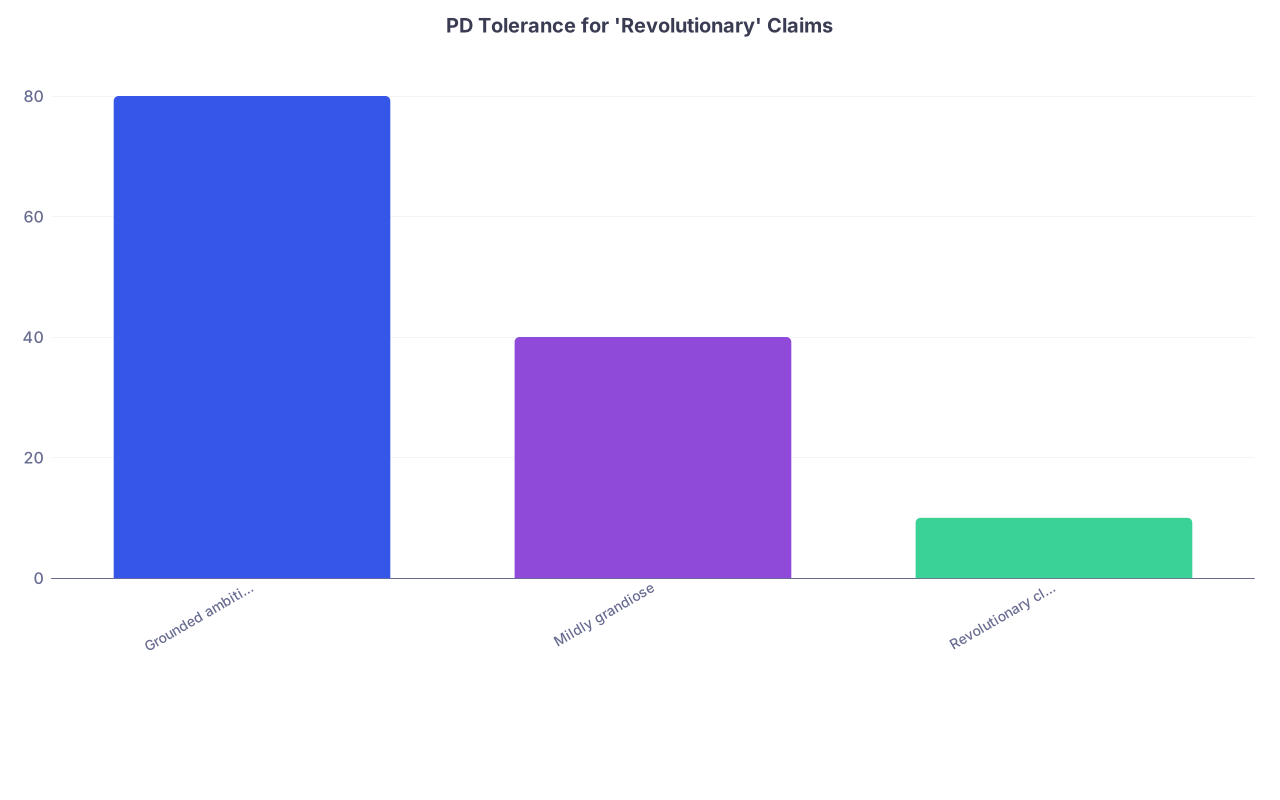
| Category | Value |
|---|---|
| Grounded ambition | 80 |
| Mildly grandiose | 40 |
| Revolutionary claims | 10 |
14. “I will redefine the future of [specialty] and bring your program along.”
This sounds ridiculous to people who have been in the field for decades and fought for incremental change in the real world. They remember the EMR rollout that took three years and ten angry committees. You are not “redefining” anything as a PGY‑1.
Better framing for serious interest in innovation:
- “I am particularly interested in the future of [AI, telemedicine, health policy], and I was drawn to your program’s work in [specific initiative]. I would welcome the chance to contribute to these efforts as I develop my skills.”
Focused. Realistic. Collaborative. Not messianic.
15. “Your program is the ideal platform for my vision to transform healthcare.”
PDs do not run a “platform.” They run a service that staffs wards, clinics, and night float. They care about vision, sure, but they care more about who is going to admit the 2 a.m. septic shock transfer.
When you talk about the future of medicine:
- Anchor it to their existing strengths: established QI projects, informatics teams, community initiatives.
- Keep your “vision” proportional to your stage of training.
- Avoid language that reduces their program to a stepping stone for your personal brand.
How to Sound Confident Without Being Overconfident
You can be strong, clear, and committed without triggering every PD’s irritation reflex. The trick is grounded confidence:
Use evidence instead of adjectives.
- Not: “I am an outstanding leader.”
- Try: “Serving as [role] for [group] taught me how to [specific skill], which I hope to bring to your residency community.”
Express enthusiasm as desire, not assumption.
- Not: “I look forward to training at your program.”
- Try: “I would be thrilled to train at your program if given the opportunity.”
Make it about fit, not your greatness.
- Not: “I will elevate your program.”
- Try: “The emphasis on [X] aligns closely with my goals in [Y], and I am eager to grow in that environment.”
Keep the hierarchy real.
- You are asking.
- They are deciding.
- The Match is the arbiter.
A Safe, Strong Structure
A grounded letter of intent usually includes:
- A clear statement of your level of interest (e.g., “#1 choice” or “one of my top choices”).
- 2–3 specific reasons tied to their program, not generic compliments.
- A brief reminder of your strengths, phrased as offerings, not guarantees.
- A humble closing that respects uncertainty and expresses gratitude.
It does not include:
- Guarantees about the Match
- Attempts to bargain over rank lists
- Self‑labeling as “top‑tier,” “star,” or “asset” without evidence
Your Next Step
Open your current letter of intent draft right now and do a ruthless scan for:
- “I will” statements that presume matching
- Any instance of “top,” “star,” “asset,” “elevate,” or “guarantee”
- Questions or hints about how they will rank you
Highlight every overconfident phrase in yellow. Then rewrite each one so it does three things: respects uncertainty, focuses on fit, and sounds like something you would not be embarrassed to hear read aloud in front of an entire selection committee.