
You are sitting at your kitchen table. It is late January. Your last interview was weeks ago. Your friends keep talking about “locking in” their dream programs. You have not heard a word from your top choice since your interview thank-you emails.
Someone on Reddit says, “Send a Letter of Intent. It worked for my friend.” Another person claims, “Programs love to know they are your number one.” You open a blank email to the PD and type: “Dear Program Director, I am writing to express my sincere intent to rank your program number one…”
Stop. This is exactly where people blow up their application in the late season.
This is not about being more enthusiastic. This is about not doing something naive, misleading, or unprofessional in the one communication programs might actually remember.
Let me walk you through the mistakes that sink applicants every year with late-season letters of intent (LOIs) and how you avoid joining them.
1. Treating a Letter of Intent Like a Lottery Ticket
The first big mistake: acting like a late-season LOI is a magic lever that can “save” a weak cycle.
Programs are not sitting there with rank lists half empty, waiting for “passionate” emails. By late season:
- Interview scores are already in
- Faculty impressions are already recorded
- Rank committee has usually met at least once
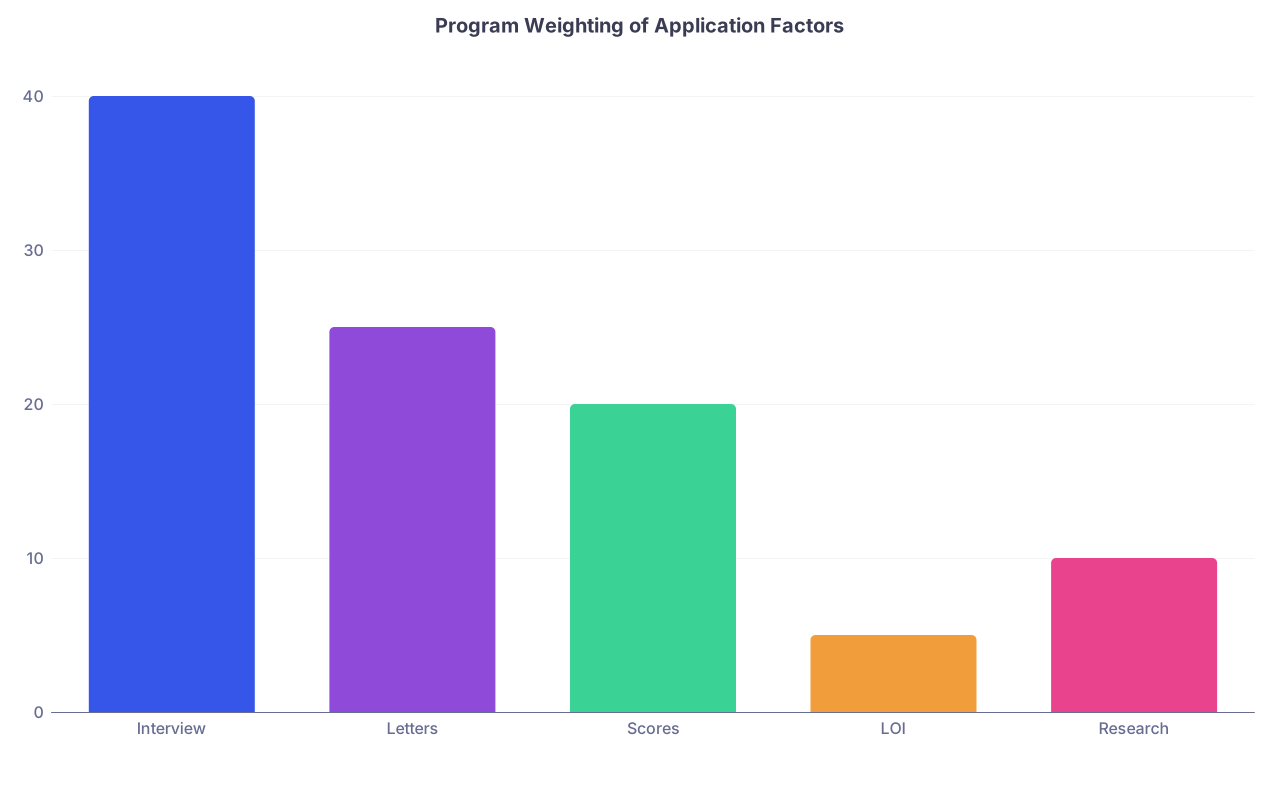
| Category | Value |
|---|---|
| Interview | 40 |
| Letters | 25 |
| Scores | 20 |
| LOI | 5 |
| Research | 10 |
The rough reality: a late LOI might tweak your position slightly if you are already in a “maybe” cluster. It will not rescue disastrous interviews, poor professionalism flags, or obvious mismatch.
The mistake is thinking: “I interviewed badly, but if I write a heartfelt LOI, they will reconsider.” They will not. If you approach the LOI as a Hail Mary instead of a minor, strategic nudge, you overpromise, sound desperate, and often cross ethical lines trying to “make it work.”
How to avoid this:
- Only send an LOI to a program where your interview was at least decent and you could realistically be ranked.
- Use it as a clarification and affirmation, not a revision of your entire candidacy.
- If you are trying to compensate for a bad interview, that is not an LOI; that is wishful thinking.
2. Lying About Ranking Them #1 (and Assuming Nobody Will Notice)
Here is the ugliest, most common mistake: sending multiple “You are my #1” letters.
Applicants think programs will never find out. That they exist in silos. They do not.
Program directors talk. Especially within the same city, specialty, or institution. I have personally heard a PD say in a rank meeting: “This is the student who told us we were their number one, and apparently they told X across town the same thing.”
Once you are branded as dishonest, that is it. Nobody wants a resident they cannot trust. A single LOI can flip a committee from “strong candidate” to “ethics concern.”
Here is the rule you ignore at your own risk:
- You get one true Letter of Intent stating “I will rank you first.”
Not three. Not “One per region.” One.
If you are not actually ready to rank a program #1, then you do not send an LOI that says you will. You can send an interest letter or update (“letter of interest,” “continued interest”), but you do not make an explicit rank promise.
Common rationalizations people use:
- “I mean, they won’t ever compare notes.”
- “I really would be happy at either place.”
- “Everyone does it. I have to play the game.”
No. Everyone does not do it. And when it blows up, it blows up hard.
How to avoid this:
- Decide honestly: which program will you rank #1 if nothing changes? That is the only place you send an explicit LOI.
- If you are still debating, do not send an LOI yet. Wait or send a non-committal interest update.
- Never, ever send conflicting written promises. If you would be embarrassed to have PDs compare your emails side by side, do not send them.
3. Confusing a Letter of Intent with a Generic “I Love Your Program” Email
Another mistake: writing a fluffy, content-free LOI that could be copy-pasted to 30 programs.
Programs can smell template language instantly. They read hundreds of applications. They know when you did not bother to say anything real.
Red flags in bad LOIs:
- “Your program is the ideal place for me to train.” (You and 500 others.)
- “I am deeply impressed with your commitment to excellence.” (What does that even mean?)
- “I look forward to contributing to your outstanding clinical and research environment.” (Which environment? You never say.)
If your letter does not clearly prove you remember your interview day, specific faculty, or concrete elements of the curriculum, it looks performative. At best, ignored. At worst, signals laziness or insincerity.
You should not write:
“Your strong clinical training, research opportunities, and supportive environment make your program my top choice.”
That sentence appears, word-for-word, in some form in half the emails PDs receive. I have seen PDs literally read these out loud and roll their eyes.
How to avoid this:
- Reference specific faculty, rotations, or experiences you actually discussed: “My conversation with Dr. Smith about your M&M culture and graduated autonomy stayed with me.”
- Mention one or two concrete features: the 4+1 schedule, the QI track, the global health elective you asked about.
- If a stranger could not tell which program you are writing to from the body of your email alone, then it is too generic.
4. Forgetting There Are Ethical Rules and NRMP Guidelines
This one can hurt you even if you mean well.
The NRMP rules are clear about one thing: programs cannot ask you how you will rank them, and you cannot be coerced to disclose your rank list. You can volunteer information, but you cannot be pressured.
Where applicants go wrong is stepping into gray areas that look like match manipulation or coercion.
Bad moves:
- Mentioning other programs by name in your LOI (“I will rank you ahead of X and Y”).
- Implying a conditional ranking (“If you rank me highly, I will rank you first”).
- Writing anything that could be read as a quid pro quo.
This kind of language does not help you. It makes you look transactional and naive about match rules. Some PDs will just delete and ignore. A few will quietly put you in the “do not deal with drama” bucket.
Also, do not ask them how they will rank you. Yes, people do that.
How to avoid this:
- Keep your LOI focused only on your own ranking intentions and your reasons.
- Use simple, clean wording: “I will be ranking [Program Name] as my first choice.”
- Never bring up what they “should” or “must” do on their rank list.
If your sentence can be read as bargaining, you should not send it.
5. Sending the Letter at the Wrong Time (or Over and Over)
Timing mistakes are underrated. I see them constantly.
There are three main timing errors:
- Sending way too early (before you have even seen all your interviews).
- Sending way too late (after rank lists are already finalized).
- Sending multiple “checking in again to say I am still very interested” emails.
Programs usually finalize rank lists in a narrow, intense window. It varies, but many sit down in early to mid-February. Some earlier, some later.
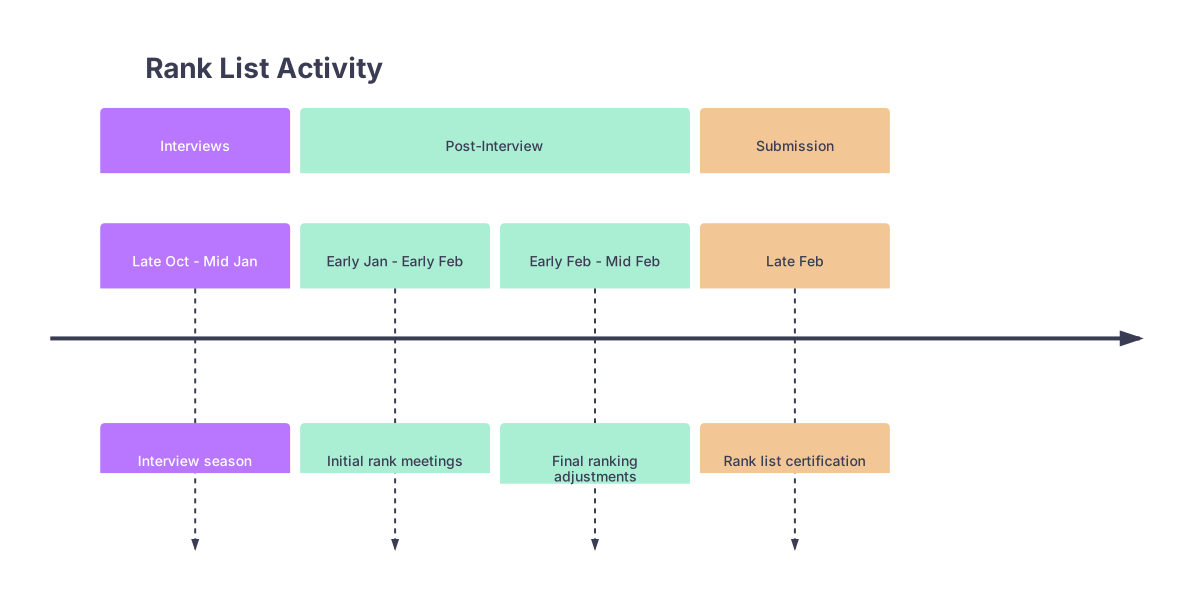
| Period | Event |
|---|---|
| Interviews - Late Oct - Mid Jan | Interview season |
| Post-Interview - Early Jan - Early Feb | Initial rank meetings |
| Post-Interview - Early Feb - Mid Feb | Final ranking adjustments |
| Submission - Late Feb | Rank list certification |
You sending an LOI in early March? That is just clogging an inbox. The list is already certified.
On the flip side, firing off an LOI in December before you have finished interviews is premature. Your preferences often shift once you actually visit more places.
Multiple follow-up “reminder LOIs” are even worse. It moves you from “enthusiastic” to “clingy” very fast.
How to avoid this:
- Rough target: send a single LOI about 2–3 weeks before NRMP rank list certification deadline, when you have seen all interviews and programs are doing final tweaks.
- One LOI per program. No drip campaign. No “just bumping this back to the top of your inbox.”
- If you are extremely early in the season, switch to a generic thank-you/update, not an intent.
6. Writing a Letter of Intent That Sounds Like an Essay, Not a Professional Email
A late-season LOI is not a personal statement redo. It is not ERAS 2.0.
Yet applicants routinely send 800-word walls of text about their childhood, their calling to medicine, their leadership in college. PDs have zero patience for that in February.
You have to remember the context: rank committees are triaging time. They might be reading:
- Committee summaries
- Evaluation forms
- Notes from interviewers
- A few high-yield emails
Nobody wants to dig through paragraphs about how you discovered your passion volunteering in undergrad to find one line about ranking.
Common stylistic mistakes:
- Overly emotional language: “It would be a dream beyond my imagination to train at your prestigious program.”
- Long autobiographical detours.
- Dramatic pleas: “I hope and pray you will give me the chance I so deeply desire.”
How to avoid this:
- 3–6 short paragraphs. 250–400 words total. That is it.
- Clear subject line: “Letter of Intent – [Full Name], [AAMC ID or Specialty]”
- Early in the body, state the key line plainly: “I will be ranking [Program] as my first choice.”
- One or two specific program-based reasons. One very brief reminder of fit. Gratitude. Done.
If a PD can read your entire LOI during a short walk from their office to conference, you are at the right length.
7. Sending It to the Wrong Person (or the Wrong Way)
You would think this is obvious. It is not.
Every year:
- LOIs sent only through a random online portal that nobody checks in February.
- Messages blasted to a generic “[email protected]” address with no clear subject line.
- Emails addressed “Dear Program Coordinator” instead of the PD or APD.
Or worse—sending a “Dear Dr. Smith” email to Dr. Patel.
Misaddressing is the kind of unforced error that makes you look sloppy. It might not destroy your chances, but it does not help.
| Mistake | Safer Alternative |
|---|---|
| Only portal message | Email PD + copy coordinator |
| Generic 'To Whom It May Concern' | Address PD by correct name and title |
| Wrong program name in body | Proofread carefully line by line |
| Sending to old interview thread | New email with clear subject line |
How to avoid this:
- Check the program website: confirm the current PD’s name and spelling.
- Send the email directly to the PD, CC the program coordinator.
- Use a fresh email thread with a professional subject.
- Double-check every instance of the program’s name and city.
If your LOI looks like it was obviously recycled from another program and not properly edited, you have already lost the “serious and intentional” impression.
8. Over-Sharing, Over-Explaining, or Sounding Desperate
A late LOI is not your therapy session. It is not your chance to explain why your Step score is low, why your dean’s letter is lukewarm, or why you think you “deserve” a spot.
Applicants often use late-season anxiety as fuel and dump it directly into their writing.
Things that instantly hurt you:
- Apologizing repeatedly for past performance (“I know my Step 1 score may be disappointing, but…”) in an LOI.
- Begging language: “Please give me a chance…” “I have nowhere else to go…”
- Oversharing personal drama (relationships, finances, mental health crises) in a way that feels unstable rather than context-appropriate.
This does not make people empathize. It often makes committees nervous about reliability, professionalism, and resilience. Those are core resident traits.
If you truly need to update them about big life events (health, family, visa changes), that might warrant a separate, calm update email, not an intent letter dressed as a confession.
How to avoid this:
- Keep the emotional register professional and measured.
- Focus on fit, alignment, and commitment, not desperation.
- If a sentence sounds like you are pleading, delete it.
Your LOI should read like a mature colleague stating a professional preference, not a student begging for a lifeline.
9. Ignoring Program Culture and Specialty Norms
An LOI in internal medicine at a mid-sized university program is not the same as an LOI in integrated plastics or derm at a top 5 institution. Some specialties and environments give these letters more weight. Some barely care.
I have seen applicants treat all programs as identical and blast the same tone across highly academic, community, and lifestyle-oriented programs. That mismatch is obvious.
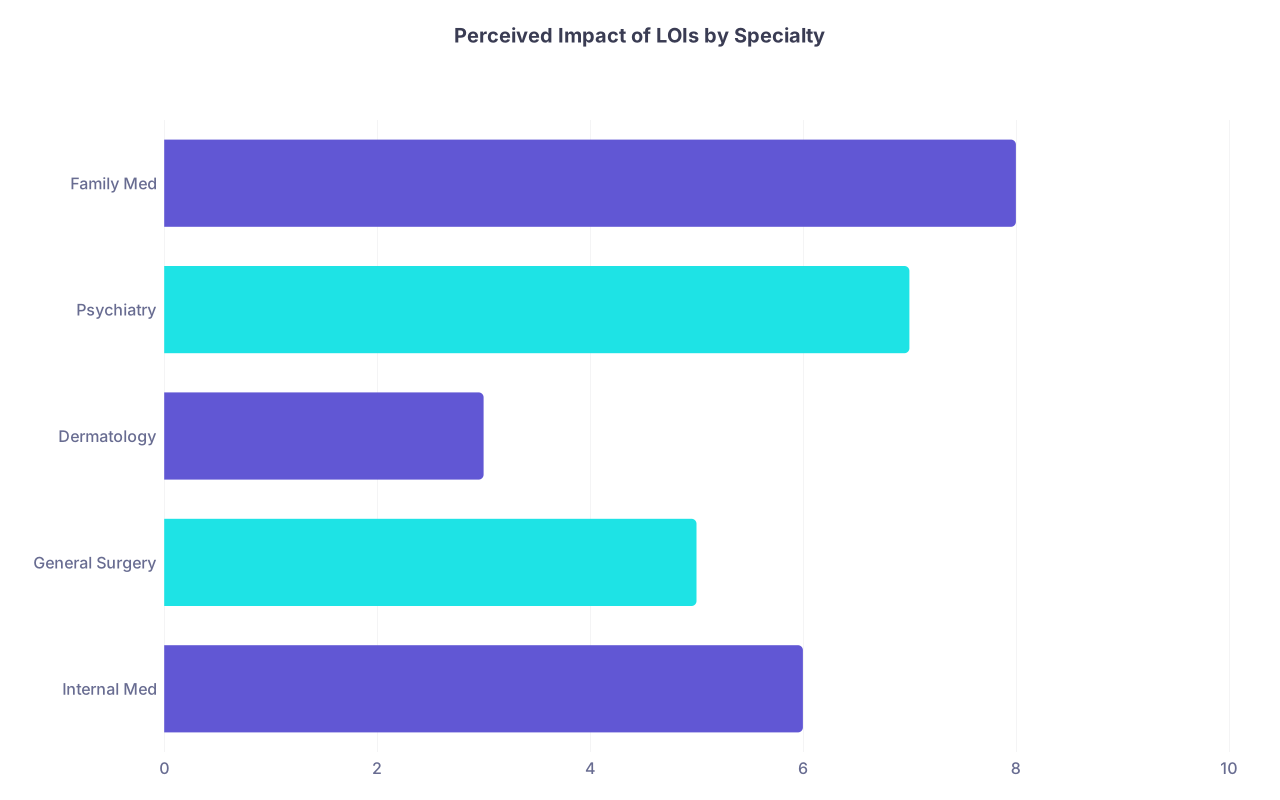
| Category | Value |
|---|---|
| Internal Med | 6 |
| General Surgery | 5 |
| Dermatology | 3 |
| Psychiatry | 7 |
| Family Med | 8 |
(Scale 1–10 estimated impact based on PD comments and applicant experiences. Reality: it varies, but not everything is “LOI-sensitive.”)
How to avoid this:
- Pay attention to signals: Did the program mention post-interview contact is discouraged or unnecessary? Believe them. Do not pester.
- If PDs explicitly said they do not change rank lists based on post-interview communication, still sending a dramatic LOI makes you look like you were not listening.
- For specialties where LOIs are more common (IM, FM, psych), you can lean slightly more into them. For ultra-competitive, hyper-academic programs that are scores- and research-heavy, do not overestimate your email’s power.
Match your tone to what you have already seen from that program: formal vs. relaxed, academic vs. community feel.
10. Not Realizing That Silence Is Sometimes the Smartest Move
Here is the part nobody on Reddit will tell you: sometimes the safest, most professional move is to not send an LOI at all.
If:
- You are genuinely torn between several programs and know your preferences may still shift.
- The program explicitly stated they do not consider post-interview communications.
- You already sent a thoughtful thank-you and nothing major has changed.
Then forcing an LOI just because “everyone else is doing it” is a mistake. Manufactured certainty looks fake. And once you put a promise in writing, you owe it.
Accept this: most of your match outcome will be decided by your:
- Application
- Interviews
- Letters of recommendation
- Institutional reputation
Not by one email in late January or early February.
The LOI is a scalpel, not a hammer. Used precisely, it can help. Used wildly, it cuts you.
Quick Visual: Safe vs Risky LOI Behavior
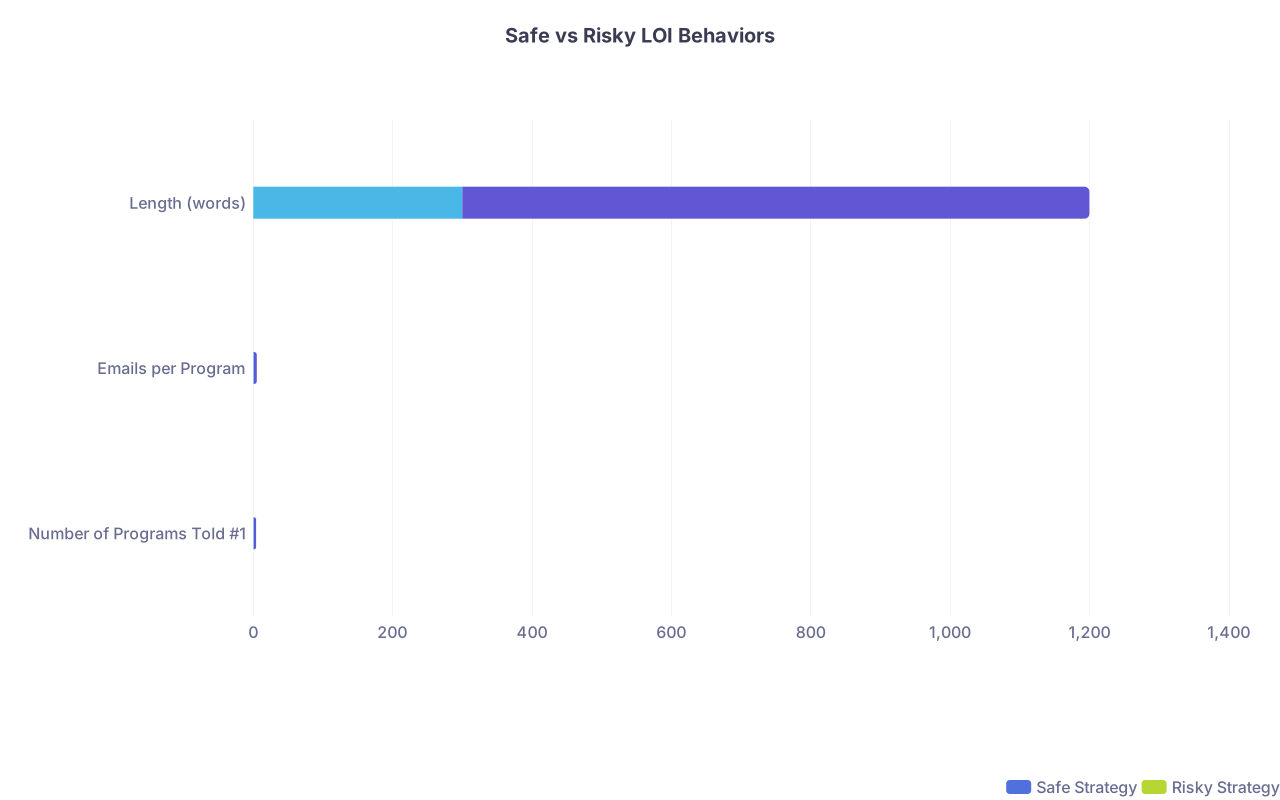
| Category | Safe Strategy | Risky Strategy |
|---|---|---|
| Number of Programs Told #1 | 1 | 3 |
| Emails per Program | 1 | 4 |
| Length (words) | 300 | 900 |
FAQs
1. If I truly love two programs equally, should I send LOIs to both and just not say “I will rank you #1”?
Yes, that is the ethical line. If you cannot honestly commit to one program as your #1, do not lie. You can send “letters of strong interest” to more than one place that say things like “I will be ranking your program very highly” without making a specific numerical promise. The mistake is only when you explicitly tell more than one program they are your first choice.
2. What if my top-choice program said during interview day that post-interview communication is not necessary?
Then you treat that as real. You can still send a brief thank-you after the interview (if you have not), but I would not send a dramatic LOI if they clearly discouraged it. If you feel absolutely compelled, keep it extremely short, respectful, and low-pressure, but accept that it may carry little or no weight. Pushing hard against stated preferences makes you look poorly calibrated.
3. Can an LOI ever hurt my chances at a program I rank #1?
Yes. That is the part people like to ignore. An LOI can hurt you if it is dishonest (multiple #1 claims), unprofessional (desperate, emotional, oversharing), sloppy (wrong names, wrong program), or annoying (multiple follow-ups). It can also hurt if it reveals poor judgment, like trying to bargain about rank positions. A strong application plus a bad LOI is worse than a strong application plus silence.
4. How do I know if my LOI is “good enough” to send?
Do this: print it or read it out loud, and check three things. First, clarity: by the end of the first short paragraph, is it completely clear you will rank them #1 (if that is true)? Second, specificity: do you mention at least one or two program-specific details that prove you actually paid attention and are not template-spamming? Third, tone: does it sound like a professional peer expressing a preference, not a frantic student begging for rescue? If it passes those three tests and is under 400 words, you are probably safe.
Open your draft email right now and look for one sentence: “I will be ranking [Program] as my first choice.” If you cannot stand fully behind that line for that specific program, delete it and rethink what you are sending.