
The fastest way to make your letter of intent look insecure and insincere is to stuff it with names.
The Hidden Risk Behind Name‑Dropping
Everyone tells you “mention people you’ve met at the program.” That advice is half-right and dangerously incomplete.
The mistake is not using a name.
The mistake is using names as a crutch instead of a proof of fit.
I’ve watched program directors read letters and literally say, “They’re just listing every person they met on interview day. This tells me nothing.” Then the letter goes into the mental trash bin along with the other 200 generic “You’re my top choice” emails.
Where name‑dropping backfires worst:
- You exaggerate relationships that are actually superficial.
- You misquote or misrepresent a faculty member.
- You reference people who barely remember you.
- You use names instead of substance about training, curriculum, or patient population.
If you think more names = more impact, you’re already heading in the wrong direction.
Let me walk you through how this goes wrong in the real world—and how to avoid looking desperate, fake, or manipulative.
Mistake #1: Inflating Casual Encounters into “Connections”
Here’s the classic error:
“After multiple discussions with Dr. X and Dr. Y, I feel deeply aligned with your program’s mission.”
You had:
- a 15-minute Zoom interview with Dr. X
- a quick small-talk exchange with Dr. Y during a resident Q&A
“Multiple discussions” is a lie. And people who conduct 40+ interviews a season can smell that exaggeration instantly.
When committees see this kind of inflation, they don’t think, “Wow, so connected.”
They think: “If they’re overstating this connection, what else are they overselling?”
Name-dropping turns toxic when:
- You turn a panel interview into “extensive conversations.”
- You treat a brief email reply as “ongoing correspondence.”
- You describe a generic info session as “clinical mentorship.”
Do not romanticize routine interactions. You are not the first applicant to try this. It reads as insecure and immature.
Better rule:
If the person would struggle to remember who you are without your ERAS photo in front of them, don’t pretend they’re your mentor.
Mistake #2: Using Names Instead of Reasons
Programs do not rank you higher because you typed more faculty names. They rank you higher because your reasons for choosing them are specific, credible, and aligned with what they actually offer.
Here’s how people misuse names:
“Speaking with Dr. Patel, Dr. Nguyen, and Dr. Smith convinced me that your program is my top choice.”
This tells the reader nothing. Why did those conversations matter? What did you learn? What did it confirm about your fit?
Program leaders are busy. If they skim your letter and mostly see a laundry list of names, they mentally translate it into:
“I’m trying to impress you instead of telling you something meaningful.”
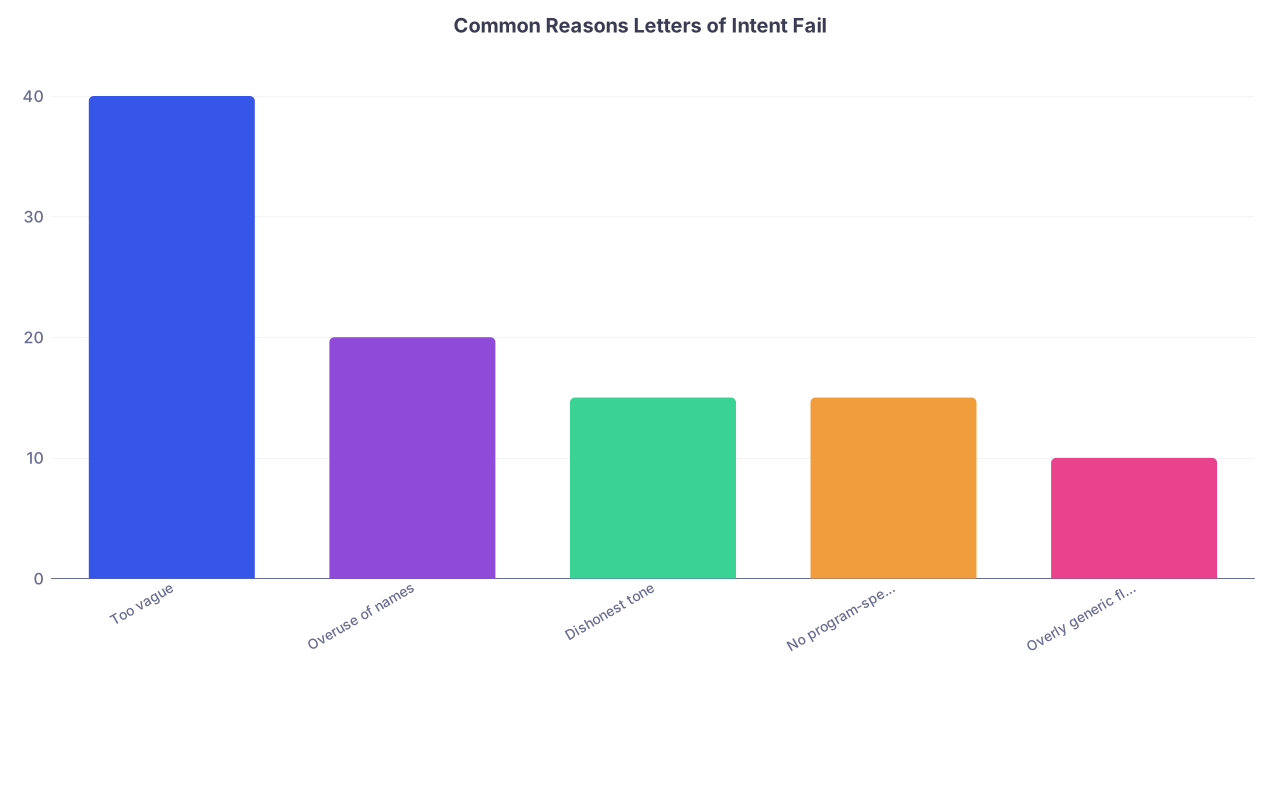
| Category | Value |
|---|---|
| Too vague | 40 |
| Overuse of names | 20 |
| Dishonest tone | 15 |
| No program-specific detail | 15 |
| Overly generic flattery | 10 |
Here’s the safer (and smarter) way:
- Use one relevant name, attached to a specific insight.
- Show what you understood about the program—not who you managed to talk to.
For example:
“My conversation with Dr. Patel about your night float system clarified how much early autonomy interns receive with strong senior backup. That balance of responsibility and support is exactly what I’m looking for.”
One name. One clear, concrete program feature. One clear link to your priorities. That works.
But if your letter is 30% list of humans and 5% actual reasons, it looks like you had nothing real to say.
Mistake #3: Misrepresenting or Misquoting Faculty
This one burns bridges.
I’ve seen applicants write things like:
“Dr. X specifically told me that residents at your program rarely work more than 60 hours per week.”
Then Dr. X reads it on a screen in a rank meeting and says, “I did not say that.”
Now you’ve created friction between yourself and a potential advocate.
Ways this goes wrong:
- You paraphrase too aggressively and change the meaning.
- You attribute a program-wide claim to a single person (“Dr. Y said you always rank interviewees you meet at the social.”).
- You try to use a faculty quote as leverage (“Dr. Z hinted that I’d be a great fit for your program.”).
Do not put words into anyone’s mouth. Ever.
If you’re going to reference something someone said:
- Keep it general, or
- Keep it short and accurate, or
- Drop the quote entirely and just describe the program feature.
Better:
“Hearing faculty describe how interns are encouraged to own their patient panels while still having strong attending support made me confident I would grow quickly in your environment.”
Notice: no risky attribution, no invented phrasing. Committees care more that you understood the structure correctly than who literally said the words.
Mistake #4: Name‑Dropping People Who Don’t Know You Well (or Don’t Like You)
This is the awkward one.
You assume: “If I mention Dr. A, Dr. B, and Dr. C, they’ll remember me and support my ranking.”
Reality:
- Dr. A barely remembers you.
- Dr. B remembers you but thought your interview was weak.
- Dr. C is neutral and exhausted from 6 weeks of interviews.
So your line:
“My conversations with Dr. A, Dr. B, and Dr. C confirmed my strong fit with your program…”
…does not magically convert them into advocates. In fact, it might backfire.
Because now those people are unintentionally put on the spot:
- “Did you like this applicant?”
- “Did they stand out?”
- “Would you rank them highly?”
If the answer is no, your name-dropping just shined a spotlight on the lack of enthusiasm.
I’ve heard versions of this in meetings:
- “I barely remember that conversation.”
- “They were fine, not memorable.”
- “Their letter makes it sound like we had a much deeper interaction than we did.”
Do not assume every person you mention is an automatic ally. Sometimes the strongest letters are the ones that reference fewer people but more substance.
Mistake #5: Dragging Residents Into It in a Weird Way
Residents’ names are trickier than faculty.
Here’s what goes wrong:
- You treat residents like senior faculty in the letter (“My mentorship under Dr. [PGY-3 Name]…” after one Zoom social).
- You use resident names to push a narrative that isn’t accurate (“Residents told me your call schedule is light and flexible,” when that was clearly joking banter).
- You paraphrase off-the-cuff comments as if they’re official program policy.
Remember: that “funny” comment a resident made about rounding or overnight cross-cover may not be something they want printed in a letter being reviewed by the PD.
Safer move:
- Refer to residents collectively unless you have a meaningful, memorable interaction with one person.
- Focus on themes: camaraderie, teamwork, how they talked about education, not their venting or jokes.
For example:
“Speaking with multiple residents during the interview day and social, I was struck by how consistently they described the culture as supportive and non-punitive, even when discussing challenging cases.”
That shows you listened and understood the atmosphere. No risky over-quoting, no weird use of specific names.
Mistake #6: Using Big Names as a Status Signal
Some applicants love to flex:
“As I discussed with Dr. Famous Surgeon at a national conference…”
They think the program will be impressed by proximity to prestige. Often it has the opposite effect.
Two big problems:
- It can read as insecure posturing.
- If Dr. Famous Surgeon is not actually affiliated with the program, it’s borderline irrelevant to a letter of intent focused on this institution.
Program directors care about:
- Why you want their training environment.
- How you’ll function in their team.
- Whether you’re being honest and grounded.
Using external big names to impress them inside a letter of intent about their program smells like: “Look how important I am.” That’s not the vibe you want.
Exception:
If a genuinely close mentor with a well-known reputation has a direct connection or has explicitly spoken highly of the program, you can carefully reference that context. Briefly.
Something like:
“My research mentor, Dr. X at [your med school], often speaks highly of the strong clinical training your graduates demonstrate when they match into our institution’s fellowships, which initially put your program on my radar.”
Short. Contextual. Not flexing for its own sake.
Mistake #7: Overwhelming the Letter with “I Spoke to…” Sentences
Let me be blunt: a letter full of “I spoke to…” lines is instantly boring.
- “I spoke to Dr. A…”
- “I had a conversation with Dr. B…”
- “In talking with Dr. C and D…”
- “During my talk with resident E…”
This rhythm screams: “I’m trying very hard to sound connected and important,” while giving the reader almost nothing new.
You are not writing your networking log. You are making a case for why this program should invest in training you.
A healthier structure:
- 1 short paragraph affirming this is your top choice (if true).
- 2–3 paragraphs with specific program features and how they align with your goals.
- 1–2 sentences referencing a person or conversation that reinforces one of those features, not replaces it.
If the core of your letter is “I loved talking to X, Y, and Z,” that tells me your understanding of the program is shallow.
Mistake #8: Using Names to Imply a Promise or Inside Track
This one makes programs very nervous.
Bad examples:
- “Dr. X encouraged me to send this letter as you’re strongly considering me for a spot.”
- “Dr. Y mentioned that my chances are excellent if I affirm my interest.”
- “My understanding from Dr. Z is that I am a strong favorite for your program.”
First, you don’t know how many people they’ve said that to.
Second, committees hate the sense that backchannel promises are being documented in writing.
You’re effectively trying to weaponize a private comment in a formal letter. That’s not just a bad look. It can damage trust between faculty and leadership—using you as the accelerant.
Programs don’t want:
- To look like they broke some implied promise.
- To be cornered into ranking you to save face.
- To have their casual encouragement dragged into the official record.
Use your letter to communicate your intentions. Not theirs.
You can say:
- “Your program is my clear first choice, and I will rank you #1.”
Do not say: - “You have indicated that I am highly likely to match if I rank you #1.”
One is professional. The other is manipulative and risky.
Mistake #9: Referencing the Wrong People or Getting Details Wrong
Simple but deadly.
Examples I’ve seen:
- Misspelling faculty names—especially the PD or chair.
- Thanking someone who didn’t actually interview you.
- Confusing two different faculty roles (calling the APD the PD, etc.).
- Mentioning a faculty member who left the program last year.
Nothing screams “I mass-produced this” like misnaming the program, city, or leadership. That’s how you go from “solid candidate” to “careless” in 3 seconds.
| Error Type | Impact Level |
|---|---|
| Misspelling PD name | High |
| Referring to wrong program | Very High |
| Mentioning ex-faculty | Medium |
| Mixing up specialties | Very High |
| Thanking wrong interviewer | Medium |
Double-check:
- Spelling of all names.
- Official titles (Program Director vs Associate, etc.).
- That the person is actually still there.
- That you haven’t copied leftover names from a previous letter.
If you cannot be trusted to get these basics correct, why should they trust you with patient orders at 3 a.m.?
What “Good” Use of Names Actually Looks Like
Let’s be precise. Because “never use names” is also bad advice.
Name usage that helps you:
- 1–2 accurate, spelled-correctly references.
- Each tied to a specific program feature or experience.
- No exaggeration of relationship.
- No implied promises or pressure.
- No attempt to flex status.
Example of a solid paragraph:
“During my interview with Dr. Lopez, I was impressed by how thoughtfully she described your approach to progressive autonomy—starting with strong supervision intern year and gradually increasing independence on the ICU and night float rotations. That structure aligns with how I’ve grown best in medical school: early close guidance, followed by deliberate space to manage complexity with backup available.”
That works because:
- The name is an anchor, not the point.
- It proves you remember something real about the program.
- It shows you’ve reflected on your learning style and fit.
If you removed “Dr. Lopez,” the paragraph would still be meaningful. That’s the test. If deleting the name breaks the sentence, you’re probably leaning on it too much.
Safer Letter of Intent Structure (Without Over-Name-Dropping)
If you want a simple structure that keeps you away from most pitfalls:
Opening (2–3 sentences)
- State clearly if they are your #1 and that you will rank them first.
- Briefly restate your genuine enthusiasm.
Program-Fit Paragraphs (2–3 paragraphs)
- Training structure (rotations, autonomy, ICU, clinic, etc.).
- Culture and teaching style.
- Patient population, research, or career development.
Sprinkle at most 1–2 names here, only where they sharpen something real.
Closing (2–3 sentences)
- Reaffirm interest and ranking commitment (if applicable).
- Thank them for their consideration.
- Keep it simple and clean.
If you do this well, you probably won’t need more than one or two specific names. And you won’t look like you’re trying to “game” the process via personal mentions.

| Step | Description |
|---|---|
| Step 1 | State program is #1 |
| Step 2 | Describe training features |
| Step 3 | Describe culture and resident experience |
| Step 4 | Optional - 1 to 2 specific name references |
| Step 5 | Restate ranking intention |
| Step 6 | Thank and close |
The Bigger Picture: What Committees Actually Want
Forget the folklore. Here’s what letter readers are really scanning for:
- Are you being honest about your interest?
- Do you have a clear, specific understanding of the program?
- Do you articulate how this environment matches your goals and learning style?
- Do you sound like someone they’d trust on their team at 2 a.m.?
Name-dropping doesn’t inherently help with any of that. In fact, when used badly, it undermines all four.
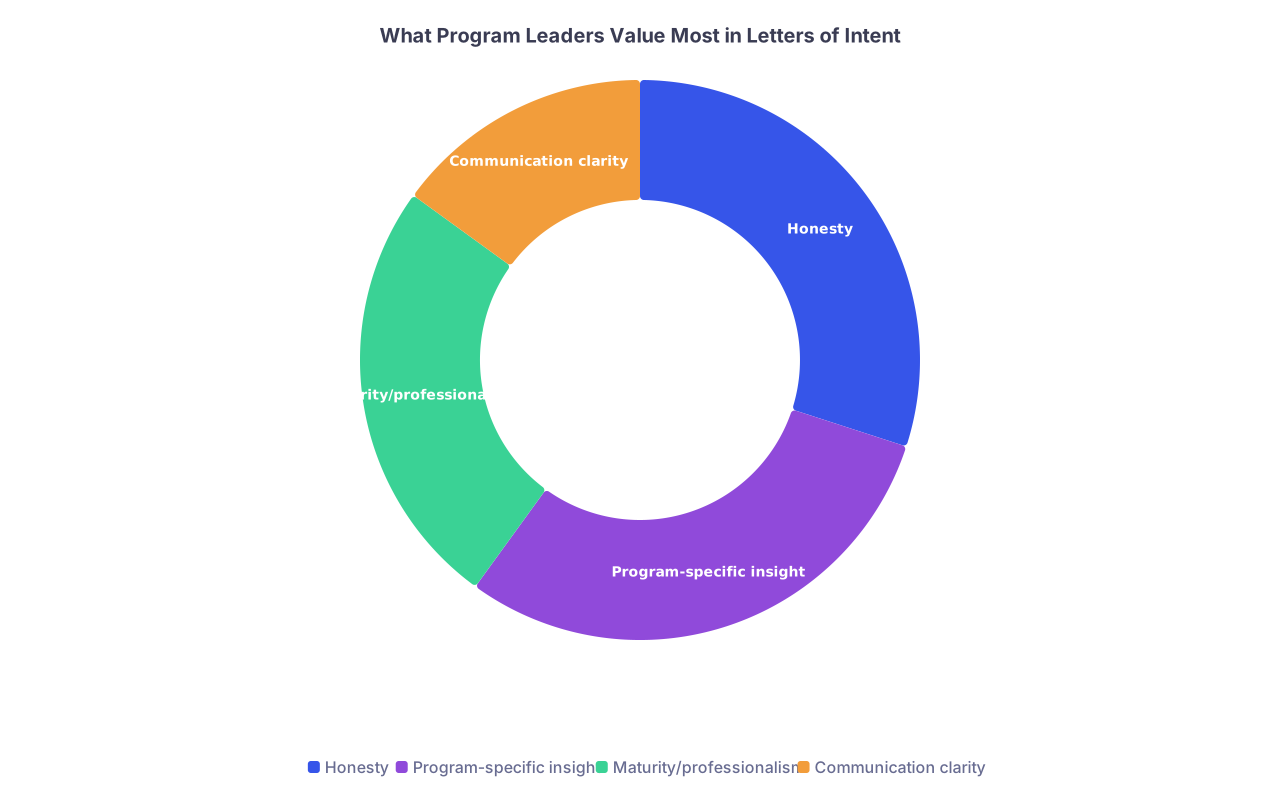
| Category | Value |
|---|---|
| Honesty | 30 |
| Program-specific insight | 30 |
| Maturity/professionalism | 25 |
| Communication clarity | 15 |
Use names like seasoning, not like the main ingredient. Too little and the dish is bland. Too much and it’s inedible.
FAQs
1. Is it ever okay to send a letter of intent that doesn’t mention any specific names?
Yes. That’s not a problem at all if your letter is rich in program-specific details—curriculum, rotation structure, patient population, call system, culture, fellowship outcomes. A letter with zero names but strong, accurate content will beat a name-heavy, generic one every single time.
2. What if a faculty member told me to mention them in my letter of intent?
You can, but keep it modest and accurate. For example: “Dr. X encouraged me to share my strong interest in your program.” Do not inflate this into promises about your ranking or theirs. And don’t use their name more than once; it starts to sound like you’re waving a permission slip.
3. Can I send different letters of intent to multiple programs saying each is my top choice?
That’s a good way to wreck your integrity. Program leadership talk. Residents talk. If it gets back to them that you told multiple programs “You are my clear #1 choice,” you will look dishonest. Reserve true “you are my top choice” language for exactly one program.
4. How do I know if I’m overusing names in my letter?
Print it out and highlight every proper name: faculty, residents, mentors, institutions. If your letter looks like it has been attacked with a highlighter, you’re probably overdoing it. As a rough rule, more than 2–3 program names in a one-page letter is usually a sign you’re leaning on names instead of substance.
Key takeaways:
Use names sparingly and honestly. Tie every name to a concrete program feature, not vague flattery. And never let name‑dropping substitute for what actually gets you ranked: clear, specific, credible reasons this program is the right place for you—and that you’re the right person for them.