
It’s late January. You just finished what you think was your last big interview. Your rank list is a mess. Your friends are talking about sending “love letters” and “letters of intent” to their top programs. Group chats are full of drafts and drama.
You’re staring at a blank email to your number one:
“Dear Program Director, I will rank your program #1…”
Here’s the problem: you have no idea if this actually matters. You’ve heard some PDs delete these on sight. Others supposedly move people up the rank list because of them.
Let’s cut through the mythology.
I’m going to walk you through what really happens on the other side of that email—what PDs say in faculty meetings, what chiefs whisper in the workroom, and why the exact same letter can be pure noise at one program and a legit tiebreaker at another.
The Uncomfortable Truth: PDs Are Not All Playing the Same Game
First big reality check: “Program Directors” are not a unified species.
Some are:
- Spreadsheet-obsessed former APDs who live in the data.
- Old-school clinicians who barely open ERAS and rely on gut and word-of-mouth.
- Politicians who care a lot about how things look—to the department chair, the GME office, the community.
- Burned-out mid-career docs who are running the program while also covering service, writing grants, and putting out daily fires.
Letters of intent land completely differently depending on which type you’ve got.
At one mid-size IM program I know, the PD has a literal Outlook rule that auto-routes “letter of intent” emails into a folder she opens once. In February. For about 15 minutes. At another, a surgical PD physically prints them and brings them into the rank meeting like trophies: “This one is committed. We want people who want to be here.”
You can’t use one blanket strategy because their psychology—and their systems—are different.
Why Some PDs Flat-Out Ignore Letters of Intent
Let me start with the ones who truly do not care. There are more of them than you’d like to believe.
1. They’ve been burned by broken “I will rank you #1” promises
Every PD who’s been in the job more than a few seasons has a story like this:
“We had an applicant from a top med school. Incredible on paper. Sent us a glowing letter promising we were #1. We bumped them up several spots because of it. Match Day? They went somewhere else. Never again.”
When that happens, trust disappears. A lot of PDs quietly make a policy—sometimes formal, sometimes just emotional:
“I will never move someone based on a letter again.”
They might still read your email. They might even appreciate the sentiment. But it does not touch the rank list.
2. They’ve decided “behavior during interview season” is a better proxy
This is one of those things PDs say off-record:
“I don’t care what they write. I care what they did.”
What they mean:
- How fast you responded to interview offers.
- Whether you were on time, present, and not weirdly scripted.
- How you treated residents and staff.
- Whether you seemed genuinely engaged with this program vs reading from a generic script.
To those PDs, a late-January or February email is theater. They already made up their mind based on the actual interactions.
3. Their rank list is committee-driven and your letter doesn’t move the needle
Some programs are very “democratic.” Rank meetings with 10+ voting members. Chief residents, core faculty, sometimes even a GME administrator in the room.
In those rooms, your letter of intent is often background noise. Here’s why:
- The file reviewer or interviewer has already given you a global rating.
- Your gestalt among the faculty is “strong,” “solid,” “fine,” or “no.”
- They’re trying to balance:
- home students
- couples
- diversity goals
- “needs” (procedural, research-heavy, continuity clinic)
- chair’s “favorites”
Your email might be read. It might be mentioned. But in a 3-hour rank meeting where they’re trying to sort 120 people, a single applicant’s letter is rarely decisive.
4. They obey their interpretation of NRMP rules—almost religiously
Some PDs are terrified of even the appearance of match violation. Many GME offices hammer this into them.
You’ll hear them say in meetings:
“We cannot base rank decisions on communication outside the interview. It’s a slippery slope and I don’t want NRMP issues.”
Is that an over-interpretation? Sometimes, yes. But it doesn’t matter. That’s their reality.
Those PDs either:
- Do not want to see your letters at all.
- Let a coordinator filter them and just acknowledge receipt with a generic response.
Behind the scenes, they’ve told their APDs and chiefs:
“Pretend these emails don’t exist. Rank based on application + interview only.”
5. They are too overwhelmed to care
This one sounds trivial, but it’s huge.
Look at a typical PD’s January:
- Preparing for ACGME site visit.
- Dealing with at least one resident on remediation.
- Fielding emails from the chair about fill rates, fellowship placements, “why didn’t we match more from [X med school] last year?”
- Running weekly didactics, scheduling, and general chaos.
Now add:
150+ emails from applicants telling them “I love your program so much.”
A lot of them autopilot to:
“Thanks for your interest in our program. We wish you the best in the Match.”
Delete. Move on.
They’re not being cruel. They’re just triaging.
Why Other PDs Absolutely Do Pay Attention
Now, flip the lens. There’s a whole other subset of PDs who do read, track, and use letters of intent. And no, this isn’t a myth your classmates made up to feel better about writing them.
I’ve sat in rank meetings where LOIs absolutely shifted things.
1. They are obsessed with “fit” and use intent as a proxy
Some PDs are hyper-focused on culture. They want people who are enthusiastic about their environment, not just any brand-name program.
They’ll say things like:
“We’re not the biggest name. If people really want to be here and thrive here, that matters more to me than another point on Step 2.”
This is especially true:
- Community programs competing with bigger academic centers.
- Mid-tier academics in crowded cities.
- Newer or rapidly expanding programs.
For them, a clear, specific letter of intent is a signal:
“This person is less likely to slide us to #10 on a huge list and more likely to be genuinely happy here.”
2. They are haunted by past unfilled spots
Nothing terrifies a PD like going partially unfilled. The chair asks questions. The GME office analyzes your “brand.” The residents get anxious.
If a program had a scare year—maybe they filled all but 1–2 spots, or they filled but felt way too close to the edge—that PD tends to overcorrect.
How?
- Track strong signals of interest.
- Look closely at “LOI to us” applicants when deciding how high to rank them.
- Use those letters as reassurance: “We probably won’t slide off everyone’s list.”
For them, a genuine “I will rank you #1” from a solid applicant is comforting. They may not fully trust it, but they give it weight.
3. They’re trying to build a certain type of resident
At some places, the PD has a mental archetype they’re trying to recruit.
For example:
- A small, research-light IM program trying to become more academic. They want residents who wrote in their PS about research and then send an LOI specifically referencing their new research tracks.
- A county EM program that values mission-driven people. A letter that clearly references underserved care and their particular ED population feels aligned.
These PDs sometimes use LOIs as a refinement tool:
“We have 4 applicants in roughly the same tier. Two sent very generic thank-yous. One ghosted. One wrote a thoughtful letter explaining exactly why our patient population and schedule model are a great fit. Put that one first.”
Notice: it’s not the existence of the letter. It’s the content and how it matches the PD’s goals.
4. They like “commitment signals” in tie-breakers
Where letters can matter a lot: the middle of the list. The gray zone.
No one debates the very top. The rock stars are going high regardless of what they write.
But once you’re in that 20–80 zone (for a class of 10–20 residents), the conversations get fuzzier:
- “I liked her a lot, but her letters were just okay.”
- “He interviewed solidly but not spectacularly.”
- “These three applicants are basically interchangeable.”
That’s where you hear:
“This one told us we’re #1.”
“She’s from nearby and wrote about family here plus sent a specific LOI.”
“This guy has another offer same region but didn’t communicate anything with us.”
Does that instantly launch you 40 spots up? No. But I’ve watched a PD say:
“Between these two, bump up the one who committed to us.”
That’s real.
How Letters of Intent Actually Flow Inside a Program
You send the email. What happens next behind the curtain?
Let me walk it the way I’ve seen it.
Scenario A: Organized academic program with coordinator triage
- Your email hits the PD’s inbox.
- PD’s smart enough not to drown in applicant mail, so they’ve told the coordinator:
“Please track anyone who explicitly says we’re their #1.” - Coordinator flags those names in a spreadsheet or in ERAS notes. Something like: “LOI – says we are #1.”
Then, in rank meeting, there’s a moment—usually mid-discussion—where that list comes up:
“Here are 14 people who said they will rank us #1. Of these, 8 are already in our top 40. The other 6 are lower. Do we want to reconsider where we slot them?”
They do not all magically jump up. But some move. The PD might say:
- “Okay, Applicant X is at 65. Solid candidate. Wants us #1. Move them into the 30s.”
- “Applicant Y is too weak overall. Leave them low.”
- “Applicant Z is in our top 15 already, great.”
Your letter basically earns you a second look.
Scenario B: Smaller/community program with PD personally tracking
Here, PD often reads and personally keeps a mental list:
“This guy from Drexel said we’re his top choice.”
“That applicant from Utah loved our ICU structure and said we’re #1.”
Rank day:
- Less formal spreadsheets.
- More: “Remember, that’s the one who wrote me that letter.”
- And: “If we like them and they say we’re #1, that’s low risk—let’s push them a bit higher.”
This is more subjective, but the letter absolutely plays into the psychology.
Scenario C: Big-name program with zero bandwidth
These are the places applicants obsess over: MGH, UCSF, Hopkins, big EM/ortho/derm powerhouses.
The truth?
- Your letter might be read by the PD.
- Or by an APD or chief.
- Or quickly scanned on a phone between cases.
But their rank list largely runs on:
- Department politics
- Institutional reputation
- Deep faculty opinions
- High-volume comparisons of elite candidates
Your LOI rarely changes anything, unless:
- You’re in a very tight tie cluster
- You have a unique connection (home student, known faculty champion)
- Or they’re particularly sensitive to “likelihood to match” due to competitive pile-ups
Is it bad to send it? No. It’s just low-yield for moving rank order at these hyper-competitive giants.
When You Should Send a Letter of Intent—and When It’s Dumb
Here’s the part most people won’t say clearly: yes, letters of intent are overused and often misused. Most students write them to too many programs and with garbage content.
Good reasons to send a true LOI
You should strongly consider a real, explicit letter of intent if:
- You have a clear, honest #1 choice.
- You would genuinely be happy to train there even if something “shinier” was an option on paper.
- You can write specific, credible reasons that match what that program values.
- You’re at least in realistic range for matching there (based on interview vibe and relative competitiveness).
In that setting, your LOI:
- Might give you a bump in the middle of the list.
- Can reinforce a very positive impression (especially at programs that care about “fit” and loyalty).
- Signals lower “flight risk” if they’re anxious about unfilled spots.
Terrible reasons to blast out “letters of intent”
These are the moves that make PDs ignore all LOIs:
- Telling more than one program “I will rank you #1.” Word gets around. Faculty cross-compare. I’ve seen applicants burned by this.
- Sending a “letter of intent” that reads like a second personal statement and never once mentions anything specific about their program. That screams “I sent 30 of these.”
- Writing it when they’re clearly out of your league and you had a lukewarm interview.
If you’re going to claim commitment, back it with something that feels anchored in reality.
How to Write One That PDs Don’t Immediately Dismiss
Let me be blunt: most LOIs fail because they are generic, dishonest, or obviously copy-pasted.
You want your letter to pass three tests in the PD’s head:
- Does this sound like a real person who interviewed here?
- Do they clearly understand something specific about our program?
- Is the level of enthusiasm believable?
A simple skeleton that actually works:
- One line: clear statement of intent.
- One short paragraph: specific, program-tied reasons.
- One short paragraph: why you’re a good match for them (not just why they’re great).
- Close with gratitude and no pressure language about the match.
Something like (condensed example):
“I’m writing to let you know that I will be ranking [Program Name] as my number one choice.
My interview day confirmed what I had hoped from working with several of your graduates: the combination of high-acuity county experience with strong subspecialty support and a tight-knit resident cohort is exactly the environment I’m looking for. The way your residents described the MICU months and the autonomy in the night float system aligns with how I learn best.
I believe I’d be a strong fit for your program’s emphasis on underserved care and resident education. I’ve spent the last two years working in our student-run clinic and leading our Step 1 coaching group, and I’d be excited to continue that kind of work in your setting.
Thank you again for the opportunity to interview. Regardless of the outcome, I’m grateful for the time you and your team invested in this process.”
Short. Honest. Specific. No begging. No weird promises beyond the only one that matters: “I will rank you #1.”
You’d be surprised how few applicants hit this bar.
Who Actually Tracks This Stuff: A Quick Reality Snapshot
To recap the spectrum of how programs treat LOIs, here’s how it often shakes out behind closed doors:
| Program Type | Typical LOI Response |
|---|---|
| Big-name academic | Read sometimes, rarely changes rank |
| Mid-tier academic | Used as tiebreaker in middle tiers |
| Community with past unfilled | Tracked and may bump committed applicants |
| Newer/small program | Can significantly influence rank within realistic pool |
| Hyper-busy PD with strict rules | Ignored or acknowledged but not used |
Are there exceptions? Of course. But if you understand this rough map, your strategy gets a lot smarter.
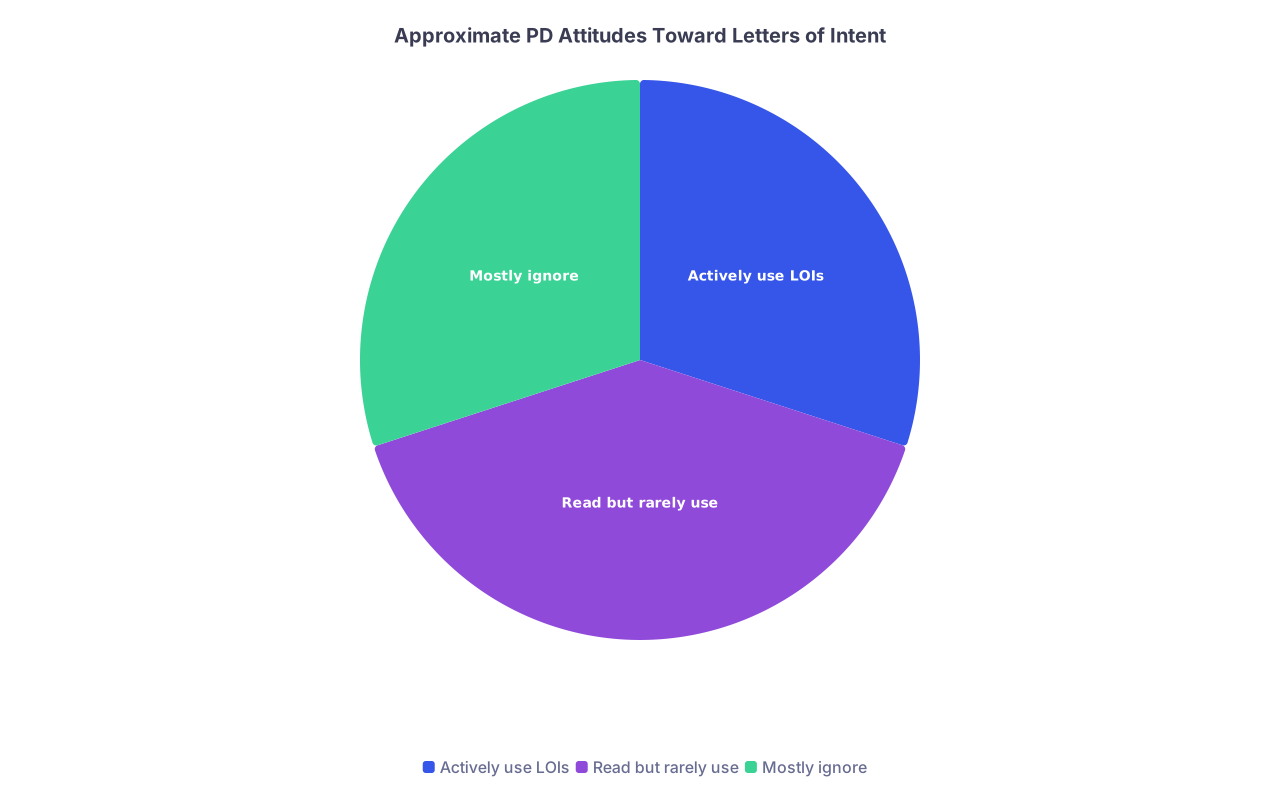
| Category | Value |
|---|---|
| Actively use LOIs | 30 |
| Read but rarely use | 40 |
| Mostly ignore | 30 |

The Future: Are Letters of Intent Dying or Here to Stay?
Let me tell you what PDs are actually grumbling about over coffee.
They’re tired. Of games. Of post-interview signaling. Of second looks, third emails, awkward phone calls, “my advisor told me to reach out.”
Some specialties and consortia are already moving to more formal signaling (preference signals, tokens, etc.). As that evolves:
- Formal signals: will carry more weight than ad hoc LOIs because they’re standardized and count-limited.
- Free-form LOIs: will still exist, but more as emotional reassurances than structured data.
Do I think LOIs will completely disappear? No. Because PDs are human, not algorithms.
As long as humans run rank meetings, someone will say “This applicant really wants to be here” and it will nudge group psychology.
What is fading is the illusion that a letter alone can rescue a weak application or a bad interview. Those days are gone if they ever existed.
What’s coming instead is a clearer stratification:
- Strong applicants + genuine LOI to a realistic top choice = mild, sometimes meaningful boost.
- Marginal applicants + spammy LOIs to many programs = noise, often ignored.
The more crowded and chaotic the match gets, the more PDs lean on structure and data. Your letter is a seasoning, not the main dish.

| Step | Description |
|---|---|
| Step 1 | Sent No LOI |
| Step 2 | Ranked Appropriately High |
| Step 3 | Ranked Middle or Low |
| Step 4 | Ranked Low or Not Ranked |
| Step 5 | Sent Genuine LOI to #1 Program |
| Step 6 | Small Upward Bump Possible |
| Step 7 | No Change in Rank |
| Step 8 | Strong Interview and Application |
| Step 9 | Average Interview and Application |
| Step 10 | Weak Interview or Application |
| Step 11 | Program Uses LOIs |
| Step 12 | Program Ignores LOIs |

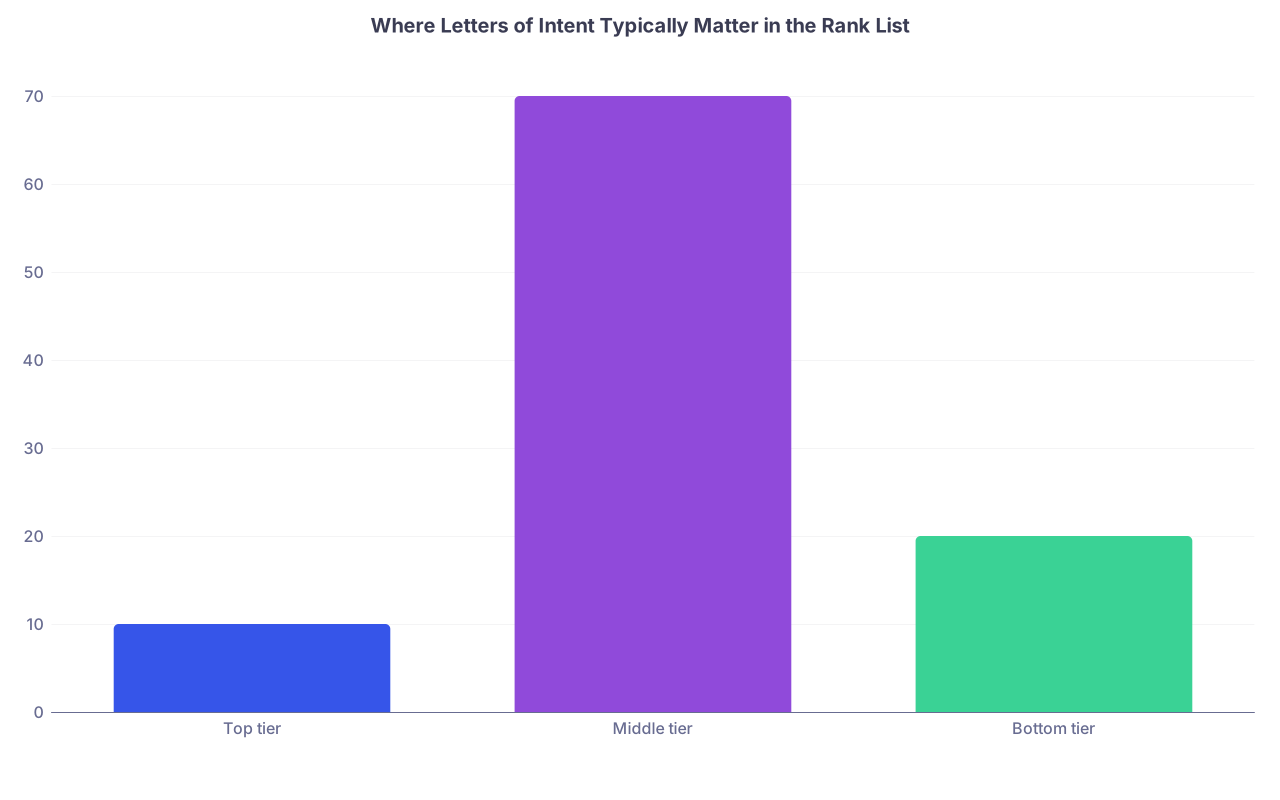
| Category | Value |
|---|---|
| Top tier | 10 |
| Middle tier | 70 |
| Bottom tier | 20 |

FAQ (exactly 4 questions)
1. Is it unethical to tell more than one program “I will rank you #1”?
Yes. Full stop. That’s not “strategy,” it’s lying. PDs talk. Faculty overlap across institutions. I’ve personally seen screenshots forwarded. You might think you’re being clever; on the other side, you look untrustworthy. Tell exactly one program they’re #1, and only if it’s actually true.
2. What if my true #1 is a huge name where I’m unlikely to move the needle—should I still send an LOI?
If you interviewed there and they’re genuinely your first choice, send it. Just keep your expectations realistic. At big-name programs, a good LOI is more about signaling professionalism and enthusiasm than about jumping 30 spots. It might matter in a tie; it will not turn a marginal application into a guaranteed match.
3. Does not sending any LOI hurt me?
No. Many excellent applicants match at fantastic programs every year without sending a single LOI. You are not penalized for opting out of this game. At programs that care about LOIs, they see them as a bonus signal in edge cases, not a requirement. Focus first on interviewing well and ranking programs honestly.
4. How late is too late to send a letter of intent?
If your email hits after the program has finalized and submitted its rank list, it’s useless. Many programs finalize in early-to-mid February; some even earlier. If you’re going to send a true LOI, do it within 1–2 weeks after your interview or no later than the first half of February. After that, you’re writing for your own anxiety, not their decision-making.
Take-home points?
First, PDs are not uniform. Some actively track and use letters of intent; others ignore them completely. That’s reality.
Second, a well-written, honest LOI to a single true #1 can help you at the margins, especially in the middle of a rank list at programs that care about fit and commitment—but it will never rescue a weak application.
Third, if you choose to play this game, do it like an adult: one program, real reasons, no spam, no lies. That’s how you stay on the right side of the people actually holding the rank list in their hands.