The way most applicants talk about “career goals” in a letter of intent is lazy and generic. That is why programs ignore it.
If you want a one-page letter of intent that actually shifts how a PD or selection chair sees you, you must integrate career goals in a way that is specific, program-linked, and believable in the constraints of a single page. Not a manifesto. Not a vague “lifelong learner” essay. A tight, strategic document.
Let me break this down specifically.
The Real Job of Career Goals in a One-Page Letter
Your career goals in a letter of intent are not there to:
- Prove you are ambitious. Everyone claims that.
- Showcase every interest you have ever had.
- Recite your CV in prose.
The goals section has three real jobs:
- Signal long-term fit with that program’s identity and resources.
- Reduce perceived risk that you will be unhappy, burn out, or leave.
- Create a coherent story connecting your past → present → future.
Program directors are pattern-recognition machines. When they see:
- Step 2 score,
- decent letters,
- okay interview,
- and a letter of intent that clearly aligns your next 3–5 years with what they actually offer…
…you move from “generic applicant” to “safe, aligned, and easy to advocate for during rank discussion.”
You are not just “sharing your dreams.” You are giving them reasons to rank you higher.
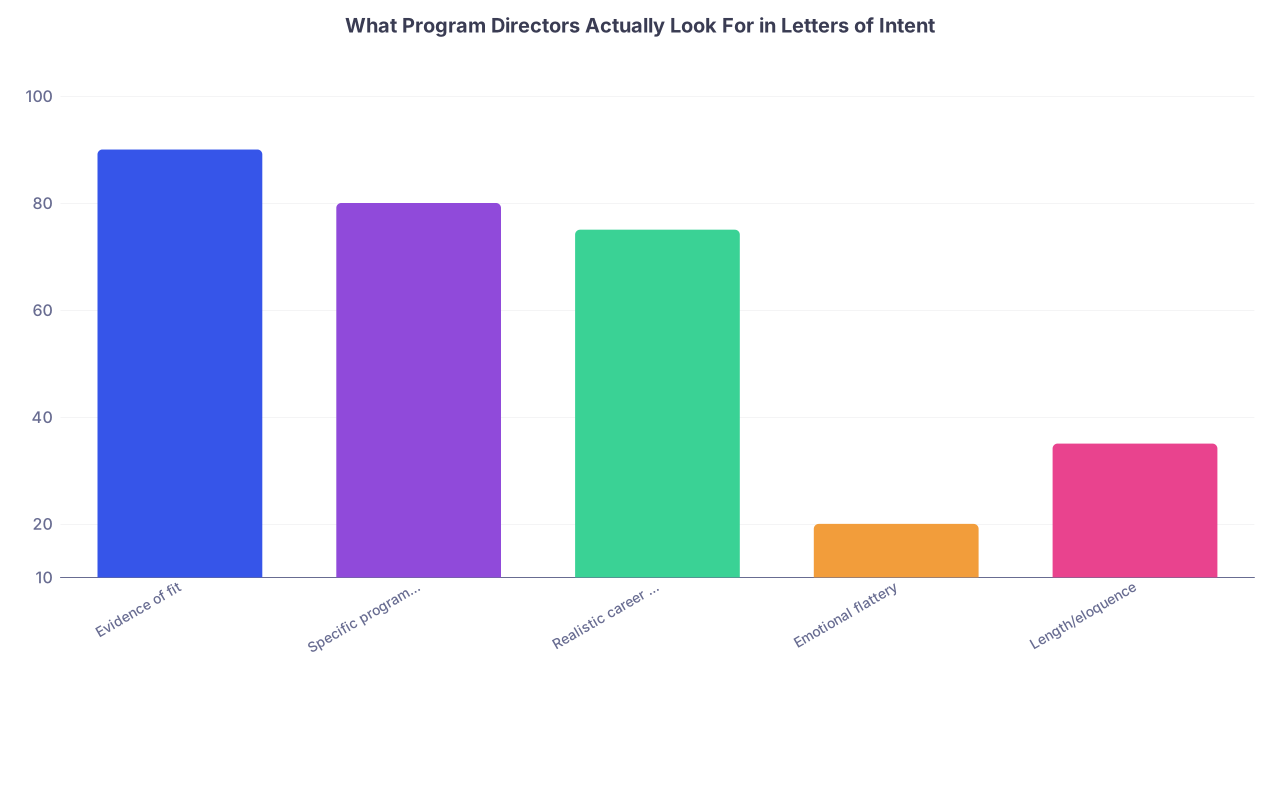
| Category | Value |
|---|---|
| Evidence of fit | 90 |
| Specific program knowledge | 80 |
| Realistic career goals | 75 |
| Emotional flattery | 20 |
| Length/eloquence | 35 |
Notice what is at the bottom of that list. Eloquence and flattery rarely move the needle. Specific, realistic goals that match their ecosystem do.
Step 1: Shrink Your Time Horizon
The biggest mistake I see: people try to cram their entire life arc into one page.
“Ever since I was six, I wanted to be a cardiothoracic surgeon, researcher, global health advocate, and health policy leader…”
No. Stop.
For a one-page letter of intent, especially late-cycle or post-interview, you focus your career goals in three layers:
- Near-term (training years: residency/fellowship duration)
- Early-career (first 3–5 years as attending)
- Long-term direction (1–2 sentences, max)
Think of it like this: the letter is not your autobiography. It is a short, convincing roadmap that answers two questions in the PD’s head:
- Will we help this person get where they want to go?
- Does what they want align with what we do here?
You only need enough detail to answer those questions decisively.
A simple structure that actually works
Keep your “goals arc” to roughly 3–4 sentences:
- One sentence: clear training goal at their program.
- One to two sentences: early-career focus (scope, setting, maybe niche).
- One sentence: broader long-term direction (academics, community leadership, subspecialty).
Everything beyond that is self-indulgence.
Example (Internal Medicine residency):
During residency, my primary goal is to develop strong clinical judgment in complex inpatient medicine while deepening my skills in medical education and quality improvement. In my first years as an attending, I plan to work in an academic safety-net setting, splitting time between inpatient medicine and resident teaching. Long term, I hope to serve as a core faculty member leading QI and curriculum projects that directly improve care for underserved patients.
That is enough. It is specific, but not absurdly detailed. No six-paragraph TED Talk.
Step 2: Anchor Your Goals to What You Have Already Done
Career goals that float without anchors read as wishful thinking. PDs have been burned by “aspiring surgeon-scientists” who never opened a paper again after Match. They are skeptical.
Your job: make your future feel like the natural next step of your past.
You do that with a simple pattern:
Past evidence → present intention → future direction
For example, in a one-page letter, this might look like:
My interest in health services research began during medical school when I worked on a project analyzing readmission patterns in patients with heart failure. That experience, combined with my ongoing involvement in our hospital’s discharge planning committee, has made me particularly focused on transitions of care. I hope to continue building this work in residency through structured QI training and projects that examine disparities in readmission and follow-up.
Two things are happening:
- You are not just saying “I want to do QI/research.” You are showing that you already started.
- You are pointing to specific, plausible next steps that a residency or fellowship can actually support.
If your past does not yet “match” your future goal perfectly, you still connect what you do have.
Example: You want a career in medical education but have minimal formal teaching roles.
Do this:
Although I have not yet had formal roles in curriculum design, I have consistently sought out informal teaching opportunities, from tutoring second-year students in pathophysiology to leading small-group review sessions before our surgery shelf. These experiences confirmed that I find teaching deeply satisfying. During residency, I hope to build on that foundation through structured teaching electives and feedback from clinician-educators.
You are not lying. You are constructing a credible trajectory.
Step 3: Map Your Goals Directly to the Program (or Institution)
This is where most applicants fall apart: they write one generic “goal paragraph” and blast it to 15 programs with minor edits. PDs can smell that from a mile away.
A one-page letter of intent that matters is customized. Not bloated, but surgically tailored.
You must explicitly connect:
- your near-term and early-career goals
- to 2–4 specific, named aspects of that program
Not “I am impressed by your strong clinical training.” That is noise.
Named. Concrete. Demonstrably real.
Let us get specific.
| Type | Example |
|---|---|
| Weak | "Your program's strong research opportunities will help me grow as a clinician-scientist." |
| Strong | "The structured research curriculum and mentorship within the Smith Outcomes Research Group would allow me to build on my work in heart failure readmissions and develop more rigorous methods training." |
| Weak | "I value your diverse patient population." |
| Strong | "The high volume of uninsured and underinsured patients at County General aligns with my goal of training in a safety-net setting where I will routinely manage complex medical and social needs." |
| Weak | "I am excited about your focus on teaching." |
| Strong | "The dedicated resident-as-teacher curriculum and opportunities to serve as a small-group facilitator for second-year medical students are exactly the kind of structured teaching experiences I am seeking." |
You see the pattern: each statement contains:
- A named program component (group, clinic, track, curriculum).
- A clear link to something you already did or plan to do.
You are telling the PD, “Here is exactly how I will use what you offer.”
Quick exercise you should actually do
For each program you are serious about, write down:
- 2 clinical features (e.g., “county hospital ICU,” “high-volume transplant,” “integrated community clinics”)
- 2 educational/research/QI features (e.g., “physician-scientist track,” “global health pathway,” “simulation curriculum”)
- 1 culture/mission feature (e.g., “commitment to rural health,” “strong support for wellness,” “tight-knit, resident-led program”)
Then, map one of your clear goals to each of these.
If you cannot map your goals to anything concrete at that program, that program may not actually be a good fit, or—more often—you have not done your homework.
Step 4: Make Your Goals Realistic and Time-Bound
Another mistake that kills credibility: goals that are grandiose or structurally impossible in the timeframe you are talking about.
You are writing a one-page letter of intent typically at three possible moments:
- For residency applications (pre- or post-interview)
- For fellowship applications
- For job/position intent (e.g., academic attending position)
In each case, the time horizon matters.
Most PDs roll their eyes at “I will revolutionize health care delivery” in a residency letter. But they respond positively to “I want to complete at least one QI project from conception to publication by the end of my second year.”
Ground your goals using:
- Rough timelines (“during residency,” “within my first three years as an attending”)
- Concrete outputs (“complete a project,” “develop and pilot a clinic-based intervention,” “design and evaluate a teaching module”)
- Reasonable scope (not “change national policy” during PGY2)
Example of overreach (I have actually seen versions of this):
During residency, I hope to develop national guidelines for sepsis management and lead multi-center randomized trials to change practice.
Compare with something a PD will take seriously:
During residency, I hope to contribute to ongoing sepsis quality initiatives by helping design and evaluate interventions on our wards and, ideally, co-author at least one manuscript focused on outcomes or implementation.
The second one sounds like someone who has at least seen how projects work.
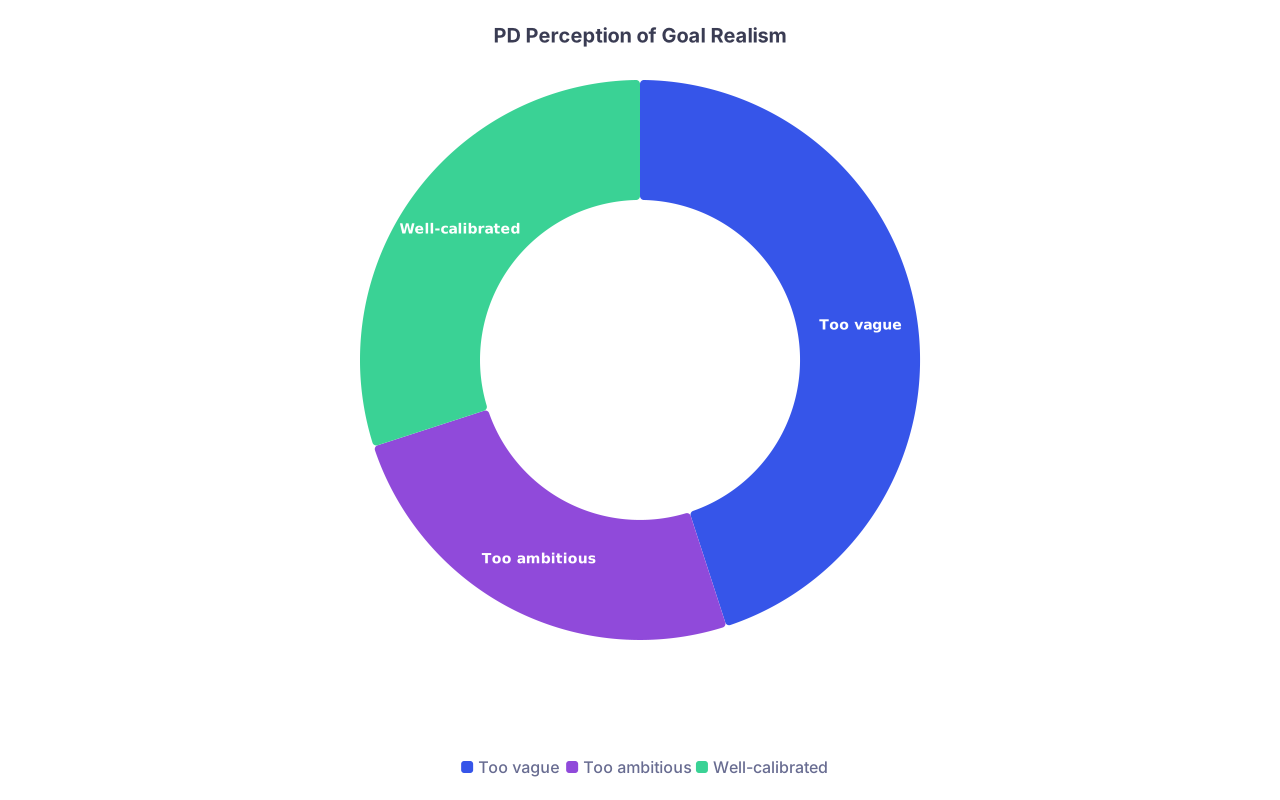
| Category | Value |
|---|---|
| Too vague | 45 |
| Too ambitious | 25 |
| Well-calibrated | 30 |
Almost half of applicants are too vague. A quarter sound delusional. You want the last third: precise, but grounded.
Step 5: Thread Career Goals Through the Whole Letter, Not Just One Paragraph
A one-page letter of intent is ~400–600 words if you are being respectful of a PD’s time. That is not much space. You cannot afford a disconnected “Career Goals” paragraph that feels like an add-on.
Your future direction needs to leak into how you:
- Open the letter
- Reference past experiences
- Describe your fit with the program
- Close the letter
This is where coherence comes in.
Simple, effective structure for a one-page LOI with goals integrated
Here is a structure I have seen consistently work:
Opening (2–3 sentences):
- State your purpose (interest in their program / signaling intent).
- Hint at your core direction (e.g., “with a long-term goal in academic primary care and medical education”).
Brief background + trajectory (1 short paragraph):
- One or two experiences that shaped your clinical/research/education interests.
- Natural pivot to what you want to develop next.
Program-specific alignment (1–2 paragraphs):
- Explicitly connect your goals to named features of their program.
- Mix clinical, scholarly, and culture/mission fit.
Concise career goals arc (3–4 sentences):
- Near-term training goals at their program.
- Early-career focus.
- Long-term direction.
Closing (2–3 sentences):
- Reiterate genuine interest and fit.
- If appropriate, signal that they are your top choice / high on your list (depending on context and honesty).
Notice: the “career goals” are not isolated. They appear in the opening, in the middle when you talk about alignment, and in the specific goals arc near the end.
Step 6: Adjust Your Goals for Different Phases and Letters
You mentioned “MISCELLANEOUS AND FUTURE OF MEDICINE” as the phase. Translation: this is not just about residency anymore. You might be talking about:
- Transition from residency to fellowship
- Transition from fellowship to job
- Or a letter connecting your clinical path to the evolving future of medicine (AI, telehealth, value-based care, etc.)
The principles are the same, but the emphasis shifts.
If you are a resident applying to fellowship
Your one-page letter should:
- Emphasize subspecialty-specific goals (not generic “I like research”).
- Show that you understand where the field is going (e.g., heart failure and devices, oncology and immunotherapy, EM and ultrasound/telehealth).
- Map your goals to their subspecialty labs, clinics, and faculty, not just the umbrella department.
Example (GI fellowship):
Over the next several years, I plan to develop expertise in inflammatory bowel disease with a focus on optimizing care coordination and outcomes for patients with complex disease. My prior work on care transitions for hospitalized patients with chronic illness, along with my ongoing QI project examining IBD readmissions, has made me particularly interested in integrated outpatient-inpatient models. Your program’s dedicated IBD center, along with Dr. Lee’s work on telehealth-based disease monitoring, aligns closely with these goals and would provide the ideal environment to develop the clinical and research skills I need.
You are now clearly tied to the current and future directions of that field, not just vaguely saying “I want to do GI.”
If you are a fellow applying for a faculty position
Now your goals must look more like:
- Definable role(s) within 1–3 years (clinical niche, admin role, education, research).
- Plausible funding and protected time plans, if research-heavy.
- Understanding of institutional priorities (population health, digital health, DEI, etc.).
You integrate language around “clinical program development,” “curriculum design,” “local implementation,” not just “I want to learn.”
Step 7: Tie Your Career Goals to the Future of Medicine Without Sounding Like a TED Talk
You are in the “future of medicine” bucket. Fine. Use it, but do not drift into buzzword soup.
Most applicants write lines like:
I am passionate about using artificial intelligence and big data to transform health care.
That tells a PD nothing. It sounds like you copied a Forbes headline.
A more sophisticated, believable way to integrate “future of medicine” themes:
- Contextualize them in a narrow clinical space.
- Show you understand limitations and practicalities.
- Connect to what that program actually touches (data warehouse, telehealth program, population health initiative, etc.).
Concrete example:
As medicine increasingly incorporates data-driven decision support, I am particularly interested in how predictive models can be integrated into everyday inpatient workflows without increasing alert fatigue or widening disparities. Working with our institution’s early sepsis alert system taught me how challenging deployment can be when frontline clinicians do not fully trust or understand the tool. Your program’s collaboration with the Center for Clinical Analytics, especially the work on real-time risk stratification on general medicine wards, would be an ideal setting to deepen my understanding of how to implement these tools responsibly.
Now you sound like someone who has touched the machine. Not just read an article about AI.
Same with telehealth, value-based care, or global health. Keep it small and real.
Step 8: Edit Ruthlessly for Specificity and Space
One-page letters demand brutality in editing. A lot of your first draft will be fluff.
Here is exactly what I have residents and applicants do:
- Highlight every sentence that could appear in any letter to any program without changing a word.
- Your job is to shrink those to < 30% of the letter.
- Everything else must be program-linked, goal-specific, or anchored to your actual history.
Then check for three red-flag patterns:
- “I am passionate about…”
- “I have always wanted to…”
- “I am confident that…”
You can keep one of those phrases. Maybe two. Any more and the letter starts to sound like generic application prose again.
Replace sentiment with specificity.
Instead of:
I am passionate about global health and hope to be involved throughout my career.
Use:
I plan to continue working in global health through periodic on-site collaborations and remote capacity-building rather than full-time overseas work. Your program’s established relationship with the Kigali Internal Medicine Training Program, including its emphasis on sustainable curriculum development, aligns with how I hope to remain engaged.
Less romance. More plan.
Step 9: A Concrete Example of Integrated Career Goals (Annotated)
Here is a compressed example for an Internal Medicine residency letter of intent, focused on career goals integration. This would be ~450–500 words in real life; I will keep it slightly lean here.
I will annotate in brackets, so you see how each piece is doing work.
Dear Dr. Patel and the Residency Selection Committee,
I am writing to express my strong interest in training at University Medical Center for Internal Medicine residency, with the long-term goal of an academic career at the intersection of inpatient medicine, quality improvement, and resident education.
[Opening: purpose + core direction in one sentence. No throat-clearing.]During medical school at State University, I gravitated toward settings where I could think through complex diagnostic problems while also examining how our systems shape outcomes. On my sub-internship in general medicine, I led a small project examining delays in antibiotic administration for patients admitted with sepsis, which ultimately resulted in a revised triage protocol. That experience, along with ongoing involvement in our hospital’s sepsis committee, confirmed that I want my career to blend direct patient care with efforts to improve how that care is delivered.
[Brief background: past evidence + present intention, already leaning toward QI and inpatient focus.]University Medical Center offers a combination of high-acuity clinical training and structured QI mentorship that I have not seen elsewhere. The dedicated QI curriculum, especially the longitudinal PGY-2 project requirement, matches my goal of leading at least one project from conception through implementation and dissemination during residency. I am particularly drawn to the Hospital Medicine QI Group’s work on sepsis bundles and readmission reduction, and would welcome the chance to build on that foundation.
[Program-specific: named features, concrete mapping to goals.]I am also deeply interested in resident education. Over the past two years, I have tutored second-year students in pathophysiology and led weekly case-based review sessions before our clerkship shelf exams. These sessions have been some of the most meaningful parts of my training. Your resident-as-teacher pathway, along with opportunities to facilitate small groups for the second-year clinical reasoning course, align closely with my goal of developing a strong foundation in bedside and classroom teaching.
[Again: past experiences → program features → clear, realistic near-term goals.]Looking ahead, my near-term goal during residency is to develop into an excellent, independent clinician who can manage complex inpatients while steadily building skills in QI methodology and teaching. In my first years as an attending, I hope to work as a hospitalist in an academic safety-net setting, splitting my time between clinical care, leading small QI initiatives, and contributing to resident education. Long term, I envision a career as a core faculty hospitalist leading QI-focused curricula and projects that improve how we care for patients with sepsis and other high-risk conditions.
[Three-tiered career arc: residency → early attending → long-term; specific but not bloated.]I left my interview day at University Medical Center convinced that your program is the environment in which I can best achieve these goals. The combination of rigorous clinical training, institutional commitment to QI, and a culture that clearly values resident teaching makes me excited about the possibility of joining your community. Thank you for considering my application.
Sincerely,
[Name] [Institution]
Career goals are everywhere in that letter, but there is no bulky “Career Goals” section. That is what you are aiming for.
Step 10: Use a Simple Pre-Submission Checklist
Before you send a one-page letter of intent that includes career goals, ask yourself:
Can a stranger reading only this letter infer:
- what kind of clinician I want to be,
- what kind of environment I want to train or work in,
- and what kind of academic/educational/research/QI direction I am drawn to?
Are there at least three specific references to this program’s actual features (by name)?
Does every mentioned “future goal” have at least one past or present anchor somewhere in the letter?
Are my timelines credible for the stage I am at?
Is the total length under one page, with no paragraph turning into a block of text that will make a PD’s eyes glaze over?
If you cannot answer “yes” down that list, you have more editing to do.
To visualize how your goals and the program’s features should line up, a simple mental map helps:

That is the skeleton under a strong one-page letter. Everything else is just sentence work.
Final Takeaways
- Career goals in a one-page letter of intent are not decoration; they are the spine that connects your past to that specific program’s future.
- Specificity wins: clear timelines, anchored goals, and named program features beat generic ambition every time.
- If your letter could be sent, unchanged, to ten programs, it is not a real letter of intent. It is background noise.