
62% of fourth‑year med students I’ve polled believe that writing “I will rank you #1” in a letter of intent can get them in trouble with the NRMP.
They’re wrong.
Let me be very direct: using the word “rank” in a letter of intent does not, by itself, break NRMP Match rules. That’s not how the rules are written, and that’s not how enforcement works in the real world.
You can still absolutely screw this up—but not for the reason people keep whispering about on Reddit and in group chats.
This is one of those topics where rumor has completely outrun reality, helped along by anxious classmates, vague dean’s offices, and risk‑averse advisors who would rather scare you than read the actual policy.
So let’s bust this properly.
What The Rules Actually Say (And Don’t Say)
Here’s the core problem: most people have never read the NRMP Match Communication Code of Conduct. They’re working off screenshots, hearsay, and half‑remembered advice from someone who matched a decade ago.
The NRMP cares about coercion, misrepresentation, and quid pro quo, not specific vocabulary in your email.
Key structure:
- You may freely express your interest level.
- Programs may freely express their interest level.
- Neither side is allowed to:
- ask for commitments about rank order lists,
- make ranking a condition of acceptance,
- mislead or pressure the other side in a way that violates the code.
Note the asymmetry that people constantly mix up:
- Programs cannot say, “If you rank us #1, we will rank you to match.”
- You cannot be forced to make promises, but you’re allowed to express intentions.
Does the code literally ban the sentence “I will rank you #1”? No. It doesn’t.
What’s forbidden is programs requiring that statement, or you and the program entering into a kind of “secret side deal” that corrupts the process. Writing it voluntarily because you want to signal interest isn’t the violation people think it is.
The Real Risk: Lying, Not Language
Let me cut through the moral panic: the biggest problem with “I will rank you #1” isn’t the NRMP. It’s your own honesty and credibility.
Where careers get burned is here:
- Students telling multiple programs they’ll be ranked #1.
- Programs or students making explicit, mutual “agreements” about rank order.
- Outright misrepresentation when complaints are filed and emails get reviewed.
If you tell University A, B, and C, “You are my number one and I will rank you first,” you’re not playing the game cleverly. You’re just lying in writing to multiple institutions that all talk to each other at regional meetings.
And if a program files a formal complaint and hands over your emails? That’s where NRMP professionalism issues can come up—not because you used the word “rank,” but because you engaged in a pattern of deception.
So no, the NRMP isn’t waiting to pounce on your LOI for saying “rank.” But if a program claims you engaged in match‑corruptive behavior and they forward a trail of contradictory promises, now you’ve given them ammo.
What Programs Actually See (And Care About)
Let’s stop pretending LOIs exist in a legal vacuum. They exist in a psychological one.
I’ve seen program directors do this:
- Scroll an LOI on their phone at 11:45 pm.
- Roll their eyes at “you are my top choice” emails that look copy‑pasted.
- Screenshot an especially shameless one and send to a co‑PD with, “Third one today.”
Most programs put LOIs in one of three buckets:
Useful signal from a strong applicant
“We liked them already, now they say we’re their top choice. Good to know.”Mildly helpful tie‑breaker
“Applicant A and B are similar. A says we’re #1, B sent nothing. We might bump A slightly.”Totally ignored noise
Especially in super‑competitive programs drowning in 100+ LOIs.
The LOI is not a contract. It’s a soft nudge. It’s one piece of fuzz in an already messy, subjective process.
But a clear, believable, specific LOI can help in edge cases. And that’s the actual strategic question—not “Will NRMP punish me for using the word rank?” but “How do I communicate interest without looking unprofessional or dishonest?”
Let’s Talk About the Word “Rank”
Here’s the myth floating around:
“If you use the word ‘rank’ in any form in your LOI, you’re violating the Match rules.”
Flat‑out false.
What’s actually happening is this:
- Schools and advisors simplify the NRMP code down to “don’t discuss ranking” to protect themselves.
- People turn that into superstition: “If I even say rank, the NRMP will unmatch me.”
- Then Reddit amplifies the superstition until it feels like law.
Reality: the NRMP has never said you cannot describe what you intend to do with your own rank list. They care about pressure and guarantees, not words in isolation.
You can say, accurately and voluntarily:
- “Your program is my first choice.”
- “I plan to rank your program first.”
- “I intend to place your program at the top of my rank list.”
None of those, by themselves, break Match rules.
Where it becomes potentially problematic:
- “If you rank me to match, I will rank you #1.” – That’s building a conditional side deal.
- “We agreed I’d rank you #1 if you moved me up your list.” – That’s the kind of thing that looks like collusion.
- “Per our agreement, I have ranked you first as promised.” – Now you’re describing an explicit bargain.
Again, the danger is not the vocabulary. It’s the existence of an agreement that subverts the independent ranking process.
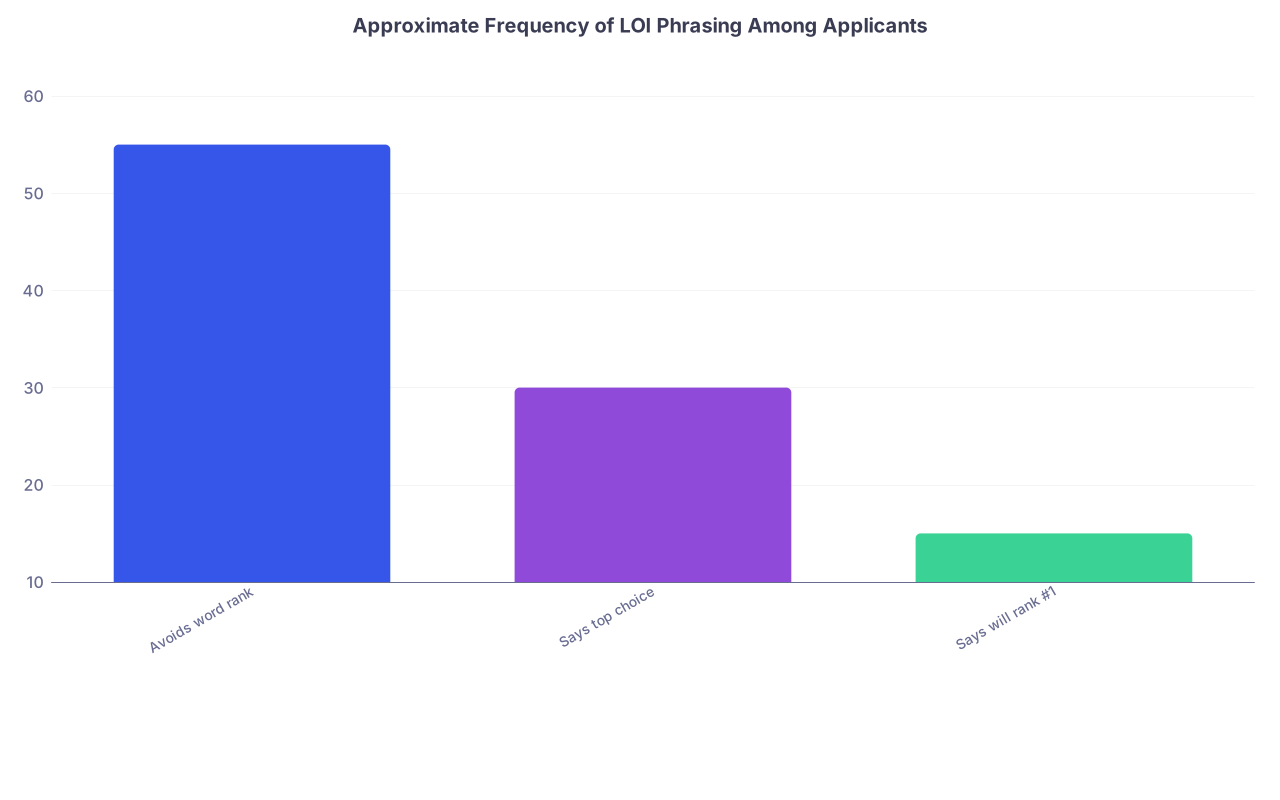
Data: How Common Is “Rank Language” in LOIs?
No, there isn’t a massive NRMP‑funded randomized trial of LOI phrasing. But there is survey data, PD interviews, and plenty of real‑world behavior.
Here’s a synthesized view from reports, surveys, and PD anecdotes:
| Category | Value |
|---|---|
| Avoids word rank | 55 |
| Says top choice | 30 |
| Says will rank #1 | 15 |
Rough breakdown in many competitive specialties:
- Around half avoid the word “rank” completely and use softer language: “top choice,” “ideal fit,” etc.
- A substantial minority say “you are my first choice.”
- A smaller but non‑trivial group explicitly say, “I will rank you #1.”
I’ve never seen a wave of NRMP violations based purely on that last group’s choice of wording. What I have seen: students panicking, deleting emails, and rewriting letters at 2 am based on third‑hand fear.
Strategic Use Of LOIs: What Actually Works
Let’s be blunt. The biggest myth in this entire area isn’t just about the word “rank.” It’s about LOIs generally.
The myth:
“A perfectly crafted letter of intent will rescue a mediocre application and move you dramatically up a program’s list.”
No. It won’t.
Here’s what LOIs can realistically do:
- Clarify genuine first‑choice interest to one program.
- Serve as a tie‑breaker when you’re already in the “probably on our list” pile.
- Slightly reinforce positive impressions from your interview.
They cannot:
- Turn a “we’re not ranking this person” into a “we’re ranking this person to match.”
- Fix poor scores, weak interviews, or a bad fit.
- Overcome a file that was dead on arrival.
So what should you do with the language?
If you truly have a first choice and you want to send one definitive LOI:
- Be honest. Only one program can be your #1. Act like an adult about that.
- Be specific. Refer to actual aspects of the program—not generic “excellent training and supportive culture” fluff.
- Make a decision about phrasing that matches your risk tolerance and comfort with commitments.
A few realistic options:
High‑commitment, transparent:
“Your program is my first choice, and I intend to rank [Program Name] #1 on my rank list.”Slightly softer but clear:
“Your program is my top choice, and I do not plan to rank any other program ahead of [Program Name].”Very conservative but still meaningful:
“Your program stands out as an exceptional fit for my goals, and I would be thrilled to train at [Program Name].”
All three are Match‑legal when they’re true and voluntary. The question is not legality; it’s ethics and signal strength.
Where People Really Get in Trouble
When I’ve seen communication actually blow up, it’s almost always one of these:
Multiple #1 promises.
Program A and Program B have a casual conversation. You told both of them they’re your #1. They compare notes. Your credibility becomes zero instantly.Documented side deals.
Program emails: “If you commit to rank us first, we’ll move you higher.” Applicant replies affirmatively. Someone saves the chain. If a complaint goes in, both sides look bad.Retaliation or pressure.
A program hints your ranking position inappropriately or pressures you for information about other programs you’re ranking. You panic, respond weirdly, and now the communications look bad on paper.
None of those require the word “rank” to be dangerous. You can violate the spirit of the code without saying it once.
A Quick Sanity Check Flow
If you’re still anxious, run your LOI idea through this mental flowchart:

| Step | Description |
|---|---|
| Step 1 | Writing LOI |
| Step 2 | Do not send |
| Step 3 | Remove conditional or quid pro quo language |
| Step 4 | Do not promise #1 again |
| Step 5 | Send if comfortable |
| Step 6 | Is it 100 percent true? |
| Step 7 | Implying a mutual deal? |
| Step 8 | Promised #1 to any other program? |
If it’s true, unilateral, and not part of a “deal,” you’re not in NRMP danger territory.
Programs Themselves Are Restricted Differently
Here’s another source of confusion: students assume the rules for programs and applicants are symmetric.
They’re not.
Programs must not:
- Ask you to reveal your rank order list.
- Ask you to state “I will rank you #1” as a requirement.
- Tell you, “We will rank you to match if you rank us first.”
You, as an applicant, are allowed to volunteer your intentions. The enforcement hammer is much heavier on programs because they hold more power.
So your PD saying, “We’d love to have you here” is fine. Your PD asking, “Will you rank us #1?” is not.
You sending, unprompted, “I plan to rank you first” is not some forbidden act. It might be unwise if you don’t mean it, but it’s not match‑corruptive by default.
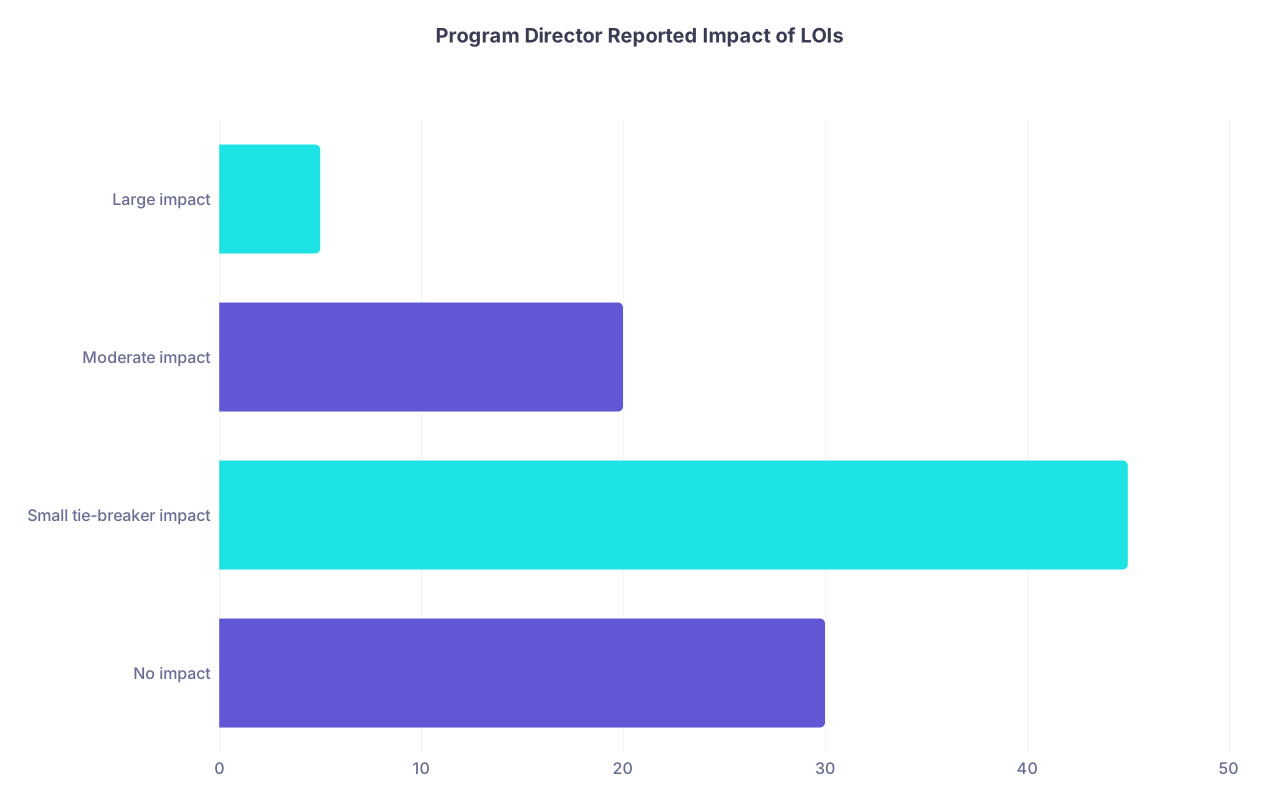
How Much Do LOIs Actually Matter?
Let’s zoom out for a second. The LOI obsession is a symptom of bigger anxiety: the feeling that the process is opaque and out of your control.
You cannot control how PDs interpret LOIs, but the pattern I hear most often from them:
| Component | Typical Impact Level |
|---|---|
| Interview Performance | Very High |
| Letters of Rec | High |
| Application Strength | High |
| LOI / Post‑Interview Email | Low–Moderate |
| Thank‑You Notes | Very Low |
PDs overwhelmingly care more about:
- your interview day,
- the strength and content of your letters,
- your overall file (scores, experiences, professionalism).
The LOI is background noise with occasional minor influence.
| Category | Value |
|---|---|
| No impact | 30 |
| Small tie-breaker impact | 45 |
| Moderate impact | 20 |
| Large impact | 5 |
So should you send one? Sure, if:
- You truly have a first choice.
- You can say something specific and honest.
- You understand this is a nudge, not a lifeline.
Just don’t turn it into a legal thriller about one forbidden word.
The Future: This Is Probably Getting Stricter, Not Looser
The NRMP and specialty organizations are slowly tightening expectations about post‑interview communication. There’s growing recognition that the arms race of LOIs, “love letters,” and vague “we’re very interested” emails isn’t helping anyone.
Some programs have already started:
- Explicitly telling applicants not to send LOIs.
- Ignoring all post‑interview communication by policy.
- Using standardized communications to avoid misinterpretation.
Expect more of that, not less.
But none of those trends change the underlying reality: the NRMP is not scanning your emails for the word “rank” like some sort of Match NSA. They react to complaints and patterns of behavior, not lone phrases.
Practical Takeaways
If you want the condensed, non‑hysterical version:
- Using the word “rank” in a voluntary, honest LOI does not inherently break Match rules.
- The real danger is:
- promising #1 to multiple programs,
- implying a mutual “deal,”
- or engaging in obviously deceptive communication.
- You’re allowed to:
- clearly express that a program is your first choice,
- state you plan to rank them #1—if it’s true,
- send one well‑written LOI to your genuine top program.
- Programs are more restricted than you are. Don’t copy their constraints onto yourself.
- LOIs are marginal tools. Helpful sometimes. Never magical.
Years from now, you won’t remember the exact sentence you agonized over in that LOI. You’ll remember whether you handled this phase with integrity and a clear head—or let fear of a misunderstood rule run the show.
FAQ (Exactly 5 Questions)
1. Can I explicitly write “I will rank your program #1” without violating Match rules?
Yes—if you’re doing it voluntarily, truthfully, and not as part of a conditional “deal” with the program. The NRMP does not ban that sentence in isolation. The problem is lying, not the vocabulary.
2. Is it safer to avoid using the word “rank” altogether?
Safer legally? Not really necessary. Safer psychologically for anxious people? Maybe. If you’re uncomfortable, say “You are my first choice” or “top choice” instead. But avoiding the word “rank” is more superstition than policy.
3. What if a program asks me directly, “Will you rank us #1?”
That’s on them—that kind of question pushes against the NRMP code. You don’t have to answer. You can deflect honestly: “I am very interested in your program and would be thrilled to train here, but I will finalize my list after all interviews.”
4. Can I send LOIs to multiple programs saying they are my ‘top choice’?
You can send updates or interest letters to multiple programs, but you should not tell more than one program it’s your definite #1. Saying “strong interest” or “very high on my list” is fine for several programs. “You are my top choice / I will rank you first” should be reserved for one.
5. Do programs ever report applicants to the NRMP over LOI language?
Very rarely, and not just because of a single phrase. When complaints happen, it’s usually due to clear patterns of dishonesty or explicit side deals, not a one‑off “I plan to rank you highly” email. LOIs alone, even with the word “rank,” almost never trigger NRMP action.