
Most letters of intent fail not because of what you say, but because you refuse to cut what does not matter.
Let me be blunt: 350 words is generous for a good LOI. If your draft “needs” 600–700 words, the problem is not the word limit. The problem is structure, repetition, and your fear of deleting sentences you like.
You want precision editing. Not “soft polishing,” not grammar corrections. Surgery. We are going to walk through exactly how to take an overstuffed LOI and compress it to a tight, high-yield, sub‑350‑word letter that programs will actually read to the end.
The Real Job of a Letter of Intent (LOI)
Most applicants misunderstand what an LOI is for, so they write the wrong letter and then struggle to cut it down.
A post‑interview LOI has exactly three jobs:
- State clearly that you will rank this program #1 (or that it is one of your top choices, if you are being more cautious).
- Give 2–3 specific, program‑anchored reasons that make your ranking decision credible.
- Reassure them you will fit and thrive there (professionalism, reliability, alignment with their strengths).
That is it. Not your life story. Not your entire CV. Not a second personal statement.
Once you accept that narrow purpose, trimming to 350 words becomes a labeling exercise: everything that supports those three jobs stays; everything else is a suspect you must justify keeping.
Stepwise Reduction: From Bloated Draft to Sub‑350 Words
Most people start with something in the 450–800 word range. Here is how I cut those down in coaching sessions, repeatedly, without losing substance.
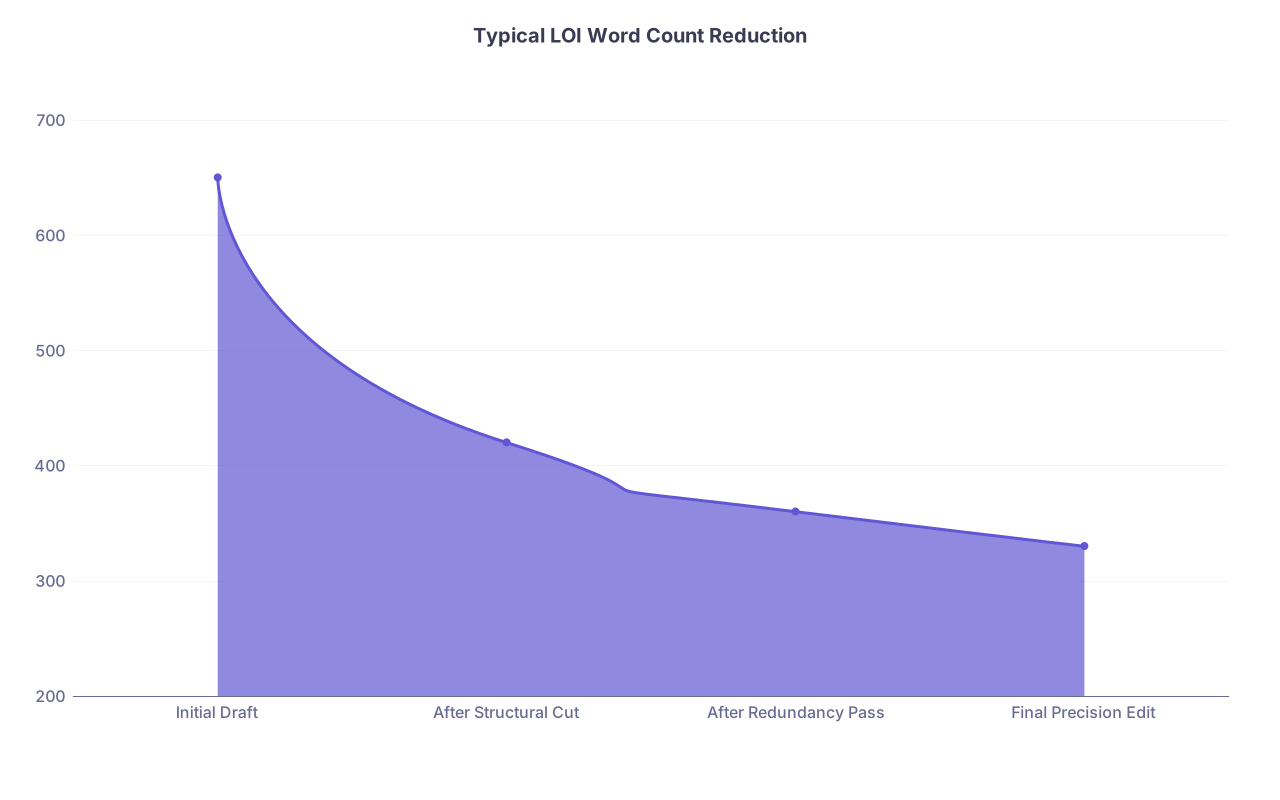
| Category | Value |
|---|---|
| Initial Draft | 650 |
| After Structural Cut | 420 |
| After Redundancy Pass | 360 |
| Final Precision Edit | 330 |
Step 1: Lock the Skeleton in 5 Sentences
Before you cut, you need a target structure. I use a 5‑sentence skeleton that reliably lands under 350 words once filled and slightly expanded.
Think in sentences, not paragraphs:
- Commitment sentence
- “Why this program” – specific features (1–2 sentences)
- “Why I fit here” – your alignment (1–2 sentences)
- Brief gratitude + professional reassurance
That is your entire letter.
Concrete template (you will customize language, but keep the logic):
- Sentence 1: “I am writing to state that I will rank [Program Name] as my first choice for [specialty] residency.”
- Sentences 2–3: “[Specific program element] and [another specific element] convinced me that I will receive outstanding training in [X] and contribute meaningfully to [Y].”
- Sentences 4–5: “My experience in [relevant training / setting] and focus on [clinical or academic niche] align closely with [program trait]. Thank you again for the opportunity to interview; I would be honored to train at [Program Name].”
Now, take your current draft. Strip it down to these five logical chunks. Literally:
- Highlight your clear commitment sentence. If you don’t have one, write it.
- Identify your “why this program” sentences, keep the best 2, delete the rest.
- Identify your “why I fit here” sentences, keep the best 2, delete the rest.
- Keep a simple thank‑you closing. Delete the flowery sendoff paragraphs.
Do not worry about the word count yet. Just enforce the skeleton.
You should already be under 450 words after this pass if you are ruthless.
What Actually Belongs in a Sub‑350‑Word LOI
To keep the letter tight, you must discriminate between “nice” information and “essential” information.
Here is the mental rule I use with residents:
If a sentence does not either (1) signal commitment, (2) prove you know this program, or (3) show you are a low‑risk, high‑yield resident for them, it is dead weight.
| Content Type | Keep in <350 Words? |
|---|---|
| Explicit #1 ranking commitment | Always |
| Program-specific features (2–3 max) | Always |
| Broad flattery (“prestigious”, “renowned”) | Usually cut |
| Detailed personal story | Almost always cut |
| One-line clinical interest summary | Keep |
| Long CV recap (research, awards) | Cut or compress |
High-yield inclusions
You do include:
Clear rank statement
“I will be ranking [Program] as my first choice.” No ambiguity. No “very highly” if you intend #1.2–3 concrete program features
Examples that pass the specificity test:- “Your 6+6 schedule with dedicated academic half-day.”
- “The strong outpatient HIV curriculum at the county site.”
- “Integration with the [Name] VA and its geriatric focus.”
If an applicant could paste the same sentence into a letter for 20 different programs, it fails.
1–2 precise alignment points
“My experience as chief of our student-run free clinic and my planned career in academic general internal medicine align strongly with your emphasis on underserved primary care and resident teaching.”One sentence that quietly reassures them
You are not telling them “I am professional and hardworking” (everyone says that). You are showing it:- “Faculty have consistently trusted me with longitudinal follow-up for complex patients on our wards.”
- “My current PD has described my work ethic and collegiality as ‘exceptional’ in our end-of-rotation feedback.”
Low-yield content that must go
You cut or radically compress:
Re‑telling the interview day schedule
“From morning report to the afternoon tour, I was impressed…” That entire paragraph is filler.Emotion without evidence
“I left feeling inspired…” “I was deeply moved…” You can have one short clause of this, not three sentences.CV duplication
“As you can see from my ERAS application, I have done X, Y, Z…” They have read it. Or they have not. Either way, repeating it in prose rarely moves the needle.Long backstory
“Since I was a child…” or “Growing up in a rural community…” That belongs in personal statements, not LOIs. You get maybe one short phrase tying your background to their mission. Not a narrative.
The Precision Editing Process: Pass by Pass
You do not get from 520 words to 330 by “reading through and trimming a bit.” That is how you end at 430 and stuck. You need distinct editing passes, each with a different job.
Pass 1: Structural Cut (Goal: 450–475 words → ~380–400)
Task: Enforce the skeleton and kill whole sentences.
Rules:
No paragraph over 4 sentences.
Long paragraphs hide redundancy.Maximum:
- 1 commitment sentence
- 2–3 program-specific reasons
- 2–3 “why me” sentences
- 1 gratitude/reassurance sentence
If you have 5 “why this program” sentences, you are not being selective. Choose the best 2–3. Combine compatible ideas into one longer sentence.
Example before (two sentences):
I was impressed by the collegial culture among residents. I also appreciated the clear support for wellness and work-life balance.
After (one sentence):
I was impressed by the collegial resident culture and the program’s concrete investment in wellness and work-life balance.
Two ideas, one sentence, 5–7 words saved without losing content.
Pass 2: Redundancy and Soft Word Bloat (Goal: ~380–400 → 340–360)
Now you attack at the phrase and word level.
You look for:
Double modifiers:
“Truly exceptional,” “deeply meaningful,” “very unique” → almost always 1–2 wasted words per phrase.Repeated concepts:
If you say “excellent teaching” twice, cut one or rephrase.Multi-word filler phrases:
- “I would like to” → “I want to” or often just delete.
- “I am writing to” → Often implied.
- “In order to” → “To”.
- “It was a pleasure to interview” → “Thank you for the opportunity to interview”.
Target reduction: 10–15% just from these trims.
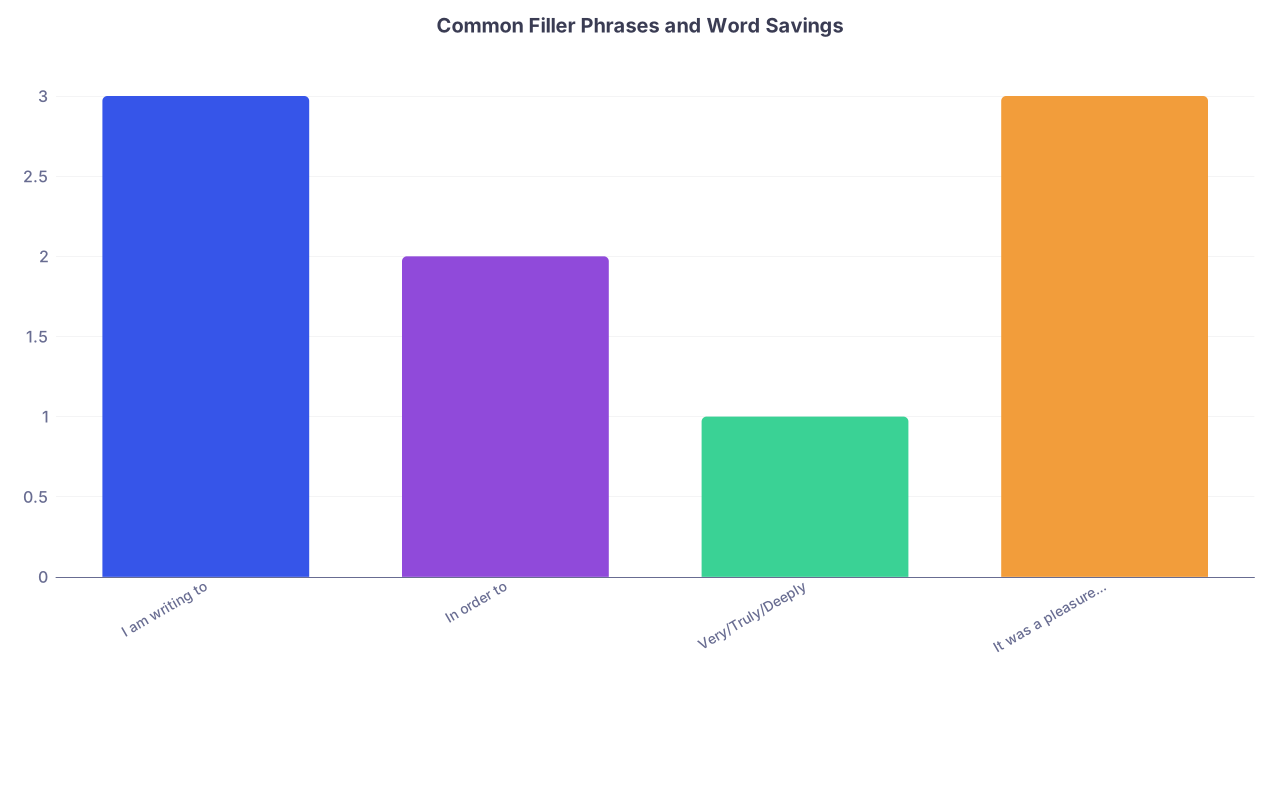
| Category | Value |
|---|---|
| I am writing to | 3 |
| In order to | 2 |
| Very/Truly/Deeply | 1 |
| It was a pleasure to | 3 |
Quick examples:
“I am writing to express my strong interest in your residency program”
→ “I am writing to state that I will rank your residency program first.”
Same length, but far more direct and less fluffy.“I believe that your program will provide me with the training and support I need to become an excellent clinician and educator”
→ “Your program will provide outstanding preparation for my goal of becoming a clinician-educator.”
You are cutting beliefs, hedge words, and vague “excellent clinician” language and replacing with specific roles.
Pass 3: Precision and Signal (Goal: 340–360 → 310–350)
This is where you ask a harsher question:
Does each sentence earn its place?
I use three tests for each sentence:
Could this sentence, as written, fit in a letter to 10 other programs?
If yes, it is either weak or needs a specific anchor.Does this sentence change how the PD ranks me?
If the answer is no or “not really,” delete or fuse it with another.Does this sentence repeat something suggested elsewhere?
For example, if your entire letter screams “I like your strong clinical training,” you do not also need “I am confident that your program will make me a strong clinician” spelled out.
Also check for meaningless intensifiers: very, highly, extremely, deeply. One or two is fine. More than that, you look like a brochure.
By the end of this pass, you should be between 300–350 words. If you are still at 380, you are protecting weak sentences.
A Concrete Before-and-After Compression Example
Let me show you how this actually plays out.
Here is a “typical” overlong LOI segment (around 190 words):
Thank you again for the opportunity to interview at the University Hospital Internal Medicine Residency. It was a true pleasure to meet with your residents and faculty, and I left the interview day feeling inspired and excited about the possibility of training at your institution. I am writing to express my strong interest in your program and to share that I will be ranking University Hospital very highly on my rank list.
I was particularly impressed by the balance between rigorous clinical training and the emphasis on wellness and support. The morning report I attended demonstrated a strong commitment to teaching and evidence-based medicine, and I appreciated the way faculty encouraged resident participation and critical thinking. The residents I met all spoke about the sense of camaraderie and teamwork, as well as how approachable the program leadership is. I was also very interested in your primary care track and the opportunities to work with underserved populations at the county clinic. Coming from a medical school with a strong focus on community engagement, I feel that this aligns closely with my values and long-term goals.
Now a compressed, sharper version of the same content (about 115 words):
Thank you again for the opportunity to interview at the University Hospital Internal Medicine Residency. I am writing to state that I will rank your program as my first choice.
Your combination of rigorous clinical training with genuine wellness support, as I saw during morning report and in conversations with residents, is exactly the environment I am seeking. The primary care track and continuity experience at the county clinic align with my commitment to underserved populations and my prior work in our student-run free clinic. I was also struck by how consistently residents described accessible, supportive leadership and a true sense of camaraderie. I am confident that I would thrive and contribute meaningfully to your program.
What changed?
- “Very highly” became “first choice.” Specific.
- Redundant sentiment (“true pleasure,” “inspired and excited”) was consolidated.
- “Strong focus on community engagement” became a concrete anchor (“student-run free clinic”).
- Repetition about camaraderie / leadership was tightened into one strong sentence.
You kept all the ideas that matter. You lost about 40% of the words.
Program-Specificity Without Overwriting
One of the most common errors I see: applicants trying so hard to be specific that they stuff 6–7 micro-details into one LOI. It reads like they are reciting the website back to the PD.
You need to select. Two or three well-chosen specifics beat a laundry list.
Good vs weak specificity
Weak:
“I was drawn to your diverse patient population, strong research, and excellent fellowship match.”
Everyone claims those.
Stronger:
“The opportunity to care for a highly diverse patient population at both your county and VA sites, combined with a culture that normalizes resident-led QI and scholarship, makes University Hospital uniquely suited to my goal of becoming a clinician-educator who works with underserved communities.”
You see the difference:
- Naming sites (county, VA)
- Naming specific activity types (QI, scholarship)
- Linking to your concrete goal (clinician-educator with underserved focus)
You are not just “impressed.” You are building a logical bridge from what they offer to who you are and who you are becoming.
How many specifics is enough?
Two anchors are usually sufficient in a sub‑350‑word letter:
- One structural / curricular feature (schedule, track, site, teaching culture).
- One mission / population / niche alignment (underserved, global health, research focus, etc.).
Aim for clarity over volume.
Handling Multiple LOIs Without Sounding Copy-Pasted
If you are sending more than one LOI (for example, one true #1 and a few “top choice” notes), you face a different precision problem: you must change enough that you are not transparently recycling.
Here is how I structure this without writing from scratch each time.

| Step | Description |
|---|---|
| Step 1 | Master LOI Template |
| Step 2 | Program Specific Section |
| Step 3 | Personal Alignment Section |
| Step 4 | Customize 2 Program Details |
| Step 5 | Customize 1 Alignment Example |
| Step 6 | Final LOI Version |
Create a 3‑part template:
Commitment line
- For true #1: “I will rank [Program] as my first choice.”
- For others (if you choose to): “I will rank [Program] among my top choices.”
Do not lie; the match algorithm will not rescue your integrity.
Program-specific block (2–3 sentences)
This you change significantly for each letter:- Name their tracks, clinics, or curricular features.
- Reference specific attendings or conferences only if you truly remember and it felt meaningful.
Personal alignment block (2–3 sentences)
This can be partially reusable, with 1–2 factual details swapped:- “My work in [X] and interest in [Y] fit well with your [Z].”
You maintain precision by anchoring to real details and by never relying on generic adjectives. “Outstanding,” “prestigious,” “renowned” do not differentiate you. They also do not survive a 350‑word limit well.
Common Mistakes That Keep You Above 350 Words
Let me call out the patterns I see most often when someone insists “I just can’t get it lower.”
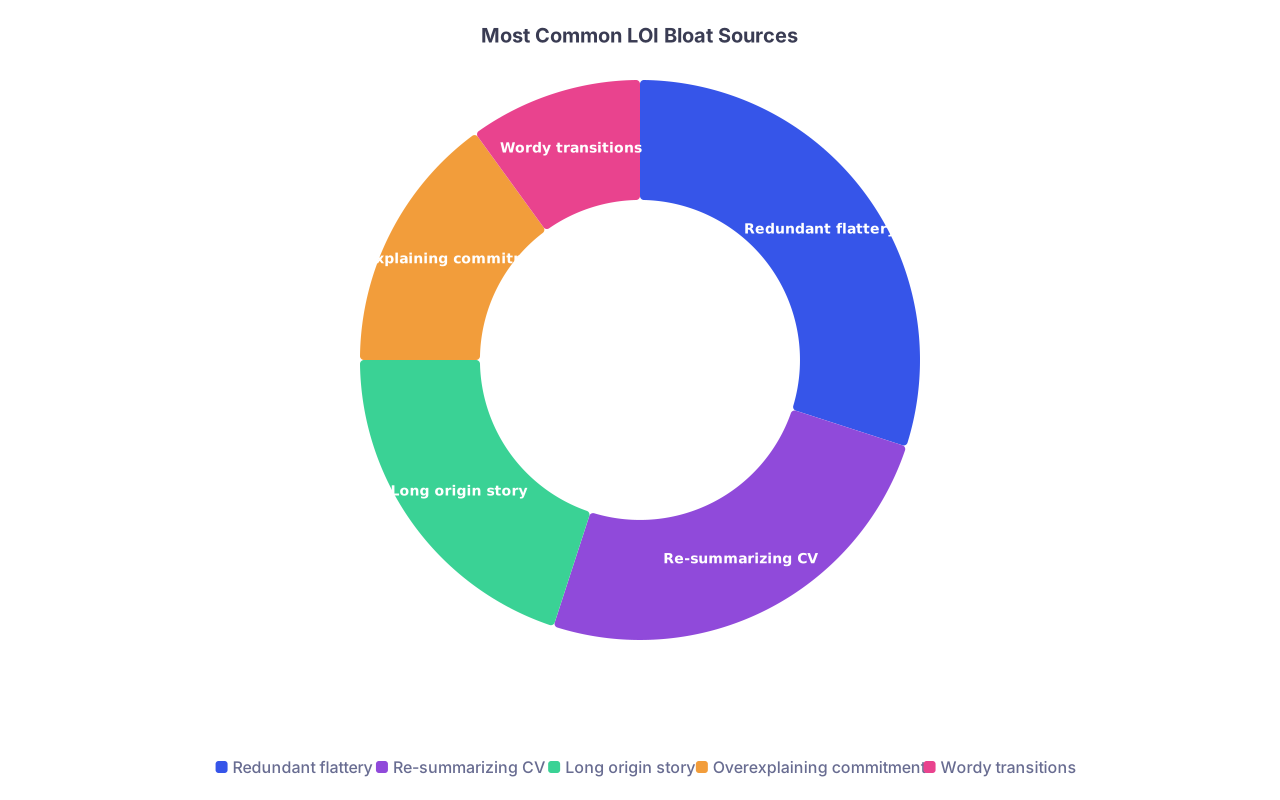
| Category | Value |
|---|---|
| Redundant flattery | 30 |
| Re-summarizing CV | 25 |
| Long origin story | 20 |
| Overexplaining commitment | 15 |
| Wordy transitions | 10 |
Writing for politeness instead of clarity
You wrap everything in “I would like to take this opportunity” and “I just wanted to say.” That is email language, not LOI language.Trying to re-sell your candidacy
LOIs are not the place to reargue your entire application. They already interviewed you. You are signaling commitment and fit, not reapplying.Long explanations of ranking ethics
Do not lecture the PD on how the match algorithm works or your philosophy of ranking. One direct sentence is plenty.Over-describing your feelings about the interview
“I left the day feeling…” plus three sentences of that. Cut to one line: “I left the interview day convinced that your program is the environment where I want to train.”Narrative tangents
Any sentence that starts to sound like your personal statement introduction probably belongs in your personal statement, not your LOI.
If you strip these categories, you almost always drop under 350 without touching the core content.
A Practical 20-Minute Editing Protocol
You are exhausted in January or February. You do not have three hours. So here is a realistic, time-boxed protocol that I actually assign to residents.

Minute 0–3: Paste your draft into a new document.
- Turn on word count.
- Mark your current length.
Minute 3–8: Structural cut.
- Enforce the 5‑sentence skeleton logic, even if that yields 7–8 total sentences.
- Delete entire redundant sentences. Do not line-edit yet.
Minute 8–13: Redundancy and filler pass.
- Highlight and remove or replace: “very,” “truly,” “deeply,” “I believe,” “in order to,” “I would like to,” “it was a pleasure to.”
- Merge close ideas into single sentences.
Minute 13–18: Specificity and signal test.
- For each sentence, write in the margin: C (commitment), P (program-specific), F (fit/you), or X.
- Any X sentence goes. If you refuse to cut it, fold its best phrase into another sentence.
Minute 18–20: Polish and format.
- Check for basic grammar and professionalism.
- Confirm word count under 350.
- Add a simple, standard closing: “Sincerely, [Name], AAMC ID #######”.
You are done. Not perfect, but more than good enough—and more importantly, it actually gets read.
Future-Facing: Precision Will Matter Even More
Letters of intent are unofficial, unregulated, and slightly awkward in the match ecosystem. But they are not going away. If anything, with more programs moving to holistic review and drowning in overcommunication, concise, signal-dense writing will become more valuable.
Programs do not have time to decode your feelings through 700 words of politeness. They will always respond better to:
- A clear commitment line
- Concrete evidence you understand their program
- A concise summary of why you fit
That is what precision editing buys you: respect for their time, and a cleaner signal about your intentions.

FAQ (Exactly 6 Questions)
1. Is 350 words a hard limit for LOIs?
No. Most programs do not specify a word or character limit for LOIs sent by email or portal messages. 350 words is a functional limit: short enough that a busy PD or APD will read the entire letter, but long enough to include 2–3 substantive points. If a portal gives you a character limit, obey that; otherwise, treat 300–350 as your strategic range.
2. Should I ever say “top choice” instead of “first choice”?
Use “first choice” only for one program, the one you will actually rank #1. If you want to express strong interest in other programs, “among my top choices” is acceptable if it is true. Do not send multiple “first choice” LOIs. Faculty talk. It damages your credibility and occasionally comes back through informal channels.
3. Can I reuse the same LOI for multiple programs?
Reusing structure is fine; reusing content verbatim is not. You can keep a stable personal alignment paragraph (e.g., your interest in underserved primary care or academic cardiology) but you must change program-specific sentences so that they could not plausibly fit another institution. If you can swap the program name and nothing breaks, it is too generic.
4. Should I mention my Step scores, research, or honors in the LOI?
Usually no, unless there is a very specific reason. The LOI is not the place to introduce new major information or reargue your metrics. They have your ERAS file. The exception: if a program has an explicit research track you discussed on interview day, one concise line linking your existing research focus to that track is reasonable.
5. How late is too late to send a letter of intent?
Ideally, you send a clear LOI 1–2 weeks before rank lists are due for programs. If you are cutting it closer, late is still better than never, but do not expect a mid-February LOI to dramatically change outcomes if they have already had extensive rank meetings. That said, a concise, clear note can still reassure them if they are on the fence.
6. Do I need to address the letter to the program director by name?
Yes, address it to the PD by name if at all possible: “Dear Dr. [Last Name],”. Confirm the current PD on the program website; leadership changes are not rare. Generic “To Whom It May Concern” looks lazy in a narrow, high-stakes context like a residency LOI.
Key points to keep in your head while you edit:
- A good LOI is a scalpel, not a sponge: commitment + 2–3 program-specific reasons + clear fit, nothing more.
- Use structured, multi-pass editing to get under 350 words; you will not get there by “light trimming.”
- Any sentence that does not change how they rank you is a candidate for deletion.