
The biggest mistake applicants make with letters of intent to chairs is assuming anyone believes them.
Let me walk you through what actually happens behind those closed doors when your “You are my number one choice” email lands in a department chair’s inbox.
What Chairs Really Do With Your Letter of Intent
Most chairs don’t read your email the moment it hits their inbox. It sits. It waits for context.
They see your name and instinctively check three things:
- Your school or program and who knows you
- Whether you’re already “on the radar” from the rank meeting notes
- Whether your letter is going to cause a political problem
Yes, politics. Your letter is not just “communication.” It’s a move in a political ecosystem: PDs, APDs, faculty champions, coordinators, and the chair.
Here’s the usual internal sequence when a letter comes in:
- The chair glances at it, gets the gist, and then forwards it to the program director with something like:
“Know this person? Worth discussing?” or “You interviewed them, right?” - If the PD responds: “Yes, strong candidate, in our top group,” your letter amplifies an existing positive impression.
- If the PD says: “Borderline; good but not in top tier,” your letter becomes a tiebreaker, not a magic key.
- If the PD says: “Major concerns,” your letter is dead on arrival.
Your letter of intent does not create a new reality. It sharpens the edges of whatever story the committee already told about you.
And here’s a blunt truth: many chairs assume at least some fraction of applicants are sending “You are my top choice” to multiple places. So when you send a letter of intent, your goal is not to be believed by default. Your goal is to be believable.
That’s the unwritten rule no one explains.
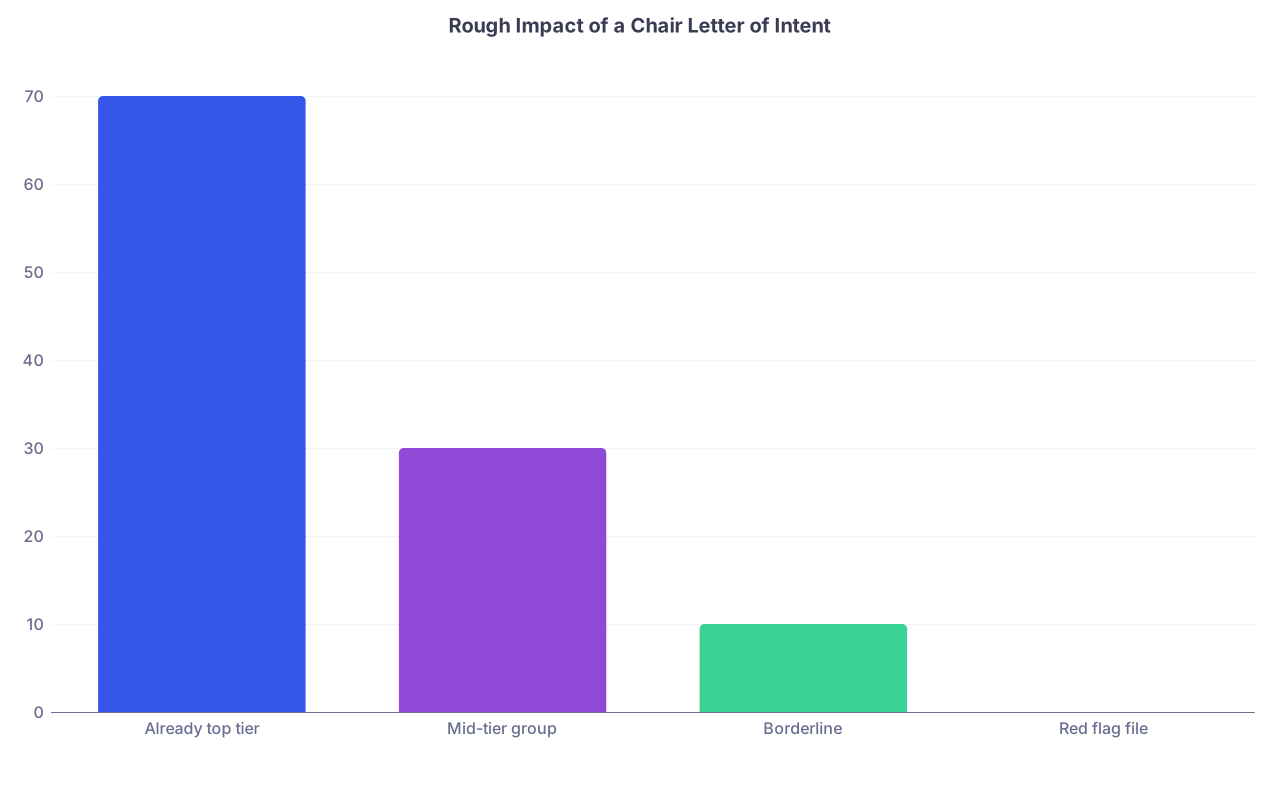
| Category | Value |
|---|---|
| Already top tier | 70 |
| Mid-tier group | 30 |
| Borderline | 10 |
| Red flag file | 0 |
Interpretation: rough percentage chance the letter meaningfully moves your position, based on where you already stand.
When a Letter to the Chair Actually Helps (and When It Hurts)
Let me be direct: there are only a few situations where a letter of intent to a chair meaningfully helps you. Everything else is emotional comfort for you and busy-work for them.
Good scenarios to write to the chair
You’re in their serious consideration band already. How do you know?
- You had a strong interview day and meaningful interactions with leadership
- Someone at the program explicitly said things like “You’d be an excellent fit here” or “We’d love to work with you”
- Their follow-up communication has felt personal, not automated
In that situation, your letter can:
- Confirm you’ll actually come if they rank you highly
- Give them cover to argue for you in the rank meeting: “They’ll come. They wrote me directly.”
- Distinguish you within the top group if they’re splitting hairs
I’ve sat in meetings where a PD said, “This person emailed the chair and me — they’re serious — if we rank them high, they’re coming.” That carries weight, especially in smaller or mid-tier programs worried about not filling with their top list.
Another viable scenario: you’re coming from a home institution or an affiliated rotation and have a direct relationship with the chair. In those cases, not writing can look disengaged. Chairs sometimes expect serious internal candidates to communicate clearly.
Bad or useless scenarios
These are where applicants waste their political capital:
- You had a mediocre or awkward interview and no one followed up enthusiastically
- You never met the chair, never worked with faculty there, and are just cold-emailing because “that’s what I heard you should do”
- You are applying to a hyper-competitive program with no realistic angle — no connections, no unusually strong metric, no compelling story — and hope a letter will “bump” you into viability
- You are sending the same generic letter to 5+ chairs and editing only the program name
In those cases, your letter is either ignored or read as noise. Chairs know desperation when they see it. And yes, they talk. I’ve heard versions of:
“Got another ‘you’re my number one’ from someone we ranked low-intermediate. Everyone’s number one apparently.”
When it hurts:
If your letter is clumsy, obviously copy-pasted, or contradicts what you told another faculty member, it can actively damage your credibility. Chairs and PDs compare notes more than you think.

The Real Hierarchy: Chair vs Program Director vs Faculty Champion
You need to understand the power structure to decide where to send what.
In most residency scenarios:
- The Program Director (PD) runs the rank list day-to-day
- The Associate Program Directors (APDs) and key faculty heavily shape that list
- The Chair has veto power, strategic influence, and final ownership of the department’s direction
The chair does not usually sit through every minute of every ranking meeting. They get distilled summaries and weigh in on:
- Strategic priorities (e.g., “We want more research-heavy residents this year”)
- Protecting favored internal candidates
- Avoiding candidates with known professionalism concerns
- Managing the politics of certain faculty recommendations
So where does your letter belong?
Here’s the unwritten playbook people inside use but almost never explain to you:
- If you already have a strong faculty champion or PD advocate there:
Your letter to the chair is additive. It gives your champion another talking point: “They even wrote the chair.” - If you have no existing connection and no standout angle:
Writing just to the chair skips the people who actually read your file in detail — and sometimes irritates them. PDs don’t love being bypassed. - If you’re a home or strong-away student:
The triad matters — PD, your primary faculty mentor, and the chair. In that setting, writing to the chair can signal seriousness about staying.
Behind closed doors, I’ve heard:
- “They sent me a very thoughtful note,” from a chair, followed by, “Are we in a position to move them up?”
- Or, “I got a letter too, but they barely connected with the residents; I don’t think it changes much,” from a PD, and that’s the end of it.
The key is this: your letter to the chair is never read in isolation. It’s filtered through the PD’s impression and the rank list reality.
| Situation | Best Primary Target |
|---|---|
| Strong interview, good PD rapport | Program Director |
| Strong away rotation with faculty ally | PD + Faculty Mentor |
| Home program applicant | PD + Chair |
| Weak connection, cold applicant | PD only (if at all) |
| Late-cycle Hail Mary | PD, not the Chair |
Content Chairs Actually Respect (And What They Roll Their Eyes At)
Chairs are busy. Think 200–400+ emails per day busy. They see through fluff instantly. They skim your message for three things:
- Are you actually connected to us?
- Are you articulating a specific, believable reason you’d thrive here?
- Are you committing in a way that reduces our risk of wasting a top rank?
The letters that work share a pattern:
- They’re short. 3–6 tight paragraphs, not an essay.
- They reference concrete interactions or details only an engaged applicant would mention.
- They clearly state what you’re committing to and why.
Here’s the structure that plays well in the real world:
Opening grounding line
Who you are, when you interviewed/rotated, one concrete anchor. Not your life story.One specific fit argument
Something the chair actually cares about: teaching, research profile, patient population, department culture, growth areas.Evidence you understand their program
Name a specific track, clinic, initiative, or value they’re proud of — and connect it to something you’ve done.Clear, unambiguous intent
If you mean “You are my number one,” say it clearly. Don’t do weasel language like “ranked very highly.”Gracious close, no demands
You’re not negotiating. You’re informing and appreciating.
What makes them roll their eyes:
- Overly dramatic flattery: “It has always been my dream to train at X.” No it hasn’t. Chairs know how applicants talk.
- Generic cut-and-paste: “Your program’s commitment to excellence.” That phrase is on their own website, and on everyone else’s.
- Bringing up minor personal hardships irrelevant to your future performance or their selection priorities. That belongs in your application, not in a last-minute letter.
- Implicit bargaining: “If ranked to match, I guarantee I will work extremely hard.” That’s the baseline, not a selling point.
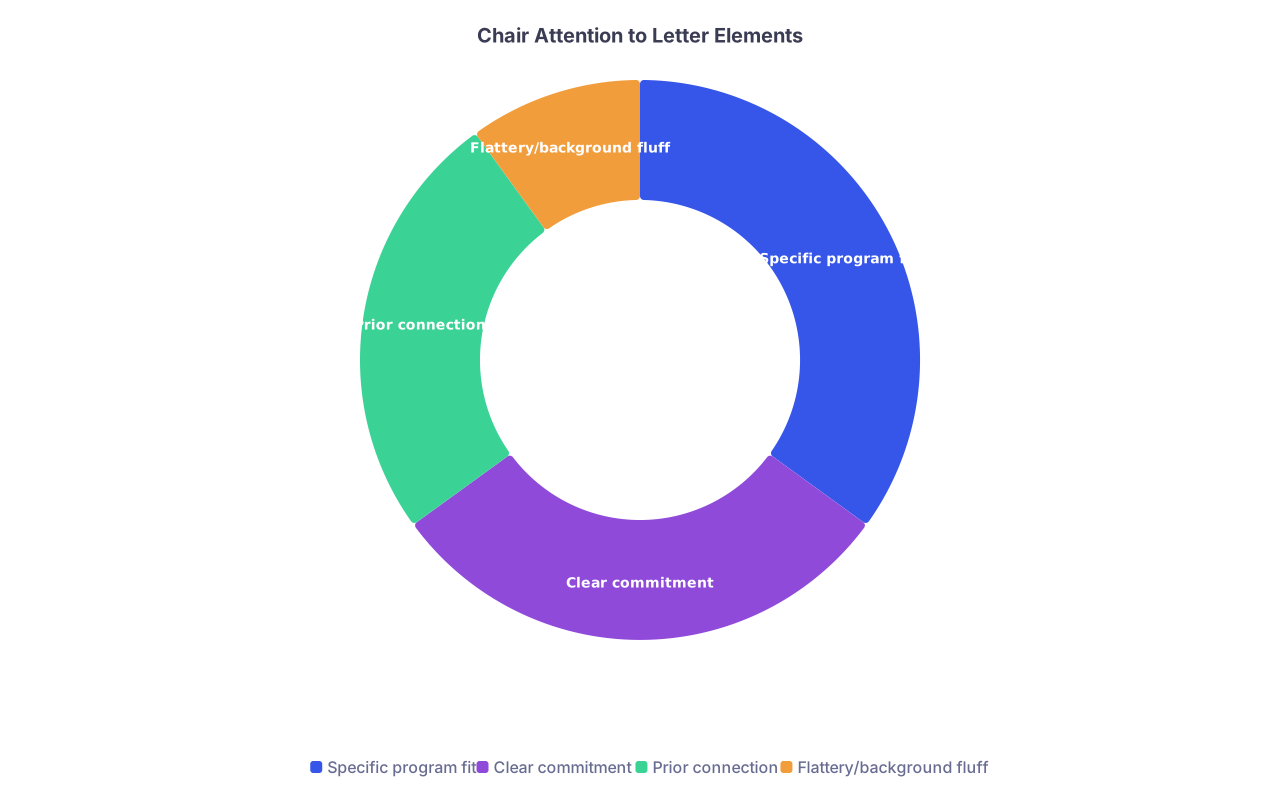
| Category | Value |
|---|---|
| Specific program fit | 35 |
| Clear commitment | 30 |
| Prior connection | 25 |
| Flattery/background fluff | 10 |
Timing, Frequency, and the Unspoken Etiquette
Timing matters more than applicants assume.
Letters sent too early look impulsive. Too late, and rank lists are essentially frozen.
Here’s how it usually plays out behind the scenes:
- Main ranking meetings happen:
- Early to mid February for most residencies
- With preliminary ranking discussions starting late January
- Chairs weigh in: before or during finalizing, not usually days before the NRMP deadline
So your best timing band:
- Late January to early February, when serious ranking discussions are active but nothing is cemented.
Too early, like December, and your letter gets lost in the pile and forgotten. I’ve seen PDs say in February, “Didn’t they email a month ago?” Then have to search their inbox.
Too late — the last 3–4 days before the list is due — and programs are already mentally and emotionally done. Many have decided days earlier and are just waiting to click submit.
How many letters?
To be blunt: you get at most one true “this is my number one” letter of intent that you can send in good conscience and not look ridiculous if someone calls you on it.
Can you send strong-interest letters to multiple programs? Yes, but they need different language and a different aim. Those are “letters of strong interest,” not “I will absolutely rank you first.”
The unwritten professional norm among people who actually respect themselves is: one true LOI, several high-interest notes.
If your PD, chair, or mentor learns you sent “You are my first choice” to multiple programs in the same specialty, you look unserious and ethically flimsy. People remember that.
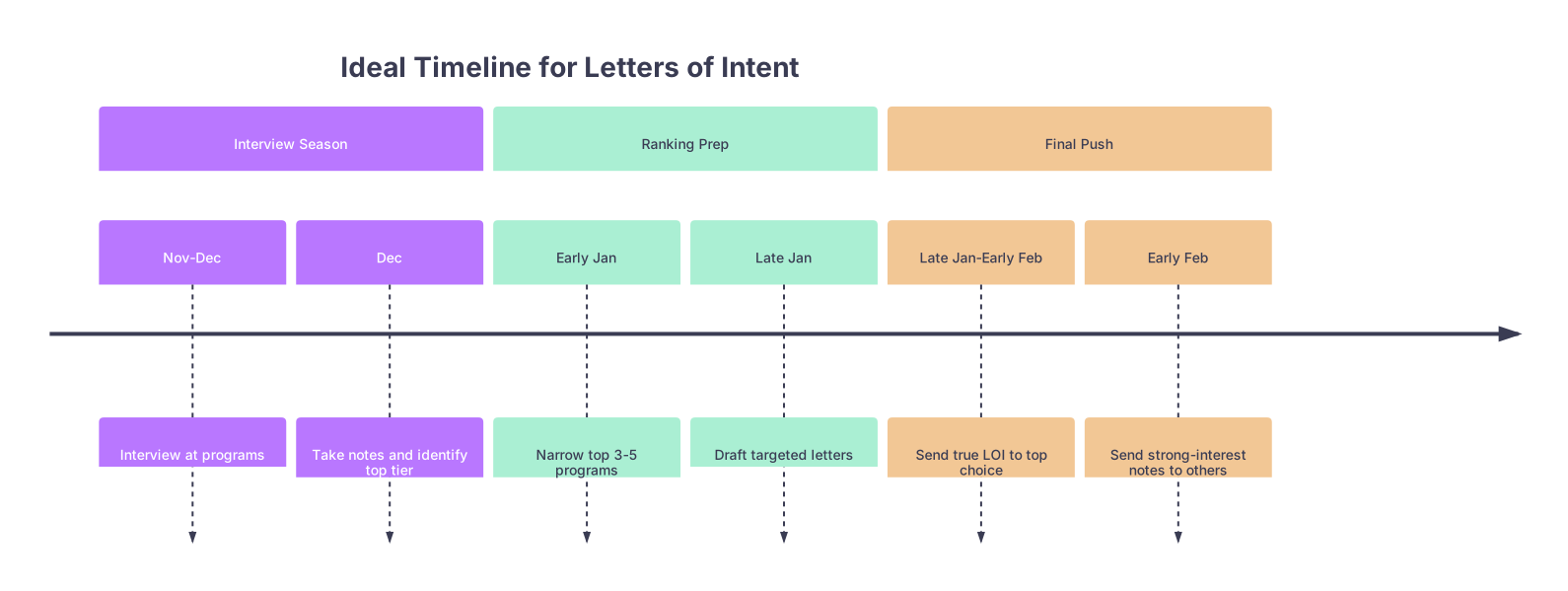
| Period | Event |
|---|---|
| Interview Season - Nov-Dec | Interview at programs |
| Interview Season - Dec | Take notes and identify top tier |
| Ranking Prep - Early Jan | Narrow top 3-5 programs |
| Ranking Prep - Late Jan | Draft targeted letters |
| Final Push - Late Jan-Early Feb | Send true LOI to top choice |
| Final Push - Early Feb | Send strong-interest notes to others |
Ethical Gray Zones No One Admits Publicly
Let’s talk about the parts everyone dances around.
Double-claiming “number one”
Do people send multiple “you’re my top choice” emails? Yes.
Do chairs and PDs know this happens? Absolutely.
Do they ever compare notes with their colleagues at other programs? Less than you fear, but more than you’d like if you’re lying.
Within the same city or institution network, cross-talk is common. I’ve heard, between two PDs at neighboring programs:
“Oh, you got their ‘number one’ note too? Interesting. They told us the same thing last week.”
You’re not going to be blacklisted nationwide for this, but your reputation with those people is toast. And you only need to get a reputation for being slippery once for it to color faculty discussions years later.
Implied promises from programs
Programs will hint. “We were very impressed.” “You’d be a great fit here.” “We hope to see you in July.” They know exactly what they’re doing.
You will be tempted to “reward” that by writing a glowing letter of intent. The reality? Those comments are sometimes genuine, sometimes soft recruitment, sometimes pure courtesy. Internal people can often tell which is which. Applicants rarely can.
Your letter of intent should be based on your actual ranking of them, not your emotional response to flattery.
Using mentors to pressure the chair
Another unwritten move: applicants get a mentor at the institution to “talk to the chair” on their behalf.
Does this help? Sometimes. But when overused, it backfires.
Chairs don’t love feeling like they’re being lobbied by every marginal faculty acquaintance. A strong internal advocate with real clout can help you a lot. Three weak advocates pestering leadership makes you look insecure and over-coached.
If a serious faculty member with longstanding credibility says, “I strongly support this candidate; they wrote you a thoughtful letter as well,” that’s powerful.
If a casual away rotation preceptor emails, “They’re nice and interested in us,” it’s background noise.
Concrete Example: What a Good Letter to a Chair Looks Like
You don’t need flowery language. You need clarity and credibility.
Here’s a stripped, realistic skeleton that tends to land well:
Subject: Letter of Intent – [Your Name], [Specialty] Applicant
Dr [Chair Last Name],
My name is [Name], a [MS4 / PGY-1 etc.] at [Your Institution]. I had the opportunity to interview with your residency program on [date] and to speak with Dr [PD/APD/Faculty] about your department’s approach to [specific thing you actually discussed].
Since that visit, I’ve thought seriously about where I can grow the most as a clinician and colleague. Your program’s [specific feature: e.g., dedicated [clinic type], robust [research area], culture of [teaching/mentorship style]] aligns very closely with how I want to train. In particular, the [named track, rotation, initiative] and the chance to work with [named faculty if appropriate] stand out as opportunities I would be genuinely excited to pursue.
After completing my interviews, I’ve decided that [Program Name] is my top choice. I will be ranking your program first and would be honored to train in your department if given the opportunity.
Thank you for the time and energy you and your faculty invest in the application process. Regardless of the outcome, I appreciated the chance to get a glimpse of the environment you’ve built there.
Sincerely,
[Name]
[School/Current Position]
AAMC ID: [ID]
Short. Specific. Honest.
Notice what’s not there:
- No detailed autobiography
- No begging or bargaining
- No vague “rank you very highly” language
- No weird attachment or PDF “letter” — email is enough
The subtext is: “I understand your program, I’ve thought about this, and I’m not wasting your time.”

Future Direction: Will These Letters Matter Less Over Time?
The honest answer: they’ll probably still matter, but in narrower circumstances.
As programs get squeezed by volume and compliance rules, and as centralized matching stays under scrutiny, several trends are obvious to those of us inside:
- More programs rely on structured scoring systems and less on “gut feel.” Letters of intent don’t fit cleanly into a rubric.
- Some specialties and institutions are quietly moving toward standardized communication policies (no promises, no implied commitments).
- There’s increasing awareness of equity issues — that applicants with savvy mentors know how to work the behind-the-scenes game, and others don’t.
So, over the next decade, I expect:
- Letters to chairs will matter most in smaller programs, mid-tier institutions, and places where personal relationships still drive a lot of departmental culture.
- Hyper-competitive, brand-name programs will give these letters very little weight unless you already have a deep institutional tie. They’re drowning in high-signal applicants anyway.
- Internal candidates and strong away rotators will still benefit from a well-timed, carefully honest letter that confirms interest and commitment.
What will not change: human beings run these departments. When someone senior believes, “If we rank this person high, they will come and they’ll be good,” that thought still shapes lists.
Your letter’s job is to give them legitimate grounds to think that about you.

FAQ: Letters of Intent to Chairs
1. Should I send my letter of intent to both the chair and the program director?
If you’re sending a true “you are my number one” letter and you’ve interacted with the PD, the safest play is to send it primarily to the PD and cc the chair, or send slightly tailored versions to each on the same day. What you do not want is the PD finding out later that you went only to the chair; some take that as a slight. When in doubt, PD first, chair copied.
2. What if I never met the chair during interview day — is it still okay to email them?
Yes, but only if you have something real to say about their department and you’re making a genuine rank-one commitment. You open with context: who you met, what you learned, and why that leads you to reach out. A cold “Dear Chair, you are my number one” with no specifics looks shallow. If your only connection is through the PD and residents, a strong, targeted letter to the PD alone may be more impactful than a blind leap to the chair.
3. Can I send a “letter of intent” to more than one program if I word it carefully?
You can send strong-interest letters to multiple programs, but you should only send one explicit “I will be ranking you first” message in a given specialty. Anything else is gaming the system and people inside the profession see right through it. For other programs you like, use language like “one of my top choices” or “a program I would be very excited to train at” without claiming rank-one status.
4. How long should my email to the chair be?
Think in terms of paragraphs, not pages. Three to six short paragraphs, under 400–450 words, is ideal. Long enough to prove you understand their program and are serious, short enough that a chair reading on a phone between meetings can get the point and forward it to the PD without irritation. If you feel the urge to attach a PDF “letter,” you’re overcomplicating it.
5. What if my mentor tells me to send a letter to the chair, but I’m not truly ranking them first?
Then you need to decide whether your integrity is for sale. The mature move is to send a strong-interest note instead of a false LOI: emphasize how much you liked them, outline why you’d be a great fit, and say you’d be excited to match there — without claiming they’re your top-ranked program. Most faculty who’ve been through modern match cycles will respect that honesty more than a scripted, dishonest “you’re my number one” they know you might be emailing to others.
Key points:
- A letter of intent to the chair amplifies the story your file already tells; it does not rewrite it.
- Chairs and PDs believe specific, grounded, honest commitment — not generic flattery or obvious copy-paste.
- You get one real “you’re my number one” per specialty; use it deliberately, and send it where the actual decision-makers will see it and believe it.