
The dirty little secret is this: yes, a letter of intent can move you on a rank list—sometimes dramatically—but only if it hits the right program, at the right time, in the right way.
Most people telling you “letters of intent don’t matter” are either being technically correct in a legalistic NRMP sense, or they’ve never sat in a rank meeting. I have. With PDs who roll their eyes at letters. And with PDs who literally say, “They told us we’re their number one—bump them up three spots.”
Let me walk you through what actually happens behind those closed doors.
How Rank Meetings Really Work (And Where Letters Fit In)
First, you need to understand the battlefield.
There isn’t one universal process. But there are common patterns.
In many mid-to-large programs, the order goes something like this:
- Faculty/interviewers score everyone and write comments
- Someone (PD, APD, or coordinator) generates a preliminary list based on scores
- Leadership sits in a room, pulls up the spreadsheet, and starts arguing
Now, here’s the part nobody tells you: by the time of that final meeting, anything that gives them a reason to move someone becomes powerful. Not guaranteed. But powerful.
Picture this scene—I’ve seen versions of it at medicine, EM, and surgery programs:
They’re at candidates 10–25. This is the “we really like them, but we can’t take everyone” zone. The PD scrolls. Someone says:
“What about Patel from Ohio State?”
“Good interview. Strong Step 2. But quiet.”
“Yeah, but they sent that letter. Said we’re their top choice.”
Pause. A few head nods.
“If we’re truly their #1, they’re very likely to match here.”
“Move them up a couple spots. Above the people we’re not sure about.”
Done. You just jumped three spots because your letter gave them one key thing: predictability.
Programs are obsessed with yield, even if they pretend they’re not.
They don’t want 10 of their top 15 to go elsewhere, then end up scrambling through mid-list backups. So when a credible applicant clearly says, “I will rank you #1,” that goes straight into the calculus in that room.
When a Letter of Intent Actually Changes the Rank List
Let’s be brutally specific. Letters of intent move the needle in these scenarios:
1. You’re in the “maybe” band, not the extremes
If you’re:
- A clear superstar (top 5%) — they’re already ranking you high. Your letter may confirm their warm fuzzy feeling, but it doesn’t change much.
- Clearly weaker and barely made the list — your letter won’t save you. The faculty comments and interview performance dominate.
Letters matter when you’re in that middle chunk where the program genuinely likes you but has too many similar applicants. That’s where soft factors tip decisions.
I’ve seen this play out as:
“We have 12 people for spots 8–18, and we need to decide the order.”
Then someone says:
“These three explicitly told us we’re their #1.”
Those three almost never drop to the bottom of that cluster. They might not shoot to the very top, but they rarely get placed below equivalent applicants who showed no commitment.
2. The program cares about “fit” and stability
Community-heavy IM? Lifestyle EM? Midsize university program in a less “sexy” city? These places care deeply about two things:
- Who will be happy here
- Who will actually show up in July
So when you write a convincing, program-specific, “I’m choosing you” letter, they hear: less risk, more commitment.
I’ve sat with:
- A midwestern IM PD who literally color-coded “likely to come” vs “flight risk” based on vibes, regional ties, and yes, letters.
- An EM PD who kept a separate tab: “Expressed we are #1.” Those names got revisited at the end.
At those programs, I’ve seen letters move people:
- From mid-20s to high teens
- From borderline “do we drop them?” to safely mid-list
- Occasionally into “we must get them if possible” territory
3. The PD personally read and remembered your letter
This is the harsh reality: some PDs don’t read these. Or they skim briefly. But some absolutely do, and they remember them.
You can tell which by their behavior on interview day:
- Programs where the PD says things like, “If we’re your top choice, let us know,” are the ones tying letters into their rank decisions.
- Programs that emphasize “We follow the match rules strictly and do not expect post-interview communication” may still read your letter, but they’re less likely to let it dictate rank movement.
I’ve heard PDs say during meetings:
“She sent a very thoughtful letter after the interview. Specific to us, not boilerplate. I got the sense she’d actually stay here long term.”
That’s the line that moves you over someone slightly stronger on paper but generic in interest.
When Letters Do Nothing (Or Annoy People)
There are also times when your letter is noise. Or worse.
The hyper-competitive, brand-name programs
Think MGH IM, UCSF, Brigham, top derm, ortho, plastics. At that level, the rank order is dominated by:
- Faculty advocates (“I will take this person on my service any day”)
- Research fit
- Institutional pedigree
- Step / clerkship firepower
- Internal politics (yes, it exists)
Letters of intent here? At best, tie-breakers between two nearly identical candidates. And that’s being generous.
I’ve literally heard:
“We assume everyone wants to come here. A ‘you’re my #1’ letter doesn’t change our process.”
And another:
“We got 80 letters of intent this year. If we honored all that, we’d need 50 number-one spots.”
At those places, your letter might be read. It might even prompt a “nice email” comment. But I have rarely seen it directly move someone more than one or two spots—if at all.
The PD who’s cynical about promises
There’s another group: PDs burned by applicants who said “You’re my #1” and then matched elsewhere.
Those PDs stop trusting letters.
One PD in EM said verbatim in a meeting:
“Everyone lies. I ignore these.”
Another IM PD tracked: who promised #1, who actually came. When the mismatch got bad, they stopped letting letters sway them.
If your letter lands with someone like that, it doesn’t hurt you… it just doesn’t do a thing.
When your letter looks copy-pasted or generic
The fastest way to make your letter meaningless is to write something that could have been sent to 25 programs with a swapped-out name.
Programs recognize that pattern instantly:
“We have been impressed by your strong clinical training, diverse patient population, and excellent fellowship match…”
That’s wallpaper. Background noise.
Compare that to:
“When Dr. S. walked us through the liver transplant list and talked about how residents manage those patients on call, it clicked for me. I could see myself on that team, at 2 a.m., taking ownership of that level of complexity.”
Now it feels like you actually remember that program, that day, those people.
Generic = ignored. Specific = at least considered.
The One-Letter Rule: Why Playing Games Backfires
Here’s where people get stupid:
Sending multiple “you are my #1” letters to different programs.
Faculty and PDs talk. Not constantly, but enough. Especially in tight-knit specialties like EM, ENT, derm, ophtho, neurosurg. It gets around.
I’ve seen this exact scenario:
- Applicant sends “You are my #1” to Program A.
- Sends a slightly different “You are my #1” to Program B in the same city.
- One PD texts the other: “Hey, did you get a #1 promise from this person too?”
- Answer: yes.
Result: instant credibility hit. Both programs drop the applicant lower than they would have originally.
That’s not theoretical. That happened.
So if you ask, “Can I send multiple LOIs saying #1?” The real insider answer is: you can. And if no one cross-checks, you might get away with it.
But if you get caught, it will absolutely hurt you more than the potential benefit of trying to hedge.
Serious programs treat your “you’re my #1” as a statement of integrity. You lie about that, and you’ve just shown them exactly what kind of colleague you’ll be.
What a High-Impact Letter of Intent Actually Looks Like
The content matters more than people realize. A good LOI does 3 things clearly:
- States unambiguously: this program is your #1
- Shows evidence-based interest — specific people, moments, and features
- Reduces perceived risk — you’re a known quantity who will show up and be stable
Here’s the rough skeleton that works backstage:
Start with a clear, direct line:
“I am writing to let you know that I will be ranking [Program] as my number one choice.”Then 2–3 concrete program-specific reasons:
“On interview day, my conversation with Dr. X about [very specific thing]…”
“Seeing how your residents [unique aspect of program]…”Align your trajectory with what they are:
“Your strong exposure to [X] combined with your [Y feature] fits my goals of [Z].”Close by reinforcing commitment, not begging:
Appreciation. Respect their process. No weird pressure.
If you’re smart, you also subtly show you’d actually move there and stay:
- Mention regional ties, significant other flexibility, past time in the area.
- Or say: “I am prepared and excited to relocate to [city] for residency and beyond.”
That answers a question PDs care about more than you think: Will this person bolt as soon as they can?
Timing: When Letters Actually Get Read and Used
This is another part applicants guess wrong.
Letters sent:
- The week after your interview: Fine as a thank-you / interest letter, but if it’s an LOI and you’re still interviewing widely, you’re lying to someone.
- Too early (December when they’re still interviewing): It gets buried. They’re not building final lists yet. It may not be in front of them during rank meeting.
The sweet spot: late January to early February, depending on specialty and when interviews end.
Why?
Because:
- Rank meetings are often in that window.
- PDs are looking at “final impression” factors.
- Your name is still fresh enough for them to connect your letter with your interview performance.
And yes, for most applicants: one true LOI.
Then, if needed, you can send interest letters (“I will rank you highly”) to one or two others. But don’t duplicate “you are my number one” language. That’s where the ethical cliff starts.
How Much Movement Are We Really Talking About?
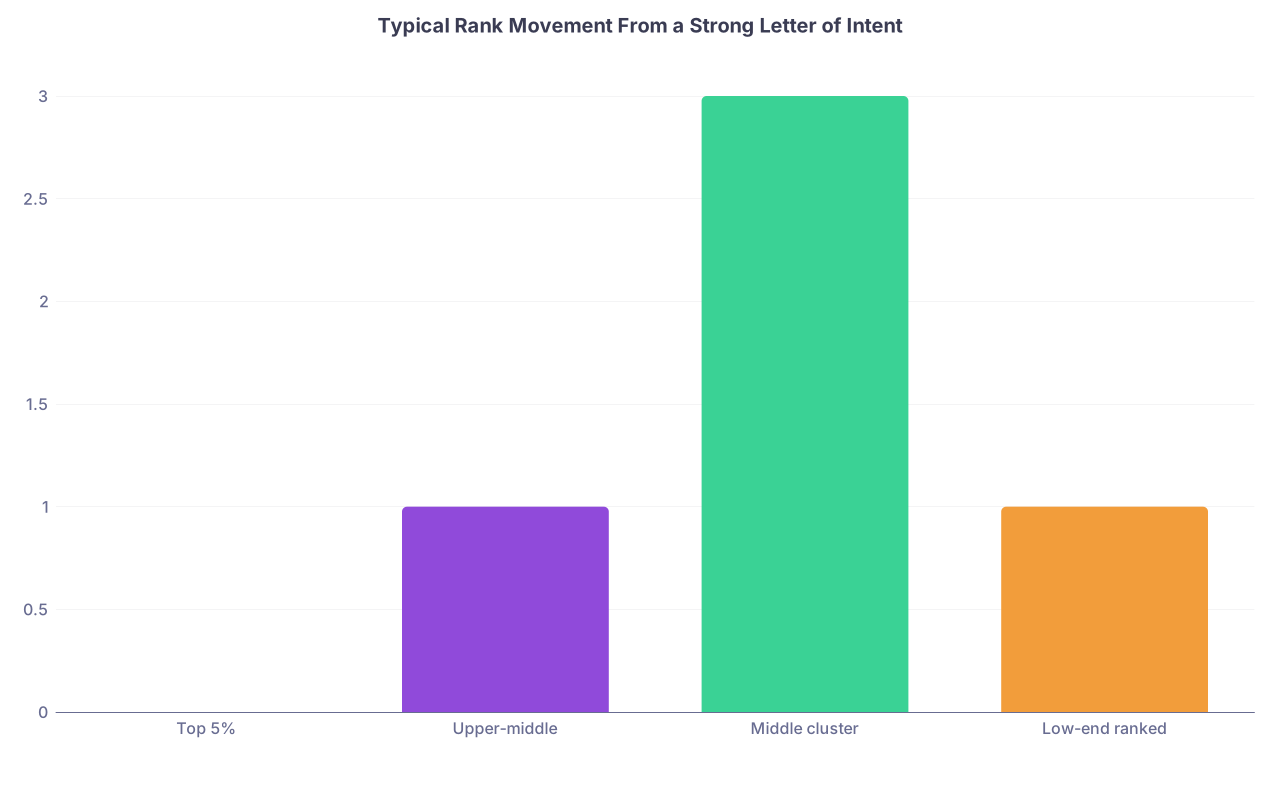
Let’s quantify this a bit. At programs that actually use letters in decision-making, here’s what I’ve seen:
| Category | Value |
|---|---|
| Top 5% | 0 |
| Upper-middle | 1 |
| Middle cluster | 3 |
| Low-end ranked | 1 |
Interpreted:
- If you’re already top 5%: maybe no movement or +0–1. You’re already high.
- Upper-middle: might bump you 1 spot if you’re competing with similar applicants.
- Middle cluster: this is where you can move 2–4 spots. That can absolutely be the difference between matching vs not, depending on how far down their list they go.
- Low-end: maybe a single-spot nudge, but letters rarely rescue a weak file.
And remember: programs are not ranking you in a vacuum. They’re also predicting where you will rank them. Letters feed that prediction model.
The Programs That Secretly Depend on Letters
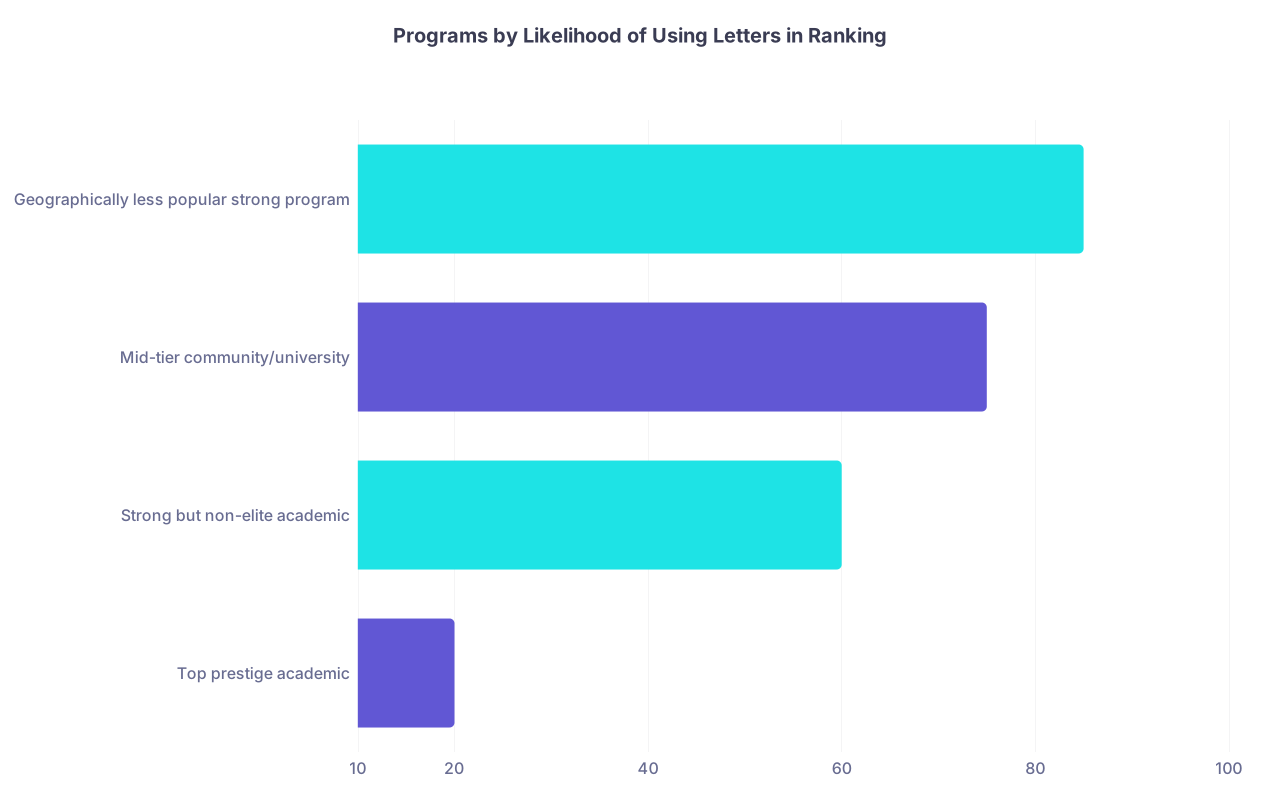
There’s a category people ignore: strong-but-not-elite academic programs and geographically challenged programs. Places that are good, but fight against location bias.
Think:
- University programs in Rust Belt cities
- Well-run community/university affiliates outside coastal metros
- Solid regional EM programs not in “destination” cities
Those PDs love credible LOIs.
They know they lose people to bigger-name places and bigger cities. So if you’re strong and tell them, “You’re my top choice,” they mark you as high-yield.
I watched a smaller but very solid program in the Midwest do this:
- They created a “priority” column: Y/N for “expressed #1 and we believe them.”
- Those Ys almost always ended up higher within their band, especially for their “must fill with strong residents” spots.
The PD literally said:
“If they’re good and we know they want to be here, I’d rather rank them above the gunner who will treat us like a backup.”
If you’re targeting that kind of program as your realistic dream, a smart LOI gives you real leverage.
Concrete Example: When a Letter Changed the Outcome
Let me give you a real composite case that’s close to what I’ve seen multiple times:
- Applicant: US MD, mid-tier school, Step 2 in the low 240s, solid but not spectacular research, strong clinical letters.
- Specialty: Internal Medicine.
- Program: Mid-sized university program in a midwestern city, good fellowship pipeline but not “prestige brand.”
Initial internal ranking: around #24. They were aiming for 18 categorical spots, usually matching through about rank 25–28.
Then the applicant sends a very specific LOI:
- Names the PD and 2 faculty they met.
- Reference to a particular noon conference and how the residents interacted.
- Mentions spouse has family within driving distance and they plan to settle in that region.
Rank meeting conversation:
“Oh, this is the one who said we’re their number one and has family nearby.”
“Yeah, good interview. People liked them.”
“If they’re truly ranking us first, they’re pretty likely to match here. Move them up into the mid-teens.”
Applicant ends up ranked #16.
The program matched through around #22.
Without that letter, they’re probably still on the list—but with less buffer. Maybe still match, maybe not. With the letter, they’re solidly inside the match-safe zone.
What You Should Actually Do With All This
Here’s the distilled, no-bull version of how to use letters of intent strategically:
Pick one program that is genuinely your #1. Not your ego’s #1. Your actual, realistic first choice where you’d be very happy to match.
Send a clear LOI to that one program only, in late January / early February, with:
- Explicit “I will rank you #1” language
- Specific, concrete details
- Alignment with their strengths and your goals
- A calm, confident tone (not desperate begging)
For 1–3 other programs you like a lot, if you want, send interest letters instead:
- “I will be ranking your program very highly.”
- Program-specific reasons.
- No “#1” language.
Don’t play games:
- Don’t send multiple LOIs claiming #1.
- Don’t copy-paste the same generic paragraph to every program.
- Don’t spam programs that clearly don’t care about post-interview communication.
If you do this, here’s what happens in the rooms you’ll never see:
- At some programs, your letter will get ignored.
- At others, it will get a nod and a “nice to know.”
- At a few, especially your realistic dream program, it may be exactly the nudge that pushes you a few spots higher.
And that’s the whole point.

| Step | Description |
|---|---|
| Step 1 | Finish Interviews |
| Step 2 | Write 1 LOI with clear #1 language |
| Step 3 | Wait and reflect |
| Step 4 | Send in late Jan or early Feb |
| Step 5 | Optionally send 1 to 3 interest emails |
| Step 6 | Identify realistic top choice |
| Step 7 | Have true #1 program |
| Category | Value |
|---|---|
| Top prestige academic | 20 |
| Strong but non-elite academic | 60 |
| Mid-tier community/university | 75 |
| Geographically less popular strong program | 85 |

| Letter Type | Typical Impact on Rank List |
|---|---|
| True LOI (#1, specific) | 0–4 spot shift in middle band |
| Generic LOI (#1, vague) | Usually ignored, sometimes negative |
| Strong interest (no #1 claim) | Tie-breaker, mild positive influence |
| Mass e-mails / copy-paste spam | No impact or mild annoyance |