
The ugly truth: most “letters of intent” sound fake, manipulative, and interchangeable—and faculty know it within three sentences.
You’re told this letter can “move you up the list.” Sometimes that’s true. More often, it just gets you silently categorized as “generic applicant who read Reddit advice.” Let me walk you through what faculty actually see, say, and think when they open your email—and what a genuinely convincing letter of intent looks like from our side of the table.
What Faculty Really Do With Letters of Intent
Let me clear up the mythology first.
At many programs, letters of intent get skimmed in 20–40 seconds. I’ve watched PDs do it live between cases. Subject line, first line, any clear signal (“ranking your program #1”, “ties to city”, “worked with Dr. X”), then close. That’s it.
But there are patterns. Different program types treat them differently:
| Program Type | Typical Use of Letters |
|---|---|
| Big-name academic | Tiebreaker only |
| Mid-tier academic | Minor bump for fit/commitment |
| Community with few home students | Moderate impact, reassurance of interest |
| Geographic “destination” city | Filter for truly committed vs tourists |
| Undersubscribed/small city | Very strong interest can matter a lot |
And here’s the part no one tells you: your letter is rarely read in isolation. It’s layered on top of:
- What you were actually like on interview day
- What the residents said about you
- Your file: scores, narrative, red flags, institution background
- What faculty remember (or don’t) about you
Your letter of intent doesn’t reinvent who you are. It either reinforces a pre-existing mental picture—or clashes with it.
A letter that feels “off” (overly polished, weirdly dramatic, zero continuity with how you came across) is a net negative. Not because it lowers your rank by 20 spots. Because it nudges you from “seems genuine” to “trying too hard / opportunistic.”
The Fast Ways Faculty Spot a Fake-Sounding Letter
Let me show you how PDs and faculty read these. I’ve literally watched them read lines out loud and roll their eyes.
Here’s what sets off alarms immediately:
1. Overblown, indistinguishable praise
“I was incredibly impressed with the collegiality, unparalleled training, and cutting-edge research at your program.”
We see this sentence 200 times a year with small cosmetic edits. There is nothing specific. Nothing that proves you were there.
Faculty thought process:
“Okay, they copied this from somewhere. Next.”
2. Formulaic “this is my number one” with zero evidence
“I am writing to inform you that X is my unequivocal first choice and I will rank your program #1.”
This line by itself is white noise. Everyone says it. The question is: does anything in the rest of the letter prove that’s true in a way that’s consistent with your file and your interview?
If your letter could be sent, unchanged, to 10 different programs just by swapping the name—disaster. Every experienced reader can tell.
3. Language that doesn’t match how you talk
You interviewed like a normal human. Then your letter arrives:
“I was profoundly moved by the synergy between clinical excellence and scholarly rigor embodied in your house staff.”
That’s ChatGPT or a committee of medical students rewriting each sentence 6 times. Faculty notice. They won’t accuse you out loud, but they’ll think: “This is not how that person talked at all.” Instant hit to authenticity.
4. Desperate or transactional tone
“I am willing to work extremely hard and do anything to match at your program.”
“I hope you can take into account how much this would mean to me and my family.”
Guilt-tripping and begging do not work. Programs are terrified of the desperate applicant who will be miserable and high-maintenance once they match. Neediness is not a flex.
5. Dishonest “you are my #1” duplicates
This is the one sin faculty do talk about behind closed doors.
Programs know some applicants send “you are my number one” letters to multiple places. When your co-applicant accidentally CCs the wrong PD, or a resident hears you say something different, or you match somewhere else and brag about “sent #1 letters to three places”—it gets remembered. PDs have long memories and long group chats.
If your letter feels inauthentic, layered on top of a culture that knows some people are straight-up lying, you get mentally filed as “says what’s convenient.”
What a Genuinely Convincing Letter Looks Like To Us
Now the part you actually need: what does read as genuine?
There are patterns we all recognize as real.
1. Grounded, specific memory of our program
You’d be amazed how many letters make it obvious the applicant barely remembers the day.
Genuine letters mention 1–3 specific, low-drama things that only someone who was actually there and paying attention would talk about.
Not the tagline on the website. Not “your commitment to diversity.” Something like:
- A specific noon conference case you still remember and why
- A senior resident who told a story that actually changed how you saw the program
- A small, real detail—like the chief spending 10 minutes going over their schedule with you and being candid about the tough months
Faculty response to this kind of detail: “Okay, they were there, they were awake, and they got the vibe right.”
2. Clear, believable alignment with your story
The best letters tie your trajectory to our setting in a way that fits your application.
Example:
- Your file: solid research in addiction medicine, MPH, ton of work with underserved communities
- Our program: heavy county population, integrated addiction consult team
A credible letter: you explicitly connect your addiction work and interest in public health with the patient population and clinical opportunities you saw here, in concrete terms.
If your letter suddenly claims you’re obsessed with robotics, and there’s zero robotics in your file or our program—nobody buys it. Authentic letters feel like the natural extension of what we already know about you.
3. Modest, non-dramatic tone
The confident but grounded letters are the ones that land.
No epic personal destiny. No “I knew from the moment I walked through your doors that this is where I was meant to be.” That’s theater.
What reads as genuine is much simpler:
- “After seeing X, Y, Z on my interview day, I realized your program fit the kind of training environment I’ve been looking for.”
- “Talking with Dr. A and residents B and C helped me understand how I’d grow here over the next three years.”
Matter-of-fact. Sincere without being saccharine.
4. Subtle understanding of what the program actually is
You’d be shocked how many letters reveal the writer doesn’t actually understand the program they’re “ranking #1.”
The authentic ones show they got the culture right.
- For a heavy-service, county-style program: you acknowledge the workload, the patient complexity, and say why that is what you want
- For a research-heavy program: you tie in specific PI interests, protected time structure, or types of projects fellows or residents typically do
- For a community program: you emphasize continuity, community ties, maybe long-term goals in the region, rather than pretending it’s an NIH-machine
When you get the culture right, faculty mentally nod: “Yes, they understand what they’re signing up for. Less likely to be miserable.”
The Anatomy of a “Real” Letter of Intent
Let’s break down how a letter that feels authentic reads from our side. I’ll give you a skeleton and then talk through why each piece works.
Clean opening that orients us fast
Faculty brain: “Who is this again?”
Your first one or two lines should immediately answer:
- Who you are
- What the purpose is
- That you actually interviewed there
Something like:
“My name is [Name], a fourth-year at [School], and I interviewed with your [specialty] residency program on [date]. I’m writing to let you know that I will be ranking [Program] as my first choice.”
That’s it. No emotional saga in the opener.
One short paragraph: what you actually saw and liked
This is where 90% of letters fail. They start listing generic “strengths” like a brochure.
Instead, you write 3–5 sentences about:
- One or two specific moments
- What those moments told you about training there
Example pattern:
“What stood out most to me was the resident report on the patient with decompensated cirrhosis. Watching the senior calmly talk through the management plan while the intern added key details, then seeing the attending step in only to fine-tune the plan, gave me a very clear sense of the autonomy and graduated responsibility your residents receive. That dynamic is exactly what I’m looking for in my training.”
Faculty reaction: “Yep, that’s a real morning report. They actually paid attention. This sounds like us.”
One paragraph: why you and this program fit
Now you connect your story and goals in a way that logically fits your file.
“My clinical interests are in [X], and I’ve sought out experiences in [Y, Z] throughout medical school. The patient population you serve at [Hospital/System], especially in [specific clinic, service, or rotation you learned about], matches what I hope to focus on in residency. The opportunity to work with [named faculty or specific niche, if real] aligns closely with my prior work in [briefly mention research/project], and I can see myself continuing that growth here.”
Faculty thought: “This is consistent with their CV. This doesn’t feel invented for us.”
Notice: no laundry list of every rotation, every award. Just the parts that map to this specific place.
One paragraph: explicit, restrained commitment
You do need to actually say the thing. But not like a soap opera.
“After my interview day and further reflection, I’m confident that [Program] is the best fit for my training and long-term goals. I’ll be ranking your program as my top choice.”
Done. No “unequivocally,” “lifelong dream,” “meant to be.” You’re not proposing marriage, you’re ranking a residency.
Short, low-key closing
End with something simple and adult:
“Thank you again for the opportunity to interview and for your consideration. I’d be grateful for the chance to train with your team.”
Sign with:
Name
Medical school
AAMC ID (optional but helpful)
Timing, Channels, and The Stuff Nobody Tells You
Let’s talk logistics, because that’s where people quietly sabotage themselves.
When to send it
Most programs really start their final rank list conversations 1–2 weeks before the rank deadline. That’s when your letter might actually get mentioned.
You want your letter:
- After you’ve truly decided on your #1
- Before those final rank meetings start
For most specialties, that’s roughly 1–2 weeks before the NRMP rank deadline. Earlier than that and it’s forgotten. Later and it might never be seen.
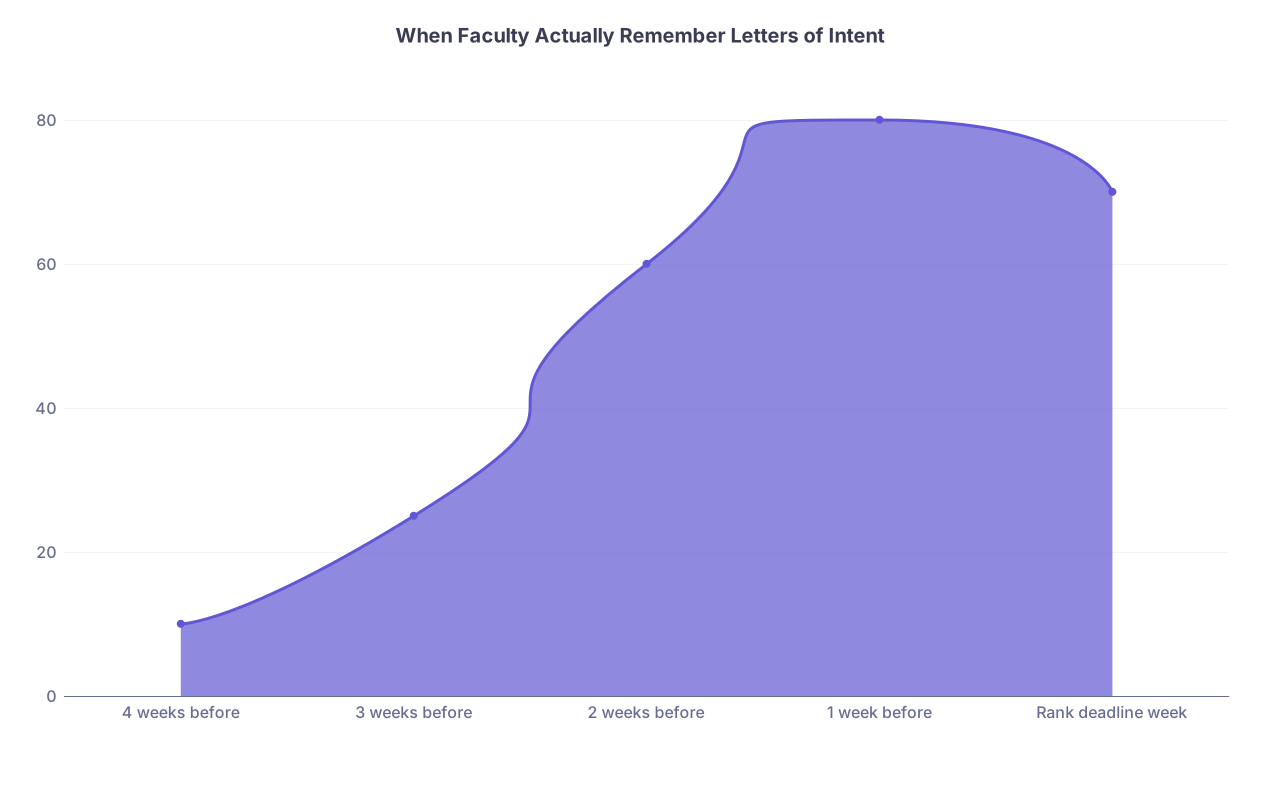
| Category | Value |
|---|---|
| 4 weeks before | 10 |
| 3 weeks before | 25 |
| 2 weeks before | 60 |
| 1 week before | 80 |
| Rank deadline week | 70 |
Those numbers aren’t from an official study, but they’re very close to how often PDs in meetings say, “Did this person send us any updates or a letter?” relative to timing.
Who to send it to
Primary: Program Director.
CC: Program Coordinator.
If you had a real, substantive connection with an associate PD or a faculty member who clearly championed you, it’s fine to CC them too. But don’t spam everyone whose email you can find.
Two audiences is enough:
- The PD, who owns the rank list
- The coordinator, who actually keeps track of incoming communication
Email subject line
Don’t get cute. Use something functional like:
“Letter of Intent – [Your Name], [Specialty] Applicant”
Faculty and coordinators need to be able to find it quickly during rank meetings.
Can you send more than one “I will rank you #1” letter?
No. This is where students lie to themselves.
There is a difference between:
- “Your program remains one of my top choices”
- “I will be ranking your program #1”
Program leadership takes the second one seriously. Some literally track it in spreadsheets. I’ve been in the room when a PD said, “We will not rank that person to match because they told a different program they were #1 last year and it got back to us.”
One #1-commitment letter. That’s it. If you want to indicate strong interest to others, use the “very high on my list” phrasing and don’t pretend it’s the same thing.
Red Flags Faculty Quietly Laugh About (Or Remember)
Let me show you a few real patterns that have made people memorable in the wrong way.
The obviously copy-pasted structure
Faculty see dozens of letters that clearly share the same skeleton, same buzzwords, same sentence order—just with different proper nouns. We know there’s some template floating in GroupMe or Reddit.
You won’t get “punished” for this. You’ll just be ignored. It screams “I did the minimum possible and mass-produced this.”
The over-sharing personal drama
“I had a very difficult year with my fiancé leaving and my grandmother passing, and matching at your program would bring my family much-needed joy.”
That’s inappropriate for a letter of intent. Your job was to disclose serious personal circumstances during the application if relevant. Using emotional hardship here comes across as manipulative, not vulnerable.
The post-interview lobbying campaign
Endless follow-up emails, multiple attendings at your home program emailing the PD, residents being DMed on Instagram, “just checking if you got my letter.” This annoys people. It doesn’t help you.
One focused, well-written letter of intent. Maybe one meaningful update if you have a genuinely big accomplishment (major paper accepted, national award, significant performance improvement). That’s it.
Example: How Faculty Experience Two Contrasting Letters
To really drive this home, let me show you how the same applicant can present as fake vs genuine.
Version 1 – The Generic, Try-Hard Letter
“Dear Program Director,
I want to express my sincerest gratitude for the opportunity to interview at your prestigious residency program. I was extremely impressed by the collegial culture, unparalleled clinical training, and strong emphasis on research. I know that I would thrive in your program and that it would allow me to reach my fullest potential as a compassionate, well-rounded physician.
After careful consideration, I am writing to let you know that your program is my unequivocal first choice, and I will be ranking it number one. The residents, faculty, and staff were all so welcoming, and I truly felt that I could see myself there. Your commitment to diversity and inclusion, as well as the cutting-edge opportunities available, make your program stand out.
Matching at your program would be a dream come true for me and my family, and I hope you will take my strong interest into account when creating your rank list. Thank you again for your time and consideration.
Sincerely,
[Name]”
Faculty reaction: “I’ve seen this 50 times this week. Nothing here ties to us. Nothing here sounds like that student. This tells me nothing.”
Version 2 – The Credible, Specific Letter
“Dear Dr. [PD],
My name is [Name], a fourth-year at [School], and I interviewed with your [specialty] residency program on January 18. I’m writing to let you know that I will be ranking [Program] as my first choice.
What stayed with me most from interview day was the morning sign-out on the MICU service. Watching the senior walk the intern through the ventilator changes on the COPD patient, and then hearing how they balanced the family’s goals of care discussion the night before, gave me a clear sense of the kind of complex, high-acuity medicine your residents handle every day. The way the attending stepped in only to clarify a few teaching points is exactly the level of autonomy and support I’m hoping for.
Throughout medical school I’ve gravitated toward caring for patients with advanced chronic disease, particularly in safety-net settings. My work in our student-run free clinic and my sub-internship on our county medicine service confirmed that I want a program with a large underserved population and strong ICU exposure. The patient population at [Hospital/System], along with the chance to rotate through both [Hospital A] and [Hospital B], matches the environment where I know I’ll grow the most.
After my interview day and further reflection, I’m confident that your program is the best fit for my clinical interests and the kind of resident I want to become. I’ll be ranking [Program] as my top choice.
Thank you again for the opportunity to interview and for your consideration. I would be grateful for the chance to train with your team.
Sincerely,
[Name]
[Medical School]”
Faculty reaction: “This is exactly how they came across on interview. They understood our ICU and patient mix. They want the kind of workload we have. They’re serious.”

| Step | Description |
|---|---|
| Step 1 | Receive Letter |
| Step 2 | Skim Subject and Opening |
| Step 3 | Minor interest noted |
| Step 4 | Read Content More Closely |
| Step 5 | Positive mental nudge |
| Step 6 | Discount as generic |
| Step 7 | Possibly referenced in rank meeting |
| Step 8 | Mentions #1 rank? |
| Step 9 | Specific and consistent? |
FAQ: Letters of Intent From the Faculty Side
1. Can a genuine letter of intent move me up the rank list meaningfully?
Yes—but within limits. If you’re already in the “we like this person” band, a strong, believable #1 letter can move you up within that cluster, especially in mid-sized academic or community programs. It will not rescue a weak application or a disastrous interview.
2. Do programs ever move someone down because of a bad or fake-sounding letter?
Rarely in a dramatic way, but yes, I’ve seen someone quietly nudged down when their letter felt dishonest (like claiming specific interests that totally contradicted their file) or excessively manipulative. More commonly, bad letters are just ignored and you lose the opportunity cost of not helping yourself.
3. Should I mention that I have a partner/family who also prefers this location?
You can, briefly, if it’s stable and not used as emotional leverage. Something like, “My partner and I are both hoping to settle long-term in [city],” is fine. A paragraph about hardships or pressure on your family is not.
4. Is it okay to send a “strong interest” letter to programs that aren’t my #1?
Yes, as long as you’re precise with language. You can say a program is “one of my top choices” or “very high on my list” without lying. Reserve “I will be ranking your program #1” for exactly one place.
5. Do I need to send a letter of intent to match?
No. Plenty of applicants match at their #1 without ever sending a letter. A genuine, well-crafted letter is a marginal advantage, not a requirement. It’s one more piece of data that can help a PD feel comfortable pushing you a few spots higher when they already like you.
Key points: most letters of intent sound fake because they could be dropped into any program’s inbox unchanged; faculty spot that instantly. What reads as genuine is simple: specific memories, believable alignment with your existing story, and a clear, restrained commitment stated once. If your letter sounds like you, could only be sent to that program, and doesn’t try too hard, you’re doing it right.