
You are staring at your draft letter of intent to your top program.
You believe what you are writing. You want them to know you are serious.
But when you reread the letter, it sounds… like a med student email. A little breathless. A little repetitive. Too many “I am extremely excited to…” and “I truly believe that…” and not enough actual substance.
This is where language level makes or breaks you. Not your sincerity. Not your scores. The difference between “eager MS4” and “ready-to-function intern” is often how you write about the same facts.
Let me break this down specifically.
1. The Core Problem: Your Ideas Are Fine. Your Language Is Not.
Most LOIs fail for the same reasons:
- Over-excited, under-edited tone
- Vague, generic phrasing
- Redundancy masquerading as passion
- Weak verbs and filler phrases
- Emotional language where professional language should be
Your actual content—why you like the program, why you fit, your rank intentions—usually is totally acceptable. What makes programs roll their eyes is how it is packaged.
Programs read hundreds of these. Many sound identical:
- “I am incredibly excited about the opportunity…”
- “I know that I will be a great fit…”
- “I am passionate about…”
- “I am writing this letter to let you know…”
This is undergraduate personal statement energy. Not physician energy.
Mature and clear language does three things:
- Strips out fluff without stripping out warmth
- Uses precise, grounded statements instead of emotional overreach
- Sounds like someone who already belongs in the professional environment
We are not talking about being “fancy.” We are talking about disciplined writing.
2. Structural Tweaks: How You Open, How You Close, How You Anchor
Before we get into line-by-line tweaks, fix the scaffolding.
A. Open Like a Colleague, Not a Fan
Bad openings are almost always one of three types:
Overly dramatic
“I am writing today with immense excitement and gratitude to express my sincere interest…”Over-explaining
“I am writing this letter to let you know that I am very interested in your program and would like to reiterate how much I appreciate the opportunity to interview with your residents and faculty.”Vague enthusiasm
“I was so impressed by your program and I know I would be a great fit.”
You need an opening that does three things in 2–3 sentences:
- States the purpose clearly
- States your intention (if this is a true #1 LOI, say so)
- Grounds the letter in the actual interaction (interview day / rotation / meeting)
Example of a mature opening:
Thank you again for the opportunity to interview with the [Program Name] Internal Medicine Residency on January 12. After meeting your residents and faculty and learning more about your curriculum, I am writing to state clearly that [Program Name] is my first choice, and I will rank your program #1.
That is it. No fireworks. Very hard to misinterpret. Sounds like an adult.
B. Close with Commitment, Not Poetry
Weak closing:
Thank you again for your time and consideration. I am excited about the possibility of joining your amazing program and hope to hear from you soon.
This says nothing. Every applicant writes this.
Better closing:
Thank you for considering my application and this update. I would be honored to train at [Program Name] and will be fully committed to contributing to your resident community and clinical services from day one.
Or even tighter:
Thank you for your continued consideration. I would be grateful for the opportunity to train at [Program Name] and will be ranking your program first.
Short. Direct. Professional.
C. Use Clear Temporal Anchors
Programs get a flood of messages. Anchoring your letter in time and context makes you sound organized and precise.
Instead of:
I really enjoyed my interview.
Use:
I greatly appreciated the interview day on January 12, particularly the chance to speak with Dr. Lee about the night float experience and to join morning report with the PGY-2s.
You are giving them timestamps and specifics: date, person, event. That is how professionals write progress notes, emails, and consults. Same muscle.
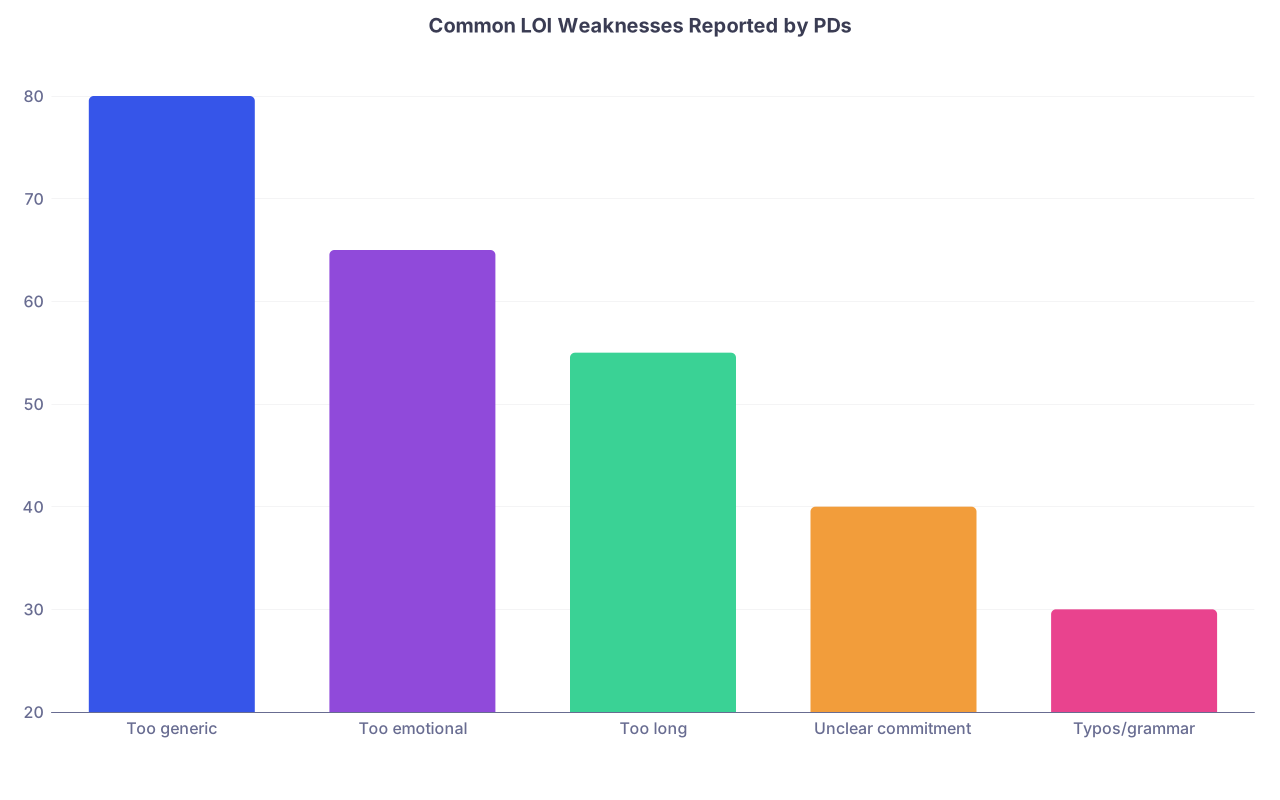
| Category | Value |
|---|---|
| Too generic | 80 |
| Too emotional | 65 |
| Too long | 55 |
| Unclear commitment | 40 |
| Typos/grammar | 30 |
3. Word-Level Tweaks: Cutting Immature Language at the Root
Now we get technical. This is where the letter shifts from “strong MS4” to “already thinks like a PGY-1”.
A. Kill the Filler Phrases. All of Them.
You probably lean on phrases that feel polite but add nothing. They make you sound tentative.
Common offenders:
- “I just wanted to say…”
- “I truly believe that…”
- “I really feel that…”
- “I think that I would be a great fit…”
- “In my opinion…”
- “I would like to mention that…”
Delete them. Not replace—delete.
Compare:
Immature:
I truly believe that I would be an excellent fit for your program because I really value the strong clinical training and emphasis on underserved populations.
Mature:
I would be an excellent fit for your program because of the strong clinical training and sustained commitment to underserved populations, which align with my prior work and long-term goals.
The second is not arrogant. It is direct. You are allowed to assert something without wrapping it in three layers of self-doubt.
B. Replace Emotion Words with Concrete Content
Too many LOIs are built on “love” and “passion” instead of actual evidence.
Weak:
I loved my interview day and felt an immediate connection with the residents. I am extremely passionate about your mission and know I would be happy there.
Stronger:
Interviewing at [Program Name] confirmed that your program matches the environment I am seeking: high-volume, team-based inpatient care with residents who clearly support one another. The way the PGY-3s described the culture—“we work hard, but we do not let each other sink”—is the type of team I want to join.
Here’s what changed:
- Emotion (“loved,” “passionate,” “immediate connection”) → replaced with observations (“high-volume,” “team-based,” specific quote)
- Vague happiness → specific environment you want to work in
Emotion is fine. But it has to ride on facts.
C. Use Strong Verbs, Not Fluffy Nouns
You want verbs that do work. Not nouns that sit there.
Bad:
- “My passion is for…”
- “My interest lies in…”
- “I have a strong desire to…”
Better:
- “I plan to build a career in…”
- “I am preparing for a future in…”
- “I have focused my clinical and research work on…”
You can almost always rewrite “I am passionate about X” as “I have done Y toward X.”
Example:
Immature:
I am passionate about medical education.
Mature:
I have pursued medical education throughout medical school by serving as a peer tutor in physiology, designing a small-group session on acid-base disorders, and co-authoring a QI project on feedback in our clerkships.
The second version shows passion through actions, not adjectives.

4. Sentence-Level Tweaks: How to Sound Clear, Not Cluttered
Mature writing has a specific rhythm: short, clean sentences anchored by a few longer, information-dense ones. You do not want a wall of 40-word sentences.
A. Cut Double-Introductions
Students love to announce what they’re about to say instead of just saying it.
Example:
I would like to take this opportunity to reiterate my strong interest in your program and to highlight a few reasons why I believe it is an excellent fit.
You can safely reduce this to:
I would like to reiterate my strong interest in your program and outline why it is an excellent fit.
Or even:
I remain strongly interested in your program because it aligns with my goals in [X, Y].
Reduce the number of “throat-clearing” segments (phrases whose only job is to warm up the sentence).
Watch for:
- “I would like to take this opportunity…”
- “I am writing to you today in order to…”
- “I wanted to follow up by saying…”
Skip the preamble. Go straight to the content.
B. Put the Important Words Up Front
Residents learn quickly: lead with the plan, then the story. Your LOI should do the same.
Weak structure:
During medical school, I have had the chance to work with underserved communities through free clinics and outreach programs, and these experiences have shown me how important it is to work in a system that values health equity, which is one of the reasons I am very interested in your program.
That is a 50+ word sentence waiting to trip over itself.
Stronger:
I am seeking a residency that treats health equity as core work, not an add-on. At [School], I spent three years in our student-run free clinic and led a mobile outreach project for uninsured patients; your program’s longitudinal clinic at [X site] is the environment where I want to continue that work.
Key changes:
- Clear goal in the first sentence
- Evidence and alignment in the second
- Split one overstuffed sentence into two focused ones
C. Avoid Redundant Trios
Students love saying the same thing three ways because it feels “strong.”
Example:
I am confident that I will thrive, excel, and grow as a resident in your program.
Pick one. Two at most.
Better:
I am confident I will grow as a resident in your program.
Or, if you want slightly more:
I am confident I will grow and contribute meaningfully as a resident in your program.
Redundancy reads as insecurity. Mature writers trust one well-chosen phrase.
| Pattern | Immature Version | Mature Version |
|---|---|---|
| Stating interest | I am extremely excited about your amazing program. | I remain strongly interested in training at your program. |
| Declaring passion | I am passionate about medical education. | I have focused on medical education through [specific work]. |
| Fit language | I know I would be a great fit at your program. | My goals in [X, Y] align closely with your program’s strengths. |
| Commitment | I would love the chance to match at your program. | I will rank your program first on my rank list. |
| Gratitude | I cannot express enough how grateful I am. | Thank you again for the opportunity to interview. |
5. Tone Tweaks: Sound Like a Future Colleague, Not a Fan
The subtext of your LOI matters more than the adjectives. Program directors read attitude between the lines.
A. Stop “Worshipping” the Program
Overly deferential language makes you sound like a premed talking to an Ivy League dean.
Immature:
Your program is truly unparalleled and I would be beyond honored to receive even the slightest consideration to join such an incredible group of faculty and residents.
This is excessive. Also, obviously not true: there are multiple excellent programs.
Mature:
Your program offers exactly the combination of rigorous inpatient training, early autonomy, and mentorship in [subfield] that I am seeking. I would be grateful for the opportunity to train there.
You respect the program. You do not idolize it.
B. Express Certainty Where It Is Appropriate
One of the most “immature” patterns I see:
I think that your program might be a place where I could thrive and learn a lot.
This is your letter of intent. This is not the time to sound tentative.
Better:
I am confident I would thrive in your program’s high-volume, team-based environment.
You can be honest without being lukewarm.
C. Use “I” and “You/Your” Strategically
If every sentence starts with “I,” you sound self-centered. If every sentence praises “your program,” you sound like a brochure.
Good LOIs alternate:
- Sentences about your background/goals (“I…”)
- Sentences about the program’s structure/culture (“Your program…”)
- Sentences about alignment (“This aligns with…”, “Together, this would…”)
Example paragraph:
I am seeking a residency with strong inpatient exposure, early graduated responsibility, and protected time for teaching. Your program’s night float structure, the resident-led teaching conferences, and the X+Y schedule directly support those goals. I would look forward to contributing as a teacher while continuing to grow clinically in that setting.
Balanced. No one is being worshipped. It reads like a conversation between professionals.

| Step | Description |
|---|---|
| Step 1 | Draft LOI |
| Step 2 | Cut filler phrases |
| Step 3 | Replace emotion with specifics |
| Step 4 | Sharpen verbs and remove redundancy |
| Step 5 | Confirm clear commitment statement |
| Step 6 | Proofread for tone and clarity |
6. Content Tweaks: Saying the Same Thing, But Like a Grown-Up
You are often stuck with the same underlying content: you liked the residents, you value education, you care about underserved patients. Fine. The trick is how you phrase these clichés.
A. “I Loved the Residents”
Immature:
I loved how friendly and welcoming the residents were and could really see myself working with them.
Mature:
The residents impressed me by how candid they were about the workload while still expressing clear satisfaction with their training. Their comment that “we are tired but not miserable” struck me as a healthy, honest culture that I would value as a trainee.
Key upgrades:
- Specific observation instead of vague “friendly”
- Nuance (workload + satisfaction) → this sounds like you listened
- A direct quote from residents → concrete, memorable
B. “I Care About Teaching”
Immature:
Teaching is very important to me and I am passionate about medical education.
Mature:
Teaching is central to my career plans. I have led review sessions for our M2 pathophysiology course, served as a near-peer tutor during clerkships, and received our school’s teaching award last year. The structured resident-as-teacher curriculum at your program would help me continue to develop these skills.
Same core idea. Mature version is credible.
C. “I Care About Underserved Patients”
Immature:
I am extremely passionate about serving underserved communities and I want to work with diverse patient populations.
Mature:
I plan to build a career in safety-net medicine. At [Institution], I spent two years at our student-run free clinic and completed my sub-I at the county hospital, where I saw how resource constraints shape daily decision-making. Your continuity clinic at [site] and your program’s longstanding relationship with [community partner] align directly with that path.
You moved from generic “diverse populations” to concrete settings, roles, and future directions.
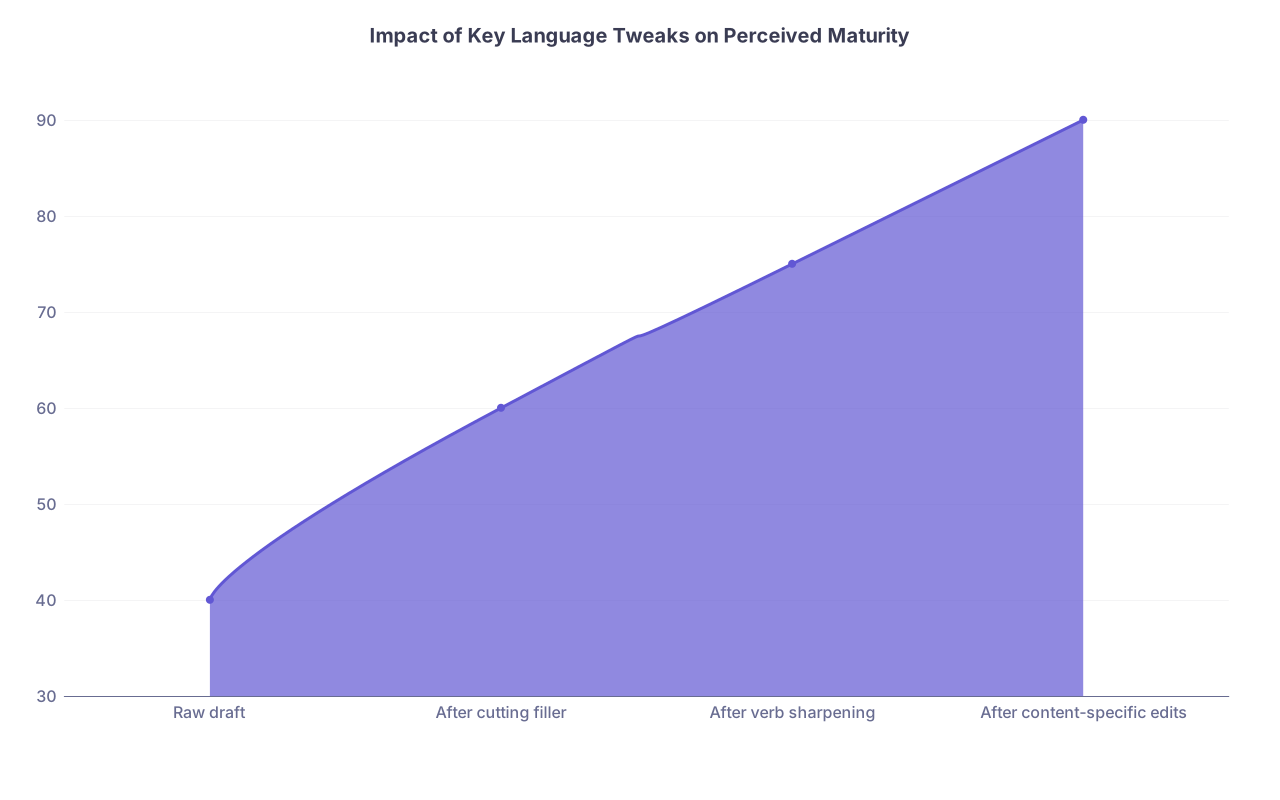
| Category | Value |
|---|---|
| Raw draft | 40 |
| After cutting filler | 60 |
| After verb sharpening | 75 |
| After content-specific edits | 90 |
7. Advanced Micro-Tweaks: Small Changes, Big Perception Shifts
Now we are past the obvious. These are small edits that signal you understand professional communication.
A. Prefer “Because” Over “As” or “Since” for Causality
“As” and “since” can be ambiguous. “Because” is clear.
Immature:
As I want to pursue cardiology, your program’s strong cardiac service appeals to me.
Mature:
Because I plan to pursue cardiology, your program’s high-volume cardiac service is especially appealing.
Small, but cleaner. The causal relationship is unmistakable.
B. Replace “Will Be Able To” with “Will”
Students love “will be able to,” which sounds hesitant and wordy.
Immature:
At your program, I will be able to grow clinically and will be able to develop my skills as a teacher.
Mature:
At your program, I will grow clinically and further develop as a teacher.
Cut the scaffolding. Keep the action.
C. Use “Although” and “While” for Nuanced Comparisons
Demonstrating that you can hold two ideas at once reads as maturity.
Example:
While I value strong subspecialty exposure, I am primarily seeking a program that emphasizes inpatient general medicine in the first year.
Or:
Although I interviewed at several excellent programs, [Program Name] stands out as the best fit for my goals in [X, Y].
You sound like someone who made a reasoned choice, not someone just “in love” with one place.
D. Remove Self-Deprecating Fillers
This slips in more than people realize:
- “I know there are many more qualified applicants, but…”
- “I may not have the highest scores, but I work very hard…”
- “While my application is not perfect…”
You do not need to introduce your weaknesses in a LOI. The letter’s job is alignment and commitment, not confessional therapy.
If you must address something (late Step 2, new publication, visa situation), do it neutrally:
Since we last spoke, I have received my Step 2 CK score (247), which is now available in ERAS.
Or:
I also wanted to update you that our abstract on [topic] was accepted as an oral presentation at [conference].
Matter-of-fact. No apology language.
8. Putting It All Together: Sample Paragraph Transformations
Let me show you real-level edits.
Original (Immature)
I am writing this letter today to let you know that I am extremely excited about your program and that I truly believe I would be a great fit. I loved my interview day and felt a strong connection with the residents, who all seemed so friendly and happy, and I really admired the way the program focuses on both clinical excellence and research opportunities. I am passionate about medical education and underserved care, and I know that I will be able to thrive in your program and grow tremendously as both a clinician and educator.
Revised (Mature)
Thank you again for the opportunity to interview at [Program Name]. After meeting your residents and faculty, I am writing to confirm that your program is my first choice, and I will rank it #1 on my list. The residents’ description of their training—“busy but supported”—and the combination of strong inpatient general medicine with structured research mentorship align closely with my goals. I have focused on medical education and safety-net care throughout medical school, and I am confident I would continue to grow in both areas as a resident in your program.
Same person. Same story. Entirely different signal.
FAQ (Exactly 6 Questions)
1. How long should a mature, clear LOI actually be?
Most strong LOIs fall in the 3–5 paragraph range, usually 250–400 words. Long enough to state your intention, give 2–3 specific alignment points, and include any meaningful updates. If you are creeping past 500 words, you are almost certainly repeating yourself or padding with emotional language.
2. Do I have to explicitly say “I will rank you #1” for it to count as a real LOI?
Yes. If this is truly your first choice, use unambiguous language: “I will rank your program first on my rank list.” Anything softer (“among my top choices,” “one of my favorites”) reads as hedging and will not be interpreted as a true LOI. Programs have seen every euphemism; clear language stands out.
3. Is it unprofessional to reuse parts of the same LOI for multiple programs?
Reusing structure is fine. Reusing vague, generic paragraphs is lazy and obvious. The mature way to do this is: keep a stable backbone (opening, brief background, closing) and customize the alignment content for each program with specific details: curriculum structure, clinical sites, faculty interests, or culture. If a paragraph could be pasted into a letter to any of 10 programs without changing a word, it is not specific enough.
4. Should I mention weaknesses in my application to “explain” them in my LOI?
Almost never. The LOI is not the place to re-argue your file. Unless you are providing new, objective context (e.g., “Step 2 CK now released,” “additional publication,” “updated visa status”), leave weaknesses alone. Mature writing focuses on what you bring and how you fit, not on reopening old deficits the program has already seen.
5. How formal should the greeting and sign-off be to sound mature but not stiff?
Use a standard greeting: “Dear Dr. [PD Last Name] and the [Program Name] Residency Leadership,” is perfectly appropriate. Sign off with “Sincerely,” or “Best regards,” followed by your full name and AAMC ID. Avoid over-familiar closings (“Warmly,” “All the best”) and anything that looks like a text message or casual email.
6. Is it better to sound more emotional and enthusiastic or more reserved and factual?
Aim for controlled enthusiasm anchored in facts. Pure emotion (“I absolutely loved…”, “I cannot imagine training anywhere else…”) without concrete backing reads as immature. Purely cold, factual writing can sound disinterested. The sweet spot: 80% content, 20% emotion. Show enthusiasm through specific observations and clear commitments, not through superlatives and exclamation points.
Key Takeaways
- Cut filler and emotional padding; replace with clear, direct statements and specific examples.
- Use precise verbs and professional tone to sound like a future colleague, not an over-eager applicant.
- State your intentions unambiguously—especially if this is your true #1—then get out of the way.