
The lazy “one-size-fits-all” LOI is dead. Programs can smell it in the first two sentences.
If you want letters of intent that actually move the needle, you must write differently for academic versus community-focused programs. Not a little differently. Completely differently in structure, emphasis, and subtext.
Let me break this down specifically.
1. Start With the Core Truth: They Want Different Things
Academic and community-focused residencies do not have the same underlying mission. If you pretend they do, your LOI reads vague and insincere.
Academic program leadership is thinking:
- “Will this person do research, publish, and make our program look good at national meetings?”
- “Will they help us match better candidates in future cycles?”
- “Are they fellowship-bound and aligned with our subspecialty strengths?”
Community-focused leadership is thinking:
- “Will this person stay late to take care of patients without complaining?”
- “Will they fit into our culture and get along with nurses, staff, and patients?”
- “Is this someone who might stay and practice in our region?”
Same applicant, different value proposition.
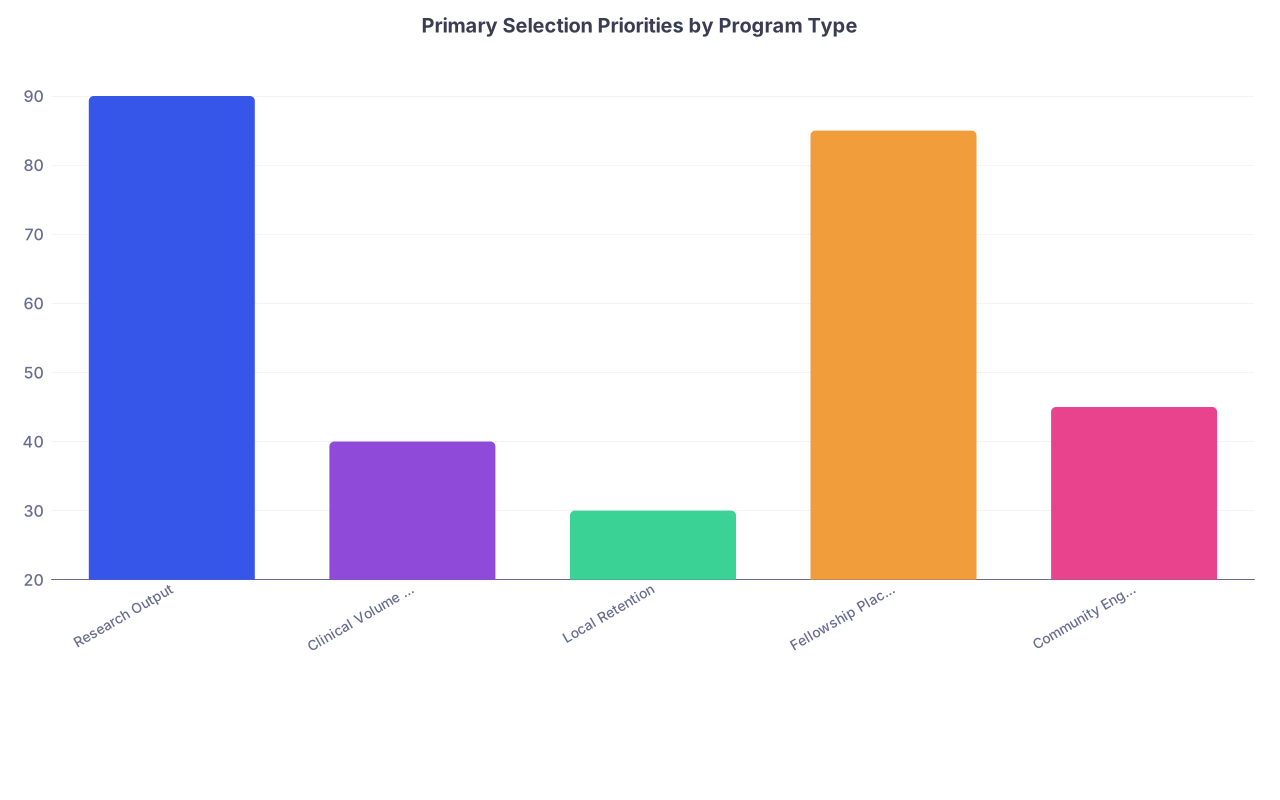
| Category | Value |
|---|---|
| Research Output | 90 |
| Clinical Volume Focus | 40 |
| Local Retention | 30 |
| Fellowship Placement | 85 |
| Community Engagement | 45 |
Interpretation:
- Academic: sky-high priority on research and fellowship placement.
- Community: clinical volume, local retention, and stability matter much more.
You do not explicitly say “I know you care about X more than Y.” That is clumsy. But you structure and weight your letter in a way that clearly shows you understand.
2. The Skeleton of a Strong LOI (That You Then Adapt)
At its core, a high-yield LOI for residency (or fellowship) has four functional parts:
- Clear statement of intent and ranking position
- Evidence-based “why you” + “why them” alignment
- Concrete memory hooks from your interactions with the program
- A clean, firm closing without desperation
You keep this skeleton. You change the organs depending on whether you are writing to an academic powerhouse or a community-heavy, service-oriented program.
Let us go piece by piece.
3. Opening Paragraph: Academic vs Community
The opening is not where you show creativity. It is where you demonstrate clarity and commitment. This is business writing, not a personal statement.
For Academic Programs
Goals:
- Immediately signal ranking intent.
- Tie that intent to goals that matter academically: research, fellowship, scholarly trajectory.
Example structure (IM to a big-name academic program):
Dear Dr. Smith and the Internal Medicine Residency Selection Committee,
I am writing to express my sincere intention to rank [Program Name] as my first choice for residency. After my interview day and conversations with Dr. Lee and the residents, I am convinced that [Program Name] offers the ideal environment to grow as a clinician-investigator and to prepare for a career in academic cardiology.
Notice:
- “First choice” is explicit. No vague “rank highly”.
- Academic future is immediately tied to the program’s identity.
What you do not do here: start with “Thank you for the opportunity to interview” and three lines of generic gratitude. One line is enough later.
For Community-Focused Programs
Goals:
- Signal ranking intent.
- Emphasize clinical practice, continuity of care, and location/community.
Example structure (FM to a strong community program):
Dear Dr. Patel and the Family Medicine Residency Leadership,
I am writing to let you know that I intend to rank [Program Name] as my top choice for residency. My experience on interview day confirmed that [Program Name] aligns perfectly with my goal of becoming a full-spectrum family physician who practices in a community setting similar to [City/Region].
Different emphasis:
- “Full-spectrum family physician,” “community setting,” “similar to [Region]” — those are buzzwords that actually matter to them.
4. Middle Section #1: “Why Them” — And How It Changes
This is where most letters fall apart. They say the same nonsense to every program:
- “Strong clinical training.”
- “Diverse patient population.”
- “Supportive faculty and residents.”
Everyone says this. It is white noise.
You must identify program-type-specific anchors.
For Academic Programs: Research, Complexity, Mentorship, Niche Strengths
You want to show that you understand what makes this academic program distinct from the other five on your list that also publish 200+ papers a year.
Anchor around:
- Specific research themes or labs.
- Protected time for scholarship.
- The structure of academic tracks (research, clinician-educator, global health).
- Subspecialty strengths aligned with your career plan.
- Exposure to complex tertiary/quaternary care pathology.
Example paragraph:
Several aspects of [Program Name] stood out to me. The dedicated clinician-investigator track, with protected research time starting in PGY-2 and the expectation of presenting at national meetings, aligns directly with my goal to continue my work in heart failure outcomes research. Speaking with Dr. Nguyen about ongoing projects using the [Institution] data warehouse made it clear that I would have both the mentorship and infrastructure to develop as an academic cardiologist.
That is tailored. It could not be copy-pasted to a community program, and it could not be used for every academic program either.
If you did research in medical school, you connect the dots:
During medical school, I completed two projects on advanced heart failure therapies, one of which was accepted as a poster at ACC. The opportunity to expand this work within your heart failure group and learn from faculty who are actively shaping guideline-directed therapy is exactly the environment I am seeking.
Key pattern: “Here is what you offer” + “Here is what I have done” + “Here is how they mesh.”
For Community-Focused Programs: Service, Autonomy, Breadth, Local Ties
Your “why them” shifts almost entirely.
Anchor around:
- High clinical volume, hands-on responsibility, early autonomy.
- Continuity clinic culture (often much stronger in community programs).
- Community partnerships (free clinics, FQHCs, school-based clinics).
- Patient demographics and local health needs.
- Long-term retention of graduates in the area.
- Team culture and staff relationships.
Example paragraph:
What resonated most about [Program Name] was the clear emphasis on longitudinal patient relationships and community-based care. Hearing the residents describe following their own panel in clinic from intern year, and seeing how many graduates have stayed to practice in the surrounding communities, reinforced my sense that this is a program that truly prepares physicians for real-world, outpatient-focused practice.
And if you have geographic or personal ties:
Having grown up in [Nearby City] and completed my third-year clerkships in this region, I have seen firsthand the gaps in access to primary care, especially for uninsured and underinsured patients. The chance to train in a program that partners with [Local FQHC] and the county health department is exactly how I hope to begin addressing those needs.
You are speaking their language: retention, service, stability, local investment.
5. Middle Section #2: “Why You” — Same Data, Different Framing
You are the same person. But the way you package your experiences should shift.
For Academic: Lean Into Scholarship and Teaching
You emphasize:
- Research productivity: abstracts, manuscripts, posters, QI projects.
- Comfort with critical appraisal, stats, methodology.
- Teaching experience: near-peer teaching, curriculum work, TA roles.
- Career trajectory: fellowship, academic appointment, niche interest.
Crucial: do not just list products. Show that you understand the process and environment.
Example:
Over the past three years, I have sought out opportunities to develop as a clinician-investigator. I completed an outcomes project evaluating 30-day readmissions among heart failure patients, which taught me how to work with large clinical datasets and collaborate closely with biostatisticians. That project resulted in a poster at [Meeting] and a manuscript that is currently under review. I have found that I enjoy not just answering clinical questions, but also the process of refining a research question and learning from negative or unexpected results.
Then connect to teaching:
I also discovered how much I enjoy teaching during my time as a small-group facilitator for the MS1 cardiovascular block and as a mentor for two preclinical students on their first QI projects. I hope to continue this path by participating in your clinician-educator track and contributing to resident and medical student education.
You are presenting yourself as someone who will thrive and produce within their academic infrastructure.
For Community: Lean Into Work Ethic, Reliability, Patient-Centeredness
Here, your LOI should make them think, “This person will carry the pager, not complain, and be kind to patients and staff.”
You emphasize:
- Heavy clinical rotations where you carried a large patient load.
- Examples of going above and beyond for patients.
- Communication skills, team relationships, nursing feedback.
- Interest in primary care, hospitalist work, EM, or other front-line practice.
- Stability: intention to live/practice in similar communities.
Example:
My most formative rotation in medical school was on our county hospital inpatient service, where our team regularly admitted 10–15 new patients overnight and cared for a medically and socially complex population. I found that I thrived in that environment: organizing my patient list, communicating clearly with nurses and consultants, and ensuring that families understood our plans. The feedback I consistently received was that I was dependable, thorough, and calm under pressure.
Then explicitly tie to their model:
That experience is exactly why I am drawn to [Program Name]’s high-volume, community-focused training model. I want a residency where I will see a wide breadth of pathology, take real ownership of my patients, and graduate confident managing common and acute conditions without overreliance on subspecialty support.
Same core person. Different headline.
6. Program Memory Hooks: Academic vs Community Details
The most convincing LOIs sound like they could only have been written by someone who actually paid attention on interview day.
You sprinkle in 2–4 specific anchors. Not ten. Just enough to prove attentiveness without reading like minutes from the interview session.
Academic Hooks
Look for:
- Named research groups, labs, or core facilities.
- Specific tracks (physician-scientist, global health, QI, clinician-educator).
- Signature rotations (e.g., transplant ICU, advanced heart failure, neuro-ICU).
- National reputation items (NIH funding rank, major ongoing trials).
Academic example:
Listening to Dr. Alvarez describe the transplant cardiology rotation and the expectation that residents present at monthly research conferences convinced me that I would be consistently pushed to engage with the evidence behind our decisions. I was particularly excited to hear that residents have contributed to ongoing trials in advanced heart failure therapies and have presented this work at national meetings.
Community Hooks
Look for:
- Specific clinics (HIV clinic, refugee clinic, migrant worker outreach).
- Longitudinal experiences (home visits, nursing home continuity).
- Culture markers: resident barbecue, wellness half-day, low turnover of leadership.
- Patient story from interview day or second look.
Community example:
I was also struck by how many residents described specific patients they have followed for years in the continuity clinic, including the story one senior shared about attending a long-term patient’s baby shower. That kind of longitudinal relationship is the reason I chose family medicine, and I could see myself building that same depth of trust at [Program Name].
If you cannot recall anything specific, that is not a writing problem. That is a reconnaissance problem. Go back to your notes, the website, the interview invite email. Or do a quick second-look Zoom if offered.
7. The Commitment Paragraph: How Hard You Go
This is where people get anxious: “Can I say you’re my #1?” “Can I tell more than one program they’re my top choice?” Here is the blunt answer.
- If you are in the United States, NRMP rules consider it unprofessional (borderline unethical) to tell multiple programs they are your “number one.”
- You can absolutely tell multiple programs you are ranking them “very highly,” but everyone knows that phrase is non-committal.
So you need two different closing strategies:
- True #1 program: explicit first-choice language.
- Others you like: strong-interest language without lying.
Academic: Sample Commitment Language
True #1:
I want to be clear that I intend to rank [Program Name] as my first choice. Your program’s strengths in [specific research area], the clinician-investigator track, and the emphasis on preparing residents for competitive fellowships align uniquely with my long-term goal of an academic career in [field].
Strong interest, not #1:
I will be ranking [Program Name] very highly on my list. The combination of rigorous clinical training and robust research infrastructure makes it one of the few programs where I can truly envision building the foundation for an academic career.
Community: Sample Commitment Language
True #1:
I will be ranking [Program Name] as my top choice for residency. The opportunity to train in a community-focused, high-acuity environment with strong continuity clinic experiences aligns exactly with my plan to practice full-time in a setting like [Region/City].
Strong interest, not #1:
I plan to rank [Program Name] near the top of my list. Your focus on community-based training and long-term patient relationships strongly matches the kind of physician I hope to become.
Do not over-promise. Programs share stories, faculty talk, and coordinators remember names.
8. Tone, Length, and Timing: Subtle Differences That Matter
Tone Differences
Academic LOIs can tolerate a slightly more formal, cerebral tone. You can write:
- “clinician-investigator”
- “scholarly environment”
- “outcomes research”
- “methodologic rigor”
Community LOIs should lean a bit more human and grounded:
- “taking care of patients over years”
- “being available to the community”
- “working closely with nurses and staff”
- “serving an underserved population”
If your letter to a community program reads like a grant proposal, it feels off. If your letter to a top-10 academic program barely mentions scholarship, you look mismatched.
Length
- Ideal range: 3–5 short paragraphs. Roughly 250–450 words.
- Below ~200 words: often feels rushed or generic.
- Over ~600: people stop reading carefully.
Academic programs: you can be closer to the upper end if you have specific research alignment. Community programs: usually better around the middle — compact, focused, not bloated.
Timing
Use this rough schedule:
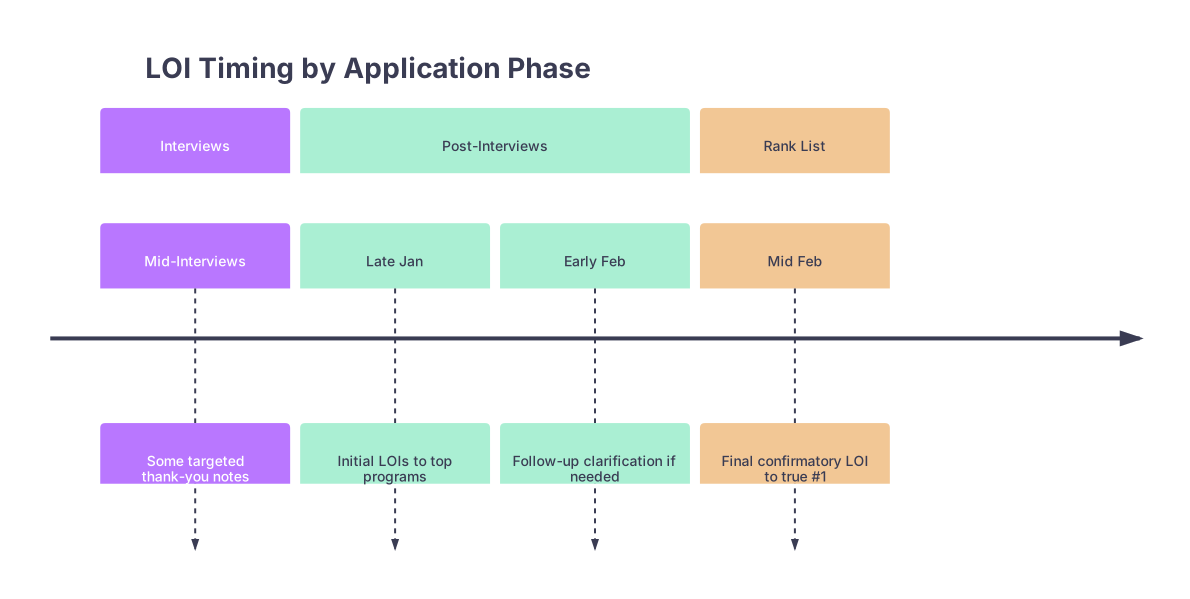
| Period | Event |
|---|---|
| Interviews - Mid-Interviews | Some targeted thank-you notes |
| Post-Interviews - Late Jan | Initial LOIs to top programs |
| Post-Interviews - Early Feb | Follow-up clarification if needed |
| Rank List - Mid Feb | Final confirmatory LOI to true #1 |
Key points:
- Do not fire off LOIs the day after every interview. You look impulsive.
- For your true #1, a single, clear LOI 1–2 weeks before rank list certification is plenty.
- Academic programs are used to LOIs; some community sites may not even track them systematically. But PDs still read emails when your name crosses their radar.
9. Side-by-Side: Academic vs Community LOI Elements
Here is how the same applicant might shift emphasis.
| Element | Academic Program Focus | Community-Focused Program Focus |
|---|---|---|
| Opening Intent | First choice for academic/fellowship path | Top choice for community-based clinical practice |
| Main Value Alignment | Research, teaching, complexity, fellowship | Service, autonomy, continuity, local needs |
| Highlighted Experience | Research projects, teaching roles, presentations | Heavy clinical load, patient stories, team feedback |
| Program Hooks | Tracks, labs, specialty strengths, conferences | Clinics, community partnerships, retention, culture |
| Future Plans | Academic position, subspecialty fellowship | Primary care, hospitalist, EM, local/regional work |
Same person. Different story angle.
10. Common Mistakes That Instantly Weaken LOIs
I have seen these repeatedly. They are fixable, but they tell a program you are not paying attention.
Copy-paste errors.
You leave another institution’s name in the body. Automatic credibility hit.Generic compliments.
“Your program offers excellent training, a diverse patient population, and supportive faculty.” This sentence could apply to 90% of programs. It tells them nothing.Over-selling research to community programs.
If you send a community IM program a letter that reads like an R01 aims page, you signal that you will be miserable there and leave for fellowship at the first chance.Downplaying clinical work to academic giants.
On the other hand, if your letter to a big academic IM program never mentions scholarship but talks only about “serving my community,” you look mismatched for their mission.Overly emotional or pleading tone.
“It has always been my dream to train at your program,” “I would be devastated if I did not match there.” This does not help you. It makes you sound unstable.No concrete specifics.
If your letter could be sent to 10 different programs with no edits beyond the name at the top, it is useless.
11. A Template You Can Actually Use (Then Adapt)
Here is a lean template you can bend toward academic or community programs. Fill in the brackets carefully.
Academic-Weighted Template
Dear Dr. [PD Last Name] and the [Specialty] Residency Selection Committee,
I am writing to express my sincere intention to rank [Program Name] as my [first choice / top choice / one of my highest-ranked programs] for residency. After my interview day and conversations with [Faculty/Residents], I am convinced that [Program Name] offers the ideal environment to prepare for a career as an academic [subspecialty or generalist].
I am particularly drawn to your [research track / clinician-investigator path / specific lab or group], as well as the opportunity to work with faculty such as [Name], whose work in [specific area] aligns closely with my interests. During medical school, I pursued projects in [brief description], resulting in [poster/manuscript/QI outcomes], and I am eager to continue developing as a clinician-investigator in an environment with robust mentorship and infrastructure.
I was especially impressed by [specific memory hook from interview day: conference structure, research-in-progress meetings, subspecialty rotation, teaching conference]. The residents described a culture that balances high academic expectations with strong peer support, which is exactly the kind of environment in which I have thrived.
Because of this fit between my academic goals and your program’s strengths, I will be ranking [Program Name] as my [explicit commitment phrase]. I would be honored to contribute to your residency community as a dedicated clinician, researcher, and teacher.
Sincerely,
[Your Name], [Medical School]
Community-Weighted Template
Dear Dr. [PD Last Name] and the [Specialty] Residency Leadership,
I am writing to let you know that I intend to rank [Program Name] as my [top choice / one of my highest-ranked programs] for residency. My interview day confirmed that your program’s focus on [community-based training / primary care / high-volume clinical experience] aligns directly with my goal of becoming a [type of physician] who serves communities like [Region/City].
I was especially drawn to your [continuity clinic model / community health partnerships / inpatient service structure], and to the way residents described taking real ownership of their patients. During my rotations at [similar setting: county hospital, community clinic], I discovered that I thrive in high-volume, team-based environments, and I consistently received feedback that I am reliable, thorough, and patient-centered.
Hearing about your work with [specific clinic, outreach program, local initiative] stood out to me as exactly the type of community engagement I hope to be part of. As someone with strong ties to [Region/State] and a long-term interest in practicing in this type of setting, I see [Program Name] as the ideal place to train.
For these reasons, I will be ranking [Program Name] as my [explicit commitment phrase]. I would be grateful for the opportunity to join your team and to care for the patients and communities you serve.
Sincerely,
[Your Name], [Medical School]
You do not send this template unedited. You use it as a scaffold, then customize aggressively.
12. Where This Fits In Your Bigger Strategy
A letter of intent is not magic. It will not turn a lukewarm interview into a guaranteed match. But for programs that were already leaning toward you, a sharp, well-aimed LOI can be the nudge that places you at the top of a tier.
The key is alignment. Academic programs want scholars who also care about patients. Community programs want workhorses who also care about people and place. Tailor your LOI so that they see you as obviously one of their own.
With that structure in place, your next step is not more letters. It is making sure your actual career plan and interview performance truly match the story you are telling. That is how you stop just “sending LOIs” and start controlling your trajectory. But that is a conversation for another day.