
You are staring at your draft letter of intent. Third coffee of the night. Cursor blinking under the line: “Thank you again for the opportunity to interview at your excellent program…”
And you know it is garbage. It sounds like every other template, it could be sent to ten different programs with a single find‑and‑replace, and it does not actually say what you are trying to say:
“I will come if you rank me.”
“I am done shopping.”
“You are my top choice.”
You are not struggling with paragraphs. You are struggling with phrases. The exact words that program directors recognize as real commitment versus fluff.
Let me break that down specifically.
The Core Problem: Programs Read Between The Lines
Program leadership has been reading these for years. They know ERAS boilerplate when they see it. They can quote the clichés by heart:
- “Your program is among my top choices…”
- “I would be honored to train at your institution…”
- “I can truly see myself thriving at your program…”
None of that signals commitment. At best, it signals that you know the etiquette. At worst, it signals that you are trying to keep your options open while pretending otherwise.
What actually matters to them in a letter of intent comes down to three questions:
- Are you giving me a clear, unambiguous ranking signal?
- Are you demonstrating specific insight into our program?
- Are you describing credible fit (what you bring + what you want) that aligns with what we actually are?
The “true commitment” phrases live at the intersection of those three.
Tier 1 Commitment: Phrases That Say “You Are My #1”
This is the nuclear category. You get one true letter of intent per cycle if you are being ethical about it. Programs know that.
If you do not say something in this territory, they almost never assume they are your actual first choice. If you do, they pay attention.
Exact phrases that clearly signal “you are my top choice”
These are the kind of sentences that pull you out of the generic pile:
“I want to state clearly that [Program Name] is my first choice, and I will rank your program #1.”
This is the cleanest version. No qualifiers. No hedging. It answers both questions: “Am I your top pick?” and “Will you actually rank us first?”
“Barring an unforeseen life event, I will rank [Program Name] #1 on my list.”
Slightly more formal, but still very strong. The “barring unforeseen…” clause is normal legal‑brain language for some people, and program directors have seen it enough that they know it is still a genuine #1 signal, not a cop‑out.
“I have completed my interviews and can say with confidence that I will rank [Program Name] first.”
This reassures them you are not sending this while you still have five more ‘top choices’ to visit. It is especially powerful late in interview season.
“After completing all of my interviews, I have decided to rank [Program Name] as my top choice and will list your program #1.”
This one adds the “I am done deciding” subtext. Very useful if this is going out in February.
-
Subtle but important structure: vote first (“I will be ranking… #1”), then emotion (“thrilled to join…”). That ordering matters. The commitment comes before the flattery.
Those five cover 95% of what you should ever need for a true letter of intent. Every real “I am all in” sentence is some variation of those elements:
- First choice / top choice / #1
- Completed (or confidently decided on) ranking
- Future tense with certainty: “will rank,” not “plan to rank” or “hope to rank”
Phrases that sound strong but are actually meaningless
Programs roll their eyes at these; I have literally heard PDs say, “This means nothing” while reading them out loud:
- “Your program is among my top choices.”
- “Your program is one of my top programs.”
- “I plan to rank your program very highly.”
- “Your program is at the top of my list.”
- “I will be ranking [Program] highly on my list.”
These are deliberately vague. They let you send three “special letters” without technically lying. Programs are not fooled. Most of them mentally translate “very highly” to “somewhere between 2–6.”
If you are truly committed, do not hide behind those phrases. If you are not truly committed, do not pretend you are. Mixed signals are worse than no signal.
Tier 2 Commitment: Phrases That Show You Actually Know The Program
You can say “I will rank you #1” all day. If your letter reads like you could have sent it to two dozen places, it loses force.
True commitment shows up in how you talk about the program, not just “what rank you assign it.”
Exact phrases that move you from generic to “this person has done their homework”
Here is what this looks like in practice.
-
Then you actually list them, concretely. For example:
- X: “the structured PGY‑1 ultrasound curriculum with protected scanning time”
- Y: “the opportunity to work longitudinally at the free‑standing children hospital”
- Z: “the emphasis on resident‑run quality improvement projects that present at national meetings”
That is commitment. Not “strong clinical training,” not “diverse patient population.” Real features.
“The combination of [specific clinic/track] and [specific site] aligns exactly with the kind of training I am seeking.”
Example:
- “The combination of the Women’s Health track and continuity clinic at the Southside FQHC aligns exactly with the kind of community‑focused internal medicine training I am seeking.”
Now a PD can picture you in their actual structure, not just as a floating name.
-
Specific people + specific behavior. For instance:
- “…culture of open feedback and resident autonomy in patient management…”
That reads very differently from “supportive and collegial environment” (useless phrase; every school brochure says that).
“I was especially struck by how your residents described [concrete practice], and it is a model I want to train in.”
Now you bring in what residents said in the pre‑interview dinner, not just faculty talking points:
- “…described their active role in leading multi‑disciplinary rounds and being the first call for ED consults…”
This tells the PD you were listening to the messy reality, not just the slide deck.
“No other program I visited offered [very specific thing], which has been central to my decision to rank you first.”
Always risky if this is not true, but powerful when it is. Example:
- “No other program I visited offered a dedicated addiction medicine rotation integrated into the primary care block schedule…”
That is a believable differentiator.
What weak, non‑committal “specifics” look like
You might think you are being specific while actually reciting a brochure. Programs see right through:
- “strong research opportunities” → Which lab? Which PI? What topic?
- “diverse patient population” → Every urban program says this.
- “strong operative experience” → This is a requirement, not a differentiator.
- “supportive and collegial culture” → Nobody writes “toxic and competitive” in their brochure.
If your “reason” could apply to more than five other programs on your list, it is not a true commitment signal. It is wallpaper.
Tier 3 Commitment: Phrases That Show You Have A Realistic, Credible Fit
Programs are not just asking, “Will you rank us #1?” They are also asking, “If we match you, will you be happy and successful here, or will you be a transfer risk / burnout risk / constant complainer?”
The phrases that calm those fears do two things:
- They tie your past to who you will be in their program.
- They show that you understand the trade‑offs of the program and accept them.
Exact phrases that demonstrate credible fit
“The strengths of your program directly match my background and goals in [field or niche].”
You then connect the dots:
- “My experience building a student‑run clinic and your program’s commitment to longitudinal community engagement through the [Clinic Name] make [Program] the environment where I can continue that work at a higher level.”
Program sees: this person is not just window‑shopping; their trajectory points here.
“I am particularly drawn to [known challenging aspect] of your training, because it matches how I learn and work best.”
For example:
- “I am particularly drawn to the high‑volume night float system and early autonomy, because I have consistently thrived in fast‑paced, responsibility‑heavy environments such as [X rotation, Y job].”
You are not blind to the workload; you are leaning into it.
“Your emphasis on [educational structure] reflects exactly what I am seeking in a residency.”
Specific, again:
- “Your emphasis on daily, case‑based morning report run by senior residents reflects exactly what I am seeking in a program that prioritizes resident teaching and stepwise responsibility.”
This tells them you care about how learning happens, not just reputation.
“As someone who intends to pursue [fellowship / career path], the mentorship structure you described with [Name] and [Name] is exactly what I am looking for.”
You are not just vaguely “interested in critical care.” You know who is there and how they will help you.
“I grew up / trained / worked in [similar environment], and I am specifically seeking a residency in a city and hospital setting like [Program’s city/hospital].”
Example:
- “Having grown up and trained in large, safety‑net academic centers, I am specifically seeking a residency in a similar environment, which makes [Program] in [City] an ideal fit for me.”
Geographical and institutional fit matter more than applicants admit. Programs care a lot if you have shown you thrive in their type of environment.
Commitment vs. Gamesmanship: Where People Screw This Up
There are a few classic mistakes I see over and over.
1. Sending multiple “you are my #1” letters
Some applicants still do this. They assume programs will never talk. Sometimes they are right. Sometimes they are not.
But here is the deeper issue: your letter changes how PDs feel, not the algorithm. The Match does not care what you wrote. People do.
Lying about rank preference:
- Damages your reputation if it gets out (and yes, residents and PDs gossip between programs).
- Undermines your own internal compass. You stop being honest even with yourself about where you want to go.
If you need multiple “signals,” fine. Use tiered language:
- One program gets: “I will rank your program #1.”
- A couple of others get: “I will be ranking your program very highly and would be thrilled to train here,” without the #1 claim.
But do not blur the line between those.
2. Using softeners that erase your commitment
These words weaken your signal:
- “hope to”
- “plan to”
- “intend to”
- “strongly considering”
Compare:
- Weak: “I plan to rank your program very highly.”
- Strong: “I will rank your program #1.”
One is a thought. The other is a decision. PDs respond to decisions.
3. Over‑selling “mutual fit” with zero evidence
If you write, “I believe there is a strong mutual fit,” you had better support that with something beyond vibe.
You need phrases like:
- “My [specific background] aligns with your [specific program focus].”
- “Your emphasis on [X] matches my experience in [Y].”
If you cannot produce those, skip the “mutual fit” language. It reads hollow.
Concrete Template: Skeleton Of A High‑Commitment Letter
Let me give you a minimal skeleton, then we will plug in some of the exact phrases.
You want four parts:
- Brief opening and thanks.
- Explicit ranking statement.
- 2–3 program‑specific reasons tied to your background.
- Closing re‑affirmation.
Here is how that can sound using the phrases we have covered.
Example structure with commitment phrases inserted
Paragraph 1 – Opening, concise:
Thank you again for the opportunity to interview at the [Program Name] Internal Medicine Residency and for the chance to learn more about your residents and faculty.
Paragraph 2 – The clear #1 commitment:
I want to state clearly that [Program Name] is my first choice, and I will rank your program #1.
Paragraph 3 – Specific aspects demonstrating you know the program:
My decision to rank [Program Name] first is driven by three specific aspects of your program: the structured PGY‑1 ultrasound curriculum with protected scanning time, the opportunity to work longitudinally at the [Clinic/Hospital Name], and the emphasis on resident‑led quality improvement that regularly results in presentations at national meetings. No other program I visited offered this combination of hands‑on procedural training, continuity with a diverse underserved population, and structured support for scholarship.
Paragraph 4 – Fit phrase tying your background to their program:
The strengths of your program directly match my background and goals in academic hospital medicine. My work developing a student‑run clinic and my ongoing QI project on heart failure readmissions have prepared me to contribute immediately to your mission of high‑value care for complex patients. Your emphasis on resident autonomy in managing high‑acuity patients at [Hospital Name] reflects exactly what I am seeking in a residency that will challenge me and accelerate my growth.
Paragraph 5 – Cultural / environment fit with concrete detail:
Working with Dr [Name] and Dr [Name] on interview day, and hearing residents describe their active role in leading multidisciplinary rounds, confirmed that your program’s culture of graded responsibility and open feedback is what I am looking for. Having trained in large, safety‑net academic centers, I am specifically seeking a residency in a similar environment, which makes [Program] in [City] an ideal fit for me both professionally and personally.
Paragraph 6 – Closing reaffirmation:
Thank you again for your consideration. I would be thrilled to join your residency class, and I look forward to ranking [Program Name] first on my list.
Every bold phrase from earlier shows up here in a natural way. There is no fluff. No “among my top choices.” No “very highly.” Just clear, honest commitment.
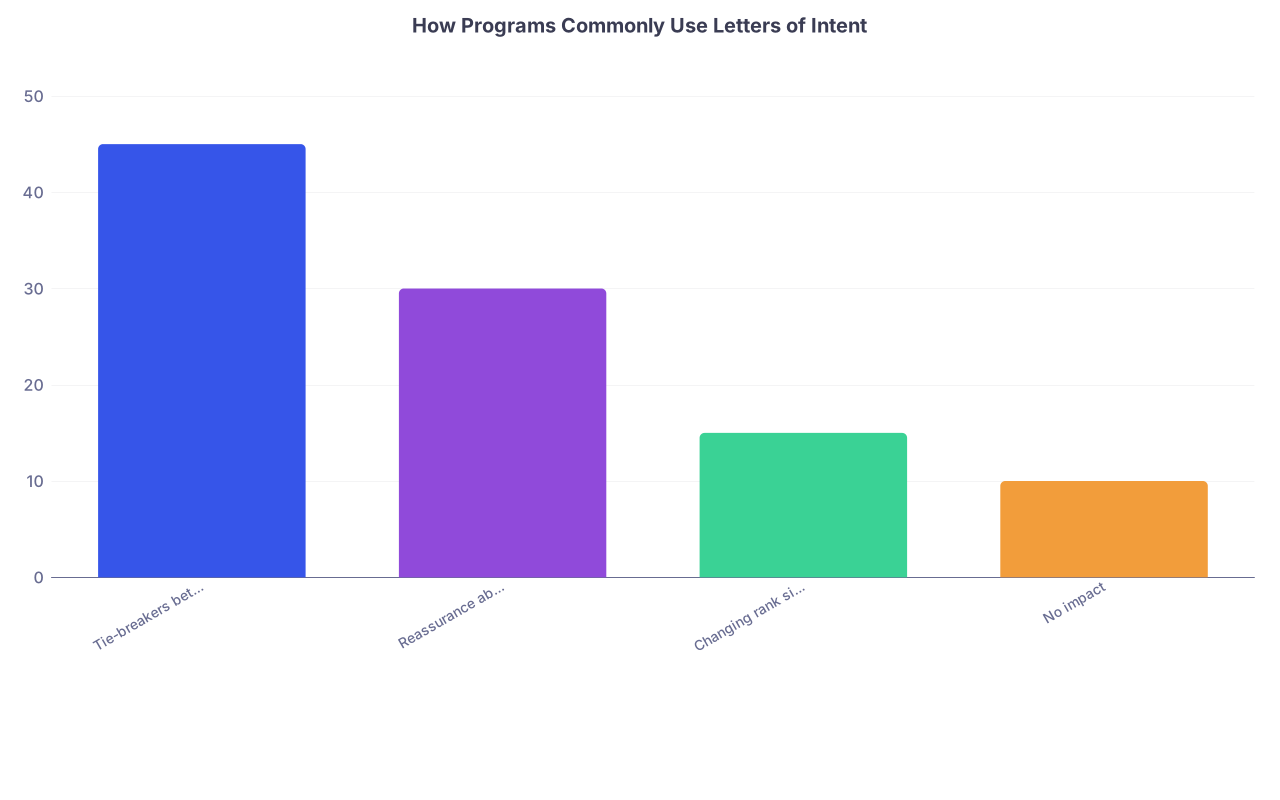
How Programs Actually Use These Letters
To understand why the exact wording matters, you need to understand where these letters fall in the mental model of program leadership.
| Category | Value |
|---|---|
| Tie-breakers between similar applicants | 45 |
| Reassurance about ranking high | 30 |
| Changing rank significantly | 15 |
| No impact | 10 |
That distribution is not from a randomized trial, obviously, but it matches what I have heard repeatedly:
- Around half the time, letters matter in the margins. You and another applicant are comparable; the one who clearly commits gets nudged up a few spots.
- Sometimes they reassure a PD that ranking you very high will not be “wasted” on someone clearly going elsewhere.
- Rarely, a stellar letter with a crystal clear #1 statement plus strong fit can pull you up meaningfully. Especially at smaller or mid‑tier programs that worry more about getting ghosted.
- Occasionally, they do nothing because the program’s list is already locked or you are already clearly at the top or bottom.
The point: letters of intent are not magic keys. They are tiebreakers and reassurance tools. But to function as that, your phrases have to be unmistakable.
Quick Comparison: Strong vs Weak Phrasing Side by Side
Sometimes it helps to see it compactly.
| Purpose | Strong Phrase | Weak Phrase |
|---|---|---|
| Declare #1 rank | "I will rank your program #1." | "I will rank your program very highly." |
| Identify top choice | "Your program is my first choice." | "Your program is among my top choices." |
| Connect to specific feature | "No other program offered [specific element]." | "You offer strong clinical training." |
| Show cultural fit | "Your culture of [X] is what I am seeking." | "You have a collegial environment." |
| Tie background to strengths | "The strengths of your program match my background." | "I believe there is mutual fit." |
If your draft looks like the right side of that table, you have work to do.
Future‑Facing Phrases: Looking Beyond Match Day
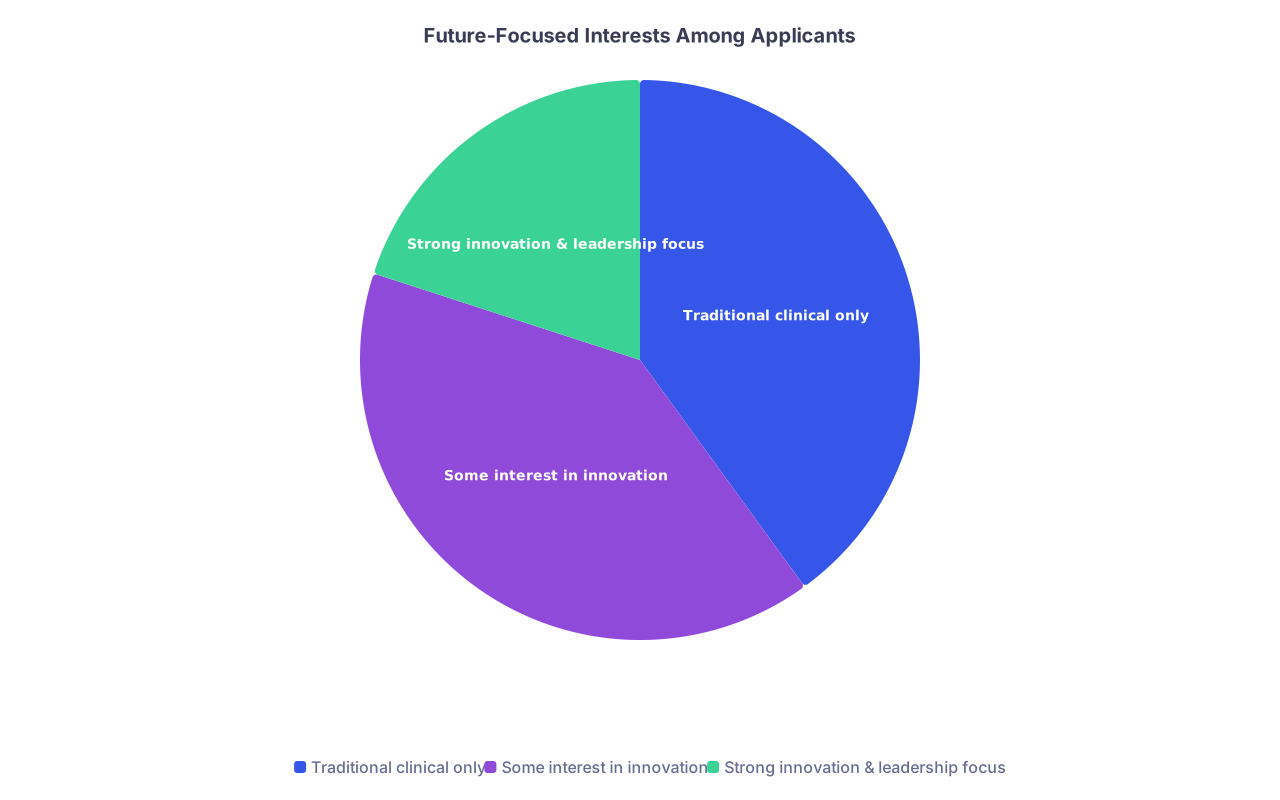
This category sits nicely in “Miscellaneous and Future of Medicine,” because some of you are not just chasing a residency slot. You are thinking about where medicine is actually going: AI, telehealth, value‑based care, rural health redesign, new care models.
Programs that care about that future will perk up if you use aligned, future‑oriented commitment language. You are not writing an essay on health policy. You are signaling that you want to build your future with their resources.
Phrases that tie your long‑term goals to their future direction
“I am committed to a career in [future‑focused area], and your program’s work in [specific initiative] makes it the place where I can develop that expertise.”
For example:
- “I am committed to a career in value‑based primary care, and your program’s work in risk‑stratified panel management at the [Name] clinic makes it the place where I can develop that expertise.”
“Your investment in [AI / telehealth / population health / rural outreach] aligns with how I see medicine evolving, and I want to be part of that work as a resident.”
Again, program‑specific:
- “Your investment in AI‑enabled triage pathways in the ED aligns with how I see medicine evolving, and I want to be part of that work as a resident physician.”
“I am looking for a residency that will train me not only to provide excellent clinical care now, but to lead in [specific transformation] over the next decade; your program’s [named project] reflects that vision.”
That is a mouthful, but it tells them you are thinking beyond PGY‑1 scut.
“The opportunity to work on [named research group / innovation lab] would allow me to build on my prior work in [short description], and I intend to pursue this during residency.”
This is commitment to an arc, not just to a place.
| Category | Value |
|---|---|
| Traditional clinical only | 40 |
| Some interest in innovation | 40 |
| Strong innovation & leadership focus | 20 |
If you are in that 20% who actually care about leading change, say it. The right programs care.
Process Snapshot: When To Send, Who To Address, How Direct To Be
The phrases we have covered sit inside a timing and process context. Get that wrong and even a strong letter loses some weight.

| Step | Description |
|---|---|
| Step 1 | Finish Most Interviews |
| Step 2 | Draft #1 Letter |
| Step 3 | Wait for Remaining Key Interviews |
| Step 4 | Send 2-3 weeks before Rank Deadline |
| Step 5 | Reassess Preferences |
| Step 6 | Clear #1 Program? |
A few hard‑won specifics:
- Timing: 2–3 weeks before the rank list deadline is ideal. Too early, and they may forget. Too late, and their list might already be effectively set.
- Recipient: Address it to the Program Director by name. CC the coordinator if you want it reliably in the right inbox.
- Subject line: Something like “Letter of Intent – [Your Name] – [Specialty]” is fine. Do not try to be cute.
- Length: 3–6 short paragraphs. This is not a personal statement. They read these between faculty meetings.
- Tone: Direct, respectful, not begging. You are not “pleading for a spot”; you are communicating a decision.
Pulling It Together: From Vague Flattery To Real Commitment
You started the night with: “Thank you again for the opportunity to interview at your excellent program…” and nothing of substance after it.
By now, you should be able to do much better.
Strip the fluff. Replace it with:
- One explicit, unambiguous #1 statement if it is truly your first choice.
- Two or three specific, program‑unique reasons that actually differentiate them.
- One or two fit phrases that tie your background and future goals to their strengths and direction.
If there is a litmus test, it is this:
Could your letter, with a global find‑and‑replace of the program name, plausibly be sent to three other programs?
If yes, you have not used the right phrases. You have not shown true commitment. You have written something to make yourself feel better, not something that will change anything.
Once you have a real letter of intent out the door, you will have a different problem: handling the anxiety that comes with making an actual decision and living with it.
With these phrases and structures down, you are ready for that step. The next part of your journey is not about more wordsmithing. It is about building a rank list you can stand behind on Match Day morning. But that is a separate conversation.