
Only 17% of residency program directors say they “fully believe” what applicants write in letters of intent.
That number should stop you. Because if they do not believe you, nothing else matters—your enthusiasm, your story, your “top choice” claim all die on arrival.
Let me break down exactly how to write LOIs that feel genuinely enthusiastic yet still professional enough that a jaded PD or selection committee member will actually trust them.
What Program Leadership Really Thinks When They Read LOIs
Here is the part applicants consistently underestimate: program leaders are reading LOIs through a filter of skepticism and fatigue.
They have seen:
- “You are my top choice” sent to 5 different programs.
- The same generic paragraph copy-pasted with names swapped.
- Over-the-top emotional language that sounds more like a college personal statement than a postgraduate professional communication.
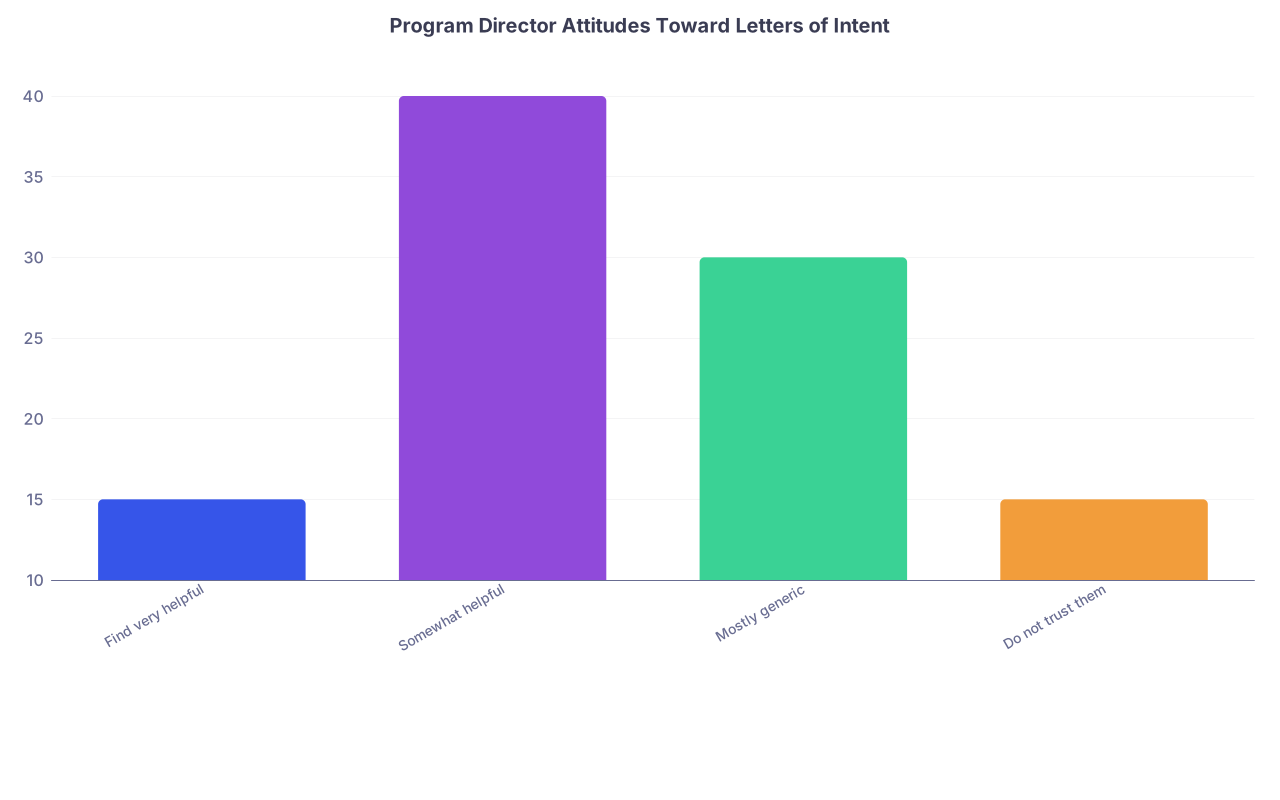
| Category | Value |
|---|---|
| Find very helpful | 15 |
| Somewhat helpful | 40 |
| Mostly generic | 30 |
| Do not trust them | 15 |
So when they read your LOI, they are subconsciously asking:
- Does this sound like a physician or like a college sophomore?
- Does this person understand hierarchy, boundaries, and professionalism?
- Is the “fit” reasoning specific enough that it could not have been written about five other places?
That is where tone and style come in. You are not just “being polite.” You are signaling judgment, maturity, and whether they’d be comfortable introducing you to a fragile ICU family at 2 a.m.
The Core Tension: Enthusiastic vs. Desperate, Warm vs. Sloppy
You are trying to do two things at once that pull in opposite directions:
- Convince them you are genuinely excited about this program
- Prove that you are already functioning like a junior colleague, not a fan
Most LOIs fail because they lean too hard to one side:
Over-enthusiastic: “I fell in love with your program the moment I stepped onto campus. The warmth was unparalleled, and I know in my heart this is where I belong.”
Translation to PD: emotionally immature, future problem when they do not get what they want.Over-professional / sterile: “Thank you for the opportunity to interview. I remain highly interested in your program and would be honored to train there.”
Translation to PD: generic, indistinguishable from 30 other emails.
The sweet spot is contained enthusiasm: clear, specific interest wrapped in concise, professional language.
Tone: How a Future Colleague Actually Sounds
Think of your LOI as coming from “Dr. You, PGY-0.” Not from a premed applicant. Not from a fan of the brand.
1. The Register: Formal, But Human
Your register should feel like:
- A structured email to an attending you respect
- A conference follow‑up note to someone senior you want to work with
- Not like talking to your best friend about your dream program
Bad register (too casual):
“Hey Dr. Smith, thanks so much for a truly amazing interview day – I honestly had a blast talking with everyone.”
Better:
“Dear Dr. Smith, thank you for an engaging and informative interview day. Speaking with your residents and faculty strengthened my interest in [Program Name].”
Bad register (too stiff / robotic):
“I am writing to formally express my utmost and sincere gratitude for the opportunity afforded to me to interview at your esteemed institution.”
Better:
“I am writing to express my sincere appreciation for the opportunity to interview at [Program Name] and to reaffirm my strong interest in training there.”
You are trimming the extremes. No “esteemed institution” nonsense. No “had a blast.” Just clean, professional language with straightforward emotion.
2. Emotional Temperature: Warm, Not Effusive
Here is a simple rule: avoid language you would be embarrassed to read out loud to a room of PDs.
Too effusive:
“I truly fell in love with your program and cannot imagine training anywhere else.”
Professional but warm:
“Your program stands out to me as the place where I could grow the most as a clinician and colleague.”
Swap out “love,” “heart,” “dream,” “cannot imagine anywhere else” for more grounded phrases:
- “stands out to me as”
- “I am especially drawn to”
- “I would be excited to contribute to”
- “I see strong alignment between…”
Those signal enthusiasm without sounding unbalanced.
3. Confidence vs. Neediness
Another trap: trying so hard to show enthusiasm that you cross into neediness.
Red‑flag phrases:
- “I hope you will see how much this means to me.”
- “Matching at your program would change my life.”
- “I know I am not the strongest applicant, but I will work harder than anyone.”
All of that makes the PD think: emotional management issues, potential boundary problems, possible professionalism headaches.
Replace that with:
- Clear statement of rank position (if you choose to give it)
- Concrete reasons for fit
- Specific ways you would contribute
“I will be ranking your program first because of the combination of…” is confident.
“I would be devastated not to match there” is needy. The first helps you. The second hurts you.
Style: Specific Structural Choices That Signal Maturity
Tone is about “how you sound.” Style is about how you build the letter. This is where most applicants go on autopilot and copy templates.
Let’s get more surgical.
1. Length: The One‑Page Discipline
More words do not equal more sincerity. They equal more skimming.
Most PDs decide how they feel about your LOI in the first 6–8 sentences. After that, they are scanning for any red flags or key declarations (“ranking you first”).
Target: 3–5 short paragraphs, roughly 250–400 words. That is it.
Over 600 words and you sound self‑absorbed or oblivious to your audience’s time.
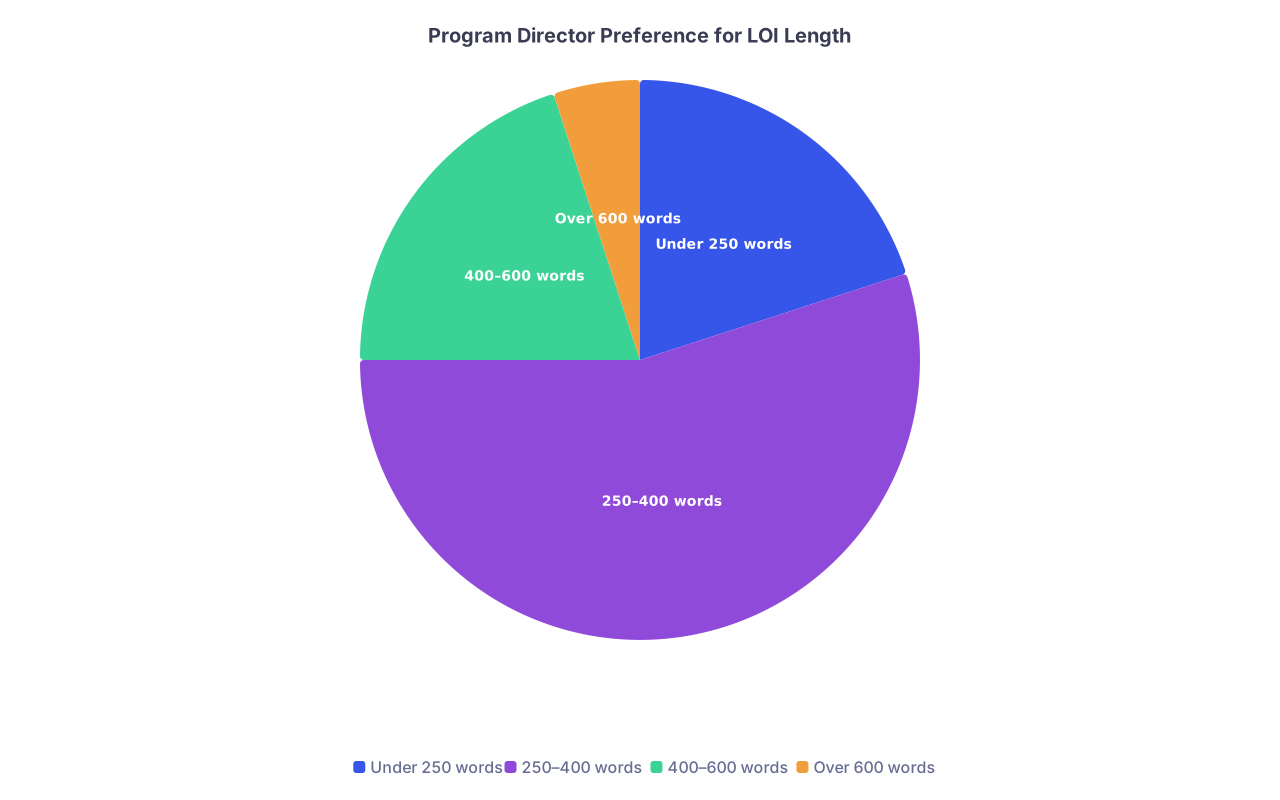
| Category | Value |
|---|---|
| Under 250 words | 20 |
| 250–400 words | 55 |
| 400–600 words | 20 |
| Over 600 words | 5 |
If you are at 700+ words, you are not “thorough.” You are ignoring the fact that they have 40 other emails to open.
2. Structure That Looks Like It Belongs in an Inbox
For residency / fellowship / job LOIs, treat it like a high‑stakes email, not a printed letter to a scholarship committee.
Basic structure that works:
- Short opening: thank + purpose (“reaffirm my interest” / “inform you of my ranking decision”)
- One paragraph: specific program‑based reasons for enthusiasm
- One paragraph: what you bring / how you fit
- Explicit statement of rank position (if appropriate and honest)
- Professional close
Anything outside that usually drifts into fluff.
Do not write your life story here. They saw your personal statement. They read your application. This is a calibrated update + signal, not Volume II: The Feelings.
3. Specificity: The Antidote to Generic Enthusiasm
If your letter could be sent to another program by swapping the name and city, you did not write a meaningful LOI. You wrote a template.
Here is what specificity actually looks like:
Weak:
“I really appreciated the supportive culture and strong clinical training at your program.”
Stronger:
“I was especially impressed by your residents’ ownership in the ICU, including the opportunity to lead family goals‑of‑care conversations while supported by the fellow and attending. That level of graduated autonomy is exactly what I am seeking.”
Or:
Weak:
“I value your commitment to research and innovation.”
Stronger:
“The structure of your research pathway, particularly the protected QI time during PGY‑2 and the mentorship model within the [X] Outcomes Center, aligns with my goal of building a career in health services research.”
Now it sounds like you were actually there. Like you listened. Like you are not just ranking based on Doximity and city size.
4. Voice: Drop the Buzzwords, Add Concrete Details
Overused, empty phrases:
- “cutting‑edge research”
- “unparalleled training”
- “diverse patient population”
- “world‑class faculty”
- “collaborative and collegial environment”
Everyone uses them. They mean almost nothing.
Replace with one concrete description or example:
- Name a specific clinic, track, or rotation
- Reference a particular conversation with a resident or faculty member
- Mention a structural feature of the program (schedule, curriculum design, conference format)
For example:
Instead of:
“Your commitment to diversity and inclusion stood out to me.”
Use:
“The resident‑run curriculum on structural racism in medicine, and residents’ description of how it changed their approach to inpatient admissions, convinced me that your program’s commitment to equity is not just aspirational.”
Now the PD sees that you noticed a real thing, not just their website tagline.
Enthusiasm Without Overpromising: Rank Language and Ethics
Here is where tone and professionalism collide with actual ethics.
Some programs explicitly say: “Do not send us a letter of intent stating we are your #1.” Others encourage it. Policies vary. And yes, some applicants lie.
That is the background.
| Phrase | How PDs Usually Read It |
|---|---|
| "I will be ranking your program first" | Clear signal, strong but binding |
| "You are my top choice" | Strong interest, sometimes vague |
| "You are among my top choices" | Interested, not committing |
| "I remain highly interested" | Mild positive, non‑committal |
| No rank language | Neutral, depends on rest of LOI |
1. If You Truly Will Rank Them First
Then say it clearly. Not in some fuzzy way they have to interpret.
Professional, direct options:
- “I will be ranking [Program Name] first on my rank list.”
- “I have decided to rank [Program Name] as my first choice.”
That is as enthusiastic as you need to get. You do not need: “in my heart” or “dream program” language on top of that. The explicit #1 signal is already maximal enthusiasm in their eyes.
Then back it up with 2–3 specific program features that justify this decision. This protects your professional image: it shows judgment, not infatuation.
2. If You Are Very Interested but Not Sure on Rank
Do not lie. Program directors talk. Faculty move between institutions. You do not want to be the applicant whose name comes up with, “Oh, that is the one who told three programs they were #1.”
Instead:
- “I remain very interested in [Program Name] and can see myself thriving there.”
- “Your program is among the top programs I am strongly considering for my final rank list.”
Yes, this is slightly weaker than “I will rank you first.” That is because it is honest. And staying honest is part of “professionalism in tone,” whether people like hearing that or not.
3. What Not to Do
Two specific mistakes that make you look unprofessional:
- Playing games with quasi‑lying phrasing, e.g., “You are my top internal medicine program in [Region]” when you are applying to only one program in that region. Program directors recognize this trick. It looks manipulative.
- Copy‑pasting your “You are my #1” paragraph to multiple programs and changing only the name. Programs share these screenshots. I have literally seen PDs pull up side‑by‑side identical letters from the same applicant.
If you do not want to commit to ranking a program first, then do not use #1 language. You can still sound very enthusiastic without pretending.
Stylistic Landmines That Instantly Kill Credibility
You can have perfect content and ruin the effect with sloppy execution. Here are the unforced errors that scream “not ready to be a physician colleague.”
1. Name Mistakes and Wrong Program Details
- Misspelling the PD’s name.
- Using the wrong specialty or program name.
- Mentioning a feature from another institution.
I have watched a PD scroll to the line “I know that [Other Program] would be an ideal place to train” and just stop reading. That applicant was done.
Do a final manual read for:
- PD name
- Program name
- Institution name
- City / state
- Any specific clinic / track names
If you are sending 10 LOIs, you triple‑check all 10. No exceptions.
2. Over‑sharing Personal Hardship or Emotion in This Context
Personal history has a place in your application and interviews. The LOI is not the time to unload new, raw trauma or highly emotional material unless the program explicitly invited updates on that kind of situation.
Red flags in LOIs:
- Long paragraphs about how not matching last year “broke you.”
- Graphic descriptions of personal medical issues.
- Heavy family drama attached to your ranking decision.
The tone here should be “steady physician” even if your personal story is complex. Brief, matter‑of‑fact updates: acceptable. Emotional unburdening: not.
3. Humor and Sarcasm
Program leaders have different humor thresholds. Some will chuckle. Others will interpret the same line as “unprofessional.”
You are not auditioning to be the funny resident. You are auditioning to be the reliable one they can trust with high‑stakes situations.
Avoid:
- Self‑deprecating jokes about being “a total nerd for call schedules.”
- Jokes about other programs (“I promise I like your weather better than [City].”)
- Trying to be clever in your sign‑off.
Boring here is good. Reliability > quirkiness.
Example: Side‑by‑Side LOI Tone and Style Fix
Let us make this concrete. Here is a flawed paragraph and how to fix it without draining the enthusiasm.
Original (common style I see):
“I absolutely fell in love with your program on interview day. The culture was unlike anything I have ever seen, and I truly cannot imagine a better place to train. Talking to the residents was inspiring, and I know deep down that [Program Name] is where I belong. I hope you will consider me favorably as you finalize your rank list.”
Problems:
- “Fell in love,” “deep down,” “where I belong” – over‑emotional
- Zero specifics – could be any program in the country
- Passive, needy closing – “I hope you will consider me favorably…”
Revised:
“Interviewing at [Program Name] confirmed for me that your program is an excellent fit. The residents’ description of early autonomy in the ICU and the strong mentorship within the [X] track align closely with how I hope to train. I would be excited to contribute to your resident community and to grow under the guidance of your faculty.”
What changed:
- Emotion level: Warm, but contained
- Details: ICU autonomy, specific track → real content
- Voice: Confident, forward‑looking, not begging
Now layer in rank language if appropriate:
“Because of these factors, I will be ranking [Program Name] first on my rank list.”
One sentence. Clean. Professional. Very clear.
Future‑Facing: LOI Tone in an Evolving Match and Medicine Landscape
We are in a transition phase.
- Step 1 went pass/fail. Programs lean more on subjective signals.
- Application inflation continues. More applications per spot. More noise.
- Generative AI now writes “perfectly polished” letters that sound synthetic.
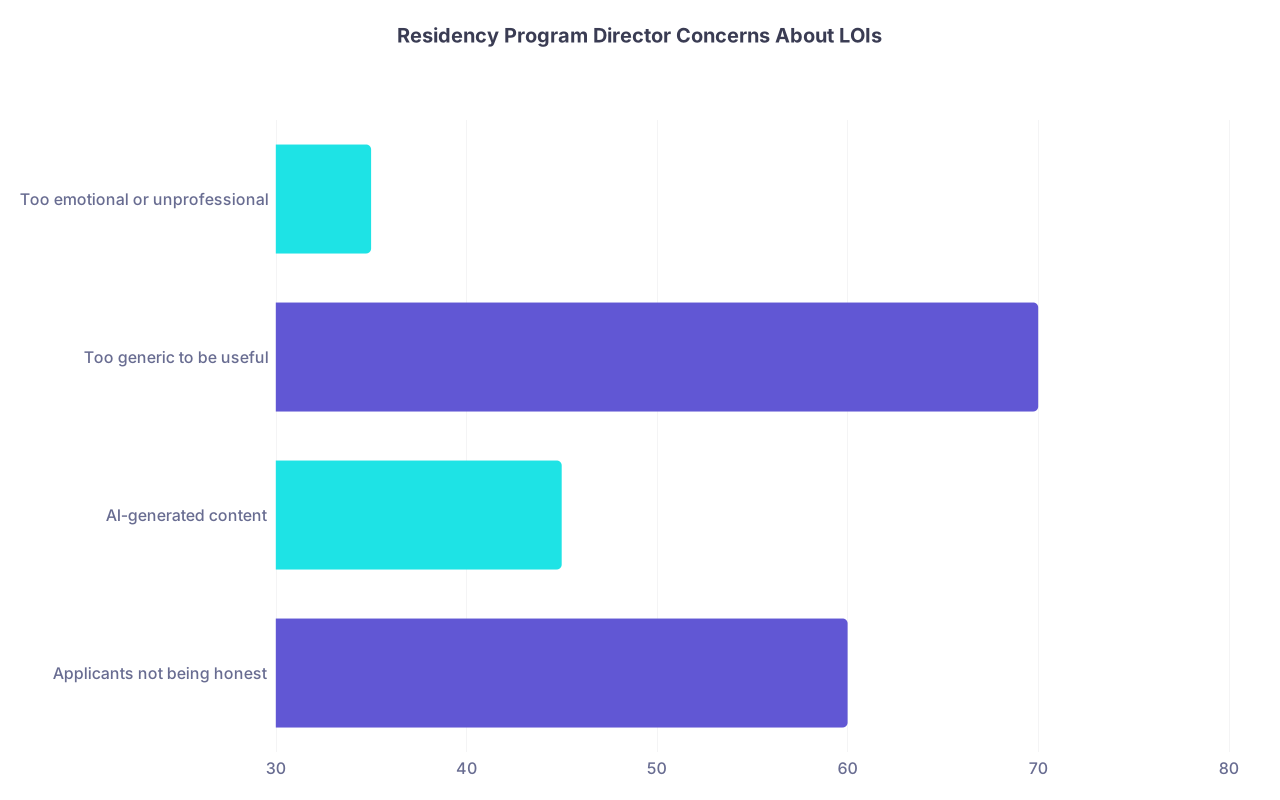
| Category | Value |
|---|---|
| Applicants not being honest | 60 |
| AI-generated content | 45 |
| Too generic to be useful | 70 |
| Too emotional or unprofessional | 35 |
The more AI‑generated sludge fills inboxes, the more PDs will look for signs of:
- Genuine, applicant‑specific details
- Normal human imperfection in syntax and structure
- A voice that sounds like an early‑career physician, not a marketing brochure
In other words: the bar is moving away from fake perfection and toward credible humanity.
If you are tempted to have a chatbot “write your LOI” and paste it verbatim, you are missing the point. The PDs who are paying attention can already spot those. They all sound the same: hyper‑polished, over‑generic, emotionally flat or weirdly enthusiastic.
Use tools for outline and grammar checks if you want. But the last 20%—your voice, your real reasons for enthusiasm, your specific experiences—must come from you. That is what keeps the tone trustworthy.
And trust is the whole game.

| Step | Description |
|---|---|
| Step 1 | Draft LOI |
| Step 2 | Remove extremes |
| Step 3 | Add specific details |
| Step 4 | Professional language |
| Step 5 | Add clear, honest ranking |
| Step 6 | Emphasize strong interest |
| Step 7 | Proofread names and details |
| Step 8 | Send to program |
| Step 9 | Tone check |
| Step 10 | Rank statement? |

FAQ: Balancing Enthusiasm and Professionalism in LOIs
1. Do I actually need to send a letter of intent, or is it optional noise?
If a program has clearly said “do not send post‑interview communication,” respect that. Otherwise, a single, well‑written LOI to your genuine top one or two programs can help. Not because it magically jumps you 20 spots, but because it clarifies fit and signals maturity. Mass‑sending generic LOIs to 20 programs is noise. A small number of targeted, specific, professional letters can matter at the margins where many applicants are clustered.
2. How many programs should I tell are my “#1”?
Exactly one. If you are not willing to commit to one, then do not use “I will rank you first” wording at all. You can still express strong interest without claiming first position. Trying to “game” the system by telling multiple programs they are #1 is unprofessional and does get discovered more often than applicants think.
3. Is it unprofessional not to mention my rank position at all?
No. Many applicants never explicitly state rank position and still match very well. What matters is that your letter clearly conveys that you understand the program, see a realistic fit, and can articulate why. Explicit #1 language is a tool, not a requirement. Use it only when it is honest and consistent with your own strategy.
4. Can I reuse parts of my LOI for multiple programs?
You can reuse general structure and a short self‑description paragraph about what you bring as an applicant. You should not reuse the program‑specific content. Each letter needs its own reasons that are clearly anchored in that program’s curriculum, culture, and structure. If changing the program name makes the letter still read correctly, it is too generic.
5. How informal can I be with greetings and sign‑offs?
Stay on the conservative side. “Dear Dr. [Last Name]” is standard. If there are two PDs, write both or use “Dear Dr. [Last Name] and the [Program Name] Selection Committee.” End with “Sincerely,” “Best regards,” or “Respectfully,” followed by your full name and AAMC ID (or ERAS / NRMP as appropriate). No “Warmly,” no first‑name‑only greeting, and definitely no nicknames.
6. What is your bottom‑line checklist before sending an LOI?
Three quick questions:
- Does this sound like something a PGY‑1 could send to their PD without embarrassment?
- Are there at least two concrete, program‑specific details that prove I paid attention?
- Is every statement about rank position completely honest?
If you can say yes to all three, your tone is probably in the right place: enthusiastic enough to be memorable, professional enough to be trusted.
Key points to keep in your head when you hit “send”:
- Enthusiasm without specifics looks fake; specifics are your enthusiasm.
- Professionalism is not stiffness; it is clarity, honesty, and respect for their time.
- Your LOI should sound like a future colleague speaking to another physician—not a fan letter to a brand.