
You are post‑interview season, inbox open, cursor blinking over a draft letter of intent to your top program. You have heard the usual advice: “Be specific, be sincere, mention faculty names.” You already did that in your thank‑you emails.
Now you are staring at a paragraph where you tried to describe “my passion for patient care,” and it reads like every other personal statement you have ever hated. You are wondering: Do I put a patient story in here? Will that look manipulative? Too long? Too emotional?
This is where clinical stories can either carry your letter… or sink it.
Let me be specific and unapologetically blunt: most letters of intent are boring, interchangeable, and skimmed in under 30 seconds. Strategic use of one or two sharp, well‑chosen clinical stories is one of the few ways to lift yours out of that sludge. But you have to do it right.
This is the playbook.
What Letters of Intent Actually Do (And Why Stories Matter)
Forget the mythology. A letter of intent will not magically reverse a weak interview or rescue a disastrous rotation. But programs do read them, especially in competitive specialties and smaller programs where faculty know the applicant pool well.
Here is what your letter of intent actually does for a program director who already met you:
- Confirms your interest is real, not just ERAS spam.
- Helps them decide if you are worth fighting for on the rank list.
- Gives them 1–2 memorable hooks to recall you in meetings: “That was the applicant who…”
Clinical stories hit all three if used properly. They:
- Anchor your interest in their program in real patient care, not abstract career goals.
- Show how you think on the wards—clinical reasoning, professionalism, humility.
- Provide a concrete image that sticks when they are flipping through dozens of names.
Without a story, your letter becomes a collection of adjectives: “committed,” “excited,” “passionate,” “aligned with your mission.” Everyone says this. No one remembers it.
With one focused story, you become: “the applicant who took extra time with the non‑English speaking stroke patient and then linked it to our safety‑net mission.”
That is rank‑list fuel.
The Right Kind of Clinical Story for a Letter of Intent
Not every patient encounter belongs in a letter of intent. In fact, most do not.
You are not writing your personal statement again. Very different job here.
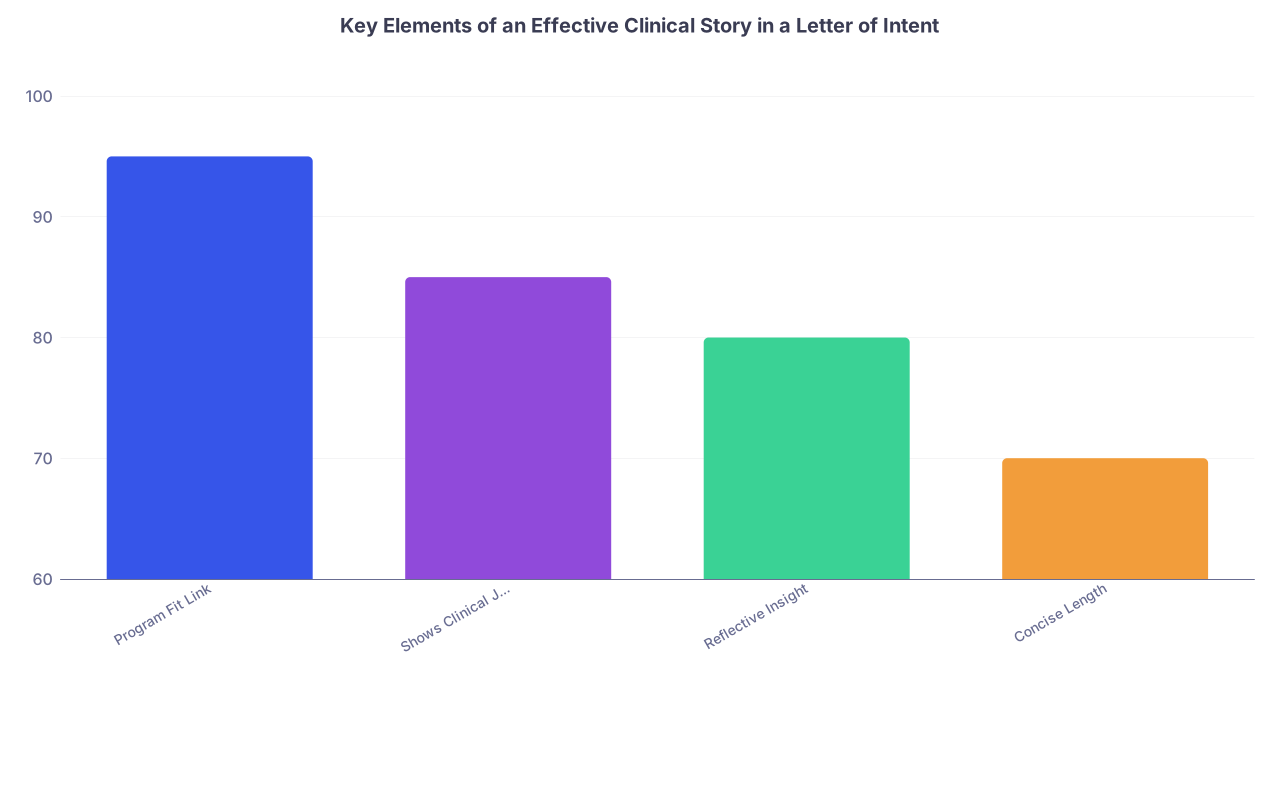
You need a story that does three things at once:
- Shows how you function clinically
- Ties directly to that specific program
- Demonstrates future potential, not just past sentiment
Think of it as: “micro‑case that proves why I belong with you.”
| Category | Value |
|---|---|
| Program Fit Link | 95 |
| Shows Clinical Judgment | 85 |
| Reflective Insight | 80 |
| Concise Length | 70 |
Let me break down the types of stories that work—and the ones that usually backfire.
High‑yield story types
“I saw your program’s mission in real life” story
Example:- Applying to a county EM program with strong social EM focus.
- Story: the night you managed a frequent‑flyer patient with substance use disorder and realized how broken the system is; you mention how faculty at their second‑look talked about longitudinal follow‑up of similar patients.
Why it works: You connect a specific population or problem you already care about with how their program addresses it.
“I function well in the environment you train in” story
Example:- Applying to a high‑volume urban IM program.
- Story: running a cross‑cover night with four new admissions and two decompensations; how you triaged, asked for help appropriately, and what you learned about your limits.
Why it works: Program sees you can survive and think in their workflow, that you understand the grind and still want it.
“I grew from a miss or near‑miss” story
Example:- Story: missing early sepsis because you anchored on CHF; you reflect, show what you changed, and note similar emphasis on diagnostic safety in their morbidity & mortality culture.
Why it works: Shows humility, growth, and alignment with programs that care about safety and reflection (most good ones do).
- Story: missing early sepsis because you anchored on CHF; you reflect, show what you changed, and note similar emphasis on diagnostic safety in their morbidity & mortality culture.
“This is the patient population that will keep me here for three years” story
Example:- Applying to a program with strong refugee/immigrant care.
- Story: a family conference with a refugee family where you navigated cultural and language barriers; you tie it to the program’s refugee health clinic you visited on interview day.
Why it works: Shows long‑term, value‑driven commitment that matches their core strengths.
Low‑yield or risky story types
These usually hurt more than help in a letter of intent:
- The “trauma dump” tragedy story with no reflection
- Graphic codes, child deaths, or anything that reads like emotional manipulation
- Stories where you are the hero and everyone else is incompetent
- Vague “I realized medicine is a privilege” paragraphs with no clinical content
- Anything that re‑hashes a story already used heavily in your personal statement
The principle: if your story could be swapped into a generic inspirational Instagram caption, it probably does not belong here.
This is not a therapy session. It is a precision tool.
Structure: Where and How to Place the Story
You have limited real estate. Your letter of intent should be about 3–5 targeted paragraphs. That is it. No one is reading a two‑page manifesto.
Your clinical story should take up roughly 25–35% of the letter. Usually a single, tight paragraph, max two.
Here is a clean architecture that works for most people:

| Step | Description |
|---|---|
| Step 1 | Opening - Clear Statement of Intent |
| Step 2 | Specific Reasons for Program Fit |
| Step 3 | Clinical Story - Proof of Fit |
| Step 4 | Future Direction - How You Will Grow There |
| Step 5 | Closing - Explicit Commitment and Gratitude |
Practical placement
- Opening: 2–3 sentences. “You are my first choice. Here is the specific program name. Here is me saying I will rank you number one.”
- Middle: one section on program‑specific reasons (curriculum, location, mentorship), then the clinical story that proves those reasons are grounded in real patient care, not brochure copy.
- Ending: future focus and explicit commitment.
The story does not go up front. You are not building suspense. The PD wants to know in the first line why you are writing and what you are committing to. Only then have you earned the right to tell a short story.
Anatomy of a Strong Clinical Paragraph
Let me walk you through what an effective clinical story paragraph actually looks like line by line.
You need four moves:
- Micro‑setup of the case
- Your action and thought process
- Reflection
- Tie‑back to their program
Here is a compressed example for an internal medicine letter of intent to a safety‑net urban program:
On my MICU month at County, I admitted a middle‑aged man with decompensated cirrhosis who had missed multiple hepatology visits because he was working two jobs without paid sick leave. Overnight, as we adjusted pressors and lactulose, what stayed with me was not the lab trend but the way his life circumstances kept colliding with our care plan. Discussing his case at morning rounds, I realized how often our critically ill patients are returning to the exact conditions that made them sick. When I heard your faculty speak on interview day about longitudinal ICU follow‑up and integrating social work into post‑ICU clinics, it matched the way I have started to think about my role beyond the first admission. I am seeking training where those broader determinants are not an afterthought, and your program’s safety‑net mission aligns directly with the kind of physician I am becoming.
Notice a few things:
- No gratuitous drama. No detailed labs. Just enough clinical texture to feel real.
- Clear “I” actions and thinking, but not performing heroics.
- Reflection is concrete, not abstract: “life circumstances colliding with care plan,” not “I saw the intersection of medicine and society.”
- Last 1–2 sentences explicitly name the program’s features and connect them to that case.
That is the formula. Tweak the content, not the structure.
Strategic Alignment: Matching Story to Program Identity
You cannot copy‑paste the same story into every letter of intent and pretend it is “tailored.” Faculty are not stupid. They see obligation language a mile away.
Pick your story after you define the program’s identity. Not before.
Look at how residents and faculty describe themselves, not just the official website. What keeps coming up?
- “We are a county shop. High acuity, limited resources.”
- “We are a tertiary referral center. Zebras, complex co‑morbidities.”
- “We are community based. Continuity and relationships matter here.”
- “We are research‑heavy. You will publish whether you like it or not.”
Then pick a clinical story that reflects:
- The setting (county vs tertiary vs rural vs VA)
- The style of medicine (team‑heavy ICU vs continuity clinic vs procedure‑driven)
- The patient population (immigrant, underserved, geriatrics, oncology, etc.)
- The educational culture (reflection, QI, systems‑based, precision medicine, AI, etc.)
| Program Identity | Strong Story Emphasis |
|---|---|
| County / Safety-net IM | Resource limits, social determinants |
| Tertiary Academic Center | Complex diagnostics, multidisciplinary care |
| Rural FM Program | Continuity, broad scope, limited access |
| Research-heavy Neurology | Case that led to clinical question |
| Innovation-focused EM | Process improvement, tech, workflow change |
If you are applying to a program positioning itself around the “future of medicine” (AI, digital health, precision oncology, telehealth), your story needs to show you have actually touched that world clinically.
Example for a program that prides itself on informatics and future‑leaning care:
On my cardiology rotation I followed a patient with heart failure who kept missing weights and diuretic adjustments, bouncing between observation and discharge. When the team enrolled him in a remote monitoring program using home BP and weight uploads, I watched his rehospitalizations drop to zero over the rest of my month. That experience pushed me to complete a small quality project on remote monitoring alerts, and it is exactly the type of technology‑enabled care you highlighted in your telehealth and AI‑in‑medicine curriculum. I want to train where those tools are routine and critically evaluated, not a side project, and your program’s focus on informatics fits that trajectory.
That is how you bring “future of medicine” from buzzword to credible personal experience in a letter of intent.
Advanced Layer: Integrating Clinical Stories With Future Plans
The category you specified—MISCELLANEOUS AND FUTURE OF MEDICINE—tells me you are likely thinking beyond traditional bread‑and‑butter training. Fellowships, innovation, policy, digital health, global work.
Fine. Then the story has to bridge present and future.
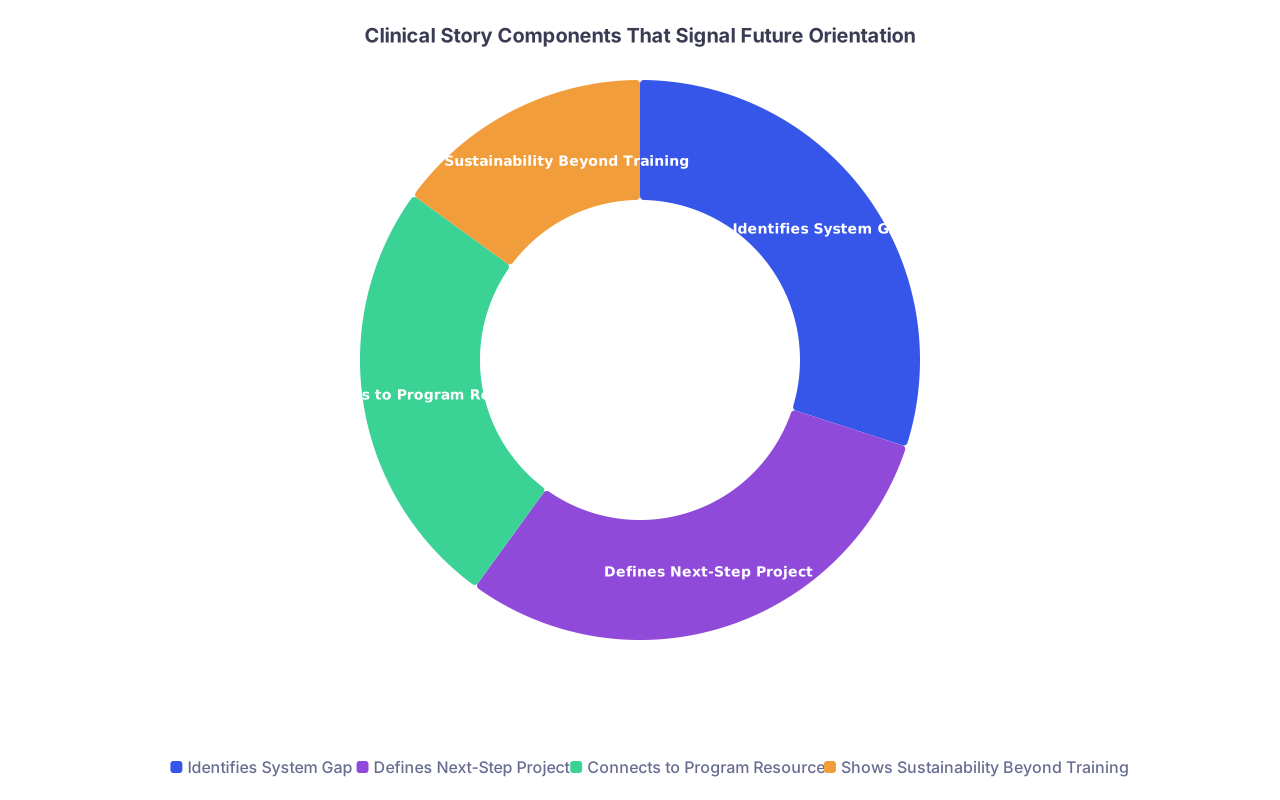
You are not just saying, “Here is a thing I saw.” You are saying, “This case changed what I want to build next, and your program is the right place to do that.”
The structure:
- Story: a real patient and real problem
- Insight: what this revealed about a gap in care
- Trajectory: what you want to work on (QI, policy, tech, research)
- Program link: how their specific resources match that trajectory
| Category | Value |
|---|---|
| Identifies System Gap | 30 |
| Defines Next-Step Project | 30 |
| Connects to Program Resource | 25 |
| Shows Sustainability Beyond Training | 15 |
Example tying to the “future of medicine” explicitly:
During my sub‑internship I cared for a series of older adults admitted after falls related to polypharmacy. Each admission involved a new reconciliation, a new discharge plan, and little sense that we were learning from the pattern. That led me to build a small dashboard to flag high‑risk medication combinations on our gen med service, which we piloted over two months. The project was rudimentary, but it showed me how basic clinical data could modify daily practice. When I learned about your program’s clinical informatics track and its collaboration with the health system’s innovation lab, I saw a path to develop those skills in a structured way. I want my future practice to combine direct patient care with building safer, data‑driven systems, and your program is one of the few that explicitly trains residents for that role.
Now your story is not random sentiment. It is the opening move of a recognizable career arc.
Common Mistakes With Clinical Stories in Letters of Intent
I have seen hundreds of these. The patterns repeat. Here are the big, fixable errors.
1. Rewriting your personal statement
If your letter of intent feels like “Personal Statement 2.0,” you are doing it wrong.
- Personal statement: Why medicine, why this specialty, who you are in broad strokes.
- Letter of intent: Why this specific program, what you will do there, and why they should rank you highly now.
Clinical stories in a letter of intent should be much narrower, more situational, and explicitly linked to that program.
2. Overly long case descriptions
You are not presenting at morning report. No one cares that the sodium was 121 or that the CT showed “patchy ground‑glass opacities.”
If the PD has to parse more than 3–4 clinical details, you have already lost them.
Rule of thumb:
- 1 sentence for who the patient was (age, key context).
- 1 sentence for the clinical problem.
- 2–4 sentences for what you did and what you learned.
- 1–2 sentences linking to the program.
If it is longer than that, cut mercilessly.
3. Ethical and privacy sloppiness
Never include:
- Names, initials, or ultra‑specific identifiers.
- Rare conditions in tiny communities that could easily identify the patient.
- Details about illegal activity that are gratuitous.
You are demonstrating judgment. If your story reads like a HIPAA violation waiting to happen, that will overshadow everything else.
4. Emotion without cognition
“I cried with the family.” “I was deeply moved.” “It was heartbreaking.”
Fine. Humans have feelings. But if that is all you show, you look emotionally affected but not intellectually engaged.
Good clinical stories in letters of intent show:
- Emotion (this mattered to me)
- Cognition (this changed how I think/act)
- Application (here is how I plan to work on this in your program)
If you cannot hit all three, pick a different story.
5. No explicit link back to the program
You would be shocked how often applicants tell a beautiful story and then… just stop. No bridge. No connection.
Assume the PD is tired and distracted. You cannot rely on them to infer the connection.
You must explicitly say versions of:
- “This is why your X clinic / track / population attracted me.”
- “When I heard your residents describe Y, it matched how I approached this case.”
- “Your Z initiative is where I could deepen the work that started with this patient.”
Spell it out. Subtlety is overrated here.
Quick Example Skeletons You Can Adapt
To save time, here are a few “plug‑and‑build” skeletons you can adapt to your situation. Do not copy them verbatim; use them as scaffolding.
Safety‑net / underserved care angle
During my [rotation] at [hospital type], I cared for [brief patient description] who was struggling with [social determinant or access issue] on top of [clinical problem]. What stayed with me was [specific tension between medical plan and real life]. Discussing the case with my team, I realized [concrete insight about systems or equity]. When I learned about your [specific clinic / community partnership / advocacy curriculum], I saw a way to develop the skills to address those same barriers at scale. I want my residency to train me not only to stabilize patients in crisis but to understand and change the structures that bring them back, and your program’s [stated mission] reflects that commitment.
Research / future of medicine / innovation angle
On my [rotation], I followed a patient with [complex condition] whose care raised repeated questions about [diagnostic uncertainty / treatment options / technology limitations]. That experience pushed me to [small project, chart review, QI, pilot idea], which showed me how much room there is to improve [specific process or knowledge gap]. Your program’s [data science track / clinical research infrastructure / innovation lab] would allow me to build the methodological skills to turn those observations into rigorous work. I want to train where asking those questions is part of the culture, and where I can contribute to the kind of [future‑leaning care] I saw the beginnings of with that patient.
How Many Stories? How Many Programs?
Resist the urge to cram three different micro‑stories into one letter. One, at most two tightly related, is enough.
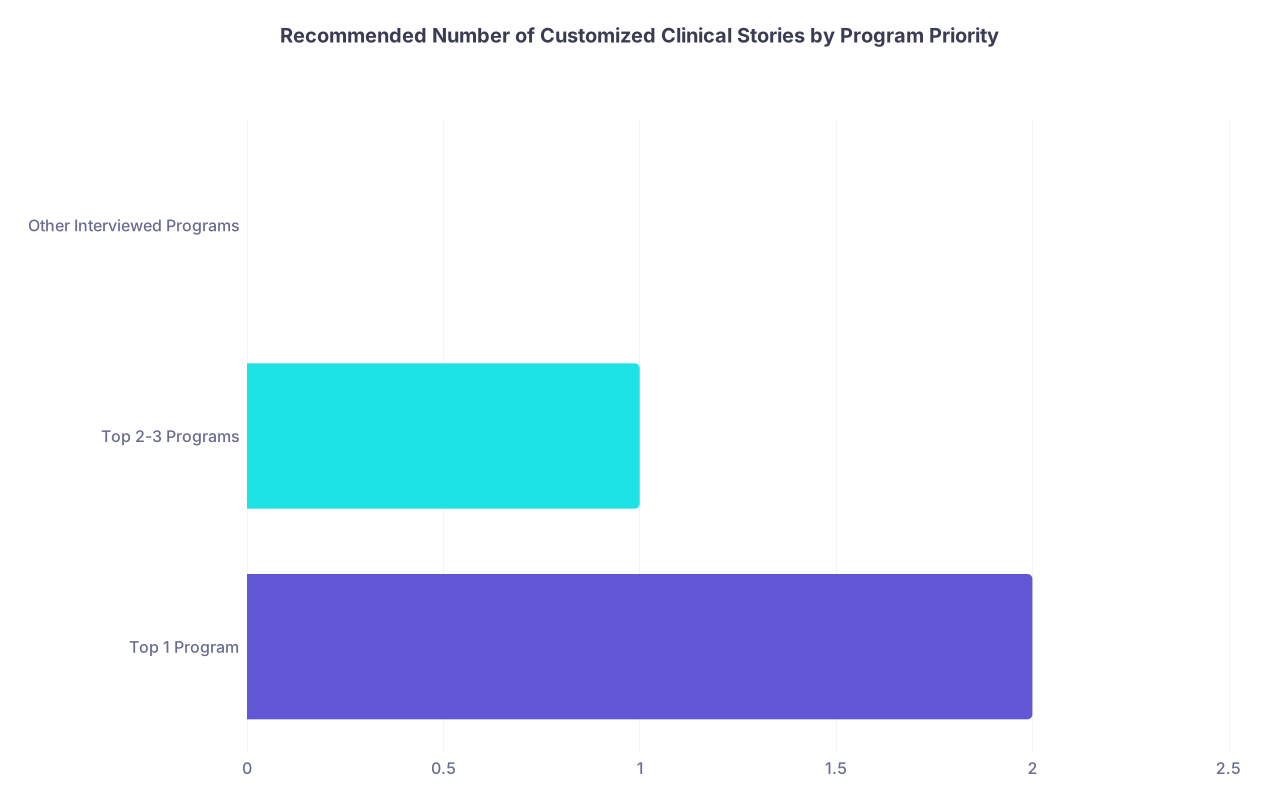
Use this rule:
- Top 1–3 programs where you will send a letter of intent: fully customized story and link.
- Other programs where you send “letters of interest”: you can reuse the framework but still adjust the program linkage sentence.
| Category | Value |
|---|---|
| Top 1 Program | 2 |
| Top 2-3 Programs | 1 |
| Other Interviewed Programs | 0 |
If you are truly sending letters of intent (meaning you are telling them they are your number one), that should be one program. Maybe two in rare, ethically gray zones. But the story has to feel written for them specifically.
FAQs
1. Should I explicitly mention that this story changed my specialty choice, or does that look indecisive?
You can, but only if that choice is already aligned and stable. For example, if you initially thought about cardiology but a palliative case pushed you toward heme/onc and you are now applying in IM with an eye to oncology, that is coherent. Do not use the story to narrate indecision (“I was torn between EM, IM, and anesthesia until…”). Use it to show depth of commitment, not vacillation.
2. What if my best story is from a different specialty than the one I am applying to?
That is fine if the core of the story is about how you think and what you value, not about doing specialty‑specific procedures. A trauma surgery case can absolutely justify EM or IM if the emphasis is on resuscitation, team communication, or systems issues. You just have to connect the lesson clearly to the specialty and the program.
3. Can I reuse a story that I mentioned briefly in my personal statement?
You can expand on a story you only mentioned in a sentence or two, as long as you bring a new angle that is tailored to the program. Do not copy whole chunks of narrative. PDs may not compare side by side, but repetition signals laziness. Treat the letter as version 2.0 of your thinking about that case, not a rerun.
4. How emotional is too emotional in a clinical story?
If the dominant impression is “this person is overwhelmed,” you went too far. You can absolutely describe being moved, frustrated, or shaken. But you must pivot quickly to “here is how I processed that and changed my behavior or plans.” The emotional arc should resolve into professional growth and a logical reason you fit this program. Tears with no action read as catharsis, not competence.
Key takeaways:
- One sharp, well‑chosen clinical story in your letter of intent can make you memorable and credible—if it proves your fit with that specific program.
- Keep the story short, reflective, and explicitly tied to future goals and the program’s strengths, especially when talking about the “future of medicine.”
- Avoid drama, vagueness, and generic “passion” language; show how you think and how you plan to build on that patient encounter during residency at their institution.