
It’s 11:42 p.m. You’ve finally finished your letter of intent to your top program. You’ve rewritten the second paragraph five times, checked the program director’s name three times, and now you’re staring at your screen with one annoying question:
Do you paste this into the email body? Or attach it as a PDF like some formal mini-personal-statement?
Let’s answer that straight and clean.
The short answer: Put the LOI in the email body. Use PDF only in special cases.
If you remember nothing else from this: for 90%+ of situations, send your letter of intent as the text of the email, not as a PDF or Word attachment.
Here’s why:
- Program leadership and coordinators read email on the fly (phone, iPad, desktop).
- Attachments are one more click, and yes, people are that busy.
- Some institutions are weird about external attachments, scanning, and spam filters.
- LOIs are informal-ish advocacy, not legal documents.
PDF can still be useful, but it’s optional and situational, not the default.
Let’s break it down properly.
What programs actually do with your LOI
Most residents and faculty don’t see this side. Program directors and coordinators do one of a few things when your LOI comes in:
- Read the email on their phone between cases, sign-outs, or clinic.
- Forward the email to the selection committee or a chief resident.
- Copy a key line (e.g., “I will rank you #1”) into their notes in ERAS or whatever system they use.
- Occasionally upload or paste parts of your message into your application file.
Notice the pattern? They work with the text, not the file.
They’re not building a beauty archive of your typography. They want:
- Clear subject line.
- Concise message in the body.
- Easy to skim on a phone.
That alone makes email-body LOIs the obvious default.
Email body vs PDF: when each format makes sense
Here’s the practical breakdown you actually need.
| Scenario | Best Format |
|---|---|
| Standard LOI to residency PD | Email body only |
| LOI to multiple faculty | Email body only |
| Extremely formal institution or country | Email body + optional PDF |
| Follow-up after second look with detailed recap | Email body |
| Uploading to portal that asks for ‘letter’ |
Use email body by default
Paste your LOI directly into the email body when:
- You’re writing to a program director, APD, or coordinator.
- You’re sending a “you’re my #1” or “very highly ranked” LOI.
- You’re sending updates + interest (new publication, AOA, etc.).
Pros of email body:
- Instant readability on mobile.
- Easier forwarding by faculty.
- No risk of attachment blocks or virus filters.
- Looks normal — this is how 99% of PD communication happens now.
The fear most people have is: “Does email look less professional than a PDF?”
Answer: no. Not in 2026. The content and clarity matter far more than whether it’s a ‘letterhead’ PDF.
When a PDF attachment is actually useful
PDF makes sense in two real scenarios:
- You’re uploading to a portal that explicitly asks for a “letter document” (e.g., some fellowships, non-ERAS systems, or internal hospital portals).
- An institution/country with very formal norms (common in certain international contexts) where everything is expected as a formal signed letter.
In those situations:
- Keep the email itself short, and:
- Attach the PDF as the “official” letter.
Example email structure there:
Subject: Letter of Intent – [Your Name], [Specialty] Applicant
Dear Dr [Last Name],
Thank you again for the opportunity to interview for your [Specialty] residency program. I’ve attached a brief letter expressing my strong interest in your program.
Best regards,
[Your Name]
AAMC ID: [xxxxxxx]
Then the PDF carries the full, formatted text. But again—this is the minority use case.
What about sending both: email text + PDF?
If you’re tempted to play it “extra safe” by doing both, here’s the honest answer:
- It’s not harmful if you do it right.
- It’s usually unnecessary for U.S. residency programs.
- If you send both, the email body is what will actually be read.
A reasonable compromise if you’re anxious and want the PDF “for the record”:
- Put the full LOI text in the email body.
- Attach a short, matching PDF with the same text and a signature.
- Add one line in the email: “I’ve attached a PDF copy of this letter for your files.”
That’s the key phrase: “for your files.” You’re signaling that the real communication is the email; the PDF is optional.
Content + structure matter more than format
People obsess over format as a safe procrastination habit. The PD does not care if it’s a PDF if the content is bad or bloated.
Here’s how to structure an email-body LOI that looks professional and gets read.
Subject line
Make it boring and clear. Boring is good.
Examples:
- “Letter of Intent – [Your Full Name], [Specialty] Applicant”
- “[Your Name] – Letter of Intent for [Institution] [Specialty] Residency”
- “Strong Interest in [Program Name] – [Your Name], AAMC [ID]”
Greeting
Use:
- “Dear Dr [Last Name],”
- If unclear or writing to a shared address: “Dear Dr [Last Name] and Selection Committee,” or “Dear Program Leadership Team,”
Skip “To whom it may concern.” It reads like you didn’t pay attention.
Body (3–5 short paragraphs max)
You’re not rewriting your personal statement. You’re answering three main questions:
- Are we your first choice / very top choice?
- Why us (specifically)?
- Anything new since the interview?
Simple skeleton:
Opening + position
- One sentence thank you.
- One clear sentence with your level of interest (“I will rank [Program] #1” or “I intend to rank [Program] very highly.”)
Specific program fit (2–3 tailored sentences)
- 1–2 things from interview day that mattered.
- Something concrete (e.g., “4+1 schedule,” “ICU experience as a PGY-1,” “emphasis on underserved populations”).
Updates (if relevant)
- New publication, award, significant rotation, Step 2 score, leadership role.
- Bullet points are fine here even in an email.
Closing
- One sentence reinforcing enthusiasm.
- Standard sign-off.
You keep it tight so it fits on one phone screen or close.
Signature block
You want a clean signature that gives them everything they need without a scavenger hunt.
Include:
- Full name
- Medical school
- Degree & anticipated grad year
- AAMC ID
- Phone number
Nothing fancy. Just functional.
Common fears about email vs PDF (and what’s actually true)
Let’s run through the usual anxiety list.
“Email looks less professional than a PDF.”
False.
What looks unprofessional is:
- Typos.
- Generic content you obviously pasted to five programs.
- Overly emotional language (“I’m begging you, this is my dream.” Please don’t.)
- Huge blocks of unbroken text.
A clean, well-written email beats a poorly written PDF 10 out of 10 times.
“Won’t a PDF feel more ‘official’ and serious?”
For a contract? Yes.
For a post-interview LOI? Not really.
Programs don’t treat LOIs as binding contracts. They treat them as data points about your genuine interest. That can be expressed perfectly in an email.
“Will coordinators or PDs not open attachments?”
Some will. Some won’t. Some are on hospital networks that make attachments a pain. Some read email almost entirely on their phones and don’t bother.
Putting your LOI in the body makes it frictionless for everyone. That’s what you want.
Formatting tips if you use a PDF
If you’re in one of those situations where PDF does matter (portal upload, very formal culture), then make it look like a real letter.
Basic rules:
- Use a normal, readable font (Times New Roman, Calibri, Arial, 11–12 pt).
- Include your contact info at the top like a standard letter.
- Date, then PD name, title, program, institution.
- Single page. If you go past one page, you’ve already lost.
- Add a simple typed signature block. A scanned signature is optional, not required.
But again: PDF is the exception, not your go-to.
A simple decision flow you can follow
Here’s the logic in one diagram you could run half-asleep:

| Step | Description |
|---|---|
| Step 1 | Need to send LOI |
| Step 2 | Use PDF for portal upload |
| Step 3 | Put LOI in email body |
| Step 4 | Email body + optional PDF |
| Step 5 | Sending by email? |
| Step 6 | US residency or similar? |
If you’re just emailing a residency PD in the US: E. Every time.
How PDs actually read LOIs (and what that means for you)
Programs are flooded. I’ve seen PD inboxes after interview season. It’s chaos:
- “Thank you” emails
- Genuine LOIs
- Vague “I really like your program” notes
- Last-minute update bombs
Most PDs and coordinators glance at:
- Who you are (name, school, maybe Step 2 if they remember).
- Whether you’re explicitly saying “rank #1” or “very highly.”
- One or two reasons that sound specific enough to be real.
Then they either:
- Make a quick mental note.
- Add a comment in their system.
- Forward your email to someone.
No one is opening a PDF, printing it, and framing it. Optimize for quick reading and quick action. That means: email text.
Quick visual: how PDs are reading your LOIs
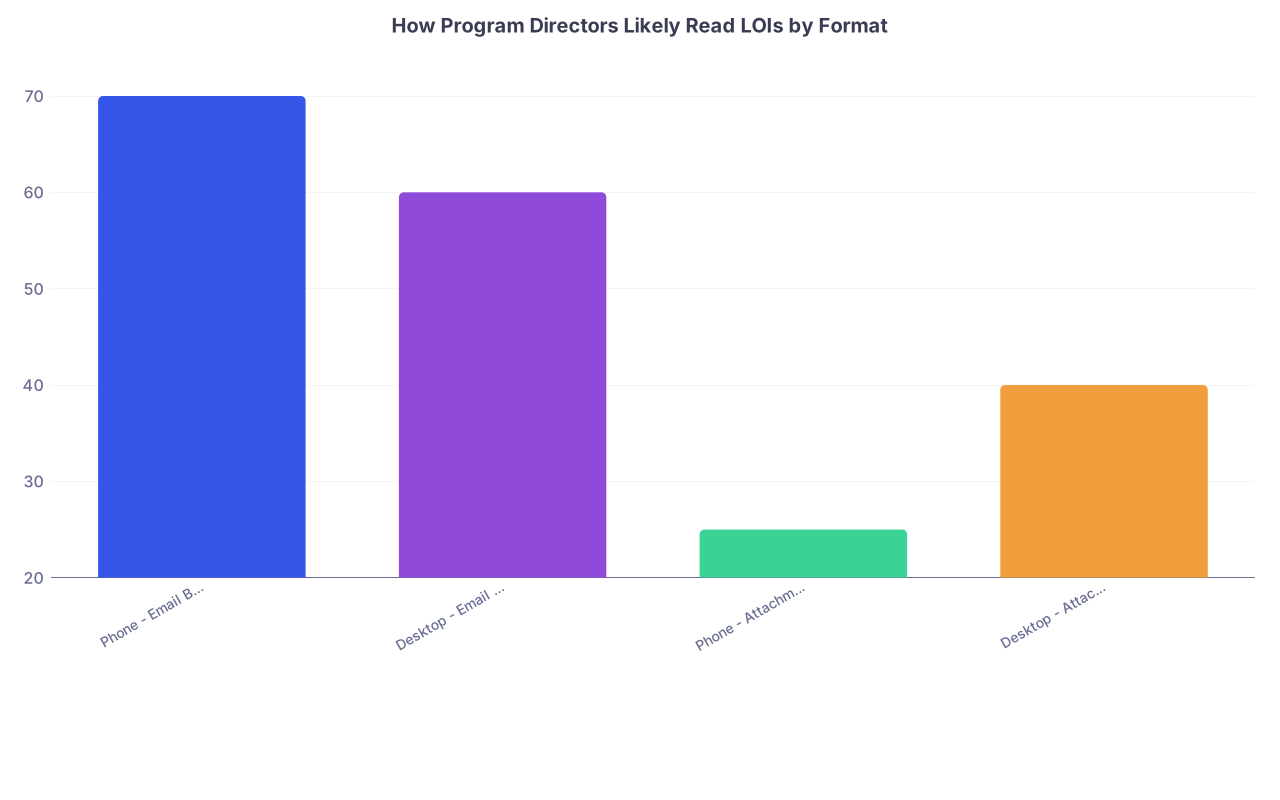
| Category | Value |
|---|---|
| Phone - Email Body | 70 |
| Desktop - Email Body | 60 |
| Phone - Attachment | 25 |
| Desktop - Attachment | 40 |
The exact numbers aren’t the point; the pattern is. Email-body text works everywhere. Attachments don’t.
Common mistakes with LOI format and delivery
I see the same few errors over and over:
Sending only a blank email with “see attached” and a PDF.
Looks robotic. Adds friction. And if the attachment doesn’t open on mobile? Useless.Over-formal subject like “Formal Letter of Intent – Confidential.”
You’re not negotiating a merger. Keep it clear and normal.Weird file types.
Don’t send .pages, .docm, or anything outside PDF/Word. If you must attach, PDF is safest.Multiple attachments with versions.
“LOI_Final.pdf”, “LOI_final2.pdf” — you’re laughing, but I’ve seen it. Keep it clean: “Lastname_LOI_Program.pdf”.Mass-blast LOIs with visible generic content.
Same paragraph sent to 15 programs with “[PROGRAM]” bracket missed in line 3. Dead giveaway.
Example: Strong, simple email-body LOI
Here’s what a clean email-body LOI looks like:
Subject: Letter of Intent – Sarah Lee, Internal Medicine Applicant
Dear Dr Martinez,
Thank you again for the opportunity to interview at the University Hospital Internal Medicine Residency. I’m writing to let you know that I will be ranking your program as my first choice.
My day at University Hospital confirmed that your program is the best fit for my goal of becoming an academic hospitalist working with underserved populations. I especially appreciated the chance to speak with Dr Patel about the hospital medicine fellowship pathway, and I was impressed by the 4+1 scheduling model that protects continuity clinic time.
Since our interview, I’ve had a manuscript accepted for publication in the Journal of Hospital Medicine as first author, focusing on readmission reduction strategies. I’ve also been selected as a chief for my sub-intern cohort, helping coordinate peer teaching sessions for MS3s.
I would be thrilled to train at University Hospital and contribute to your program’s commitment to patient-centered care and resident education. Thank you again for your time and consideration.
Best regards,
Sarah Lee, MS4
State University College of Medicine
AAMC ID: 12345678
(555) 123-4567
[email protected]
No PDF needed. This is exactly the kind of message a PD can read on their phone walking between meetings.
FAQ: Email vs PDF for LOIs
1. Should I ever send a LOI as a Word document instead of PDF?
No. If you’re using an attachment, use PDF. Word files can have formatting issues, track changes remnants, and macro warnings. PDF is clean, stable, and less annoying.
2. Will programs judge me negatively for using email instead of an attached ‘formal letter’?
No. They care what you say, not whether it’s inside a box on your fake letterhead. A well-written, honest email is completely standard and accepted.
3. Is it okay to copy the text of my PDF LOI into the email body as well?
Yes, and if you’re attaching a PDF, you should copy the text into the email body. The email text is what will actually get read; the PDF is extra.
4. Do I need a handwritten or scanned signature on a PDF LOI?
Not for residency or most fellowships. A typed signature block is enough. This is not a legal contract; it’s a communication of intent.
5. How long should my LOI be if it’s in the email body?
Aim for 250–400 words. Short enough to be digestible on one phone screen, long enough to clearly state: your interest level, why this program, and any key updates.
6. Can I send one generic PDF LOI to multiple programs to save time?
You can, but it’s a bad idea. Programs can smell generic content a mile away. If you’re going to send a LOI at all—email or PDF—it needs to be tailored to that program.
7. If I already sent a thank-you email, is it weird to send a later LOI by email too?
Not at all. That’s normal. Just keep the LOI focused on your ranking intent and any updates. You don’t need to rehash every compliment from your thank-you message.
Key takeaways:
- For residency and most fellowships, send your LOI in the email body, not as a PDF.
- Use PDF only when a portal or very formal context specifically calls for a document.
- Focus on clear, honest content and easy readability—format is secondary to what you actually say.