
Most letter of intent subject lines are too vague, too long, or too desperate. You can do better in 10 words or less.
You’re not trying to “trick” someone into opening your email. You’re trying to make it brutally obvious: who you are, what you want, and that this is worth 10 seconds of their time.
Let me give you the short answer first, then we’ll unpack variations.
The best all‑purpose subject line for a letter of intent email is:
“Letter of Intent – [Full Name], [Program Name]”
Example:
Letter of Intent – Jane Smith, Internal Medicine Applicant, Mayo Clinic
Clean. Professional. No drama. It tells them exactly what’s inside and makes it easy to find later.
Now let’s get specific.
1. The Core Formula: Subject Line That Actually Works
Your subject line should do three things:
- Flag the email type (Letter of Intent)
- Identify you clearly (name + applicant type)
- Connect you to their institution (school/program name)
Here’s the basic formula:
Letter of Intent – [Your Full Name], [Applicant Type], [School/Program Name]
Examples:
- Letter of Intent – Alex Nguyen, MD Applicant, UCSF School of Medicine
- Letter of Intent – Priya Patel, EM Residency Applicant, University of Michigan
- Letter of Intent – Daniel Ortiz, Waitlisted Applicant, Stanford School of Medicine
If you’re applying to residency, you can optionally add the specialty:
- Letter of Intent – John Park, Psychiatry Applicant, NYU
- Letter of Intent – Sarah Lee, Pediatrics Residency Applicant, CHOP
That’s it. You don’t need “Urgent” or “Time Sensitive” or 17 exclamation points. You’re not a spam bot.
2. Variations for Different Situations
Different phase, slightly different subject. Here’s exactly what to use.
| Scenario | Recommended Subject Line |
|---|---|
| Pre‑interview LOI | Letter of Interest – [Name], [Applicant Type], [School] |
| Post‑interview LOI | Letter of Intent – [Name], [Applicant Type], [School] |
| Waitlist LOI | Letter of Intent – [Name], Waitlisted Applicant, [School] |
| Update + LOI | Update and Letter of Intent – [Name], [School] |
| Rank #1 declaration | Letter of Intent – [Name], Ranking [Program] #1 |
A. Pre‑interview “interest” email
If you haven’t interviewed yet, don’t call it a “Letter of Intent” unless the institution explicitly encourages that. Use “Letter of Interest” instead.
Example:
- Letter of Interest – Maria Gonzalez, MD Applicant, UC Davis
- Letter of Interest – Jacob Kim, EM Residency Applicant, University of Colorado
You’re signalling enthusiasm, not making a binding‑feeling promise.
B. Post‑interview letter of intent (most common)
After the interview, if this is your top choice and you’re committing (ethically) to that language:
- Letter of Intent – Ahmed Ali, MD Applicant, Johns Hopkins
- Letter of Intent – Emily Brown, IM Residency Applicant, Duke
Keep it clean and straightforward. They know what a letter of intent is.
C. Waitlist letter of intent
You want them to know you’re on the waitlist as soon as they see the subject.
- Letter of Intent – Chloe Davis, Waitlisted Applicant, Yale SOM
- Letter of Intent – Michael Chen, Waitlisted MD Applicant, Northwestern
That “Waitlisted” tag helps when they’re sorting 500+ emails in March.
D. Update + LOI combo
If you’re sending an update (new publication, award, grade) at the same time:
- Update and Letter of Intent – Jason Wu, MD Applicant, Vanderbilt
- Academic Update and Letter of Intent – Hannah Ross, Waitlisted Applicant, UCLA
Putting “Update” first highlights there’s new info, not just more feelings.
E. “You are my #1” for residency
NRMP rules allow you to tell programs how you intend to rank them, as long as you don’t ask them to reciprocate. Your subject line can reflect that without sounding unhinged.
- Letter of Intent – Rachel Singh, Ranking [Program Name] #1
- Letter of Intent – Mark Rivera, [Specialty] Applicant, [Program] – Ranking #1
Example:
- Letter of Intent – David Lin, IM Applicant, MGH – Ranking #1
Don’t write “I will absolutely die if I don’t match here” in the subject line. Or anywhere, really.
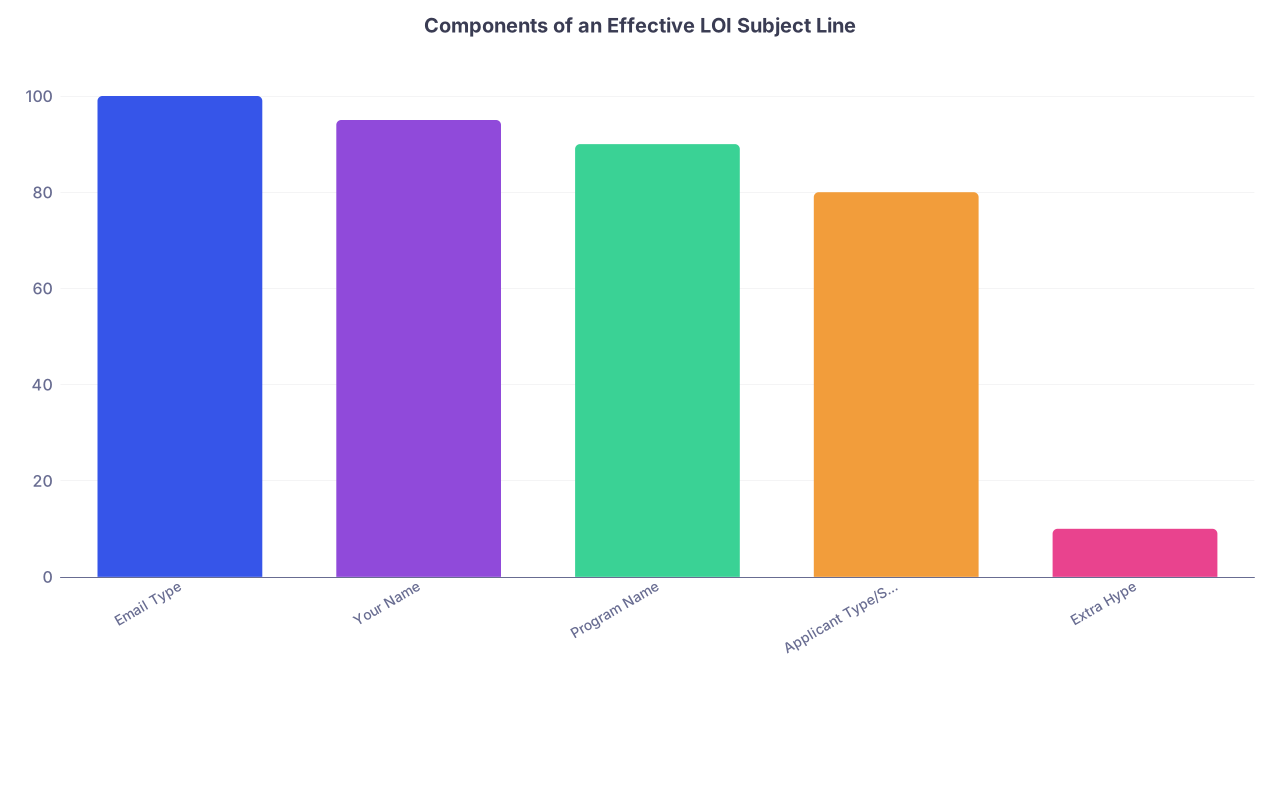
| Category | Value |
|---|---|
| Email Type | 100 |
| Your Name | 95 |
| Program Name | 90 |
| Applicant Type/Status | 80 |
| Extra Hype | 10 |
3. What NOT to Put in Your Subject Line
Here’s where people mess this up. I’ve seen all of these in real inboxes:
- “Please Read – URGENT!!!!”
- “My Letter to You”
- “Thank you for the amazing interview!!!”
- “I will 100% attend if accepted”
- “Follow up #3 – really hoping to hear back”
These share a few problems:
They’re emotional instead of informational.
They look like spam.
They age badly when forwarded around a committee.
Avoid:
Desperation language
No “begging,” “pleading,” “desperate,” “last chance.”Excessive punctuation or all caps
One exclamation mark in the body, fine. In the subject line? No.Clickbait / vagueness
“A quick note” or “Thank you again” tells them nothing and gets lost.Over‑personalizing
Don’t put “for Dr. Smith only” or “private” in the subject. Committees share things. It’s not just “for” one person.
If your subject line sounds like a marketing email, change it.
4. Who Are You Sending This To? (And How That Affects Subject Line)
The subject line doesn’t change much by recipient, but the to field does.
Standard hierarchy:
Medical school admissions:
Send to the general admissions email (e.g., [email protected]). CC your regional dean or interviewer if you’ve had direct contact and it’s appropriate.Residency programs:
Send to the program coordinator’s listed email. CC the program director only if programs commonly allow it or you’ve been invited to communicate directly.Fellowship:
Similar to residency: main program/fellowship coordinator, optional PD CC.
Your subject line should still follow the same pattern:
- Letter of Intent – [Name], [Applicant Type], [School/Program]
If your school/program has an online portal that requires all communication to go through it, then email might be ignored or discouraged. In that case, use their portal message system and use the same subject line convention when you can.

| Step | Description |
|---|---|
| Step 1 | Decide to send LOI |
| Step 2 | Use Letter of Interest |
| Step 3 | Use Letter of Intent |
| Step 4 | Use Letter of Intent with Waitlisted |
| Step 5 | Email admissions or coordinator |
| Step 6 | Use clear subject line |
| Step 7 | Interview completed? |
| Step 8 | Top choice or waitlist? |
5. How Long Should the Subject Line Be?
Shorter than you think.
Aim for 50 characters or fewer so it doesn’t get cut off on mobile. But don’t mutilate clarity just to save 3 characters.
Worst case, prioritize in this order:
- Email type: “Letter of Intent” or “Letter of Interest”
- Your full name
- Program or school name
- Applicant type or status (MD, DO, IM applicant, waitlisted, etc.)
If you have to trim, cut adjectives and extra descriptors, not those four components.
Bad (too long, cluttered):
“Letter of Intent and Update – Johnathan Michael Anderson, Extremely Grateful Waitlisted MD Applicant, University of Washington School of Medicine”
Better:
“Letter of Intent – John Anderson, Waitlisted MD Applicant, UW”
You’re not writing poetry. You’re writing a locator tag for a busy inbox.
6. Timing and Frequency: Subject Line vs. Being Annoying
Subject line won’t save you from over‑emailing. Here’s the blunt reality:
- Medical school: 1 substantive LOI/update every 4–6 weeks is reasonable.
- Residency: 1 clear LOI to your #1 program is enough. Maybe one polite update if something big changes (publication, AOA, new Step 2 score).
If you’re sending your third “Letter of Intent” email to the same place with a slightly tweaked subject line, the subject isn’t the problem. The strategy is.
If you must send a second message to the same school/program, adjust the subject:
First:
- Letter of Intent – [Name], [Applicant Type], [School]
Second (weeks later, major update):
- Update and Letter of Intent – [Name], [Applicant Type], [School]
Don’t send “Second Letter of Intent” or “Final Letter of Intent.” It makes you sound like a movie sequel.
7. Matching Subject Line to Email Content (Don’t Mislabel)
If your email is actually just an update and you’re not clearly stating they’re your first choice, don’t call it a letter of intent. That’s how trust gets torched.
Use:
- “Update – [Name], [Applicant Type], [School]”
- “Application Update – [Name], [Program]”
If you say “Letter of Intent” in the subject, your body better include something like:
- “I would attend [School/Program] if accepted.” (for med school)
- “I will be ranking [Program] as my first choice.” (for residency)
No hedging. No “strongly considering.” Then it’s just a feelings email, not a letter of intent.
8. Quick Subject Line Swipes You Can Copy
Pick one that matches your situation and plug in your info.
Medical school – post‑interview, top choice:
- Letter of Intent – [Name], MD Applicant, [School]
- Letter of Intent – [Name], [School of Medicine]
Medical school – waitlisted:
- Letter of Intent – [Name], Waitlisted MD Applicant, [School]
- Letter of Intent – [Name], Waitlist, [School of Medicine]
Residency – rank #1:
- Letter of Intent – [Name], [Specialty] Applicant, [Program] – Ranking #1
- Letter of Intent – [Name], Ranking [Program] #1
Residency – strong interest but not committing #1 (call it a “letter of interest,” not intent):
Fellowship:
- Letter of Intent – [Name], [Fellowship Type] Applicant, [Program]
- Letter of Interest – [Name], [Fellowship Type], [Institution]

9. The “Future of Medicine” Angle: Will Subject Lines Even Matter?
You’re in a phase of medicine where everything is getting more centralized, more automated, more portal‑based.
A few trends I’m already seeing:
- More schools and programs routing everything through applicant portals instead of email
- Automated systems tagging emails by keywords like “update,” “LOI,” “waitlist”
- Centralized communication teams skimming and summarizing, not directors reading every word
What does that mean for you?
Subject lines become metadata. If your subject clearly says “Letter of Intent – [Name] – [School] – Waitlisted,” it’s easier for a coordinator to tag, forward, or drop it into the right folder. If it just says “Thank you again!” it dies in the noise.
As medicine leans further into AI triage and automated inboxes, clarity and standardization win. Your subject line is part of that. Think like you’re labelling a chart, not writing a poem.
FAQ: Letter of Intent Email Subject Lines
1. Should I always use the phrase “Letter of Intent” in the subject line?
No. Use “Letter of Intent” when you’re clearly stating the school/program is your top choice (or you’d attend if accepted). If you’re just expressing interest or giving an update, use “Letter of Interest” or “Application Update” instead. Don’t oversell—admissions people can tell.
2. Is it okay to mention “Ranking you #1” in a residency subject line?
Yes, that’s acceptable and often helpful. Something like “Letter of Intent – [Name], Ranking [Program] #1” is clear and honest. Just don’t ask them how they will rank you—that crosses a line with NRMP communication rules.
3. Should I personalize the subject line with the specific specialty?
If there’s room, yes. “Letter of Intent – John Doe, Neurology Applicant, [Program]” is better than a generic “Applicant.” It helps in large hospitals with multiple programs. If adding specialty makes it too long, name and program beat specialty.
4. Do I need to reference my AAMC ID or ERAS ID in the subject line?
Generally no, unless the school/program specifically requests it. IDs belong in the body or signature. The subject line’s job is quick recognition, not full identification. If you must add an ID, keep it short and at the end: “Letter of Intent – [Name], [Program] – AAMC [ID].”
5. Can I reuse the same subject line if I send a second email to the same program?
You can, but it’s cleaner to slightly adjust it if the purpose changes. First: “Letter of Intent – [Name], [Program].” Second with news: “Update and Letter of Intent – [Name], [Program].” Don’t send multiple “Letter of Intent” messages with no new substance—that’s just noise.
6. Will a perfect subject line fix a weak application?
No. Subject lines don’t save a poor GPA, low scores, or bad interviews. What they do is prevent a good, strategic letter from getting buried. Think of the subject as good clinical documentation: it won’t cure the patient, but it makes sure the right person actually sees the story.
Bottom line:
Use a clear, boringly professional subject line: “Letter of Intent – [Name], [Program].”
Match the label to your actual content—don’t call it a letter of intent if you’re not truly committing.
Skip the drama. Your subject line’s job is simple: make your email easy to find, easy to understand, and impossible to mistake for spam.