
Most applicants address their letter of intent to the wrong person—and programs notice.
You’re not overthinking this. Who you address your letter of intent to actually matters. It signals whether you understand how residency programs work, whether you did your homework, and whether you treat the process professionally.
Let me walk you through exactly who to address at each kind of program, how to handle weird situations, and when it’s fine to use a generic salutation (and when it’s lazy).
The Core Rule: Address It to the Person Who Controls the Rank List
Here’s the simple hierarchy:
- Program Director (PD) – default and safest choice
- Associate / Assistant Program Director – only if clearly the right contact
- Chair or Department Head – sometimes appropriate for very academic places
- “Residency Selection Committee” – last-resort, when no names/roles are clear
Your north star: address your letter to the person (or entity) most directly responsible for resident selection and the rank list. For 90%+ of programs, that’s the Program Director.
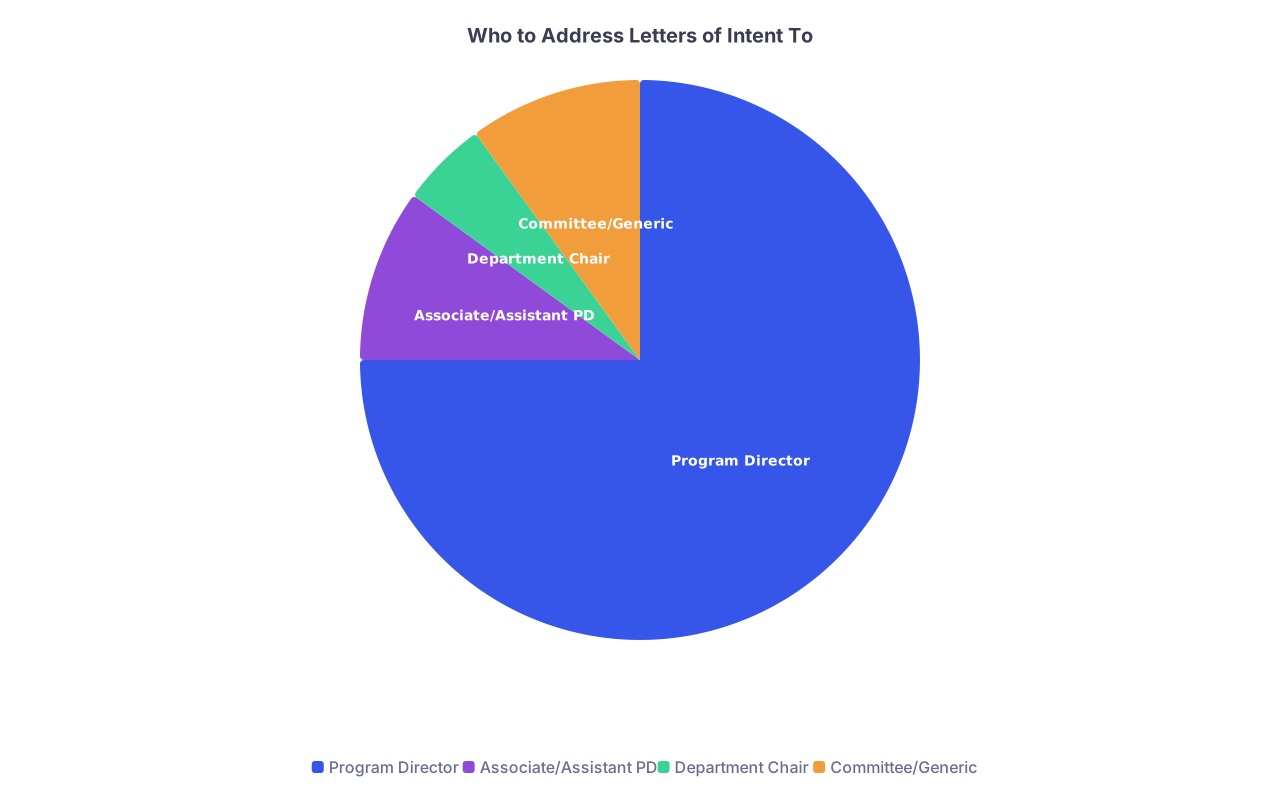
| Category | Value |
|---|---|
| Program Director | 75 |
| Associate/Assistant PD | 10 |
| Department Chair | 5 |
| Committee/Generic | 10 |
Step-by-Step: Who to Address at Each Program Type
1. Standard University or Academic Program
Default: the Program Director. By name.
- Formal title + full name
- Department and program
- Institution
Example:
John Smith, MD
Program Director, Internal Medicine Residency Program
Department of Medicine, University of Michigan
Salutation:
Dear Dr. Smith,
Do not write “Dear Program Director” at a place where the PD’s name is clearly listed. That screams: “I did not bother to spend 30 seconds on your website.”
Where to find the name:
- Program website: “Residency Leadership” or “Program Leadership” page
- FREIDA listing
- Interview emails (often signed by PD or coordinator)
If you cannot confirm whether they are MD vs DO (or their degree mix), “Dr. [Last Name]” is perfectly correct and safe.
2. Community Program with a Clear Program Director
Same rule: Program Director first.
These programs often have smaller teams. PDs may remember applicants who show attention to detail.
Format:
Jane Doe, DO
Program Director, Family Medicine Residency Program
[Hospital Name]
Salutation:
Dear Dr. Doe,
Unless they specifically told you “Call me Sarah,” you still use “Dr. LastName” in a letter of intent. You are not their colleague yet.
3. Programs Where the Chair Clearly Runs the Show
Some very academic or historically old-school departments (especially in surgical subspecialties) still position the Chair as the visible leader of the residency program, with the PD as more day-to-day.
Things I look for that suggest addressing the Chair might be appropriate:
- Website language like: “Residents are selected by the Department of X under the leadership of the Chair…”
- The Chair led your interview day, did a long welcome talk, and explicitly discussed selection
- The PD has “Interim” before their title and everything else centers on the Chair
In those rare cases, you can address your letter to the Chair, if they are clearly the central decision-maker. But you must still reference the residency itself.
Example:
Michael Nguyen, MD
Chair, Department of Surgery
General Surgery Residency Program
[Institution]
Salutation:
Dear Dr. Nguyen,
If you’re unsure whether to address PD or Chair at a very academic program, PD is still safer. The PD will absolutely be involved in ranking you. The Chair might not even read your letter.
4. When You Interviewed Most Closely with an Associate/Assistant PD
Here’s where applicants overthink.
You interviewed mainly with an Associate PD or Site Director. They were your point of contact. You felt connected. Should you address the letter to them?
My rule:
- If the Program Director is clearly listed and active → address to the PD
- You can still mention the APD or Site Director in the body of the letter
For example:
Dear Dr. Patel,
I’m writing to express my strong interest in training at [Program]. I especially appreciated my conversation with Dr. Garcia about the categorical residents’ experience at your county site…
Only address to an Associate/Assistant PD instead of PD if:
- The program website explicitly lists them as “Acting Program Director” or “Interim Program Director”
- Your interview day material or emails describe them as being responsible for “resident selection” or “the rank list”
- The PD role is vacant and APD is clearly serving as primary leader
Otherwise, PD stays at the top of the food chain for your salutation.
5. When There Is No Clearly Listed PD (or They Just Left)
This happens. Especially this year, with turnover.
Signs of trouble:
- Website leadership page is outdated by several years
- Your interview email says “Interim leadership” or mentions someone just stepped down
- Recent name change in PD that doesn’t match the website
In this situation, use one of these:
If there’s an Interim PD named:
Sarah Lee, MD
Interim Program Director, Pediatrics Residency Program
[Institution]Dear Dr. Lee,
If there is no PD listed anywhere, and the contact is a generic office:
Residency Selection Committee
[Program Name] Residency Program
Department of [X], [Institution]Dear Members of the Residency Selection Committee,
That’s your safety net. It shows respect without guessing wrong.
6. Should You Ever Address It to the Program Coordinator?
No.
Coordinators are absolutely central to residency life, and many understand applicants better than faculty do. But they do not control the rank list.
You may email a coordinator and say, “Could you please forward this letter of intent to Dr. [PD] and the selection committee?” That’s fine. But the letter itself should not be addressed to the coordinator.
Bad:
Dear Ms. Johnson,
Good:
John Smith, MD
Program Director, Emergency Medicine Residency Program
[Institution]Dear Dr. Smith,
[Body of letter]
Sincerely,
[Your Name]— sent as an attachment or inline text via email to Ms. Johnson with a brief note asking her to forward.
How to Handle Specific, Messy Real-World Scenarios
Let’s talk through the edge cases that actually trip people up.

Scenario 1: Website Lists “Co-Program Directors”
This is common in large academic programs, joint-campus programs, and some EM, IM, and Peds programs.
Best move: pick one primary PD to address, ideally:
- Whoever is listed first, or
- Whoever matched the campus or track where you interviewed
Example:
Emily Carter, MD and Daniel Ross, MD
Co-Program Directors, Emergency Medicine Residency Program
[Institution]
Salutation:
Dear Dr. Carter and Dr. Ross,
Or, if it feels forced, you can address to both in the header and open with “Dear Dr. Carter and Dr. Ross,” or just to the first one. Both are acceptable. The key is you’re not ignoring the co-PD structure.
Scenario 2: You Interviewed at a Separate Track (County, VA, Research Track)
In this case, look closely:
- Many programs have a single PD and then track directors/site directors
- Some have fully separate PDs for primary vs county vs VA vs community tracks
If your interview material calls the person “Track Director” or “Site Director,” but the main PD is still obvious, address your letter to the main PD, but reference the track clearly in your content.
Example:
Dear Dr. Williams,
I’m writing to express that [Program] remains my top choice for residency, specifically the County Hospital track…
If the track explicitly has its own Program Director (e.g., “VA Internal Medicine Program Director”), and you applied to that track, you address the letter to that track’s PD.
Scenario 3: You’re Writing a Letter of Intent to an Advanced Program (e.g., Derm, Rad Onc, Anesthesia)
For advanced specialties, you still address to the PD of the specialty residency. Your TY or prelim year has its own letter logic.
For example, for a letter to a Dermatology PD:
Dear Dr. Chen,
No need to mention your internship PD in this letter. That’s a separate issue.
Scenario 4: You Don’t Remember Who You Interviewed With
This happens more than people admit. After 12 interviews, names blur.
Here’s what to do:
- Check your calendar and old Zoom links / confirmation emails
- Re-open any attached schedules from interview invites
- Look for “Interview schedule” PDFs or handouts from the day
If you still can’t reconstruct it, don’t fake familiarity. Just address the PD properly and keep the letter formal and straightforward.
Formatting: How the Header and Salutation Should Actually Look
Here’s the clean format you should copy:
At the top of the letter (not just in the email body):
[Date]
[Full Name], [Degree(s)]
Program Director, [Specialty] Residency Program
Department of [X]
[Institution Name]
[City, State]Dear Dr. [Last Name],
Then your letter.
| Situation | Best Addressee |
|---|---|
| Standard academic IM program | Program Director by full name |
| Co-program directors listed | Both names, or first-listed PD |
| No PD visible, generic contact | Residency Selection Committee |
| Track within single main program | Main PD by name |
| Separate PD for your track | Specific track PD by name |
Things that look sloppy or lazy:
- “To Whom It May Concern”
- “Dear Program Director” when the PD name is public
- Addressing the hospital only: “Dear [Hospital Name] Residency”
- Misspelling the PD’s name or using the wrong institution name (this kills you more than you think)
Email vs PDF: Do I Change the Addressee?
No. Keep it formal either way.
If you attach a PDF:
- Inside the PDF: full header and salutation to PD
- In the email body: brief note to coordinator or generic email address
Example email body:
Dear Ms. Rivera,
I hope you are doing well. Attached is a letter of intent addressed to Dr. Ahmed and the Internal Medicine Residency Selection Committee, confirming my strong interest in [Program].
Thank you very much for your help in forwarding this to the appropriate parties.
Best regards,
[Your Name], AAMC ID [#######]
If you paste your letter directly in the email instead of attaching:
- Still start with the PD’s header and “Dear Dr. [LastName],”
- Do NOT just start with “Hi” and a paragraph

| Step | Description |
|---|---|
| Step 1 | Find Program on Website |
| Step 2 | Address to PD by Name |
| Step 3 | Address to Interim PD by Name |
| Step 4 | Address to Residency Selection Committee |
| Step 5 | Use Residency Selection Committee as Generic |
| Step 6 | Is PD Name Listed? |
| Step 7 | Is Interim PD Listed? |
| Step 8 | Is Selection Committee Mentioned? |
Common Mistakes That Make You Look Unprofessional
I’ve seen all of these. They’re avoidable:
- Copy-paste disasters: wrong program name, wrong specialty, or wrong institution in the header
- Referring to the wrong city or affiliated hospital (e.g., mixing up campuses)
- Using casual greetings: “Hi Dr. Smith,” “Hello John,” etc.
- Addressing it to “Admissions Committee” (this is not med school anymore)
- Writing “Dear Residency Program Director and Committee” with no name when the PD is front-and-center on their website
If you’re applying to competitive specialties, tiny errors separate people quickly. You cannot control your Step score at this point, but you can absolutely control whether you look careful and respectful.

Quick Checklist Before You Send Any Letter of Intent
Run through this, literally:
- Did I address it to the Program Director by correct name and title (or clearly correct alternative)?
- Did I spell their name and institution correctly?
- Did I avoid addressing it to the coordinator, “To Whom It May Concern,” or “Dear Program Director” when a name exists?
- Does the department/specialty in the header match the actual program?
- If there are co-PDs, did I make a deliberate, reasonable choice (not random)?
- Am I comfortable with this being read aloud at a rank meeting with my name on it?
If yes across the board, you’re fine.
FAQ: Addressing Letters of Intent Correctly
1. What if the PD changed after I interviewed and I’m not sure who’s in charge now?
Look for updated news on the program site, check recent emails from the program, and verify FREIDA if you can. If nothing is clear, you can safely use: “Dear Members of the [Specialty] Residency Selection Committee,” in the salutation and list “Residency Selection Committee” in the header. That avoids naming the wrong PD while still sounding polished and appropriate.
2. Is it acceptable to use “Dear Program Director” if I can’t find a name?
Only as an absolute last resort and only after you’ve looked on the website, FREIDA, and your interview emails. Even then, “Dear Members of the Residency Selection Committee” sounds more intentional and less generic. Using “Dear Program Director” when their name is visible is lazy and reflects poorly on you.
3. Should I ever address my letter of intent to more than two people?
No. Once you start listing three-plus names, it looks awkward and confused. If there are multiple co-PDs or major leaders, pick the primary PD (or both co-PDs at most) for the header, and assume they’ll share the content with whoever needs to see it. The function of the salutation is formality, not roll call.
4. I feel closer to the Associate PD I interviewed with than the PD. Can I address the letter to them instead?
Usually, no. The PD is the primary decision-maker and name attached to the rank list. Mention the Associate PD and your conversation in the body of the letter to personalize it. But keep the formal addressee as the Program Director unless the APD is clearly listed as Acting or Interim PD.
5. Do I need to tailor the addressee format for osteopathic vs allopathic programs?
The only thing that changes is the degree line in the header (MD vs DO vs MD, PhD, etc.). Your salutation remains “Dr. [Last Name].” You do not need to call out “osteopathic” in the salutation or change tone. Just ensure degrees and titles match what’s listed on the program’s site.
6. If I’m sending multiple update letters and then a final letter of intent, do I keep addressing them to the PD every time?
Yes. Every formal letter that’s meant for the selection process should still be addressed to the PD (or selection committee where appropriate). Brief scheduling or thank-you emails can go to the coordinator or interviewer directly, but anything that might land in the file used at rank time should look like a proper, PD-addressed letter.
Bottom line:
Address your letter of intent to the Program Director by name whenever humanly possible.
If the PD isn’t clear, use the residency selection committee rather than guessing.
Avoid lazy generic salutations—your attention to this detail is one of the few controllable signals of professionalism you still have.