
Most letters of intent are too long and too vague. Yours should be neither.
You’re not writing a manifesto. You’re writing a precise signal: “I will come here if you take me.” The length and structure should support that message, not bury it.
Here’s the answer you actually need.
Ideal Length: How Long Should a Letter of Intent Be?
For medical school or residency, a strong letter of intent should be:
- Word count: 300–500 words
- Page length: Less than 1 page, single-spaced
- Format: Professional email or PDF attachment (depending on instructions)
If you want a hard line:
Go shorter rather than longer. A clean 350–400 words almost always beats 800+ words of rambling.
Why?
Because the person reading your letter is:
- Skimming between meetings
- Reviewing dozens of files in a row
- Already familiar with your application
They don’t need your life story again. They need clarity:
- Are you explicitly stating this program/school is your top choice?
- Will you actually attend if accepted?
- Do you understand who they are and why you fit?
If your letter doesn’t answer those in under a page, it’s not a length problem. It’s a focus problem.
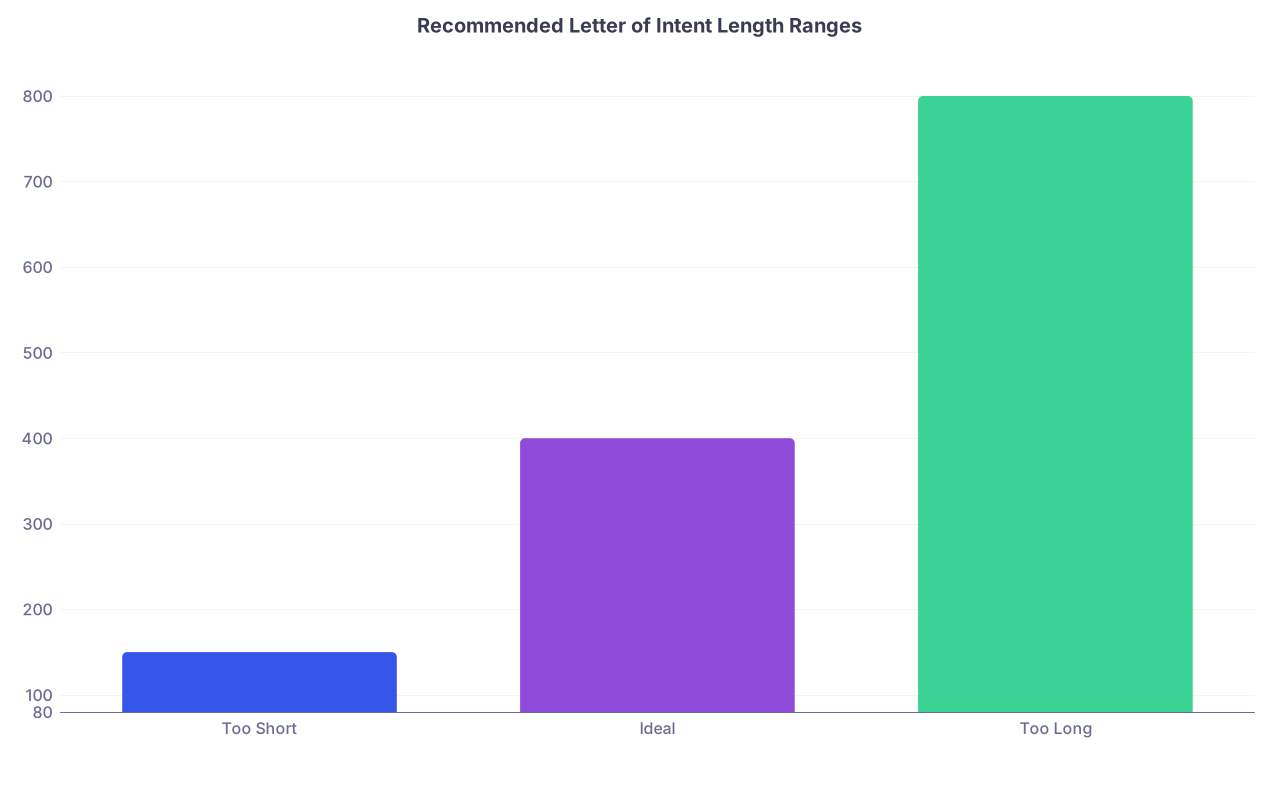
| Category | Value |
|---|---|
| Too Short | 150 |
| Ideal | 400 |
| Too Long | 800 |
Quick ranges:
- Under 200 words: Usually too thin. Feels generic, under-invested.
- 300–500 words: Ideal. Enough space for a real argument without fluff.
- 600–800+ words: Often bloated. Readers start skimming or rolling their eyes.
Core Structure: Paragraph-by-Paragraph Breakdown
You don’t need a “creative” structure. You need a predictable, efficient one that admissions and program leadership can digest in 30–60 seconds.
I recommend a 4–5 paragraph structure:
- Opening: Clear commitment (2–3 sentences)
- Why this program/school (1 short paragraph)
- Why you are a fit (1 short paragraph)
- Update(s) or added value since application (optional paragraph)
- Closing: Restate commitment + professionalism (2–3 sentences)
Let’s break that down.
1. Opening Paragraph (50–80 words)
Job: State your intention and your commitment. Immediately.
Bad openers I see constantly:
- “My name is X and I am currently a fourth-year medical student at Y…”
- “Thank you so much for considering my application to your distinguished program…”
They already know who you are. Your name and school are in the header or signature.
Stronger opener:
- One sentence of context (who you are / program)
- One sentence of unequivocal intent
Example structure:
- “I’m writing to express my clear intent to attend [Program/School Name] if offered a position.”
- “After interviewing with your program and reflecting on my goals, I am confident that [Program] is my top choice, and I will rank/accept it first.”
You want them to finish paragraph one and think: “Got it. This person is committing.”
2. “Why This Program” Paragraph (75–125 words)
This is where most people write fluff. “Your excellent clinical training, research opportunities, and supportive environment…” could describe literally 200+ programs.
You need specifics. 3–4 targeted points is enough:
- A particular track (e.g., primary care, physician-scientist, global health)
- Named faculty you’ve actually researched or met
- Unique curriculum/structure (e.g., longitudinal clinics, early subspecialty exposure)
- Culture or values tied to something real you saw on interview day
This paragraph answers: “Do you actually understand who we are?”
If I can replace the program name with any other and it still makes sense, you haven’t done your job.

3. “Why You Fit Here” Paragraph (75–125 words)
Now flip it: tie yourself to what you just praised.
Do not restate your entire CV. They already saw your ERAS or AMCAS.
Pick 2–3 aligned strengths:
- If you praised their strong underserved care: mention your FQHC work, free clinic leadership, or community outreach.
- If you highlighted their research: reference your specific project type, not generic “I love research.”
- If you liked their team-based culture: point to tangible examples of collaboration or leadership, not vague “I am a team player.”
Think of this as: “Here is why I won’t just be happy here; I will contribute here.”
4. Updates / New Information Paragraph (optional, 50–100 words)
Use this only if you have actual updates since the application:
- New publication or presentation
- Updated leadership role or project outcome
- Step/board score release (for residency)
- New award, scholarship, or honor
Do not pad this with minor things:
- “I continue to enjoy my rotations” – empty.
- “I am still committed to medicine” – I would hope so.
A useful structure:
- One sentence introducing that you have updates
- 1–3 short, specific items in one compact paragraph
If you truly have nothing new, skip this. A clean 3-paragraph letter is better than forced updates.
5. Closing Paragraph (50–80 words)
This is where you:
- Restate your commitment clearly
- Thank them once, briefly
- Signal professionalism and openness to follow-up
Examples of what this sounds like:
- “To be clear, if I am fortunate enough to receive an offer from [Program], I will accept it.”
- “I’m grateful for your continued consideration and would be honored to train/join your incoming class.”
Avoid over-apologizing, begging, or trying to guilt them. Confident, respectful, firm.
Formatting and Delivery: Don’t Sabotage Yourself
The content matters most, but presentation still sends a signal.
Here’s what I’ve seen work best repeatedly:
- Format: Professional email body is usually fine. Some applicants attach a PDF on letterhead as well, but that’s optional unless the school/program specifies.
- Length on screen: The entire letter should be viewable with one or two scrolls on a laptop screen. If they’re scrolling three times, it’s too long.
- Greeting: “Dear Dr. [PD/Dean Last Name]” or “Dear [Program Director/Dean]” if you truly cannot find a name. Avoid “To Whom It May Concern” unless there’s no alternative.
| Length (words) | Approx. Page Length | Typical Reaction |
|---|---|---|
| 150–250 | ~1/3–1/2 page | Clear but a bit thin; fine if sharp |
| 300–400 | ~1 page or less | Ideal: substantial but quick to read |
| 500–600 | 1+ page | Starting to feel long; skimmed |
| 700–900 | 1.5–2 pages | Often seen as excessive; risks annoyance |
Keep formatting clean:
- Standard font (12pt Times New Roman, Arial, Calibri if attaching a letter)
- No colored text, no creative formatting, no inspirational quotes in the signature
- Professional email address
- Clear subject line: “Letter of Intent – [Full Name] – [Program Name]”
What Absolutely Must Be in the Letter (and What Shouldn’t)
If you remember nothing else, remember this section.
Non‑negotiable elements
Every strong letter of intent, regardless of word count, includes:
Explicit top-choice language
Not “I am very interested.”
Use one of the following if it’s true:- “You are my top choice.”
- “I will attend if accepted.”
- “I will rank your program first.”
Specific, credible reasons
No copy-paste lists. Show you know them.Professional tone
Respectful, concise, confident. Not casual, not desperate.Consistency with what you told others
You can only have one true letter of intent. Programs talk. Deans talk. You do not want to be the subject of the “we both got letters saying we’re the top choice” phone call.
Things to avoid
- Rewriting your personal statement. They already read that.
- Emotional pressure. “Attending your program would mean everything to me and my family” is not a strategy.
- Ultimatums or complaints. Don’t reference other interviews, offers, or waitlists.
- Lengthy backstory. No one needs a deep childhood narrative in a letter of intent.

How Your Word Count Should Break Down
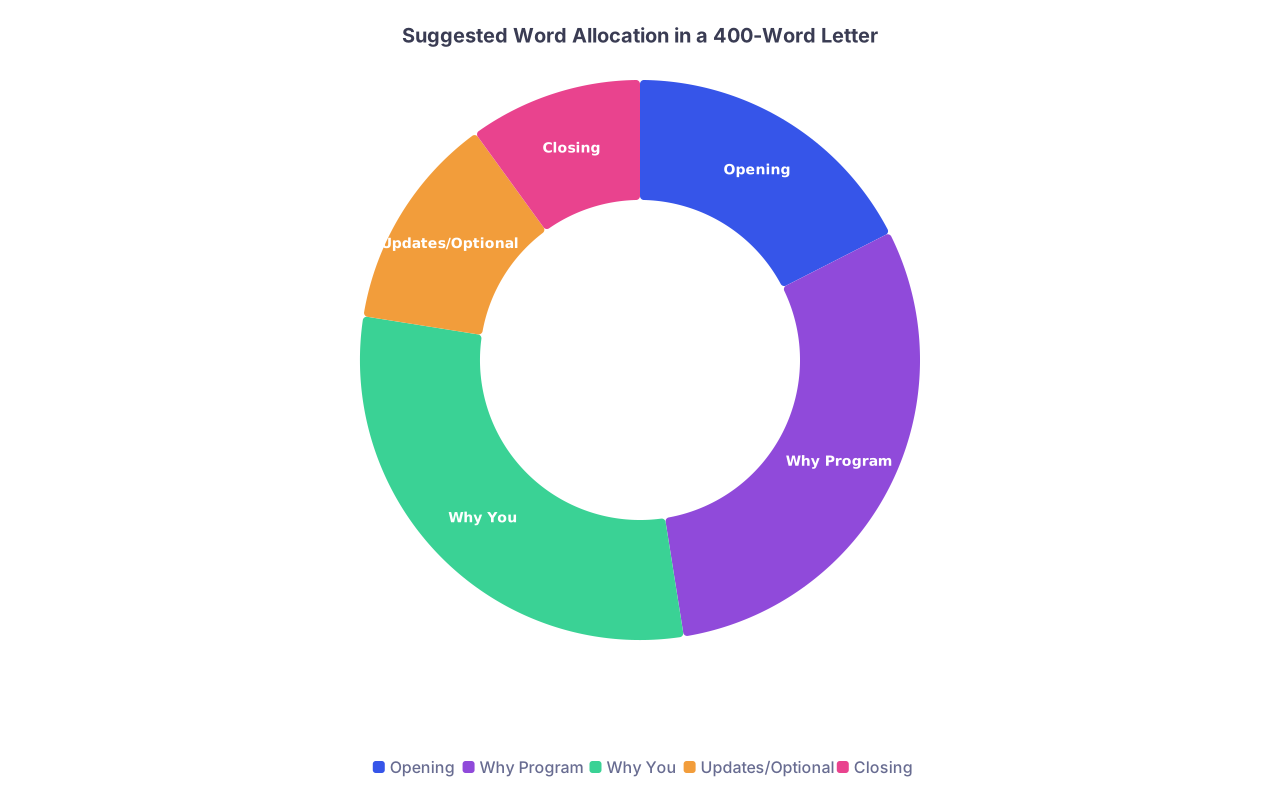
If you’re the type who likes numbers, here’s a solid allocation for a 400-word letter of intent:
- Opening: 60–70 words
- Why this program: 100–120 words
- Why you fit: 100–120 words
- Updates (optional): 50–70 words
- Closing: 40–60 words
Roughly:
- 15–20%: Clear commitment
- 45–55%: Specific fit (program → you, you → program)
- 15–20%: Updates
- 15–20%: Polished close
| Category | Value |
|---|---|
| Opening | 70 |
| Why Program | 120 |
| Why You | 120 |
| Updates/Optional | 50 |
| Closing | 40 |
If you’re closer to 300 words, you basically compress the “why program” and “why you” into tight, combined paragraphs and probably skip the update section unless you have something major.
When Going Longer Is Justified (Rarely)
There are a few edge cases where pushing toward 500–550 words can be acceptable:
- You have significant, new updates that materially change your profile (major publication, new degree, national award).
- You’re addressing a very specific concern that the program has already raised with you and you can do it concisely.
- You’re dual-applying for a very niche track or combined program where alignment really does require extra explanation.
Even then, you still aim for:
- Clear commitment early
- One-page max
- No repetition
If you feel “[But everything I wrote feels essential],” it’s usually a sign you haven’t edited hard enough. Every strong letter I’ve reviewed went through at least one brutal cut.

| Step | Description |
|---|---|
| Step 1 | Draft 700 words |
| Step 2 | Identify core message |
| Step 3 | Cut repetition and fluff |
| Step 4 | Check word count 300-500 |
| Step 5 | Verify explicit commitment |
| Step 6 | Final proofread |
FAQs
1. Is 250 words too short for a letter of intent?
Usually yes, 250 words is on the short side. It can work if every sentence is sharp and you have no major updates, but most people need 300–400 words to clearly state commitment, give specific reasons, and show fit. If you’re under 250, you’re probably leaving persuasive material on the table.
2. Is a 1.5–2 page letter of intent a problem?
Yes. That’s too long. Readers will skim or get annoyed. You are not writing a new personal statement; you’re delivering a targeted signal. Keep it under one page, ideally in the 300–500 word zone. If you’re at two pages, you almost definitely have repetition, generic fluff, or unnecessary backstory.
3. Can I send more than one letter of intent?
You can send interest or update letters to multiple places, but you should only send one true letter of intent where you state “top choice” / “I will attend” / “I will rank you first.” Programs talk. Getting caught sending conflicting intent letters is a fast way to lose trust and potentially offers.
4. Should I mention other programs or offers in my letter?
No. Do not compare, negotiate, or name-drop other programs or schools. Your letter of intent is about your commitment to them, not your market value. Saying “I have multiple offers but you are my top choice” adds nothing useful and can come across as posturing.
5. How late is too late to send a letter of intent?
For residency, ideally before rank lists are finalized. For medical school, usually while you’re still under active consideration or waitlisted, not months after silence. Exact timing depends on the cycle, but as a rule: send it once you’re certain they’re your top choice and you have a polished, concise letter ready—not impulsively and not three days before final deadlines.
Key takeaways:
Keep your letter of intent 300–500 words, under one page, and brutally focused on three things: clear commitment, specific reasons you want them, and clear evidence you’re a strong fit for what they actually are. Cut everything else.