
Can I Mention My Rank List Directly in a Letter of Intent?
What actually happens if you write, “You are my #1 rank choice” in a letter of intent—and mean it?
Here’s the blunt answer: Yes, you can mention your rank list directly. The better question is whether you should, exactly how to phrase it, and how to avoid crossing ethical or NRMP lines.
Let’s walk through this like I would explain it to a panicked applicant two weeks before rank list certification.
1. The Core Question: Is It Allowed?
Short version:
- Ethically acceptable: Yes, if you’re being truthful.
- NRMP-legal: Yes, if you don’t ask for or demand reciprocal ranking.
- Strategically smart: Often yes, if the program is truly your top choice.
The NRMP Match Participation Agreement is very clear about one thing: programs and applicants cannot require each other to disclose rank lists and cannot make ranking decisions contingent on such disclosures.
What it does not say is that you’re forbidden from volunteering your true intentions.
So saying:
“I will be ranking [Program Name] as my first choice.”
is allowed.
What you cannot do is:
- Ask: “Will you rank me to match if I rank you #1?”
- Agree to some kind of mutual guarantee.
- Exert pressure like: “I’ll only rank you #1 if you promise to rank me highly.”
That’s where you start stepping into NRMP violation territory.
2. Exact Phrases: What To Say and What To Avoid
This is what most people actually want: the wording.
Strong, Clear, and Safe Phrases
Use one of these if the program is truly your top choice:
- “I will be ranking [Program Name] as my first choice in the Match.”
- “I have decided to rank [Program Name] #1 on my rank list.”
- “You will be my top ranked program in the upcoming Match.”
Those all do the job. They’re explicit, honest, and unambiguous.
Softer But Still Clear Versions
If you’re unsure about going all-in, or you’re writing to a program you like but won’t rank #1:
- “I will be ranking [Program Name] very highly on my list.”
- “Your program is one of my top choices and I’d be thrilled to match here.”
- “You remain a leading choice for my training.”
These are intentionally vague. That’s fine—as long as you’re not pretending it means more than it actually does.
Phrases You Should Avoid
These create legal/ethical risk or just sound bad:
“If you rank me to match, I will rank you #1.”
(Conditional, transactional, and not allowed.)“Please tell me where I stand on your rank list.”
(They’re not supposed to disclose that.)“I expect to match at your program if you rank me highly.”
(Sounds entitled and naive about how the algorithm actually works.)Any lie:
“You are my #1 choice” sent to 3 different programs. They do talk. Faculty switch programs. People remember names. This comes back to bite you.
3. Ethics and NRMP Rules: Where the Line Actually Is
Let’s be precise.
The NRMP prohibits:
- Requiring rank list disclosure
- Asking for rank positions
- Making “commitments” that are contingent on ranking behavior
- Misrepresenting policies or intentions
It does not prohibit:
- Voluntarily telling a program they’re your first choice
- Expressing strong interest in matching there
- Sending a letter of intent that says “I plan to rank you #1”
The real ethical test is simple:
- Are you telling the truth?
- Are you avoiding pressure, coercion, or quid-pro-quo?
- Are you avoiding asking them to break the rules?
If yes to all three, you’re fine.
4. Strategy: When Is It Worth Saying “You’re My #1”?
You only get one credible #1 letter of intent. If you send more than one, you’re not strategic. You’re dishonest.
You should mention your rank list directly IF ALL of these are true:
- You’ve finished interviews at programs that could realistically outrank it for you.
- You’ve compared location, training, fellowship prospects, support, and culture.
- You would not regret matching there over any other option.
- You’re willing to stick to your word even if another program emails you later with flattery.
If you’re still flip‑flopping between 2–3 places, don’t send a true “#1” promise yet. Send “strong interest” notes instead.
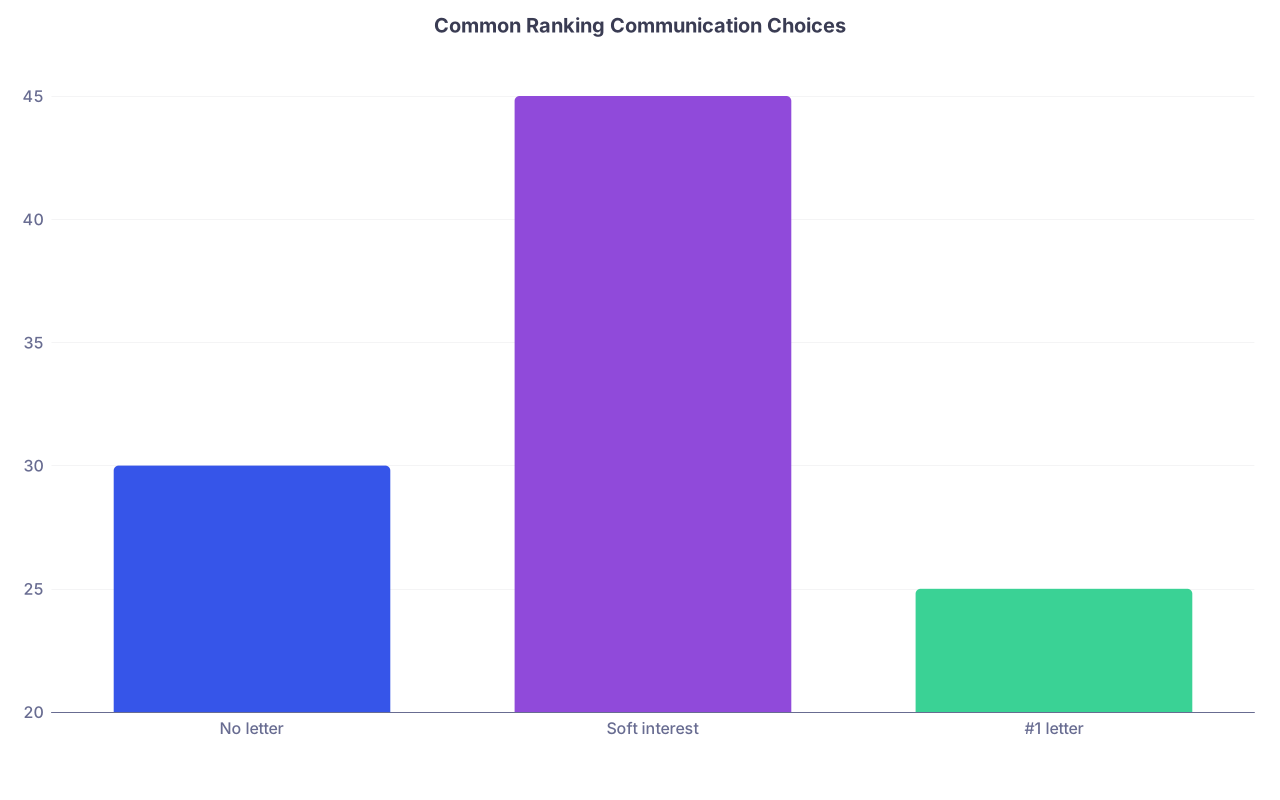
| Category | Value |
|---|---|
| No letter | 30 |
| Soft interest | 45 |
| #1 letter | 25 |
Roughly speaking (based on anecdotal program director comments and survey data), many applicants underuse clear #1 letters because they’re afraid of “bothering” programs. That’s a mistake. Thoughtful programs actually appreciate clarity—if you’re honest.
5. What Programs Actually Think When You Say It
Here’s what I’ve heard in real selection committee rooms:
- “She said we’re her number one. That does matter to me, if we like her already.”
- “He told two programs they were his first choice. Someone forwarded me his other email.”
- “A #1 letter doesn’t save a weak applicant, but it might bump a mid-range candidate a bit higher.”
So how does a direct “you’re my #1” usually function?
It works as a tie‑breaker or small nudge, not a rescue rope.
If you’re already:
- In the “probably rankable, mid‑list” group → it can push you up a bit.
- In the “borderline” group → it might get you onto the list vs off.
- In the “automatic no” group → it won’t save you.
No program is going to blow up their entire rank order list because of one letter. But a sincere, specific #1 statement can help at the margins.
6. How to Structure a Letter That Mentions Your Rank List
Do not write a three‑page essay. Do not recap your entire CV.
Aim for 3–6 tight paragraphs:
Opening + clear statement of intent
One or two sentences. Direct.Why this program is your #1 (specifics)
Not fluff. Concrete reasons that prove you remember the program.Why you fit (focused alignment)
A couple of lines connecting your goals with what they offer.Reassurance of sincerity and gratitude
Close politely and firmly.
Example skeleton:
Dear Dr. [Program Director],
Thank you again for the opportunity to interview at [Program Name]. After completing my interviews, I have decided that [Program Name] will be ranked #1 on my rank list in the upcoming Match.
I came to this decision because of [specific feature 1], [specific feature 2], and the clear sense of [culture/mentorship/education] I experienced when speaking with [names]. Your focus on [X] aligns directly with my interest in [Y].
My background in [brief point] and long‑term goal of [brief point] make me confident I would thrive in your program and contribute to [research/education/clinical mission]. I would be honored to train at [Program Name] and am excited about the possibility of joining your team.
Thank you again for your time and consideration.
Sincerely,
[Your Name], [AAMC/NRMP ID if appropriate]
That’s it. No drama. No begging. Clear and respectful.

| Step | Description |
|---|---|
| Step 1 | Interested in program |
| Step 2 | Send soft interest note |
| Step 3 | Wait and reassess |
| Step 4 | Draft #1 letter |
| Step 5 | Include clear statement and reasons |
| Step 6 | Send to PD and coordinator |
| Step 7 | Is it truly your #1? |
| Step 8 | Finished all key interviews? |
7. Common Traps and Dumb Moves (Avoid These)
I’ve seen all of these. Don’t repeat them.
Sending a “you’re my #1” email to multiple programs.
People talk. Faculty move institutions. This is the fastest way to torch your credibility.Using vague language but hoping they interpret it as #1.
“Top choice” and “very highly” are not the same as “#1.” Programs know the difference.Begging or sounding desperate.
“Please, I really need this” does not help you. It can actually hurt you.Writing a novel.
If a PD opens your letter and sees a wall of text, they’re skimming at best. Short and focused wins.Sending it the day before rank list certification.
Some programs finalize their list early. Aim to send your #1 letter 1–3 weeks before rank deadline, not the night before.
| Situation | Good Phrase | Bad Phrase |
|---|---|---|
| True #1 program | "I will rank your program #1." | "I know we will match if you rank me high." |
| Strong but not #1 | "I will rank you very highly." | "You are definitely my top program." |
| Early in season, unsure | "Your program is among my top choices." | "You are my first choice" (then change) |
8. The “Future of Medicine” Angle: Does This Still Matter?
You might wonder: with the Match algorithm, holistic review, and increasingly structured interviews, does a letter of intent—even one naming your rank—still matter?
Yes. But not in the way premed forums fantasize about.
As programs adopt more data‑driven and holistic tools, the influence of any single signal goes down. But genuine, well‑timed signals of interest still play a role in:
- Breaking ties between similar applicants
- Reassuring programs you’re likely to be happy there
- Informally shaping impressions in committee discussions
I expect two things in the future:
- More standardized signaling tokens in some specialties (like EM’s preference signaling), which may partially replace “you’re my #1” emails.
- Less tolerance for manipulative communication, especially anything that feels like horse‑trading about ranks.
But an honest, respectful letter that explicitly says “you’re my first choice” will always have a place. Humans still run these programs. They still care who actually wants to be there.
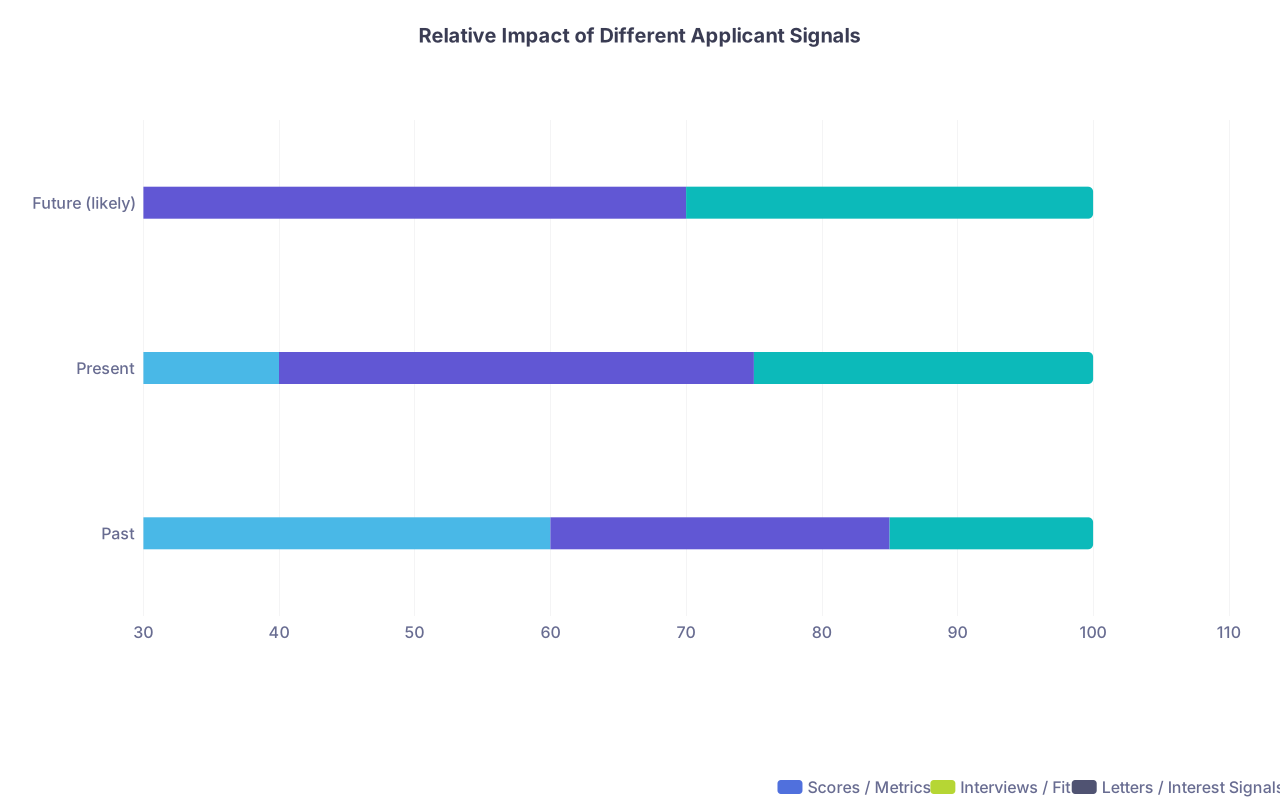
| Category | Scores / Metrics | Interviews / Fit | Letters / Interest Signals |
|---|---|---|---|
| Past | 60 | 25 | 15 |
| Present | 40 | 35 | 25 |
| Future (likely) | 30 | 40 | 30 |
9. Practical Steps: What You Should Do Today
If you’re anywhere near rank list season, do this:
- List your top 3–5 programs.
- Decide—today—who is honestly your #1. Not your parents’ #1. Not Reddit’s #1. Yours.
- Draft a 3–4 paragraph letter using the template above.
- Read it out loud. Cut anything that sounds like fluff or begging.
- Send it to the PD (CC the coordinator) within a reasonable timeframe before rank list finalization.
And then stop. Don’t follow up weekly. Don’t fish for reassurance.

FAQ: Letters of Intent and Rank Lists
1. Can I tell more than one program they’re my “top choice”?
You can say “top choice” to multiple programs, but then the phrase becomes meaningless. If you mean “#1,” say “#1.” If you don’t, don’t pretend. The only message that truly stands out is a single, honest “I will rank you #1.”
2. Should I mention my full rank order list in the letter (e.g., “You’re 2 of 12”)?
No. That’s over‑sharing and slightly bizarre. Programs don’t need to know exactly where they sit unless they’re #1 and you want to tell them that. Anything beyond “#1” or “ranked very highly” is unnecessary and can feel awkward.
3. Will saying “You are my #1” guarantee that I match there?
No. It might help you move up their rank list slightly, but it’s not a contract and not a guarantee. If they already don’t see you as a fit or you’re far down their list, your letter will not magically override that. Treat it as a tie‑breaker, not a golden ticket.
4. When is the best time to send a #1 rank letter of intent?
Typically 1–3 weeks before the rank list certification deadline. Too early, and you might change your mind or they may forget. Too late, and their list may be essentially finalized. If you know early and are confident, late January to early February is a common sweet spot for March Match specialties.
5. Should I send my letter to faculty interviewers too, or just the PD?
Send it to the program director and CC the program coordinator. If there was a specific faculty champion who clearly loved you, you can send a separate, shorter “thank you + I ranked you highly” email, but keep the explicit “you are my #1” in one primary letter to the PD.
6. What if I send a #1 letter and then realize I changed my mind?
This is the nightmare scenario and why I tell people not to rush. If it happens, there’s no clean fix that doesn’t make you look unreliable somewhere. Ethically, your options are: stick to your original commitment and rank them #1 anyway, or accept that you misled them and live with that. The better move is to be absolutely sure before you send a #1 letter.
Open the draft email you’ve been putting off and write the first sentence: “After completing my interviews, I have decided to rank [Program Name] #1 on my rank list.” If you hesitate writing that about any program, you’re not ready to send a true letter of intent yet—so start by clarifying your own priorities.