
The most valuable letter of intent is not the one you send. It is the one a powerful faculty advocate sends for you—at the right time, to the right person, with the right message.
If you have someone offering to “reach out” or “put in a word” or “support you with letters,” you’re sitting on leverage most applicants never get. Most people waste it. They let the advocate send generic emails, to random programs, at random times, with no coordination. Then they’re surprised it does nothing.
Let’s not do that.
Below is exactly how to think and act when a faculty advocate offers to support you—how to coordinate their outreach with your own letters of intent (LOIs) so you look focused, credible, and serious to programs instead of scattered and desperate.
1. First, Figure Out What Kind of Advocate You Actually Have
Not all “advocates” are created equal. You need to sort out who you’re dealing with before you plan anything.
Here’s the blunt breakdown:
| Advocate Type | Typical Impact | How Many Programs They Should Contact |
|---|---|---|
| PD/chair at your home program | High to very high | 3–8 top targets |
| Well-known subspecialist with national rep | High | 5–10 focused |
| Mid-level faculty, respected locally | Moderate | 5–15 balanced |
| Recent grad fellow/resident | Low to moderate | 5–10 relationship-based |
| Community preceptor with no academic ties | Low | 3–5 thoughtful |
You’re aiming to answer three questions fast:
- How senior are they? (PD, chair, division chief, associate PD, regular faculty, fellow?)
- How connected are they nationally in your specialty? (Do they present at big conferences? Sit on committees? You’ll know. People mention it.)
- How much do they actually know you and your work? (Have they supervised your clinical work, research, QI, leadership?)
Because here’s the reality:
- A short, specific email from a PD or big-name subspecialist can do more than ten generic LOIs from you.
- A long, generic letter from a random attending who barely remembers you? That’s decoration. Not influence.
So before you cheer, get clear. You will coordinate differently if the person is your department chair versus your outpatient preceptor who is “happy to help however they can.”
2. Stop Saying “Thank You So Much” and Start Saying “Here’s the Plan”
Most residents/students respond to an offer like this with:
“Thank you so much, that would be amazing!”
Then they go back to Anki or rounds and never follow up with structure. The faculty member also gets busy, forgets, maybe fires off a random email in January that says, “X is great, please consider them.” That’s it.
Instead, you respond like this (and yes, you can basically steal this structure):
“Thank you so much for being willing to support me. It would help me a lot if we could coordinate your outreach with my letters of interest so programs hear a consistent message.
I’m currently very interested in [Specialty] programs with strong [X/Y/Z features]. My top tier includes: [Program A], [Program B], [Program C].
Would it be okay if I sent you:
- A short, prioritized list of programs where your email would be especially impactful
- 2–3 bullet points for each program about why I’m particularly interested
- A brief draft of how I’m describing my interests so that your note can align with that?”
That’s how you turn vague goodwill into a coordinated signal.
Key move: You frame this as helping them be more effective, not you micromanaging them. Faculty actually appreciate not having to guess.
3. Decide Where You Send LOIs vs Where They Reach Out (and When Both)
You have three main tools:
- Your own LOI to the program (official program email, portal, or PD)
- Their email/letter of advocacy
- Timing coordination (who goes first, who follows up, when)
You can’t just blast everything everywhere. That looks sloppy.
A realistic coordination framework
Think in tiers.
| Program Tier | Your LOI | Faculty Advocate Outreach | Timing Strategy |
|---|---|---|---|
| #1 True Top Choice | Yes | Yes | You first, them 3–7 days later |
| Top 5–8 programs | Yes | Yes (if strong advocate) | Can be concurrent or staggered |
| Middle interest | Maybe | Maybe (if they have direct ties) | Only if targeted |
| Safety / backup | Optional | Usually no | Save advocate capital |
Basic rules of thumb:
- Tier 1: You send a clear, explicit LOI. “You are my top choice” is reserved for one program. Your advocate sends a short backing email referencing your seriousness and fit.
- Tier 2: You send strong interest letters. Your advocate selectively reaches out to those where they either know someone or your chances would really shift with a nudge.
- Tier 3 and below: They stay off the list unless they personally insist or have an unusually strong tie there.
You’re rationing their political capital and their time. If they email 25 programs with your name, none of those emails will feel meaningful, and they’ll probably stop halfway through anyway.
4. How to Time Everything Around the Interview and Rank Timeline
Timing is where most people mess this up. They either send everything way too early (October) or way too late (a week before rank lists are due).
Here’s a sane timing structure.
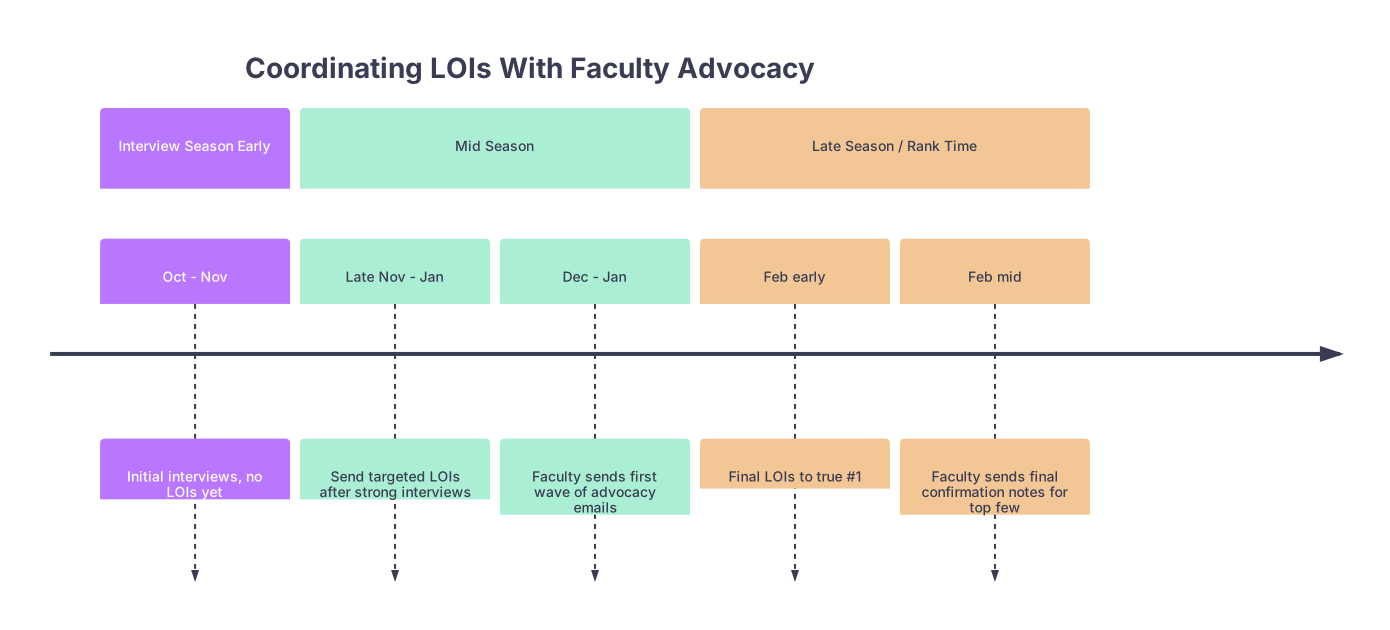
| Period | Event |
|---|---|
| Interview Season Early - Oct - Nov | Initial interviews, no LOIs yet |
| Mid Season - Late Nov - Jan | Send targeted LOIs after strong interviews |
| Mid Season - Dec - Jan | Faculty sends first wave of advocacy emails |
| Late Season / Rank Time - Feb early | Final LOIs to true #1 |
| Late Season / Rank Time - Feb mid | Faculty sends final confirmation notes for top few |
Practical timing rules:
- Don’t send LOIs before your interview unless there’s an unusual situation (late invite push, you’re coming off a waitlist, PD explicitly told your advisor to reach out).
- Ideal: LOI within 24–72 hours after an interview when interest is high and you’re fresh in their mind.
- Faculty advocacy:
- For your true top program: either
- You send LOI first, then they email PD a few days later: “X told me they are extremely interested in your program and would be an excellent fit…”
- Or they email shortly before your interview, if they already know the PD and can say, “Keep an eye out for this candidate.”
- For your true top program: either
- Late-season: In February, a brief, coordinated “confirmation” note (you to PD, them to PD or program leadership) reinforcing that you’ll rank highly or #1.
The anchor idea: Never let the program hear a big message from your advocate that contradicts or precedes your own communication. You do not want a PD thinking, “Funny, this student’s mentor says this is their top choice but I have never heard that from them.”
5. What Your Advocate Should Actually Say (And How You Can Help Without Writing It For Them)
Do not script their email word-for-word. That crosses a line and many faculty hate it.
You can, however, make their life easy by sending them:
- Your CV or ERAS application PDF
- Your personal statement
- A short “framing paragraph” of how you’re describing your goals
- A list of programs + why each one is on your target list (2–3 bullets per program)
Something like this:
“For [Program X], I’ve been emphasizing:
- Strong focus on [underserved care / research / global health / procedural volume]
- [Specific faculty or track] I’d like to work with/under
- I grew up in [region] and hope to return long term”
Then you trust them to put that in their own voice.
Core elements their email/letter should include
You’re hoping their message hits these beats:
Clear relationship
“I’ve worked closely with [Name] as [their role—sub-I, resident, research mentee, chief resident, etc.]”Specific strength signal
Not “hardworking and compassionate” fluff. Instead:
“One of the top 5 residents I’ve worked with in the last decade” or
“Strongest clinical reasoning among this year’s MS4 cohort”
Program directors respond to relative ranking statements.Fit for that specific program
A sentence tying your interests to that program’s known strengths.Explicit ask / endorsement
“I strongly encourage you to consider [Name] favorably on your rank list. I believe they would excel in your program.”
No paragraph-long life story. PDs read quickly. You want tight, credible endorsement.
6. Handling the “Top Choice” Problem So You Don’t Look Dishonest
Here’s where everyone gets nervous.
You want to tell multiple programs you “would be thrilled to train there.” Only one can be told honestly they are your true #1 choice.
Your faculty advocate should not be emailing five PDs saying “Program X is their top choice” with different names each time. Someone will compare notes at a conference and then you look like a politician, not a physician.
Use this framework:
- You tell one program in clear words:
“I will rank your program first” / “You are my top choice.” - To others, you say:
“I will rank your program very highly” or
“Your program is one of my top choices” (but don’t overdo this—if it’s not close to true, skip it). - Ask your advocate to echo that same structure:
- For your true #1: “X has told me your program is their top choice, and they plan to rank you first.”
- For other top programs: “X is very interested in your program and plans to rank you highly.”
If you switch your true #1 late in the season, you have two options and both are messy:
- Own it with your advocate and send a new, honest message (accepting the risk).
- Don’t switch your stated top choice. Accept that your verbal commitment matters more than a small rank list tweak.
My bias? Don’t play games with explicit “You are my #1” messages. Treat them as real commitments.
7. Common Scenarios and Exactly What To Do
Let’s go through a few very real situations I’ve seen.
Scenario A: Chair of your department says, “Send me a list of places and I’ll email the PDs.”
What you do:
- Narrow your list to 5–8 serious targets, not 20+.
- For each, send:
- Program name
- PD name + email (if you can find it)
- 2–3 bullet points: why you’re interested
- Whether you’ve already interviewed or are hoping for an interview
- Clarify whether you’ve already sent any LOIs and what you said.
Suggested email to them:
“I’ve attached a short list of 7 programs where your outreach would be especially meaningful. For each, I noted whether I’ve interviewed yet and why I’m particularly interested, so your note can match my expressed interests. I’m very grateful for your support and happy to adjust the list if you think some are better targets than others.”
Scenario B: Strong subspecialty mentor offers advocacy, but they only know PDs at a few specific programs
Perfect. Do not expand their role. Focus.
You:
- Ask them which PDs or programs they know personally.
- Limit your ask to those 3–6 programs.
- Coordinate timing around your interview or LOI there.
You don’t need this person emailing 12 random community programs they’ve never talked to. Wasted ammo.
Scenario C: You already sent a “you’re my top choice” LOI, then a month later your PD offers to support you
You have two paths:
- Ask them to reinforce that same program as your clear #1. This is ideal.
- If you want them to support other programs too, have them use softer language there: “will rank highly,” “extremely interested,” but do not let them call anyone else your “top choice.”
You also quietly accept that your true #1 is now locked. Don’t be the person who tells three PDs they’re #1.
8. Future Direction: How This Kind of Faculty Advocacy Is Evolving
Residency programs are slowly getting more cynical about LOIs. Everyone sends them. Many sound the same. A lot are clearly copy-pasted.
What has not lost value: trusted, targeted faculty-to-faculty communication.
But even that is shifting:
- PDs now get bombarded with emails from advisors, deans, and students.
- Generic “this is a great student” notes are increasingly ignored or delegated.
- Short, credible messages from people they actually know or from leaders in their field still move the needle.
Looking forward:
You will see more structured backchannels (advisors talking directly to PDs during rank season) and less weight given to essay-style LOIs. The signal that matters is:
- Are you serious about us?
- Does someone we respect vouch for you specifically, not generically?
- Does your track record line up with what we need?
Coordinated LOIs plus advocate outreach is exactly that: a focused seriousness signal. When done right, it cuts through the noise of hundreds of ERAS PDFs.
9. Quick Visual: Where to Put Your Energy
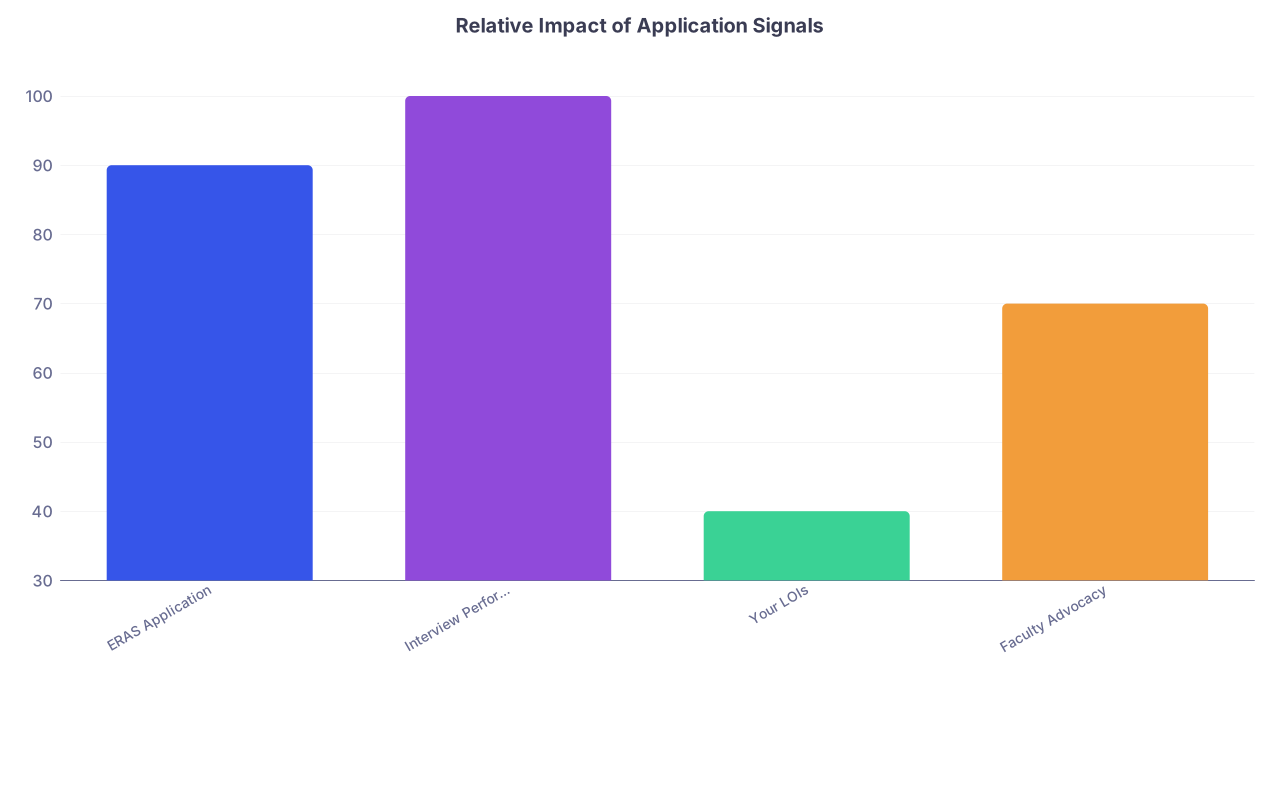
| Category | Value |
|---|---|
| ERAS Application | 90 |
| Interview Performance | 100 |
| Your LOIs | 40 |
| Faculty Advocacy | 70 |
Interpretation (approximate, but directionally right):
- Interview is king.
- ERAS gets you in the door.
- Your LOIs help, but rarely rescue a poor interview.
- Strong faculty advocacy sits in between: not as powerful as a stellar interview, but much stronger than your own LOI alone.
So no, letters and advocacy won’t turn a disaster into a match. But they absolutely break ties and shift borderlines.
FAQ (Exactly 3 Questions)
1. Should my faculty advocate email programs before I’ve interviewed or only after?
If they know the PD personally, an email before can help you get an interview or get you on the PD’s radar. That’s especially useful if you’re borderline on paper. If they don’t know anyone there, I’d lean toward them emailing after your interview, reinforcing your interest and performance. Pre-interview cold outreach from random faculty doesn’t do much.
2. Can multiple different faculty advocates email the same program for me?
They can, but you should be careful. Two coordinated notes (for example, your subspecialty mentor and your PD) can be powerful. Four or five separate emails from half a department just annoy the PD. If you’re going to have more than one person reach out, make sure:
- They each know the program in some way
- Their messages say something distinct
- Nobody exaggerates your “top choice” status in conflicting ways
3. What if my faculty advocate writes something I don’t fully agree with or overpromises (like saying I’ll rank a place first)?
You have to prevent that before it happens. When you send them your program list and interest bullets, spell out clearly where you’re saying “top choice” vs “rank highly.” You can say: “For transparency, I’ve told only [Program X] they’re my true #1. For others, I’m using the language ‘rank highly.’ I’d appreciate if your note could mirror that.” Once they send the email, you do not really get to walk it back without looking disorganized or disingenuous.
Open your program list right now and write three columns: “My LOI only,” “Shared with advocate,” and “Advocate only.” Start putting programs into each bucket. That simple act turns vague support into an actual coordinated strategy.