
The worst thing you can do with a letter of intent is lie. The second worst is tell the truth badly.
You’re here because you actually have a real, single top choice. Not “one of my top three.” Not “I’d be happy anywhere.” A real number one. And you’re trying to figure out how to write one honest LOI without sounding desperate, generic, or shady.
Good. Let’s handle it properly.
1. First, be sure you’re really in “single top choice” territory
Before we talk about what to write, I want to be blunt: a true LOI is a one‑shot weapon. You do not send this to multiple programs. You do not “kind of” mean it. If you’re not 100% sure, don’t pull the trigger yet.
Here’s how to sanity‑check yourself.
Ask yourself three questions and answer them like an adult, not like someone trying to avoid cognitive dissonance:
- If this program ranked me last on their list, would I still rank them #1 on mine?
- If I got into this program and a “more prestigious” one magically offered me a spot late, would I still stay with this one?
- Am I willing to withdraw all other LOIs and not send another “you are my top choice” to anyone else this cycle?
If the answer to any of those is “uhhh… maybe?” you’re not ready for a true LOI. You can still send a “strong interest” or “very high on my list” letter. But not a “you are my clear #1.”
If your answers are all “yes, obviously” and you’d bet your own reputation on it, then you’re in the right situation for this article.
Now, the second filter: does this program even make sense as a top choice on paper?
Things that should be true (or very close) for a single top choice:
- Their training structure actually fits your goals (not fantasy goals—your real ones).
- You’d be fine living in that city for the entire length of training.
- You’ve done enough due diligence (interview day, second look, talking to current residents, maybe faculty) to not be in pure infatuation mode.
If instead your “top choice” is just “the highest‑ranked name that interviewed me,” pause. That’s not a top choice; that’s insecurity dressed up as strategy.
2. What programs actually use LOIs for—and what they don’t
You’re worried about the ethics and the impact, so let’s cut through the nonsense.
Programs use strong, clear letters of intent for a few things:
- To break ties between similarly ranked applicants.
- To bump someone they liked into a slightly higher band when they need people likely to actually come.
- To feel more confident that if they put you high, they won’t “waste” a rank spot on someone unlikely to match there.
Programs do not use LOIs to:
- Completely overhaul their entire rank list for one person.
- Accept “promises” as binding contracts. They know people lie.
- Override terrible fit or serious red flags. An LOI doesn’t erase that your interview was awkward or your letters were mediocre.
So what does that mean for you?
If you’re in their “we like this person” range, a clean, honest, specific LOI can help. It won’t turn a “no” into a “yes,” but it can turn “probably somewhere in the middle” into “a bit higher because they’re likely to come and they fit us.”
If you’re clearly out of their usual range—scores, grades, red flags—the LOI is not magic. Send it if you want, but don’t build your emotional survival on it.
3. The ethics: what’s allowed, what’s shady, what’s flat‑out wrong
You’re in medicine. You’re going to spend a career signing orders, consenting patients, and making decisions where your word matters. Don’t start that career by playing word games with a program.
Three basic rules:
- You send one true LOI per cycle. One “you are my number one,” period.
- The letter must be factually true. No “I will definitely rank you first” if you’re still debating. No “I’ve always dreamed of your program” if you first heard of it in October.
- Don’t try to be clever with weasel words. “You are my top choice among midwestern university programs with strong X” is garbage. Programs see through that.
NRMP rules don’t ban you from telling a program they’re your top choice. The match rules ban coercion and requiring disclosures. They don’t ban voluntary expression of preference. What is a problem is lying. Ethically, if not formally.
If you already told two different programs “you’re my #1” on the phone or in emails? Do not double down in writing. Fix it moving forward. Send a real LOI to the actual top choice and keep communication with others in the “very interested” zone without promising anything.
4. Timing: when to send the honest LOI
The letter is useless if it arrives after their rank meeting.
Most programs finalize their rank lists sometime between late January and mid‑February. Some meet once. Some meet multiple times. You won’t know the exact day.
So work within a reasonable window:
- Best: 1–3 weeks before you think they’re ranking. For many, that’s early February.
- Acceptable: any time from the week after your interview up through about two weeks before rank list certification.
- Too late: a few days before rank list lock. It might still get read; it’s just unlikely to change anything structural.
If you’re reading this in December or early January and you are already sure? You can send it now. There’s no rule that it has to be right before ranking. But I’d wait until you’ve completed all interviews where you might realistically rank above them—unless you are absolutely sure nothing will surpass this program.
5. The LOI structure: what to include, what to avoid
You’re writing one honest LOI. So it needs to be crisp, specific, and not a rambling personal statement 2.0.
Think of it as four short pieces:
- Clear statement of your intent (unambiguous, early in the letter).
- Concrete program‑specific reasons why they’re your #1.
- How you fit them (and they fit you) in real, non‑fluffy terms.
- A clean, respectful close.
Let’s walk through each.
5.1. Opening line: state your intent in plain English
Do not bury the lede. Make it painfully obvious in the first 2–3 sentences.
Bad:
“I wanted to take a moment to reiterate my strong interest in your program…”
Everyone writes some version of that. It means nothing.
Good:
“I am writing to let you know that [Program Name] is my clear first choice for residency, and I intend to rank your program #1.”
That’s it. That one sentence tells them exactly why you’re in their inbox.
You can follow it with one brief sentence of context, like:
“After completing all of my interviews and reflecting on what I want from my training and my life outside the hospital, no other program aligns as closely with my goals.”
Notice the order: statement of intent, then explanation. Not the other way around.

| Step | Description |
|---|---|
| Step 1 | Identify True Top Choice |
| Step 2 | Send strong interest letters only |
| Step 3 | Draft single honest LOI |
| Step 4 | Send to PD and CC coordinator |
| Step 5 | Do not send LOI to any other program |
| Step 6 | 100 percent sure? |
5.2. The middle: show you know them, not just “a good program”
This is where most LOIs die. They sound like they were copy‑pasted and sent to five places with the names swapped.
You need details that:
- Could only apply to this program.
- Aren’t easily scraped from their website.
- Connect directly to your goals, experiences, or values.
Think in three buckets:
- Training structure
- People and culture
- Location and life factors (used carefully, not as the only reason)
Concrete examples:
Training structure:
- “Your dedicated PGY-2 geriatrics clinic and strong home‑based primary care exposure align with my long‑term goal of caring for medically complex older adults in the community.”
- “The fact that PGY-3 residents routinely function as primary surgeons for common laparoscopic cases is exactly the operative autonomy I’m looking for.”
People and culture:
- “On interview day, every resident I spoke with—especially Dr. X and Dr. Y—described the faculty as ‘protective of our education’ and gave specific examples of attendings pushing back on extra calls that would compromise their learning.”
- “The way your PD talked about supporting residents through parental leave made it clear this is a place that treats people as humans first, trainees second.”
Location:
- “My partner already works in [City], and having our support system here during residency would make it sustainable for both of us.”
- “I have close family in [Region], and being near them is not just a bonus; it’s a practical necessity as I help care for my aging parents.”
You don’t need all three categories, but you need enough that someone reading it thinks, “This person actually paid attention, and their reasons track.”
Avoid:
- “Your program’s reputation for excellence…”
- “Your strong clinical training across diverse populations…”
- “Your commitment to research, teaching, and patient care…”
Those phrases are wallpaper. They could apply to 95% of programs.
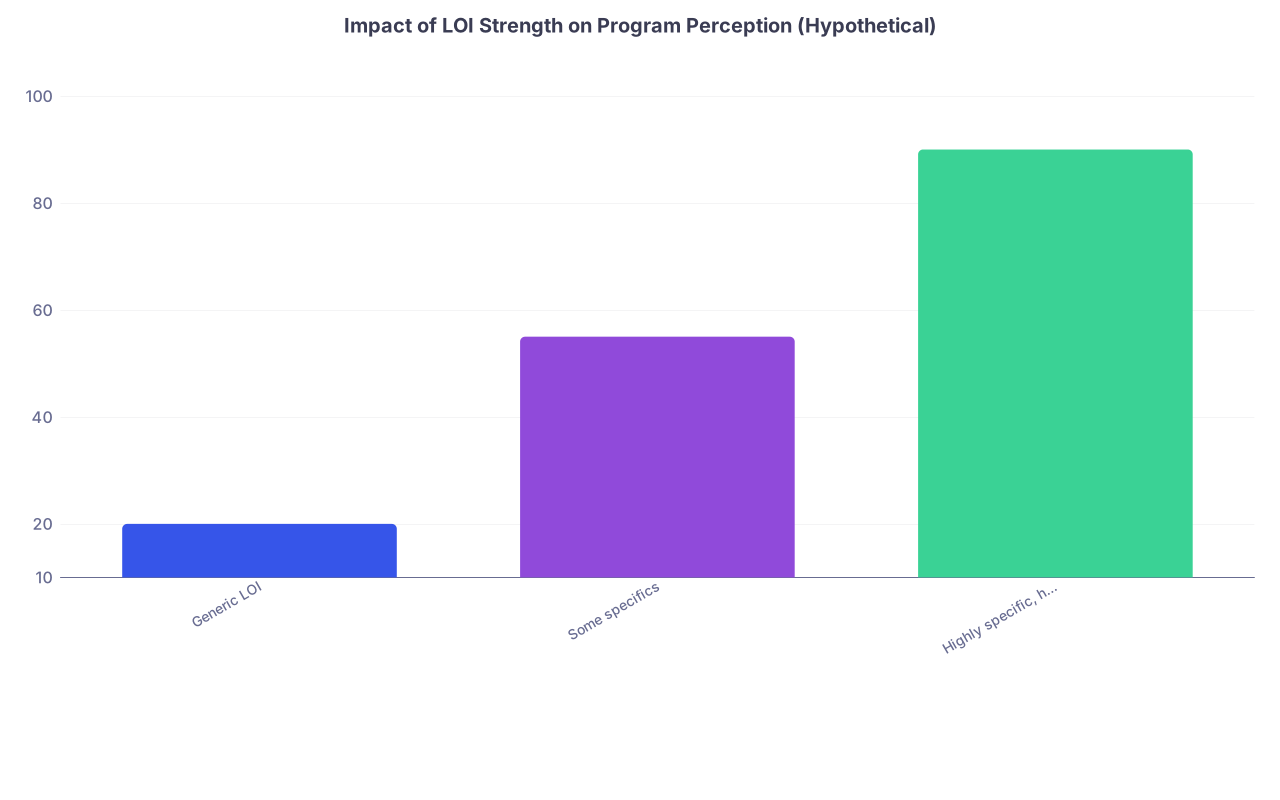
| Category | Value |
|---|---|
| Generic LOI | 20 |
| Some specifics | 55 |
| Highly specific, honest LOI | 90 |
6. Actually writing the letter: a concrete template you can adapt
Here’s a skeleton that works. Do not copy it word‑for‑word; you’ll sound like everyone else who finds templates online. But you can steal the structure and adapt the phrasing.
Subject line options (email):
- “Letter of Intent – [Your Name], [Specialty] Applicant”
- “[Your Name] – [Program Name] is my #1 choice”
Body:
Dear Dr. [Program Director Last Name],
I am writing to let you know that [Program Name] is my clear first choice for residency, and I intend to rank your program #1.
After completing my interviews and reflecting on what I want from my training and my life outside the hospital, no other program aligns as closely with my goals. In particular, [specific feature #1] and [specific feature #2] make your program uniquely suited to the type of physician I’m working to become.
[1–2 short paragraphs of specifics]
For example:
- One paragraph about training structure and opportunities.
- One paragraph about culture/people/location and how they match your situation.
I believe I would be a strong fit for [Program Name]. My experiences in [briefly mention 1–2 key experiences—sub‑I at a similar program, leadership, specific patient population work] prepared me to contribute meaningfully to your resident community from day one. I’m particularly excited about the opportunity to [1–2 concrete things you’d do there: join a track, work with a faculty member, help with a clinic initiative].
Thank you again for the opportunity to interview with your program and for the warm welcome from your residents and faculty. I would be thrilled to train at [Program Name] and hope to have the chance to do so.
Sincerely,
[Your Full Name]
[AAMC ID or ERAS ID]
[Email] | [Phone]
That’s it. One page max. Tight, specific, direct.
No need for life story. No need for trauma narrative. No need for “since childhood, I dreamed of…” unless that’s actually true and somehow tied to this specific place (and even then, careful with drama).
7. Where and how to send it: mechanics that matter more than you think
You do not want your single honest LOI stuck in a spam filter or lost in a coordinator’s inbox.
Basic mechanics:
- Format: Email is standard. PDF attachment optional, but the actual text should be in the body so it’s easy to forward.
- To: Program Director (PD).
- CC: Program coordinator. Optionally APD you had meaningful interaction with, if appropriate.
- Subject line: make your intent obvious (see earlier examples).
- Timing: once, not repeatedly. You don’t need to resend or “bump” it.
One more thing: send it from the same email you used for ERAS or that they’ve used to communicate with you. Don’t create some new “professional” email mid‑cycle.

8. Common mistakes that ruin an otherwise honest LOI
You can be 100% truthful and still undercut yourself with sloppy choices. Here are the big errors I keep seeing.
Vague flattery
“Your impressive faculty” means nothing. Name at most one or two specific people or roles and why they matter to you.Making it all about prestige
“Your reputation and national ranking…”
They already know their rank. If that’s your main driver, you sound status‑chasing, not like someone who fits their mission.Overpromising
“If I match at your program, I will revolutionize your QI curriculum and lead multiple multicenter trials.”
Relax. Show ambition, sure, but don’t sound delusional.Writing a second LOI to another program later
This is the big one. Do not do this. If you change your mind before sending the first LOI, fine—send it to the final choice. But once you’ve sent a “you are my clear first choice” and then send another somewhere else, you’ve crossed an ethical line.Overly emotional or chaotic tone
“My entire future depends on your program” or “I will be devastated if I don’t match there.”
That puts programs off. They want stable residents, not people framing this as life‑or‑death.Treating it like a negotiation
Do not ask for guarantees, “if‑then” statements, or try to probe your rank spot. Just state your intent and fit and leave it.
| Situation | Weak Phrase | Strong Alternative |
|---|---|---|
| Stating preference | "You are one of my top choices" | "You are my clear first choice and I will rank you #1" |
| Program strength | "Your program is excellent" | "Your dedicated X clinic and Y track align with my goal to Z" |
| Culture | "Residents seemed nice" | "Residents consistently described strong support when dealing with schedule changes and burnout" |
| Fit | "I would be a great fit" | "My experience in A and B has prepared me to contribute to C at your program" |
9. What to do with other programs once you’ve sent your LOI
You still rank other programs. You still like other programs. You just like this one the most. So how do you communicate with everyone else without lying?
With other programs, your language shifts from “top choice” to “very interested” or “ranked highly.”
Examples you can use in update/interest emails:
- “I continue to be very interested in [Program Name] and expect to rank your program highly.”
- “After completing my interviews, I remain enthusiastic about the possibility of training at [Program Name] and would be excited to match here.”
Notice what’s missing: any claim that they’re your #1. That’s reserved for the one true LOI.
If they call or email fishing for your rank order (they shouldn’t, but it happens), you are not obligated to reveal it. You can say:
“I’m still finalizing my list, but I can say that your program will be ranked very highly. I had a great experience on interview day and would be happy to train there.”
And leave it at that. You’re allowed to keep the exact rank order to yourself. NRMP actually encourages that.
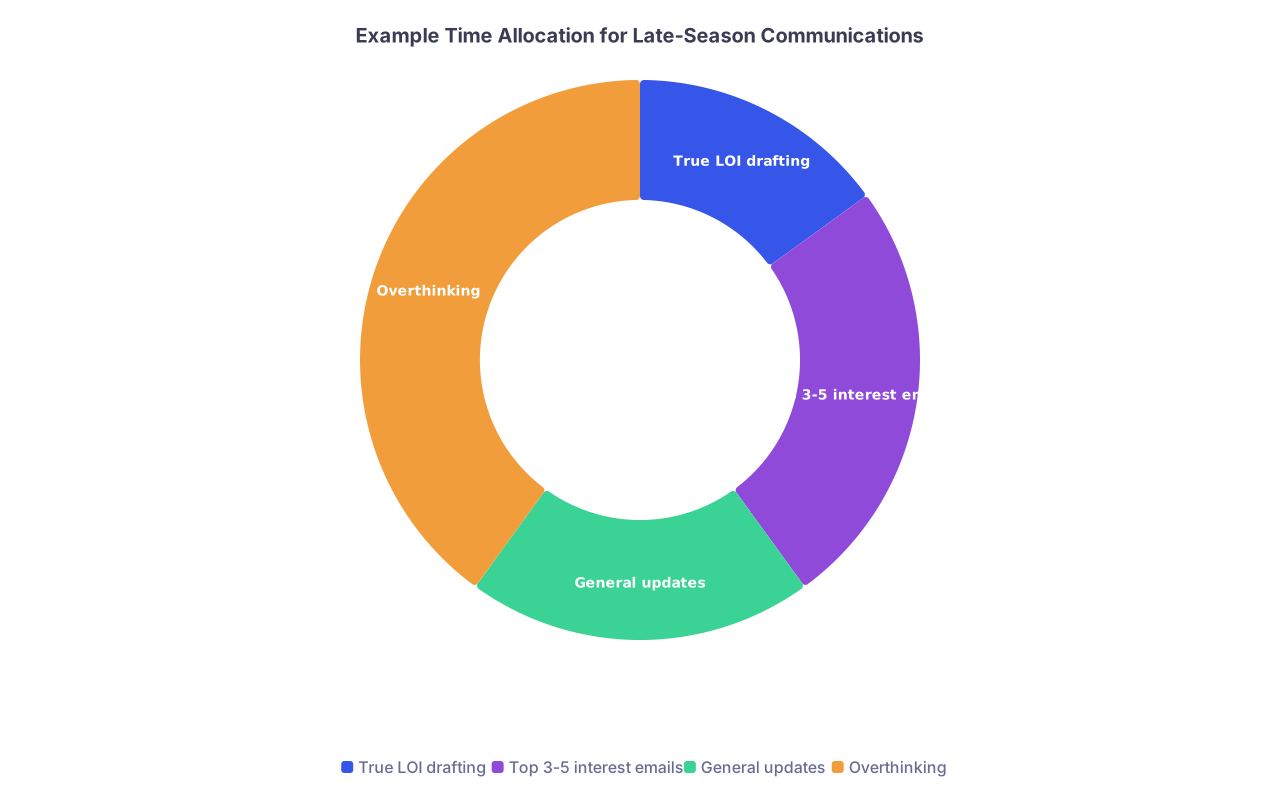
| Category | Value |
|---|---|
| True LOI drafting | 15 |
| Top 3-5 interest emails | 25 |
| General updates | 20 |
| Overthinking | 40 |
10. The emotional side: handling the wait after you’ve committed
Once you hit send on an honest LOI, you’re exposed. It feels like you’ve put all your chips on one square.
Here’s the adult reality:
- They might appreciate the letter and still not rank you as high as you wish.
- They might really like you and the letter and still not reach you on their list.
- You might not match there and never know how much the LOI helped or didn’t.
You do the LOI for two reasons:
- To give a program accurate, honest information that may tilt a close call in your favor.
- So that you know you made your preference clear and didn’t sit on your hands hoping they’d “just know.”
Once you’ve done that, your job is to build a rational rank list, top to bottom, and protect your own mental health.
That means:
- Don’t obsessively reread the LOI.
- Don’t send follow‑up LOIs or “just checking you saw this” messages.
- Don’t interpret silence as rejection. Many programs never reply to LOIs.
You took your shot. That’s all you can do.

11. Quick recap: if you truly have a single top choice, here’s what you do
Keep this tight:
- Confirm it’s truly your clear #1 and you won’t send a similar promise anywhere else.
- Write a short, direct LOI: state they’re your first choice and you’ll rank them #1, give 2–4 program‑specific reasons, and explain your fit without fluff.
- Send it once to the PD (cc coordinator), on time, then stop tinkering and build a smart, honest rank list for everywhere else.
That’s the whole playbook. One honest letter. No drama. No games.