
You walk out of your second look day, badge still swinging on your lanyard, brain buzzing. The chief resident remembered your name, you vibed with the residents at lunch, and the PD said, “I hope we see you here in July.” On the train home, you open your notes and think: “Okay… now what? Do I send a letter of intent? How strong? How soon? To whom?”
If that’s where you are, good. You’re in the window where a Letter of Intent (LOI) actually matters—right after a second look. But this is also where people screw it up with vague, over-the-top, or ethically questionable emails.
Let’s walk through exactly what to do.
1. First, Get Clear on Your Actual Intent
Do not open your email before you answer this question honestly:
Is this program truly your number one—above all others—right now?
Not “top three.” Not “probably my #1 if I don’t get X.”
Letter of intent means: If I submit a rank list today, you are #1.
If the answer is “I think so?” slow down. Here’s how to get to a real answer:
Sit with your full list of programs and rank them on:
- Training quality
- Location / support system
- Resident vibe / culture
- Fellowships / career outcomes
- Personal priorities (family, partner, etc.)
For each program, write one sentence:
- “If I match here, in five years I’ll be glad because ___.”
- If you’re forcing it, that’s not your #1.
Ask yourself the ugly question:
“If my dream program called today and promised me a spot, would I take it over this second-look program?”
If yes, you cannot ethically send this program an LOI saying they’re your #1.
If, after all that, this second-look program is clearly on top, then a post-second-look LOI is appropriate and often powerful. Program leadership absolutely pays more attention when an LOI follows a real, recent in-person second look. It shows you cared enough to come back and still like what you saw.
If it’s not your true #1, you can still follow up—but that’s a different kind of email: a strong “thank you / high interest” note, not an LOI. I’ll show you both.
2. Timing and Logistics: When and How to Send
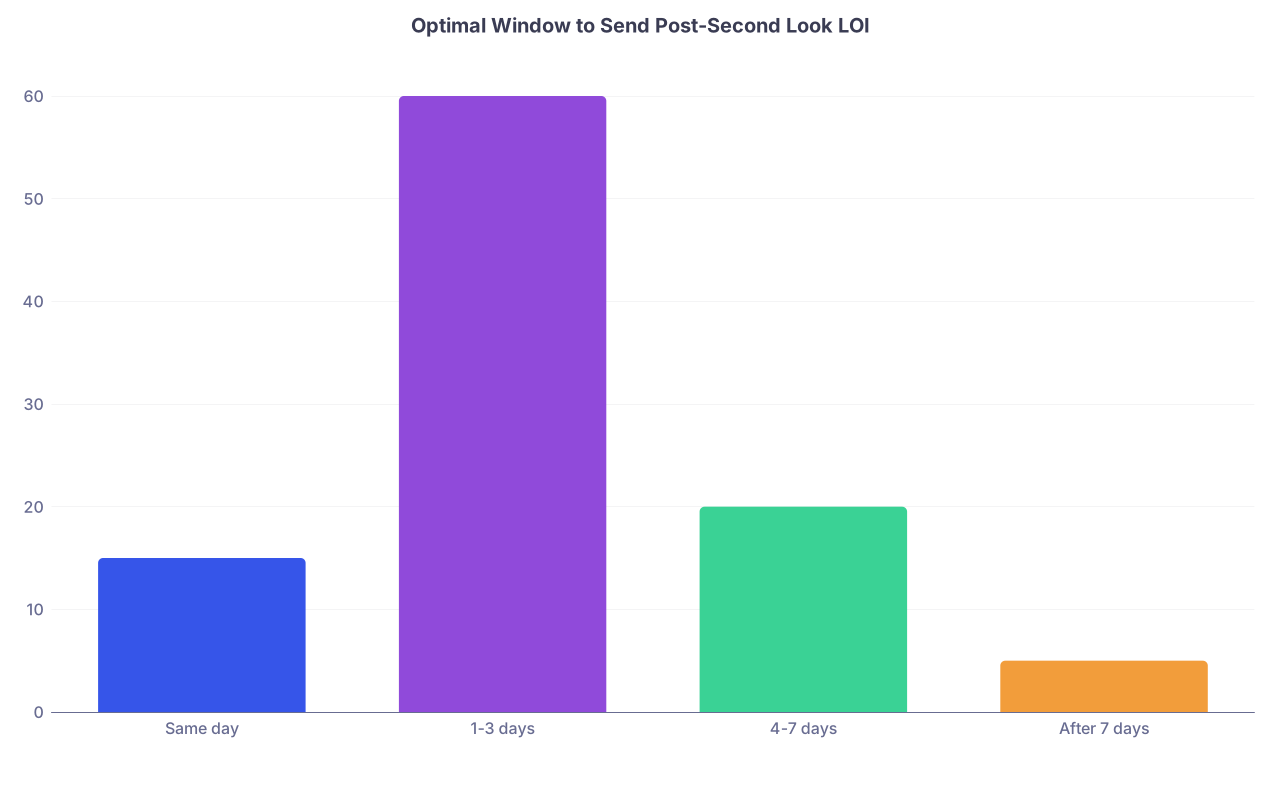
You want to hit the sweet spot: recent enough to be connected to your second look, not so late it gets lost in pre-rank-list chaos.
Ideal timing:
- 24–72 hours after your second look
Long enough to process and be specific, short enough that people remember you.
If your second look was very close to rank list deadline, send it within 24 hours. Do not wait a week – by then, many programs have already had key rank meetings.
How to send:
- Format: Email, not a PDF attachment. No one wants to open attachments on their phone in between consults.
- Subject line: Clear and boring is best.
- “Letter of Intent – [Full Name], [Specialty] Applicant”
- “Thank you & Letter of Intent – [Your Name], [AAMC/ERAS ID]”
- Recipients:
- Always: Program Director
- Often: Program Coordinator (cc)
- Optional: Associate PD you connected with, or chief resident (cc, not main recipient)
If you had a specific faculty mentor from the program who spent time with you, you can send a separate short thank you email referencing your LOI to PD. But don’t send three LOIs to three people. One letter. One message.
| Category | Value |
|---|---|
| Same day | 15 |
| 1-3 days | 60 |
| 4-7 days | 20 |
| After 7 days | 5 |
3. What Your LOI After a Second Look Should Actually Say
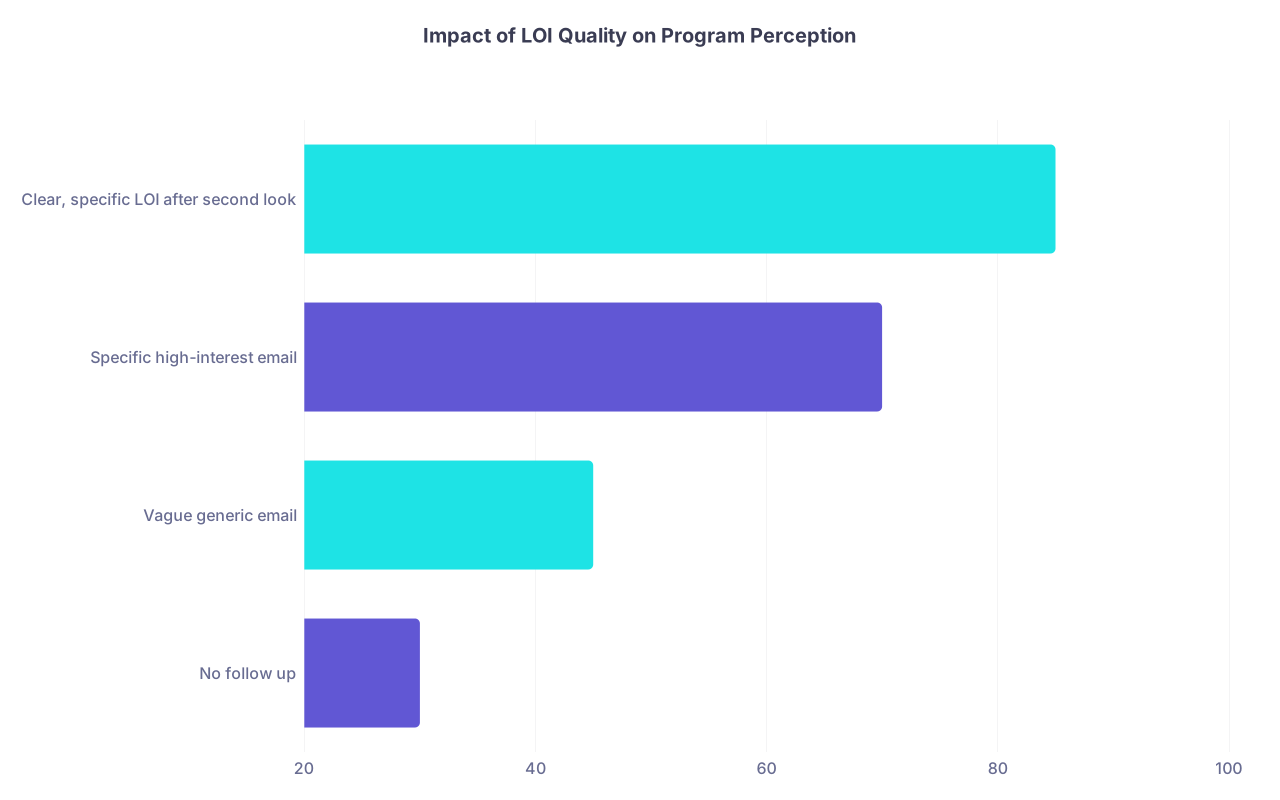
After a second look, you have one big advantage: you can be specific. Most generic LOIs read like AI wrote them: “I love the collegial environment and strong clinical training.” Garbage. Everyone says that.
Here’s the spine of a strong post-second-look LOI:
- Clear opening: gratitude + explicit statement of intent
- Concrete proof you paid attention at the second look
- Alignment: how your goals match what they offer
- Simple, honest closing
Let’s build it piece by piece.
Opening: Say the Real Thing in the First 2–3 Sentences
Do not bury the lead. PDs skim.
Example:
Dear Dr. Smith,
Thank you again for hosting me for a second look on January 6. After this visit and careful consideration of all my options, I am writing to tell you that [Program Name] is my unequivocal first choice, and I intend to rank your program #1 on my list.
That’s it. Direct. No “strongly considering ranking highly.” That phrase means nothing. It signals fear.
Middle: Use Your Second Look as Evidence
This is where most people sound like a brochure. Don’t.
You want 2–3 specific points that only someone who actually attended that second look could say.
Think of:
- A specific rotation or curriculum detail you discussed:
- “The chance to rotate at the county hospital and the VA, as Dr. Lee described, fits exactly with my goal of caring for diverse and underserved patients.”
- A resident interaction that mattered:
- “My afternoon on wards with Dr. Patel and the interns confirmed what I sensed on interview day: residents here support each other, even on busy call days.”
- A structural feature:
- “The 4+2 schedule you highlighted, with dedicated time for continuity clinic, matches my priority of building strong outpatient skills.”
Tie each point to something about you.
Example paragraph:
During the second look, seeing your residents manage complex heart failure patients on the CCU, and hearing how they feel supported by attendings during difficult decisions, reinforced my desire to train in a program with strong, hands-on critical care. My prior work in the MICU during sub-internships showed me how important that environment is for my growth.
Alignment: Connect to Your Future
Residency PDs care about where you’re going, not just what you liked.
Answer: “If we invest 3–7 years in you, who do you become and how does our program fit?”
Example:
I plan to pursue a career in academic general internal medicine with a focus on medical education. The opportunities your program offers—especially the clinician-educator track and the chance to mentor students through the residency teaching certificate program—match my long-term goals. I can clearly see myself growing into a chief resident and future faculty member in a setting like [Program Name].
Short, not a life story.
Closing: Respectful, Not Needy
You don’t need to beg. You’ve stated your intent; that’s the heavy lift.
Example:
Thank you again for the opportunity to get to know [Program Name] more deeply. Please let me know if I can provide any additional information.
Sincerely,
[Your Full Name]
AAMC/ERAS ID: XXXXXXXX
[Email] | [Phone]
That’s it. No “I would be forever grateful” or “This has been my dream since childhood.” This is not a Disney movie. It’s a business decision on both sides.

4. What Not to Do with a Post-Second-Look LOI
Here’s where applicants quietly burn credibility.
Don’t Send Multiple “You’re My #1” LOIs
Yes, some applicants send LOIs saying “you’re my #1” to three different programs. PDs talk. Associates move between programs. Faculty share stories at conferences.
If you’re caught, you’re done. At minimum, you look untrustworthy. At worst, it can hurt you at multiple places.
One LOI saying “you are my #1”. That’s it.
If you want to express strong interest to others, use language like:
- “Your program remains one of my very top choices.”
- “I will be ranking your program highly.”
- “I would be thrilled to train at [Program Name].”
You can say that to several places. You cannot ethically promise multiple places they are your top.
Don’t Ask for Anything Explicit
Don’t say:
- “I hope this improves my status on your rank list.”
- “I’d appreciate any consideration to be ranked more favorably.”
- “Please let me know my chances of matching.”
Programs can’t (and won’t) give you that information legitimately. And asking for it makes you look naive about match rules.
Your job: state your intent. Their job: build a rank list.
Don’t Turn It Into an Essay
Nobody wants to read a 1,200-word LOI. PDs skim emails on their phones between cases and family dinners.
Good length: 250–450 words. More than 600 and you’re dragging.
If you can’t say it succinctly, you don’t understand what you actually want.
Don’t Be Vague About Ranking
If you’re sending a true LOI, use plain language:
- “unequivocal first choice”
- “my first choice for residency”
- “I intend to rank your program #1”
Not:
- “I am very interested”
- “I will rank you highly” (this is non-committal)
- “top choice” (too slippery; could be “one of my top choices”)
Be brave enough to say the real thing or don’t send it.
5. High-Interest Email vs True LOI: Know the Difference
You might be in this situation:
You did a second look. You loved it. But you still honestly don’t know if it will be #1 once you see how you feel about another program or when your partner weighs in.
Fine. You still should follow up. Just don’t lie.
Here’s how to send a honest, strong “high interest after second look” email.
Subject: “Thank You for Second Look – [Your Name], [Specialty] Applicant”
Core structure is similar:
- Gratitude for the visit.
- Specifics from the second look.
- Clear statement of strong interest.
- No false promise.
Example language:
After my second look on January 6, I remain extremely enthusiastic about [Program Name]. The chance to work with residents like Dr. Patel and Dr. Nguyen and experience both the university and county hospital settings confirmed that your program is an excellent fit for my goals in [field/interest]. I will be ranking [Program Name] very highly on my rank list and would be excited to train with your team.
Notice the difference?
- LOI: “my first choice” / “rank #1”
- High-interest: “very highly” / “extremely enthusiastic” / “excellent fit”
Both are respectful and useful. Only one is a promise.
| Situation | Type of Email | Key Phrase to Use |
|---|---|---|
| Program is true #1 | True LOI | "I will rank your program #1" |
| Program is top 3, but not sure yet | High-interest email | "I will rank your program highly" |
| Program moved up, but not top tier | Thank you + interest | "I remain very interested" |
| Program dropped lower on your list | Simple thank you | No rank language |
6. Handling Program Policies and NRMP Rules
Some programs openly say, “We do not consider post-interview communication.” Others don’t mention it but quietly track it. You’re stuck reading tea leaves.
Here’s how to handle that:
If they explicitly say “don’t send us LOIs” or “post-interview communication won’t be read,” you respect that.
If you really want to communicate, send a very brief thank you through the coordinator, without LOI language. Don’t make them feel you can’t follow instructions.If they’re neutral or vague: a concise LOI is fine and common.
On NRMP rules:
You’re allowed to state your intentions (e.g., “I will rank you #1”). They’re not allowed to demand reciprocal commitments or tell you where they’ll rank you. You also shouldn’t pressure them to do so.
One more point people ignore: LOIs are not binding in a legal sense. You could technically change your mind later. But if you do this casually, it says something about you. Professionally. Ethically. You want to be the kind of person whose word means something—even when nobody could “catch” you.
So if you send an LOI and then everything in your life changes and you truly must alter your rank list, fine. Just don’t treat LOIs like throwaway lines.

| Step | Description |
|---|---|
| Step 1 | Second look completed |
| Step 2 | Send true LOI in 1-3 days |
| Step 3 | Send high-interest email |
| Step 4 | Send simple thank you or skip |
| Step 5 | Is this your true #1? |
| Step 6 | Top tier choice? |
7. Quick Example: Full LOI After Second Look
Use this as a template, then customize hard. Don’t just swap names.
Subject: Letter of Intent – Jane Doe, Internal Medicine Applicant
Dear Dr. Smith,
Thank you again for the opportunity to return for a second look at the [University Hospital] Internal Medicine Residency on January 6. After this visit and careful consideration of all my options, I am writing to let you know that your program is my unequivocal first choice, and I intend to rank [University Hospital] #1 on my rank list.
During the second look, I was especially impressed by the collegial atmosphere among your residents on the wards and the strong teaching presence by faculty on the MICU service. Rounding with Dr. Patel and the interns, and hearing how they have grown in managing complex patients while still feeling supported, confirmed that this is the type of environment in which I will thrive.
I plan to pursue a career in academic general internal medicine with a focus on medical education and care for underserved populations. The combination of your clinician-educator track, continuity clinic at the community health center, and opportunities to work with medical students through the teaching certificate program aligns directly with these goals. I can clearly see myself developing into a chief resident and, eventually, a faculty member in a department like yours.
Thank you again for your time and for offering such an informative second look experience. Please let me know if I can provide any additional information.
Sincerely,
Jane Doe
AAMC ID: 12345678
[email protected] | (555) 123-4567
Adjust the length and specifics to your situation. But keep the spine:
- Clear #1 statement
- Second look specifics
- Future alignment
- Clean close

8. Final Details That Quietly Matter
A few small things that separate you from the herd:
- No errors. Run spellcheck. Read it out loud once. PDs absolutely notice sloppiness.
- Name the right program. Do not mix up program names, cities, or specialties. Yes, people do this. Yes, it kills your credibility instantly.
- Keep your signature clean. Full name, ID, contact. Not 12 inspirational quotes.
- Send it yourself. Not through some weird third-party system. From the same email you used in your application.
If you’re worried about “annoying” programs: one well-written LOI after a second look is not annoying. Ten scattered “just checking in” emails are.
| Category | Value |
|---|---|
| No follow up | 30 |
| Vague generic email | 45 |
| Specific high-interest email | 70 |
| Clear, specific LOI after second look | 85 |
9. Bottom Line
After a second look, you’re in a rare position: you’ve seen the program up close, and they’ve seen that you cared enough to come back. Use that once.
Three things to remember:
- Only send a true LOI if this program is honestly your #1 and say that plainly.
- Leverage your second look: mention concrete details and link them to your goals, not generic fluff.
- Keep it ethical, concise, and precise—one real LOI, a few honest high-interest notes, and then let your rank list and their rank list do their jobs.
If you’re staring at a draft and not sure whether it’s an LOI or just wishful thinking, you probably already know the answer. Adjust the language to match your actual intent, hit send once, and move on to building the rest of your life.