
The way most people mention their partner in a letter of intent is lazy and backfires.
If your partner’s match actually matters, you cannot just toss in one sentence about “being couples matched” and hope programs read your mind. They won’t. You need a clear, strategic way to integrate couples information into LOIs that helps both of you instead of sinking you.
This is a tricky, political, emotionally loaded situation. You’re trying to:
- Advocate for yourself
- Support your partner
- Avoid sounding needy, entitled, or like a package deal no one asked for
Let’s walk through how to handle it like an adult, not a panicked M4 at 2 AM.
1. First, decide if your partner’s match should be in your LOI at all
Not every relationship belongs in every letter of intent. Some do. Some absolutely should stay out of it.
Here’s the blunt rule:
If your partner’s match materially constrains where you can go and you’re genuinely planning your rank list around that, then yes—your LOI strategy should acknowledge it. If not, leave it out.
Good reasons to include couples info:
- You’re in the NRMP Couples Match together
- You’re both matching but in different systems that still need geographic alignment (e.g., one in NRMP, the other in military match, but same city matters)
- Your partner is locked into a location (active duty assignment, green card constraints, kids and spouse already working in the city, etc.) and you’d realistically turn down even a dream program if it’s too far away
Weak or bad reasons:
- “We’re dating and would like to be near each other if possible” but you’d still go far away if your #1 called
- Casual relationships, situationships, or “we’re seeing where things go”
- Vague “family in the area” when the “family” is one person you started dating six months ago
Programs are not your relationship counselors. They don’t want drama. If your partner’s situation is a real limiting factor, you mention it. If not, do not drag it into your professional letter.
2. Understand what programs actually worry about when you mention a partner
I’ve seen PDs do this in real time: they see “my partner is also in the match” and immediately think three things:
- Are they going to bail on us if the partner lands somewhere else?
- Are they ranking us only because of geography?
- Is this going to complicate scheduling, negotiation, or future retention?
You’ll notice none of those are “How can we help this wonderful couple live their dreams.”
So you have to write your LOI in a way that:
- Reassures them about your commitment to the program
- Clarifies whether you’re asking for anything or simply explaining context
- Avoids sounding as if you’re leveraging them against another program
What they like seeing:
- Clear, adult explanation of your couples situation
- Strong independent interest in their program—apart from your partner
- Evidence that you’ve thought this through and aren’t going to email them 20 times in February with chaos updates
What they hate:
- Vague references like “my significant other is also applying in the region” without any clarity
- Implying they’re “backup” if a different city works out better for the couple
- Emotional pressure: “It would mean the world if we could start our lives together here” (no—this is not a scholarship essay)
3. Where to put couples info in your LOI and how much space it gets
Your partner is part of the story. They are not the whole story.
Rough structure of a smart LOI that includes couples info:
- Opening: Clear intent (why you’re writing, your level of interest)
- Body paragraph(s): Why this program fits you professionally and personally
- Couples section: One short paragraph with tightly written, concrete info
- Closing: Reaffirmation of interest + appreciation
Put the couples info in the second half of the letter. Never lead with it. If your first paragraph is about your partner, you’ve already told them the wrong thing: that the main reason you care is geography.
You’re aiming for something like: 10–20% of the letter on the couples situation, 80–90% on your own fit.
4. The three core scenarios and exact wording strategies
Let’s get specific. Different couples situations need different tones.
Scenario A: True NRMP Couples Match in the same specialty region
Example: You’re both applying IM in the Northeast and you interviewed at the same hospital or same city.
Goals:
- Signal genuine interest in this program
- Make clear you understand how couples match works and that you’re using it professionally, not emotionally
- Possibly coordinate interest if both of you liked the same program
How to phrase it:
- Be factual: “We are participating in the NRMP Couples Match”
- Be specific: “X is applying in Y specialty, also in Z region/city”
- Avoid dramatics or pleading
Sample paragraph:
My partner and I are participating in the NRMP Couples Match. They are applying to Internal Medicine as well and have also been very impressed with programs in [City]. While I am excited about several institutions in the area, [Program Name] stands out to me independently for its strong [specific feature], the supportive culture I observed on interview day, and the opportunities in [specific track/pathway].
Notice: You mentioned the partner, but you brought it back to your reasons and their strengths.
If your partner also interviewed at the same institution (different department):
My partner is applying to Psychiatry and also interviewed at [Hospital Name]. We are couples matching and both left our respective interview days genuinely impressed by the collegial atmosphere and commitment to resident education here.
That’s enough. No need to say “We would be thrilled to train here together” 14 different ways.
Scenario B: You’re couples matching, but your partner is elsewhere in the city or nearby
Example: You’re applying to EM; they’re applying to a tech job or PhD program in the same metro. You still need to be local.
Here, PDs mainly care: “Will you bail if that other opportunity doesn’t work out?”
You counter that by:
- Emphasizing your independent interest in the institution and city
- Being clear about geography without sounding cagey
Sample paragraph:
My partner is currently applying to graduate programs in [City], and we are planning our next few years around this region. Even independent of that, I found that [Program Name] offered exactly what I’m looking for in residency: high-acuity clinical experience, strong mentorship in [subfield], and a resident cohort that clearly enjoys working together.
Short, adult, clear. No drama.
If your partner already has a firm position in the city (military assignment, job):
My partner has accepted a position in [City] starting this summer, so I am specifically focusing my rank list on programs in this area. Within [City], [Program Name] is my top choice because of [A, B, C].
That line—“Within [City], [Program Name] is my top choice”—is powerful. It gives them a clear sense of where they stand within the relevant geography without claiming “You’re #1 overall” if that’s not true.
Scenario C: Your partner is the primary constraint (kids, visa, deployment, etc.)
Here, the risk is sounding like you’re basically forced into them and might be dissatisfied. You cannot ignore the reality, but you can frame it as intentional.
Example paragraph:
My partner and I have two young children, and our extended family support is all based in [City]. Because of this, I am intentionally limiting my rank list to programs in this area. Within that group, [Program Name] stands out not only for its clinical training but also for the resident wellness resources and family-friendly culture I heard about from your residents.
Or for a visa/immigration situation:
My partner’s immigration status requires us to remain in [State/Region], so I am focusing my rank list exclusively on programs in this area. I want to be transparent about that constraint while also emphasizing that [Program Name] is not just a geographic fit. It aligns closely with my long-term goal of becoming a [career aim], especially through your [specific feature].
You’re being honest about constraint while clearly demonstrating chosen interest, not just “closest acceptable option.”
5. What you should not say about your partner in LOIs
Some things set off alarm bells immediately. Avoid these like a bad call room couch.
Bad moves:
“I will rank you highly if my partner also matches nearby.”
Translation to PDs: “We’re a flight risk.”“We are a package and want to be in the same program.”
Programs don’t sign up for combo deals.“I am willing to adjust my career goals to be closer to my partner.”
Makes you look uncommitted to the specialty and easily swayed.Oversharing: “We have been long-distance for three years and it has been incredibly stressful for our relationship, so matching together is very important to us.”
True maybe. Still not letter of intent material.Emotional blackmail language: “It would devastate us to be apart again.”
PDs are not going to choose residents based on who will be saddest.
Your LOI is not therapy. It’s a professional statement with a bit of personal context—no more.
6. Coordinating LOIs as a couple without sounding scripted
If you’re both writing LOIs and referencing each other, your stories should be:
- Consistent on facts
- Distinct in voice and emphasis
Programs absolutely compare notes across departments. If your IM PD and your partner’s Psych PD have lunch and see identical paragraphs, it looks contrived.
Do this instead:
- Agree on factual points:
- Both in NRMP couples match?
- Same city focus?
- Are you both using “Program X is our top choice in [city]” or something similar?
- Then write your letters separately and share later for a quick sanity check.
Example alignment:
You:
My partner is applying to Psychiatry and also interviewed at [Hospital]. We are couples matching and are focused on training in [City], where we plan to build our long-term home.
Partner:
My partner is applying to Internal Medicine and also interviewed at [Hospital]. We are participating in the couples match and are prioritizing [City] as the place we want to build our careers and raise a family.
Same facts. Slightly different framing. That looks natural.
7. When to send couples-related LOIs and to whom
Timing matters. Here’s the general play:
- Post-interview, pre-rank: The typical LOI window. This is when couples info belongs.
- Program you truly intend to rank #1 overall: This is where you use stronger phrasing (“I will be ranking [Program Name] #1”). If you do this, do not lie. Ever.
- Other programs in the same city/region: You can still send an interest letter, but tone it down: “I will be ranking [Program Name] highly” or “among my top choices in [City].”
If your partner has not heard from a program where you interviewed (or vice versa), do not use your LOI to advocate that they should grant an interview. That’s a separate, delicate maneuver and often backfires. Programs do not like feeling pressured to rescue your couples strategy.
8. Concrete templates you can adapt right now
You’re probably tired and want actual words. Fair.
Template 1: True #1 program, both interviewed there
Dear Dr. [PD Last Name],
I am writing to express my strong interest in the [Specialty] residency at [Program Name]. After reflecting on the interview day and speaking with your residents, I have decided that I will be ranking [Program Name] as my number one choice.
I was particularly drawn to [specific feature 1], [specific feature 2], and the clear camaraderie among the residents. The combination of rigorous clinical training, robust mentorship in [subfield/track], and the patient population at [Hospital/System] aligns exactly with the type of physician I hope to become.
My partner and I are participating in the NRMP Couples Match. They are applying to [Partner Specialty] and also interviewed at [Program/Department Name]. We were both impressed by the educational environment at [Institution] and are excited by the possibility of training here together, though my commitment to [Program Name] is grounded in how well it fits my own training goals.
Thank you again for the opportunity to interview and for your consideration of my application. I would be honored to train at [Program Name].
Sincerely,
[Your Name], [Med School]
Template 2: Geographic constraint, but not claiming #1
Dear Dr. [PD Last Name],
Thank you again for the opportunity to interview at [Program Name]. After learning more about your curriculum, meeting the residents, and seeing the clinical environment first-hand, I remain very interested in your program and intend to rank it highly.
I am specifically focusing my rank list on programs in [City/Region], as my partner will be [starting a job/graduate program/assigned for military duty] here this summer. Within this area, [Program Name] stands out because of [A, B, C concrete elements]. The emphasis on [X] and the support for residents pursuing [Y] align closely with my goals of becoming a [career aim].
I appreciate your time and consideration. It would be a privilege to train at [Program Name].
Sincerely,
[Your Name]
Use these as skeletons. Swap out details. Keep the tone honest, restrained, and clear.
9. Quick comparison: smart vs. risky couples language
| Situation | Strong Language | Risky Language |
|---|---|---|
| NRMP couples match, same institution | "We are participating in the NRMP Couples Match, and my partner also interviewed at [Institution] in [Department]." | "Because my partner interviewed here too, matching together at your program is our top priority above everything." |
| Geographic constraint | "I am intentionally limiting my rank list to [City] because my partner has accepted a position here." | "I have no choice but to stay in [City] because of my partner, so I hope your program will accommodate us." |
| Expressing interest | "[Program] is my top choice in [City] because of [specific reasons]." | "I will choose whichever program allows my partner and me to be closest together." |
| Emotional tone | "We are excited about the possibility of training in the same city." | "It would be devastating for us to be separated again, so we are desperate to end up together here." |
10. How this fits into the bigger Match strategy
Integrating your partner into LOIs is one piece of a larger puzzle:
- Your actual rank list logic
- Your partner’s rank list and how tightly they’re willing to coordinate
- Program competitiveness and how realistic your geographic clustering is
To keep your head straight, map it visually.

| Step | Description |
|---|---|
| Step 1 | List all programs both of you interviewed at |
| Step 2 | Mark shared cities and regions |
| Step 3 | Identify mutual top choice institution |
| Step 4 | Prioritize cities with multiple programs |
| Step 5 | Send #1 LOIs with couples info |
| Step 6 | Adjust rank lists based on priorities and realism |
| Step 7 | Any shared institutions? |
You're not just writing letters. You’re engineering a joint outcome with limited variables and too much emotion in the mix. On purpose, you need structure.
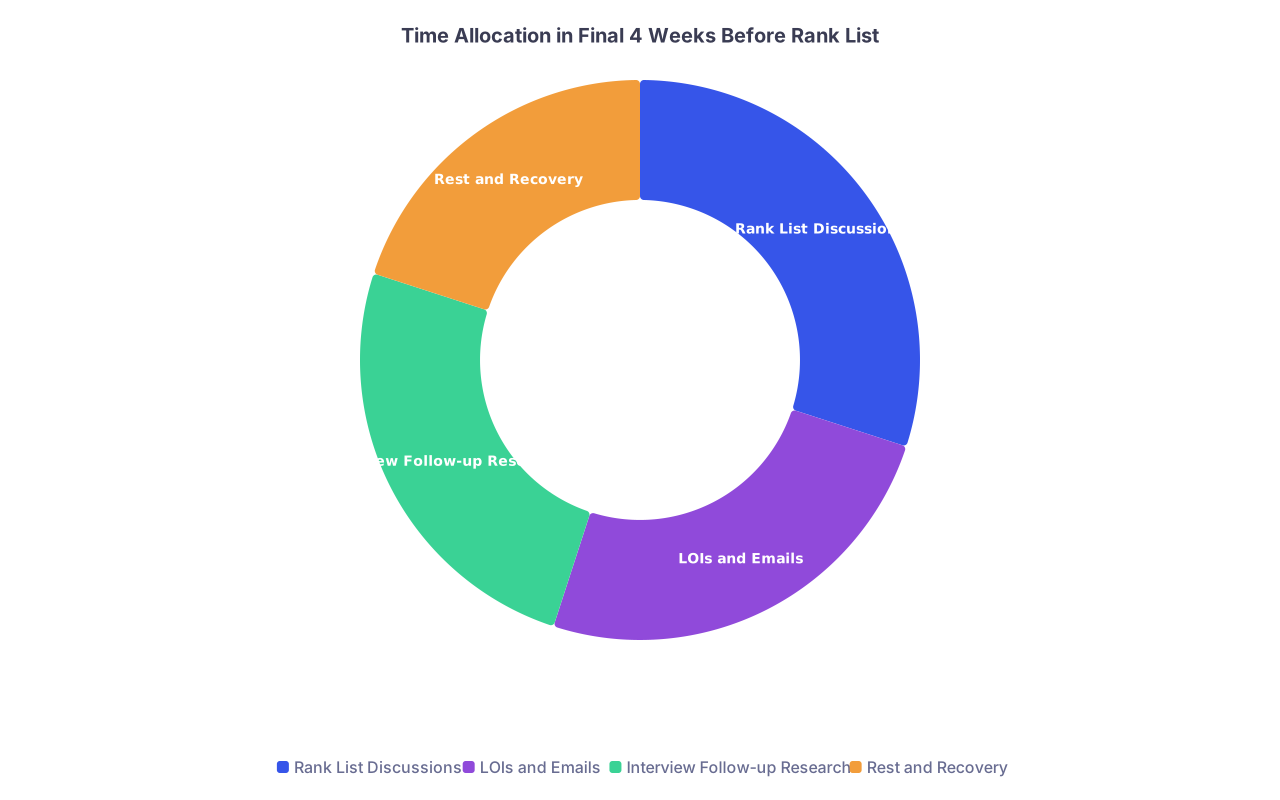
| Category | Value |
|---|---|
| Rank List Discussions | 30 |
| LOIs and Emails | 25 |
| Interview Follow-up Research | 25 |
| Rest and Recovery | 20 |
And yes, you do need some rest in that pie chart or you’ll start making dumb, fear-based choices.
11. A quick word about honesty and overpromising
I’ve seen this a few too many times: couples panic, scatter identical “You are my #1” letters to multiple programs or mislead about how tied to the region they truly are.
Two problems:
- PDs talk. Informally, but they do.
- You might actually get what you said you wanted—and realize you lied to yourself too.
If you say “You are my number one” in an LOI, treat that like a contract with your own integrity. If you say “I’m ranking you highly,” that gives you some room—as long as it’s true.
Same with couples constraints. If you say, “We are only ranking programs in [City],” then don’t quietly rank something far away at #2 “just in case.” Either admit you’re still open, or commit and live with the outcome. But don’t play both sides and expect everyone else to pretend they didn’t notice.
12. Big picture: what you’re really signaling when you integrate couples info well
When you handle this correctly, your LOI sends several subtle but important signals:
- You’re capable of managing complex life variables without drama
- You can advocate for your needs without making them someone else’s problem
- You’re honest about constraints but still focused on being the best resident you can be
Program directors are constantly scouting for red flags. “Chaotic personal life spilling into professional decisions” is a major one. A clean, grounded paragraph about your partner actually becomes a green flag if done well.
You’re showing them the kind of colleague they’d be dealing with when schedules go sideways at 3 AM and childcare falls through. That matters more than you think.

FAQ (Exactly 4 Questions)
1. Should I ever not mention the couples match, even if we’re using it?
Yes. If a program is truly not going to be ranked in a way that depends on your partner’s location (for example, it’s your clear solo #1 and your partner has flexibility), you might leave couples details out and keep the LOI purely about your fit. Mention couples info when geography or your partner’s status meaningfully affects your rank list or the program’s understanding of your intentions.
2. Can I ask a program directly to help my partner get an interview?
You can, but I don’t recommend doing it in your LOI. If you’re going to try this, it should be a separate, very cautiously worded email, ideally after your interview, addressed to someone with enough seniority but not in a way that pressures them. Even then, it often does not work and sometimes irritates them. Use this sparingly and accept a quiet “no” as the most likely outcome.
3. What if we break up after sending couples-related LOIs?
Painful, but it happens. If the breakup changes your geography or rank list meaningfully, the professional thing is to send a brief follow-up note to any program where your LOI explicitly stated a couples constraint. You do not need to give personal details. Something like: “Since my last email, my personal circumstances have changed and I am no longer participating in the couples match. My interest in [Program Name] remains strong and I will be ranking your program highly.” Short. Clean. Done.
4. How many programs should I send LOIs with couples info to?
For most couples, 1–3 programs where the information genuinely matters is plenty. Your clear #1 (or joint #1 institution) gets the explicit “#1” letter. Other key programs in your realistic geographic cluster can get softer interest letters that still mention the couples context. If you’re blasting 10+ programs with couples language, you’re not being strategic—you’re just anxious. Pull it back and prioritize where the signal might actually move the needle.
You are not just trying to “squeeze in” a sentence about your partner. You’re building a coherent story about what you want, where you can realistically go, and how that intersects with another human’s training or career.
Do that cleanly now, and you’ll walk into residency orientation with fewer regrets and fewer “what ifs.” With these pieces in place, the next big move is ranking strategy as a couple—and that’s a whole separate game of its own.