It’s mid-January. You’ve been refreshing your email for weeks. The school you care about most finally moves your status from “under review” to… “Interview Waitlist.” Not rejected. Not invited. Purgatory.
You read the portal message three times. It says some version of: “Due to a high volume of qualified applicants, we are unable to offer you an interview at this time. You have been placed on our interview waitlist.” Maybe they add: “No additional information is required.”
You do not believe that last sentence. Nor should you.
This is exactly the situation where a targeted, smart interest letter can help you. Not magic. Not a golden ticket. But a quiet, real lever you can pull while everyone else just sits and waits.
Let’s walk through how to use it without being annoying, desperate, or ignored.
1. What “Interview Waitlist” Actually Means (And What It Doesn’t)
First, decode where you actually stand.
Programs and schools love vague language. “Hold,” “under consideration,” “tier 2,” “priority reserve,” “postponed decision.” Functionally, most of these are “we might interview you if things open up.”
Here’s the honest translation of “Interview Waitlist”:
- You passed a baseline screen.
- You are competitive on paper.
- Other people, for now, are slightly ahead of you.
- If enough people decline, cancel, or no-show, they’ll dip into this pile.
They’re juggling:
- Limited interview days and faculty time
- Yield protection (who’s likely to come if accepted)
- Institutional priorities (home students, mission fit, diversity goals, strong ties)
They’re also dealing with melt: people canceling interviews as they get better options or acceptances.
All of that means: movement happens. Interview spots do open, especially:
- Right after interview invites go out (first wave of cancellations)
- After the first interview dates (when people decide they hate a place)
- As deposit deadlines or rank list deadlines get close
So no, you’re not dead in the water. But you’re also not high priority by default.
That’s where a well-executed interest letter can move you from “generic waitlist body” to “actual person we remember.”
2. Should You Even Send an Interest Letter?
Not every waitlist deserves your effort. Some do. Some really do not.
Here’s how I’d think about it.
You should strongly consider sending a letter if:
- This school/program is in your realistic top 5
- Their mission and your background clearly align (not imaginary, actually align)
- You have something specific to say beyond “I really like your program”
- You have at least a few weeks to months left in their interview season
You can skip or keep it minimal if:
- It’s a “would be nice” place, but you’d easily go elsewhere over them
- The portal explicitly says: “Do not send additional communications” and they historically mean it
- It’s March for medical school or very late in the residency season and they’re basically done interviewing
If you’re not sure how much weight they give to letters of interest/intent, check SDN/Reddit/old threads, or ask upperclassmen who successfully interviewed there. Some schools basically ignore interest letters; some absolutely do not.
3. Interest Letter vs Letter of Intent vs Update Letter
People mix these up constantly. Admissions doesn’t always care about the labels, but you should, because it changes what you commit to.
Quick breakdown:
| Letter Type | Main Purpose | Commitment Level |
|---|---|---|
| Interest Letter | Show strong ongoing interest | Low – “very interested” |
| Letter of Intent | State they are #1 choice | High – “I will attend” |
| Update Letter | Provide new accomplishments | None – just info |
If you are waitlisted for an interview, you’re usually writing an interest letter, possibly with updates embedded.
You do not send a letter of intent to a place that has not even invited you yet, unless:
- It’s truly your number one,
- You understand the word “intent” means something, and
- You’re ready to look ridiculous if you later choose somewhere else.
Most of the time, you’ll stick with: “Very high interest” language, not “you are my clear first choice and I will absolutely attend” language.
4. Timing: When To Send An Interest Letter
You’re on the interview waitlist. Now what?
You need to pick your spot: not too early, not when it’s over.
Basic rule of thumb
- As soon as you’re waitlisted: wait 5–10 days. Don’t fire off a letter the same hour; it screams panic.
- After that, send one solid, high-quality interest/update letter.
- If the season runs long and you’re still in limbo 4–6 weeks later, you can consider one additional, short check-in if you have something truly new to add.
Best timing leverage points:
- Right after New Year (for med schools and some residencies) when they’re recalibrating who’s actually coming.
- After big interview waves, when they see no-show rates.
- Before their last interview block, if you know roughly when that is.
Do not email them every 10–14 days fishing for a status change. That’s how you get your name remembered for the wrong reason.
5. Who To Send It To (And How)
This part people overcomplicate.
Default target:
- Admissions email listed on their site, or
- Program coordinator for residency, or
- Named contact for “Admissions inquiries” in your portal
Ideal upgrade:
- Address the letter to the Dean/Director of Admissions (med school)
- Or Program Director and Coordinator (residency)
- CC’ing the coordinator is fine. They’re the actual gatekeepers of logistics.
Subject line examples:
- “Applicant Update and Continued Interest – [Your Name], [AMCAS/AAMC/ERAS ID]”
- “Interview Waitlist – Continued Strong Interest – [Your Name], [ID]”
Attach as a PDF (one page), named something boring and clear:Lastname_Firstname_InterestLetter_[School].pdf
Put a short, polite 2–3 line email body:
“Dear [Name],
Thank you for your continued consideration of my application. I’ve attached a brief letter updating my file and expressing my strong interest in [School/Program]. I remain very enthusiastic about the opportunity to interview.
Sincerely,
[Name]
[ID]”
That’s it. Do not write a novel in the email body.
6. What Actually Belongs In The Letter (Line by Line)
Now the meat. One page. No more. If you go to a second page, you’re doing it wrong.
You’re trying to accomplish 4 things:
- Confirm you’re still very interested
- Show fit with specifics
- Offer meaningful updates or context
- Make it easy to picture you actually there
Here’s a structure that works.
1) Header and opener
Standard letter format. Date. Their address. Your name and ID in the top right or below your signature.
Opening paragraph (3–5 sentences):
- Acknowledge your waitlist status
- Reaffirm that you remain very interested
- One specific, non-generic reason why
Example:
Dear Dr. Smith and Members of the Admissions Committee,
Thank you for continuing to consider my application to [School of Medicine/Residency Program]. I understand I am currently on the interview waitlist, and I want to express my strong ongoing interest in the opportunity to interview. [School/Program] remains one of my top choices because of its [specific, real feature], which aligns closely with my interests in [X, Y].
Don’t say “top choice” unless you mean it. “One of my top choices” is accurate and safe.
2) Specific fit: two or three sharp points
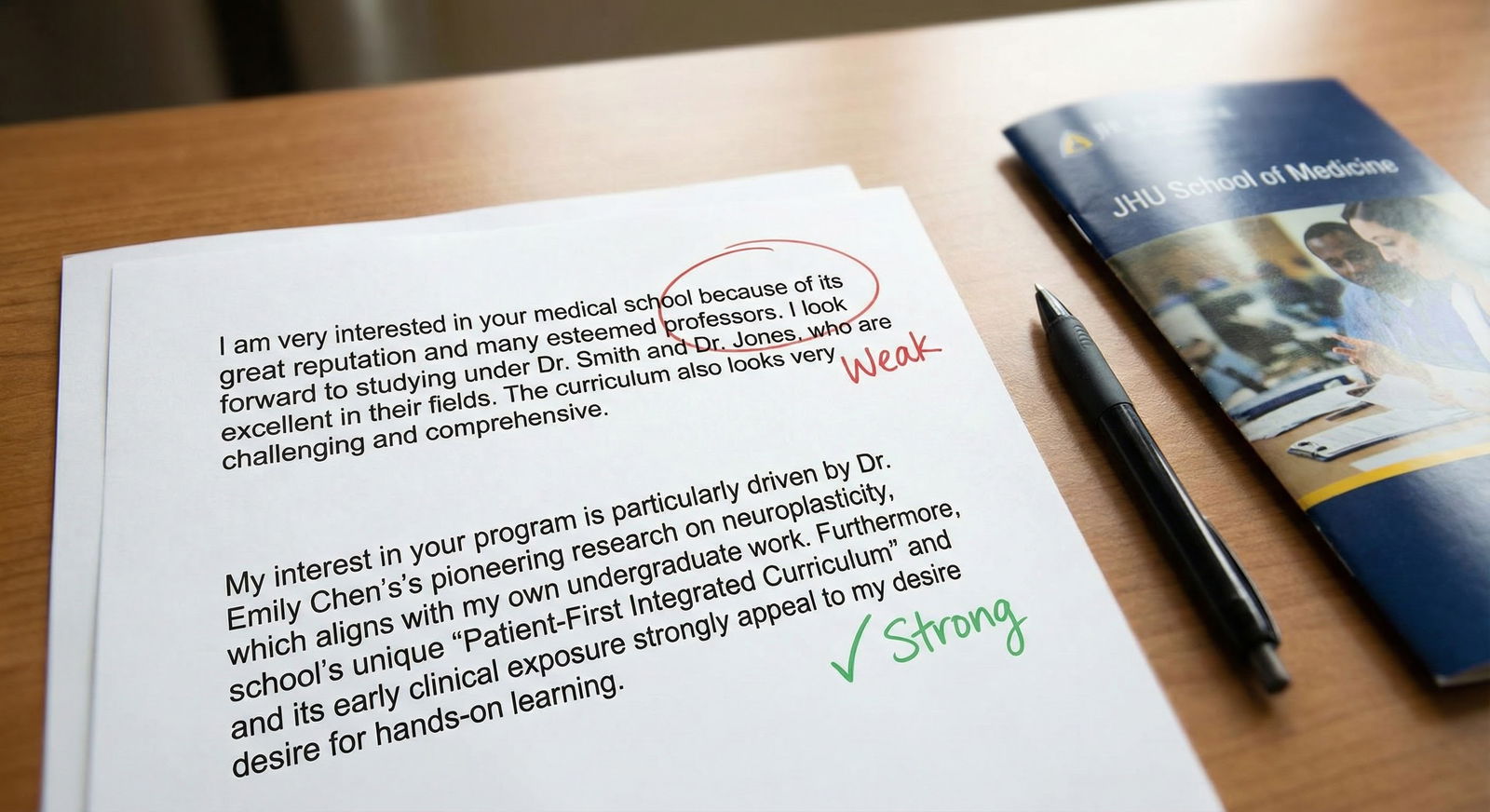
This is where bad letters fall apart. “Great curriculum” and “diverse patient population” are filler. Everyone writes that.
You want 2–3 short, specific bullets in paragraph form:
- Named faculty or tracks that realistically align with your past or planned work
- Concrete program elements that you cannot just copy-paste across schools
- Geographical/family reasons only if they’re compelling and not the entire story
Example:
During this application cycle, I’ve reflected further on how my experiences align with [School/Program]. In my work at the free clinic, I developed a strong interest in caring for patients with chronic liver disease. The opportunity to learn from faculty like Dr. Patel in your hepatology division, and to participate in the [X Liver Disease Initiative], fits directly with my clinical and research goals.
I am particularly drawn to your [longitudinal clinic / global health track / specific rotation], as it mirrors the continuity model that has been most meaningful to me as a student.
If you can’t name anything precise, you did not do your homework.
3) Updates: what’s new since you applied
This is critical. If nothing has changed in your life in 6–9 months, that raises a different question.
Keep it selective. Think:
- New leadership roles that are real, not “I’m now treasurer of a group of 4 people”
- Manuscripts accepted or submitted (yes, include “submitted” or “in press” honestly)
- Presentations, abstracts, or awards
- Step 2/COMLEX 2 scores (if strong and not already known)
- New clinical responsibilities that reflect maturity
Write it in one tight paragraph or a short list embedded in prose:
Since submitting my application, I have continued to strengthen my preparation for medical training. In November, I was promoted to lead student coordinator at our student-run clinic, where I now supervise and teach junior volunteers and coordinate our weekly quality improvement meetings. I also presented a poster on [topic] at the [Conference], and our related manuscript was recently accepted for publication in [Journal]. These experiences have reinforced my commitment to caring for underserved populations and to contributing to academic medicine.
If you have test scores you’re proud of:
I also received my Step 2 CK score of 255, which I hope provides additional evidence of my readiness for your rigorous training environment.
Do not bury a bad score in there. If it’s weaker, focus on your rotations, evals, and concrete performance.
4) Personal stake: why this place, for you
This is the emotional bridge. Not cheesy. Just honest.
Examples:
- Ties to the city or region that suggest you’re likely to come and stay
- Family situation (partner’s job, kids, caregiving) if you’re comfortable sharing
- Longstanding connection: you grew up there, volunteered there, did research there
Having grown up in [region] and trained in safety-net settings that resemble [Hospital System], I can realistically see myself building a long-term career in this community. My partner has recently accepted a position in [city], which further solidifies our plan to remain in the area. If given the chance to train at [Program], I would be excited not only to learn there, but to stay and serve this patient population over the long term.
Programs care about this more than they admit: who’s likely to accept and stay.
5) Close with clear but honest enthusiasm
Wrap with one short paragraph:
I recognize that interview slots are limited and appreciate the difficulty of these decisions. If an interview spot becomes available, I would be genuinely grateful for the opportunity to speak with you and learn more about [School/Program]. Thank you again for your continued consideration of my application.
Sincerely,
[Name]
[ID]
No begging. No melodrama. Just professional and direct.
7. How Much Does This Actually Help?
The unfair answer: it depends on the place.
But I’ve watched the following scenarios play out over and over:
Two similar applicants on the interview waitlist. One sends a sharp, specific interest/update letter. Later, a single interview slot opens. The name they’ve seen recently—attached to concrete achievements and clear fit—gets the invite.
Programs under pressure late in the season to meet mission goals (primary care, rural, research heavy, etc.) go back through their list looking for people whose letters scream “this is actually my thing.” Those people get called.
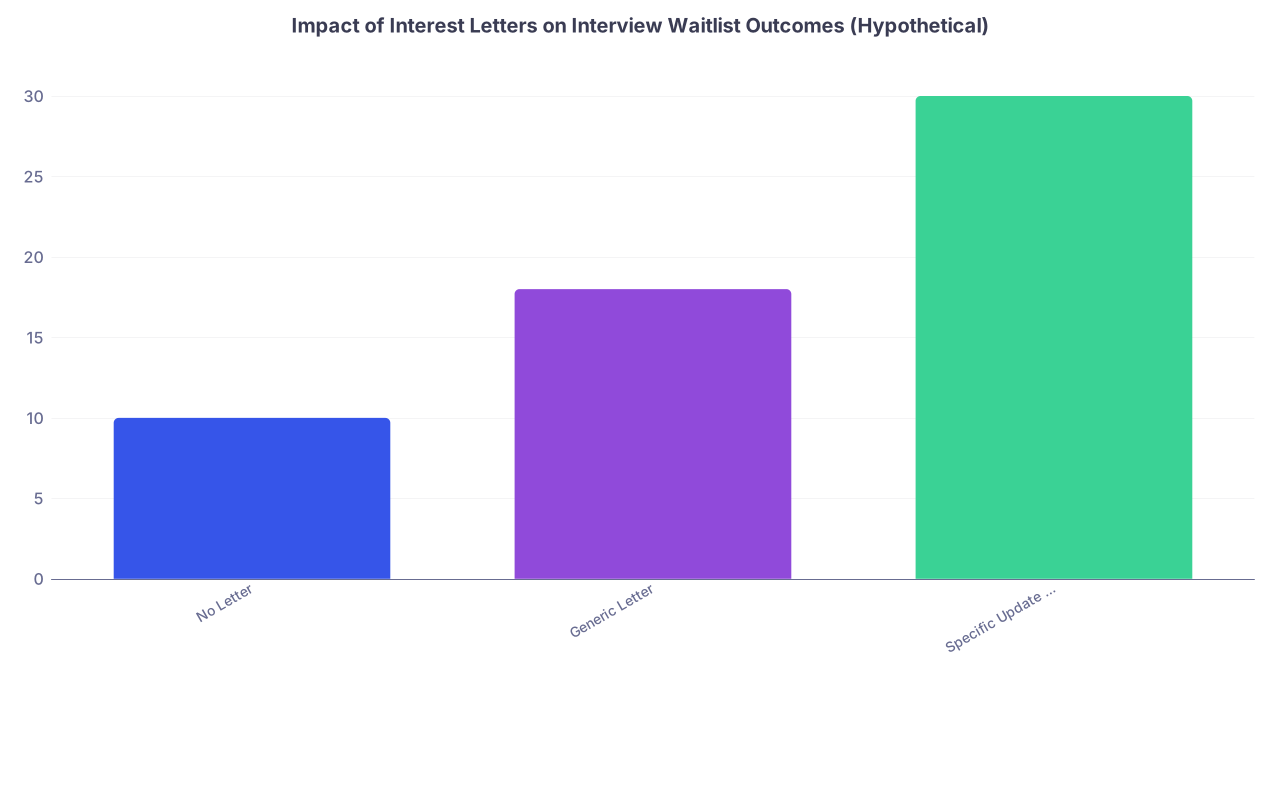
| Category | Value |
|---|---|
| No Letter | 10 |
| Generic Letter | 18 |
| Specific Update + Fit Letter | 30 |
Are those numbers real? No, this is illustrative. But the pattern matches what coordinators and PDs quietly say: content and specificity matter. Generic “I remain very interested” form letters may move the needle a little. High-quality, clearly tailored letters can matter more.
And sometimes, yes, it changes nothing. That’s reality. But you control what you can control.
8. Common Mistakes That Get Your Letter Ignored
If you’re going to bother, avoid these.
Writing a copy-paste letter
If I can replace the school name with another program and nothing breaks, you wasted the opportunity.Sounding desperate or transactional
“I will absolutely attend if accepted” sent to five schools is dishonest, and they know people lie. Also: don’t talk about how “devastated” you were to be waitlisted.Making it all about prestige
“Your program’s reputation and ranking…” They’ve read that 200 times. It makes you sound shallow and replaceable.Rehashing your entire personal statement
This is not “My life story, Part II.” Assume they know the basics; give them new angles and updates.Being vague about updates
“I have continued to grow as a leader and clinician” means nothing. Tell me what you did. In 1–2 tight sentences.Overemailing after sending the letter
You send the letter. Then you send a second email “just checking if you received my letter.” Then a portal message. That’s how you become That Applicant.
9. What To Do After You Send It (And How To Stay Sane)
You send the letter. Now you want to watch your portal like a hawk. Don’t.
Realistically, your steps are:
- Document when and to whom you sent it (simple spreadsheet).
- Do not send another message for at least a month unless you have a substantial new update.
- Keep working on what’s in front of you: rotations, research, Step 2, current job.
If they respond:
- A short “thank you for the update; we’ll add this to your file” is normal.
- No response at all is also normal. Silence does not mean it hurt you.
If weeks go by and nothing happens: that doesn’t mean your letter was useless. It means the interview math and class composition didn’t break your way. There’s a lot of randomness in who cancels and when.
What you don’t do:
- Call them asking where you are on the waitlist. Many places do not rank it; they pull contextually (mission fit, specific needs).
- Ask, “Was my letter helpful?” while decisions are still ongoing. That just puts them in an awkward position.
10. If This School Is Truly Your #1: Using Intent Carefully
If you’re at the point where one specific school or program is clearly your number one, you might consider a Letter of Intent rather than just an interest letter.
Difference in tone:
- Interest: “One of my top choices,” “I am very enthusiastic about the possibility”
- Intent: “If accepted, I will attend,” “You are my first choice”
If you’re still waiting for an interview, a letter of intent is a heavier move. I’d only do it if:
- You’ve already interviewed at other strong places and, after reflection, still know this is #1
- You’re done shopping for prestige; you actually know where you’d be happiest
- You’re prepared to follow through, even if a shinier name appears later
Programs absolutely care about intent from credible applicants. But if your class or specialty is small, and word gets around that you told multiple programs they were “unequivocally” your first choice, you damage your reputation.
If you’re not ready for that commitment, stick to high interest, high specificity, and let that do the work.
11. Quick Example Skeleton You Can Adapt
Not a template to copy word-for-word, but a skeleton you can plug into:
- Opening: thank them, acknowledge interview waitlist, reaffirm strong interest
- One paragraph on why them, with at least 2 concrete, named elements
- One paragraph on what’s new since you applied (2–4 key updates)
- One short paragraph on personal stake/fit (location, mission, long-term plan)
- Simple, respectful close
12. The Bigger Picture: You’re Practicing How To Advocate For Yourself
This situation sucks. You’re qualified, but sidelined. An interest letter will not fix the system. It will not override big red flags or a huge step score gap.
But using an interest letter well does build a skill you’ll need again:
- When a rotation director “forgets” to send your grade
- When a PD is on the fence about ranking you higher
- When you want a specific fellowship or job and you’re not their first pick
Same muscles:
- Be clear about your interest
- Show why you fit, specifically
- Provide new, relevant info that changes the calculus
- Be persistent, but not obnoxious
That’s the game.
Key points to walk away with:
- Being on an interview waitlist means you’re in range; a smart, specific interest letter can tilt marginal decisions in your favor—but only if it’s tailored, concrete, and honest.
- Send one high-quality, one-page letter to the right person, with real updates and clear fit; avoid generic praise, desperation, and overcontacting.
- Use this as practice for professional self-advocacy: you’re not begging for a favor—you’re making it easier for a busy committee to see why you’re a good bet.