
The blunt answer: No, you should absolutely not send a letter of intent to every program you interview with. That’s not strategy. That’s spam with a header.
Let’s walk through what actually works — and what quietly hurts you.
The Core Answer: One True LOI, A Few Strong Signals
A real letter of intent in residency land means one thing:
“If you rank me, I will rank you #1.”
That’s it. It’s not “you’re one of my favorites.” It’s not “top 3.” It’s not “high on my list.” A genuine LOI is a promise. You break that too often, and yes, programs remember. PDs talk.
Here’s the framework I recommend:
- 1 true Letter of Intent – sent to your #1 program only
- A few (2–5) strong interest / love letters – “I plan to rank you highly” type, honestly worded, no promises
- Polite thank-you emails – for every place you interview if you want, short and low-effort
Anything beyond that — blasting LOIs to every program — comes off as desperate, dishonest, and unsophisticated. It does not help your rank position.
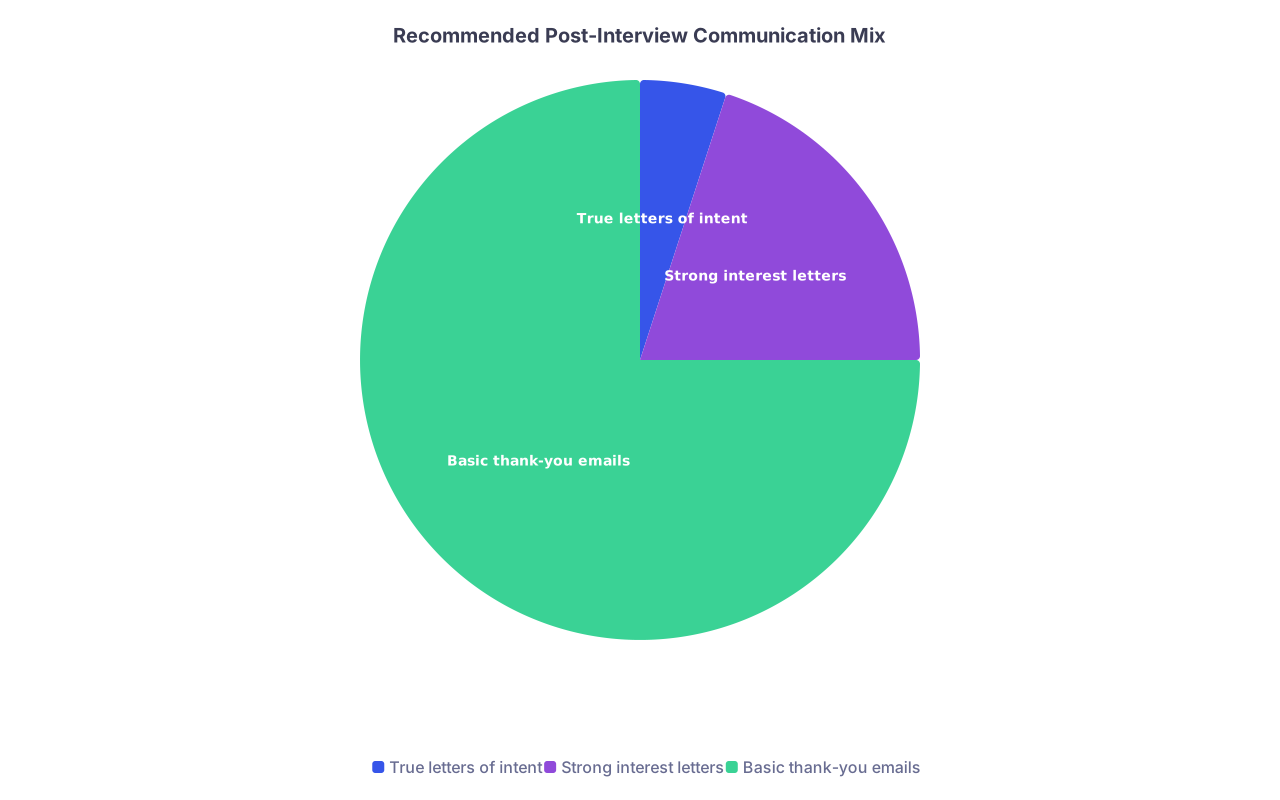
| Category | Value |
|---|---|
| True letters of intent | 1 |
| Strong interest letters | 4 |
| Basic thank-you emails | 15 |
Why You Should Not Send LOIs to Every Program
1. Programs know you can’t rank 15 places #1
PDs aren’t naive. If you send:
- “You’re my top choice”
- “You’re my clear #1”
- “I intend to train at your program”
…to more than one place, you’ve left the realm of strategy and entered the realm of lying.
And here’s the part students underestimate: faculty and PDs compare notes—especially in small specialties or tight regions. I’ve literally heard, “Funny, they told us we were their clear #1 last week,” over lunch at a conference.
You might not get “caught” formally. But if you do, you’ve just signaled:
- Poor judgment
- Dishonesty under low stakes
- Willingness to say whatever you think someone wants to hear
That’s not the resident anyone wants.
2. Over-communication dilutes real enthusiasm
If every program gets a 1,000-word essay about how they’re your soulmate, none of them means anything.
Programs read these signals relatively fast:
- A short but specific email that references faculty, cases, or rotations you discussed = strong signal
- A generic, clearly copy-pasted “you are my perfect fit” sent on the same date as your other 18 programs = background noise
When you tell everyone they’re special, nobody is.
3. You’re wasting energy you should spend on rank list clarity
Late-January / February energy should go into:
- Ranking programs in a way that matches your actual values
- Talking to mentors who know you and the field
- Considering geography, family, wellness, and training quality realistically
You don’t need 15 LOIs. You need one clear #1 and a thoughtful list.
What Actually Works: A Clean Communication Strategy
Here’s the system I’ve seen work for dozens of applicants in IM, surgery, EM, psych, and others.

Step 1: Decide your true #1
After interviews are done (or once you’re 95% sure), ask:
- Where would I be genuinely thrilled to match, above all others?
- If I got into every program I interviewed at, where would I sign today?
That program gets:
- One clear, honest, unambiguous Letter of Intent
- Sent once you’re confident, usually January–early February
Key: don’t send a “maybe LOI” then change your mind. Pick carefully.
Step 2: Draft a true Letter of Intent (for ONE program)
Your LOI should:
- State your intent clearly
- “I am writing to let you know that I intend to rank [Program Name] as my first choice on my rank list.”
- Anchor it to specifics
- Name faculty, residents, cases, curriculum, clinical sites, or vibes that genuinely resonated with you.
- Connect your background to them
- “My interest in X, my prior work in Y, and my long-term goal of Z align with your program’s focus on…”
- Keep it one page max
- Tight, respectful, professional.
Don’t write a novel. PDs don’t have time.
Step 3: Send “strong interest” emails to a few programs
These are not LOIs. You don’t promise #1. You simply send a clear, enthusiastic signal.
Language that works:
- “I plan to rank [Program] very highly on my list.”
- “Your program remains one of my top choices.”
- “After completing all my interviews, I continue to feel that [Program] is an excellent fit for my training.”
Avoid phrasing that implies exclusivity if it’s not true:
- Don’t say “top choice” unless you genuinely mean the top.
- Don’t copy-paste your LOI template and just change the name.
These messages can be shorter than an LOI:
- 1–2 tight paragraphs
- Reference something specific from your interview day
- Remind them briefly who you are (school, degree, or a notable detail)
Step 4: Optional short thank-you emails everywhere else
If you want, you can send short thank-yous to all programs you interviewed with:
- Within 24–72 hours of the interview
- Simple and direct
Example structure:
- Subject: “Thank you – [Your Name], [Specialty] applicant”
- 3–5 sentences total
- One concrete callback to your conversation or the day
- No ranking language, no promises
These are fine. They’re polite. They won’t hurt you. They also won’t magically drag you 20 spots up a rank list. Treat them as courtesy, not strategy.
How Programs Actually View Letters of Intent
Here’s the painful truth: some programs care; some don’t; few care as much as applicants believe.
| Program Type | Typical View of LOIs |
|---|---|
| Highly competitive academic | Mild tie-breaker, not huge |
| Mid-tier university | Helpful signal in close calls |
| Community program | Variable, sometimes valued |
| Very top tier "name brand" | Often noise, not decisive |
| Small / niche specialty | Can matter more |
Patterns I’ve actually heard from PDs and APDs:
- “If we’re already high on someone, an LOI might nudge them up a tiny bit.”
- “If we’re lukewarm on someone, no LOI will fix that.”
- “Most letters say the same things, and many sound dishonest.”
So does it help? Sometimes. Marginally. Especially as a tie-breaker among a group we already like.
It never replaces:
- Strong SLOEs / letters
- Good interview performance
- Consistent record aligned with the specialty
And it absolutely can hurt if it’s manipulative or obviously copy-pasted.
Ethical Lines You Should Not Cross
Let me be very clear on this:
You should not:
- Send multiple programs “You are my #1”
- Imply they are your top choice if they’re not
- Let a mentor send conflicting “this is their top program” emails for different places
Match rules technically focus on coercive behavior from programs, but your own ethics still matter. Just because you’re under pressure doesn’t justify lying.
You can:
- Express strong interest in multiple programs honestly
- Say “top tier,” “top group,” “ranked highly” when that’s true
- Change your mind about your rank list after an interest email (as long as you didn’t explicitly promise #1)
The line is false promises, not changing your mind in good faith.
Concrete Templates (That Don’t Make You Sound Ridiculous)
Use these as skeletons. Personalize or they’ll sound like everyone else.
1. True Letter of Intent (ONE program only)
Subject: Letter of Intent – [Your Name], [Specialty] Applicant
Dear Dr. [PD Last Name] and the [Program Name] Residency Selection Committee,
I am writing to let you know that I intend to rank the [Program Name] [Specialty] Residency Program as my first choice on my rank list.
After completing my interviews, I continue to feel that [Program Name] is the best fit for my training and long-term goals. I was particularly impressed by [specific feature – e.g., your commitment to underserved populations at X clinic, the resident autonomy at Y hospital, the structured X curriculum, etc.]. My conversations with Dr. [Faculty] and several residents confirmed that this is a program where I would be challenged, supported, and able to grow into the kind of physician I want to become.
My background in [briefly mention 1–2 relevant experiences or interests] aligns strongly with the opportunities at [Program Name], especially [tie 1–2 specifics to the program]. I would be honored to train at your institution and contribute to your resident community.
Thank you again for the opportunity to interview and for your consideration.
Sincerely,
[Your Name]
[Medical School]
AAMC ID: [ID]
2. Strong Interest (Top-but-not-#1 programs)
Subject: Continued Interest – [Your Name], [Specialty] Applicant
Dear Dr. [PD Last Name],
I wanted to thank you again for the opportunity to interview at [Program Name] and to let you know that I plan to rank your program very highly on my list.
The chance to [mention 1–2 specific things – e.g., train at both [Hospital A] and [Hospital B], work with [faculty or division], or be part of a tight-knit resident cohort] really stood out to me. My conversations with your residents reinforced my sense that [Program Name] would be an excellent fit for me both academically and personally.
Thank you again for your time and consideration.
Best regards,
[Your Name]
[Medical School]
AAMC ID: [ID]
3. Simple Thank-You (All programs if you wish)
Subject: Thank you – [Your Name], [Specialty] Interview
Dear Dr. [PD Last Name],
Thank you for the opportunity to interview with the [Program Name] [Specialty] Residency. I appreciated learning more about your program and especially enjoyed [specific moment or feature – resident panel, a particular case discussed, tour of X, etc.].
I’m grateful for your time and consideration.
Sincerely,
[Your Name]
Don’t mechanically send the same three sentences to 20 PDs with zero personalization. It shows.
When In Doubt: Use This Decision Flow
Use this logic the moment you’re tempted to mass-LOI every program.

| Step | Description |
|---|---|
| Step 1 | Finished Interviews |
| Step 2 | Send ONE true LOI to #1 |
| Step 3 | Wait and think, talk to mentors |
| Step 4 | Identify next few top programs |
| Step 5 | Send honest strong interest emails to 2-5 programs |
| Step 6 | Optional short thank-yous to others |
| Step 7 | Finalize honest rank list |
| Step 8 | Do I have a clear #1? |
If you find yourself thinking, “Maybe I’ll just tell 4 programs they’re my #1,” stop. That’s your red flag.
FAQ: Letters of Intent for Residency (5 Quick Answers)
1. Can a Letter of Intent actually move me up a rank list?
Sometimes, but usually only at the margins. If a program already likes you and you’re clustered with a group of similar candidates, a sincere LOI can bump you a bit. It will not rescue a weak file or a bad interview. Think “tie-breaker,” not “make-or-break.”
2. What if I sent an LOI and later change my mind about my #1?
If you explicitly said “I will rank you #1” and then don’t, you’ve crossed an ethical line. Programs might never find out, but you’ll know you lied. Better approach: don’t send a true LOI until you’re certain. If you’re not sure yet, stick with “I plan to rank you highly” language instead of an absolute promise.
3. Should I tell a program if they’re my ‘top 3’ or ‘top 5’?
You can, but it’s not that helpful and often sounds like hedging. Better: use phrases like “rank you highly” or “one of my top choices.” Programs understand that as genuine enthusiasm without pretending they’re #1. “Top 3” can sound oddly transactional and is easy to overuse.
4. Do programs get annoyed by too many emails?
Yes, some do. PD inboxes are brutal in January/February. One thoughtful email is fine. A thank-you plus a later interest email is usually fine. Weekly “just checking in” messages or multiple long essays? Annoying and pointless. When in doubt: fewer, more targeted, more specific.
5. Should I ask my mentors to email the PD on my behalf after interviews?
If your mentor genuinely knows you well and knows the PD, a single, sincere advocacy email for your top one or two programs can help. But don’t orchestrate a campaign where three different attendings tell three different programs “this is their top choice.” Keep your story consistent and your asks reasonable.
Open your running program list right now and mark exactly one program as your true #1. That’s the only place that deserves a real letter of intent — everything else should get honest, measured, and specific interest, not empty promises.