
Are you about to tell two programs they’re your “absolute top choice”?
Stop. That is the mistake that quietly wrecks otherwise solid applications every single year.
Everyone talks about “love letters” to residency programs like they are some harmless, feel-good tradition. They are not. A true “number one” letter of intent is a binding ethical statement inside a system that still runs on trust, back-channel communication, and reputation.
Send that letter to more than one program and you are betting your entire professional reputation that no one will ever compare notes, no faculty will ever switch institutions, and no PD will ever talk.
They do. I have seen it.
This is not about scaring you away from expressing interest. It is about preventing you from making one of the few unforced errors that can do real damage in a small, gossipy world like medicine.
Let’s walk through the traps, the quiet consequences, and how to show interest without lying to anyone.
1. The ethical trap: why a “number one” letter is not just “enthusiasm”
Programs know you are playing a game. They are not naïve. But there is a big difference between:
- “I am very interested in your program.”
- “You are one of my top choices.”
- “I intend to rank your program first.”
That last one is not casual.
When you send a true “number one” letter, you are implying all of this:
- You have completed your interview season (or almost).
- You have compared programs.
- You have decided who is #1.
- You will submit your NRMP rank list with that program in the top position.
It is essentially an ethical contract, even if it is not legally enforceable.
Here is the part applicants underestimate:
Program directors and faculty take honesty very personally. They are used to patients lying, administrators spinning things, but they still expect trainees to be fundamentally straight with them. When you say “You are my number one,” they assume you understand what you are saying.
If you tell two different programs they are both your #1, here is where you step into real danger:
- You have now lied to at least one group of people who might:
- Sit on fellowship selection committees in 3–5 years.
- Write or block letters for you.
- Be asked informally about you by a colleague at another institution.
- End up on your home institution’s faculty later.
Medicine is small. Academic medicine is microscopic.
You do not need an official “NRMP rules violation” to be harmed. A simple, “We had an odd interaction with that applicant; I would be cautious,” said quietly in the right room, can cost you fellowships, jobs, or positions of responsibility later.
2. The communication web you are underestimating
You might think: “There’s no centralized database of letters. How would they ever know?”
Let me show you exactly how they find out.
2.1. Common overlap: faculty, alumni, and gossip
Residency leadership talks.
Not every day. Not about everyone. But they talk.
- A PD at Program A does fellowship at Program B.
- An APD at Program C used to be core faculty at Program D.
- Faculty from Programs E and F sit on the same national committee.
Now picture this scenario (not hypothetical; versions of this happen every year):
Program Director, over coffee at a national meeting, says:
“We had this applicant from State Med. Interviewed well. Sent us a letter saying we’re their absolute number one.”
Colleague responds: “Interesting. They told us the same thing.”
That is all it takes. One sentence.
You have now gone from “strong candidate” to “we cannot trust this person’s word” in two institutions at once.
2.2. The internal grapevine
Even inside a single city:
- County hospital program and university program share faculty.
- Children’s hospital is staffed by attendings with appointments at multiple residencies.
- Surgical subspecialists work across academic and community centers.
When you send multiple “number one” letters in the same city or region, the chance of cross-talk rises dramatically.
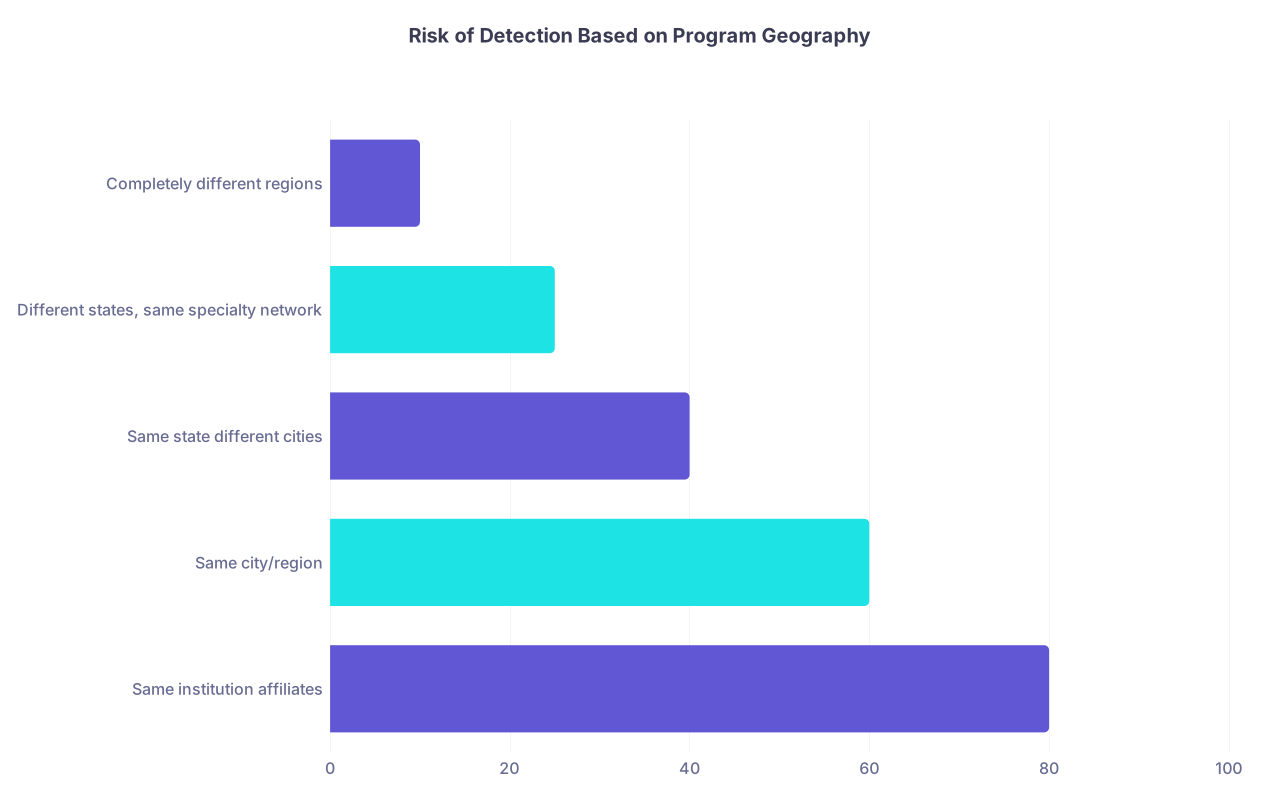
| Category | Value |
|---|---|
| Same institution affiliates | 80 |
| Same city/region | 60 |
| Same state different cities | 40 |
| Different states, same specialty network | 25 |
| Completely different regions | 10 |
You will not see this risk number anywhere official. But those relative differences are very real.
3. The concrete consequences you are not thinking about
The worst mistake is assuming: “What is the downside? If they do not find out, I might get a boost at two places.”
Let me be very clear about consequences.
3.1. Immediate cycle: you can drop on rank lists
If a program finds out you lied:
- Best case: You are moved down their rank list.
- Common case: You are removed from their list entirely.
- Occasional case: The PD emails your dean or home PD and expresses concern.
You will never know this happened. You will just not match there.
But damage like that does not stay contained.
3.2. Long term: reputation follows you
Imagine you match at Program A, but Program B finds out you lied to them. Over the next few years:
- Fellows and attendings from Program B rotate through your new hospital.
- They remember your name. They remember the deception.
- Down the line, you apply for fellowship. A PD from Program B is now on that committee.
Will they formally note “this person lied about rank intentions” on an official NRMP report? Probably not.
Will they quietly question your integrity when decisions are made between two similar candidates? Very likely.
And here is the really ugly version: sometimes program leadership changes. A PD or APD you lied to may:
- Move to your matched institution as new leadership.
- End up reviewing your promotion file.
- Be asked to sign off on your chief resident application.
Now you are trying to build trust with someone whose first interaction with you was dishonesty.
4. The match algorithm myth that tricks people into lying
A lot of applicants get into trouble because they only half-understand the match algorithm.
Here is the key point everyone should tattoo on their brain:
- The NRMP algorithm is applicant-optimal if you rank programs in your true order of preference.
In normal language:
You do not need to tell a program they are #1 to “improve your odds,” as long as you rank them #1 on your list. The algorithm already gives you that advantage.
Letters do not change the math. They can only change:
- How high a program chooses to place you on their list.
- Whether they get a positive or negative vibe about you.
Where you get into trouble is when you believe one of these very dumb, very persistent myths:
- “If I tell them they are my number one, they are almost obligated to rank me high.”
- “If I send multiple number one letters, I maximize my chances at multiple programs.”
No. What you maximize is the risk that someone will catch you and decide you are untrustworthy.
The algorithm rewards honest ranking. Not games.
You gain nothing structural from lying, only potentially a slightly warmer feeling from a PD who thinks you chose them. That is a terrible tradeoff if there is any chance of being caught.
5. Where people cross the line without realizing it
The actual email or letter is where otherwise decent people quietly drift into unethical territory.
Here is the spectrum you need to understand.
5.1. Phrases that are generally safe to use at multiple programs
These show strong interest without locking you into a lie:
- “I remain very interested in your program.”
- “Your program is among my top choices.”
- “I can see myself thriving in your training environment.”
- “I intend to rank your program highly.”
You can send those to several programs because they are true and non-exclusive.
5.2. Phrases that are ethically binding (and should be used once, if at all)
These are effectively “I will rank you first” statements:
- “I intend to rank your program first.”
- “You are my clear first choice.”
- “Your program is my number one choice for residency.”
- “If offered the opportunity, I will be honored to train at [Program] as my top choice.”
Those should go only to your actual #1.
Send them to two programs and you are doing the exact thing PDs complain about at national meetings every year.
6. Special scenarios: where you are most tempted to cheat
There are a few common situations where people talk themselves into sending multiple #1 letters. Let me walk through them and why they are dangerous.
6.1. The “I need a safety net” rationalization
Situation:
You like Program A the most, but you are terrified you might not match there. Program B is slightly less ideal but feels “safer.”
Thought process:
“If I tell both they are number one, maybe I get bumped up and secure at least one strong option.”
Problem:
- If they never talk, you gain maybe a tiny bump. Maybe.
- If they ever do talk, you lose trust with both. You could end up:
- Lower on both lists.
- Off one or both lists altogether.
You turned anxiety into a lie, and that lie into risk you absolutely did not need to take.
6.2. The couples match panic
Couples match applicants are at especially high risk of doing something rash.
Scenario:
You and your partner are trying to align programs across cities. You each have complicated rank lists. Someone suggests, “Maybe we each send multiple #1 letters to increase alignment odds.”
This is where careers go sideways:
- More programs involved = more faculty overlap = more chance someone compares notes.
- You now have two people’s reputations on the line, not one.
- If you get labeled as the “dishonest couple,” that can follow both of you into fellowship discussions.
There are ethical ways to communicate as a couples match:
- “We are couples matching and remain highly interested in your program.”
- “Your program is at the top of my list among [city] options.” But you cannot ethically tell three different programs they are your overall #1.
6.3. The late surprise favorite
You were certain Program X was your top choice. Sent them a #1 letter. Then you interview at Program Y unexpectedly late in the season and you love it.
Now you feel stuck. You regret the first letter and feel tempted to send a second.
Do not fix one lie with another. Do not compound your problem.
You have two honest options:
- Keep your original #1 ranking and honor what you already promised.
- Change your mind, rank the new favorite #1, but do not send another #1 letter. Accept that you cannot “double certify” your new preference.
No one can stop you from changing your rank list. But you still control whether you start stacking lies on top of a single mistake.
7. How to show strong interest without boxing yourself in
You do not need a “you are my #1” letter to show real enthusiasm. You just have to be precise.
Here is a simple framework that keeps you out of trouble:
Decide if you will send any true #1 letter at all.
You are not obligated to. Many people match perfectly fine without ever sending one.If you do send a true #1 letter:
- Do it once.
- Do it late enough that you are sure of your ranking (near final rank submission).
- Use explicit language: “I intend to rank [Program Name] first.”
For all other programs you like, use “highly interested” language:
- “Your program is among those I am most excited about.”
- “I will be ranking your program highly.”
Avoid artificial specificity that is functionally deceptive.
For example: “You are my top choice in [city].”
If that is literally true (you only interviewed at two in that city and they are actually above the other), fine. If not, you are playing semantic games that still smell like dishonesty.Answer PDs honestly if directly asked
Sometimes in a post-interview communication or phone call, a PD will ask:- “Where do we stand on your list?” Your options:
- If they are truly #1 and you are decided: say so.
- If you are not sure: “You are among my top programs, but I am still finalizing my list.”
- If they are not #1: never say they are. Ever.
8. The hidden red flag for programs: desperation + flattery
Program directors are not dumb. They can smell certain letters a mile away:
- Over-the-top flattery without specifics
- Copy-pasted generic paragraphs about “diverse patient population” that could apply to any program
- A sudden interest in their “research mission” when you never mentioned research in your interview
Now add on top of that a claim of “You are my #1.”
To them, this combo screams:
- “This applicant is desperate.”
- “This applicant is saying what they think we want to hear.”
- “This may not be reliable information.”
Even if you never send multiple #1 letters, an exaggerated, insincere tone can still backfire. That is another way to quietly drop on their list.
9. A clear rule set so you do not blow this
If you forget everything else, keep these rules:
| Situation | What You Should Do |
|---|---|
| You have a clear #1 program | Optional: send one honest letter stating you will rank them first |
| You like several programs a lot | Send “high interest” letters, no exclusive language |
| You feel unsure / list still fluid | Do not send any true #1 letters yet |
| You already sent one and changed your mind | Change your rank list if needed, but do not send another #1 letter |
| You are couples matching | Use careful, non-exclusive interest language at multiple programs |
And here is the ethical line you cannot cross without risk:
You may only tell one program you will rank them #1 overall.
Not “per city,” not “per region,” not “per categorical vs prelim.” One.
10. What to do instead of scheming with multiple #1 letters
If you are tempted to send multiple “you are my top choice” messages, usually it is because you are anxious about not matching.
That anxiety is real. Lying will not actually fix it.
Here is what actually helps your chances:
- Crafting a truthful rank list in the order you want to train.
- Sending well-written, specific, non-exclusive interest letters to programs you genuinely like.
- Making sure your application is complete, Step scores updated, and any major red flags are addressed responsibly.
- Getting your home PD or a trusted faculty advocate to send a brief, supportive note to a few programs on your behalf. That carries far more weight than your own “you are my favorite” letter.
](https://cdn.residencyadvisor.com/images/articles_svg/chart-relative-impact-on-match-outcome-3624.svg "Relative Impact on Match Outcome")
| Category | Value |
|---|---|
| Strong application content | 90 |
| Faculty advocacy | 75 |
| Thoughtful rank list | 80 |
| Honest interest letters | 40 |
| [Multiple #1 letters](https://residencyadvisor.com/resources/letter-of-intent-strategy/how-multiple-letters-of-intent-get-you-blacklisted-quietly) | 5 |
Look at that last bar. Multiple #1 letters do almost nothing for you, and can still poison your file.
Your next step today
Open your email drafts or notes app right now and find any “letter of intent” language you are planning to use.
Highlight every sentence that implies exclusivity:
- “Number one”
- “Clear first choice”
- “Intend to rank you first”
Now ask yourself one hard question:
Exactly one program or more than one?
If the answer is anything other than “exactly one,” fix it today. Strip those lines down to honest, strong interest wording. Keep your integrity intact before you ever click send.