
The fastest way to destroy your credibility with a program director is a sloppy, dishonest letter of intent.
You think they cannot tell when you are bluffing? They can. They do. Every year.
You are playing with fire here. A letter of intent can help you slightly; it can also quietly kill your chances if you make the wrong moves. And no one will ever tell you it was the letter that did it.
Let’s walk through the fatal mistakes that make you look dishonest—and how to avoid nuking your reputation with a single email.
1. The “I’m Ranking You #1” Lie (And Yes, They Compare Notes)
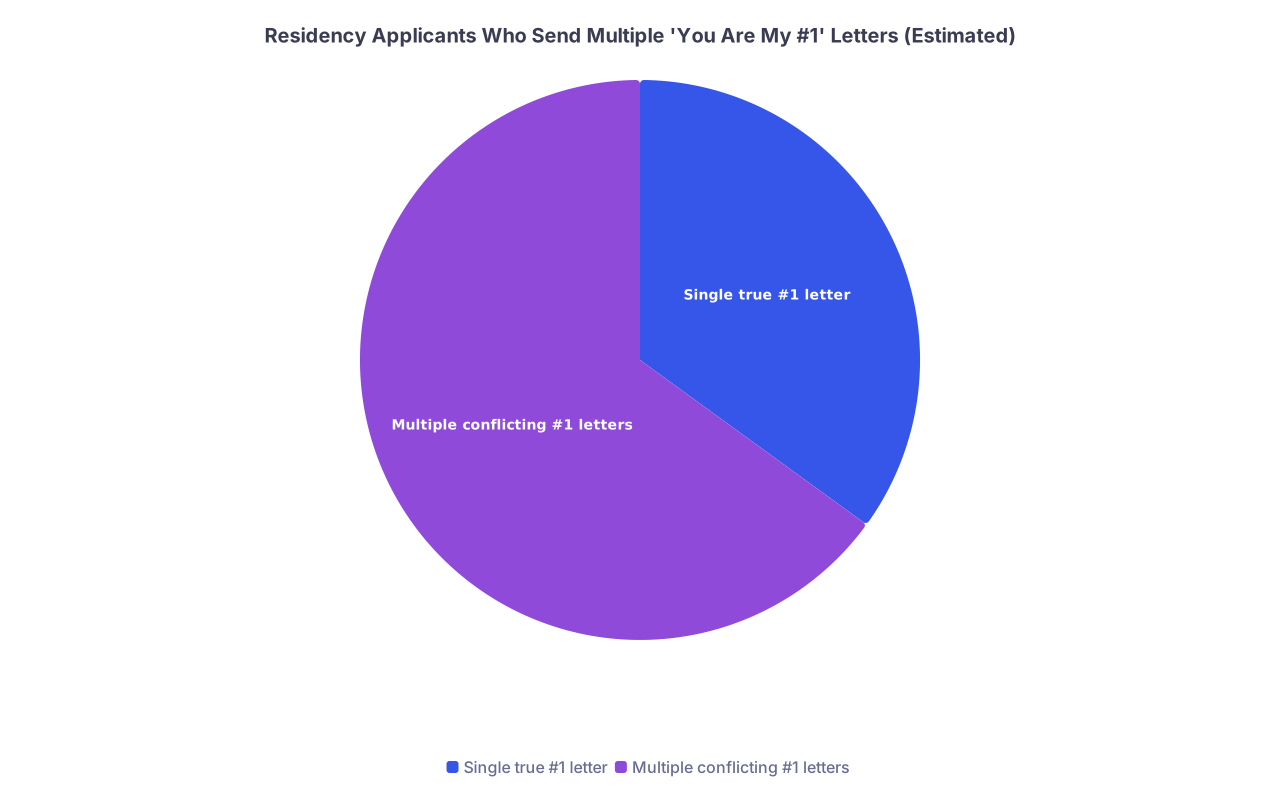
| Category | Value |
|---|---|
| Single true #1 letter | 35 |
| Multiple conflicting #1 letters | 65 |
The worst, most common integrity violation: telling more than one program they’re your “unequivocal #1 choice.”
Do not do this. Not “be careful.” Not “do it tastefully.” Just don’t.
Why it’s such a big deal:
- Programs talk. Not every day, not about every applicant—but they absolutely compare notes, especially in competitive specialties or small regions.
- PDs move. That APD you lied to at one place might be PD at your dream fellowship in five years. They remember names.
- Coordinators talk too. Some have been in their roles for 10–20 years. They’ve seen the same applicant send identical “you’re my top choice” letters to neighboring programs in the same city.
Here’s the part students don’t get: the Match algorithm already protects you. You do not need to flatter multiple programs with fake #1 claims. That doesn’t help you. It just makes you look untrustworthy if it’s exposed.
Red flags that scream “dishonest” here:
- You send three separate “I will rank you #1” letters.
- You use copy-paste language and forget to change a program name (yes, this happens more than you think).
- You send “you’re my #1” after the program has clearly signaled they’re not ranking you highly (interview felt dead, no contact, late invite, etc.). It looks desperate and insincere.
The honest, safe version:
- Choose exactly one program to tell “I will be ranking your program #1.”
- Use that phrase only if it’s true.
- Say it once. No hedging. No “one of my top choices” if you mean #1; and don’t say #1 if you mean “I’d be happy here but I prefer five other places.”
If you’re not sure who is #1 yet, then don’t write a #1 letter. Send a strong, specific “very interested” letter instead. More on that later.
2. Vague, Generic Flattery That Feels Manufactured

Program directors read hundreds of emails every interview season. You are not the first person to tell them:
- “Your program is a perfect fit for my goals.”
- “I loved my interview day.”
- “I would be honored to train at such a prestigious institution.”
This is background noise. Worse, if your whole letter reads like a thesaurus plus clichés, you look fake.
The mistake:
You try so hard to sound “professional” that you write like a ChatGPT impersonator with no actual memory of the program.
What feels dishonest:
- Statements that could be pasted into any program’s email with no change.
- Compliments that don’t match your record. (You’ve done zero research, yet pretend “strong research focus” is your priority.)
- Repeating phrases from their website like a mirror. PDs know their own marketing language; when you parrot it back, they roll their eyes.
How to avoid this:
Anchor your interest in concrete, specific observations from interview day or your research.
Weak:
“Your program’s dedication to education was evident throughout the day.”
Stronger:
“On interview day, the interns described their weekly SIM sessions and how the chiefs adjust the curriculum based on resident feedback. That kind of responsive teaching is rare; I haven’t seen it emphasized the same way elsewhere.”
Notice: a PD reading that can tell you were actually present, actually listening. That’s what reads as honest, even if they know your email is strategic.
If you can’t name:
- one specific rotation detail
- one named faculty member and what they said
- one structural element of the program (schedule, mentorship model, research support, community)
…then you haven’t earned the right to claim “your program is my ideal fit.” It sounds like a lie because, functionally, it is.
3. Overpromising Your Future Self (And Sounding Delusional)
There’s a quiet flavor of dishonesty students slide into: writing like they can guarantee future outcomes.
Things like:
- “If I match at your program, I will definitely pursue a clinician-scientist career and secure NIH funding.”
- “I am committed to becoming a leader in national cardiology societies.”
- “I will bring multiple grants and high-impact publications to your department.”
On paper, it sounds ambitious. To a PD, it reads as either naïve or unserious.
The mistake:
You mistake performative ambition for genuine commitment. You oversell your future to compensate for present weaknesses.
Residency leadership has seen residents burn out, switch specialties, leave academia, change paths completely. They know you have no clue yet who you’ll be in five years. Exaggerated certainty feels dishonest, even if you “mean it.”
Smarter approach that doesn’t trigger doubt:
- Tie your intentions to what you’ve already done.
- Use language of trajectory, not guarantees.
Dishonest-feeling version:
“I will become a leading researcher in inflammatory bowel disease.”
Credible version:
“My research to date has focused on inflammatory bowel disease outcomes, and I’m eager to continue that work with Dr X’s group, while staying open to refining my focus as I get more clinical exposure.”
See the difference? One sounds like a pose. The other sounds like a grounded adult who understands uncertainty.
If your letter leans heavily on “I will definitely…” and “I promise I’ll…”, read it again. It probably sounds more like a campaign speech than an honest reflection of where you are and where you’re headed.
4. Timeline Games and Backdoor Pressure

| Step | Description |
|---|---|
| Step 1 | Interview Completed |
| Step 2 | Send Single Clear LOI |
| Step 3 | Wait and Take Notes |
| Step 4 | Send Honest Interest Letters |
| Step 5 | Avoid New #1 Claims |
| Step 6 | Know True #1? |
| Step 7 | Late Jan? |
Another way applicants accidentally look dishonest: they play weird timing games.
Examples I’ve seen:
- Sending an “I will rank you #1” letter before they’ve finished all their interviews—then turning around and sending another one to a later program they liked more.
- Sending a panicked LOI the day after hearing a rumor that “this program likes letters.” It reads reactive, not authentic.
- Writing a “I’m ranking you #1” email in mid-February to a program that barely remembers you, trying to influence their list at the last second. It feels transactional and opportunistic.
PDs are not stupid. They know the calendar. They know when interview season ends. They can guess when you’ve seen other programs.
A late, dramatic shift in your tone (“After careful reflection, your program is now my clear #1”) can sound like you’re just trying to game the match, not expressing any deep conviction.
How to avoid looking like a schemer:
- Decide your true #1 after most or all of your interviews, not after your second one.
- Don’t send a LOI in October. That’s just weird.
- Aim for late January to early February for a #1 LOI, depending on your specialty’s timeline.
- Do not send a second, contradictory #1 letter, even if your preferences evolve. That’s the risk you take by declaring early; better to wait than to lie.
If you’ve already messed this up and sent two conflicting “you’re my #1” letters? Own it. Don’t try to cover it up. But going forward in your career, remember how bad it felt and never repeat that pattern.
5. Copy-Paste Disasters and Sloppy Errors

Nothing screams “I don’t actually care about you” like:
- Using the wrong program name
- Mentioning a faculty member who doesn’t work there
- Referencing a “3+1 schedule” at a program that very proudly switched to X+Y
- Saying “When I visited your beautiful city of Chicago” to a program in Cleveland
These aren’t small typos. These are evidence-of-lies typos. They prove your letter was not actually about them.
Program directors and coordinators share these examples with each other. I’ve heard them read them out loud in offices with half-laughter, half-contempt.
What this signals:
- You likely sent the same “you’re my #1” letter to multiple places.
- You didn’t respect them enough to review carefully.
- Your supposed “genuine interest” is fake.
Your letter of intent has one job: communicate serious, specific interest. Sloppy copy-paste errors are the opposite of that.
How to protect yourself:
Create a simple verification checklist you run before sending any LOI:
| Item to Verify | What You Should Confirm |
|---|---|
| Program name | Exact spelling, correct institution |
| City and state | Matches actual program location |
| PD and coordinator names | Correct titles and spelling |
| Program details mentioned | Fit that specific program only |
| Rank statement (if any) | Consistent with your real list |
If any paragraph in your letter could reasonably apply to 5 or more other programs without a single change, it’s too generic. Fix it.
6. Misrepresenting Your Rank List Strategy
This is more subtle but just as dangerous.
The mistake:
You write a letter implying some ranking behavior that you do not actually intend to follow.
Examples:
- “I will be ranking your program extremely highly” when you know they’ll end up 7th of 12.
- “You’re among my very top choices” when they’re realistically in your mid-tier.
- “I can see myself very happy training here” sent to every single program you visited, with identical wording.
Is it strictly lying? Depends how you rationalize it. But it lands as manipulative when PDs sense you’re trying to get something from them (a higher rank) without offering honest information in return.
Here’s the nuance most applicants miss:
You are not obligated to disclose your exact rank position. The match was designed so you do not need to.
So if you disclose it, or hint at it, and you aren’t accurate, that’s on you. No one forced you to go there.
Safer, fully honest alternatives:
- “Your program is one of the places where I can most clearly see myself thriving.”
- “After visiting multiple programs, I can say this is one of the top environments I would be genuinely excited to join.”
- “I will be ranking your program highly on my list” (only if they are truly in your top cluster, not barely above places you disliked).
Use language you could say under oath later without cringing. That’s the test.
7. Emotional Manipulation and Guilt-Tripping
PDs do not respond well to emotional manipulation. At all.
Problem phrases that cross the line:
- “Matching at your program would mean everything to me, and I don’t know what I’ll do if I don’t match there.”
- “I have family who are counting on me to stay in this city; I hope you’ll take that into account ranking me highly.”
- “This is my last chance and I’m begging you to give me an opportunity.”
Yes, your life circumstances matter. But there is a huge difference between:
“I have family responsibilities in this region and would be deeply grateful for the chance to train close to home.”
…versus trying to guilt them into saving you.
Residency programs are under pressure too: patient care, call coverage, accreditation, budget. They are not your therapist or your parent. When you push your emotional burden onto them, you look unprofessional and, frankly, manipulative.
Tell the truth about your constraints (regional needs, family health, visa concerns) once, clearly, and without begging. Then stop. That reads as honest. Anything beyond that starts feeling like you’re trying to twist their arm.
8. Ignoring the Rules and Pretending You Didn’t
Some specialties and some programs explicitly state:
“We do not consider post-interview communication” or
“We discourage letters of intent.”
And yet every year, people think, “Yeah, but my letter will be the exception.”
It won’t. And worse, it makes you look like someone who ignores instructions when inconvenient.
Red flags that make you look dishonest or self-serving:
- Writing a long LOI to a program whose website and pre-interview email explicitly said not to send anything beyond a thank-you.
- Asking directly: “Where will I fall on your rank list?” when they’ve told you they can’t answer that.
- Trying to backdoor info from residents: “Did the PD say anything about ranking me?”
You’re not clever. You’re broadcasting that you’ll bend rules wherever it benefits you.
If a program says they don’t want LOIs, believe them.
You can still send a short, specific thank-you right after the interview if that’s allowed. But the big “I will rank you #1” manifesto? Save it for programs that explicitly say post-interview communication is welcome or at least not discouraged.
9. What an Honest, Strong Letter of Intent Actually Looks Like
Let me put this together so you see the contrast.
Elements that read as honest:
- Specific references to interview day, residents, schedule, or faculty.
- A single clear, direct rank statement (“I will be ranking your program #1”) used one time in the entire season.
- No wild future guarantees. Your career goals sound ambitious but grounded.
- No copy-paste errors, wrong names, or mismatched details.
- Language that you wouldn’t be ashamed to reread in five years if the PD became your fellowship director.
A simple skeleton that doesn’t trip red flags:
- Brief reminder of who you are (name, interview date).
- One clear statement of your level of interest (including #1 if true).
- 2–3 specific reasons this program stands out to you personally.
- Short closing that expresses gratitude, no begging, no pressure.
That’s it. Anything more is optional; anything more toxic (lies, flattery, pressure, manipulative emotion) is what gets you quietly dropped on rank lists.
FAQ (Exactly 3 Questions)
1. Do I have to send a letter of intent to match at my top program?
No. Many applicants match at their #1 without ever sending a LOI. The match algorithm already favors your preferences. A letter of intent is a mild signal, not a magic ticket. If you send one, it should be because you have a genuine, specific preference—not because you’re scared you’ll lose without it.
2. What if I already told two programs they’re my #1 choice?
Then you’ve made the mistake this whole article is trying to prevent. You can’t undo the emails, but you can learn from it. Do not send any more #1 letters. Do not try to “clarify” by sending complicated follow-ups; that just draws more attention to the inconsistency. Rank your programs honestly and move on. In the future, never commit in writing to more than one #1.
3. Is it dishonest to not tell my actual #1 they are my #1?
No. You are never obligated to disclose your rank order list to any program. Silence is not lying. Dishonesty starts when you choose to say something about your rank that isn’t accurate. If you’re uncomfortable committing or think you might change your mind, skip the #1 claim and send a sincere “very strong interest” letter instead.
Open your current letter of intent draft right now and highlight every sentence that could be sent to three other programs without changing a word. Those lines are your danger zone—rewrite them today with specific, verifiable details or delete them before they quietly damage your credibility.